3/20/2006

Finished!

Filed under: — dave @ 8:19 am

I’ve just finished working on a little book, called What every Student Should Know about Researching Online, which I co-authored with Shireen Campbell (which explains the light posting the last few days). It’s going to be roughly 128 pages, and it’s designed to supplement college textbooks in a variety of disciplines.

It’s based on our earlier book Researching Online, but the book had to be nearly completely rewritten from scratch, since the last time we touched that book was in 2002 — light years ago, in internet terms. There was no mention of blogs, MySpace and Facebook didn’t exist yet (we mention them now merely to suggest they aren’t very good research sources), and Google was still just a little search engine company.

Here’s the table of contents:

1. Creating an online persona
2. A field guide to participating in online discussion
3. Evaluating sources
4. Finding the right information
5. Managing the information you find
6. Giving credit to your sources: Copyright online
7. Giving credit to your sources: Documenting online sources
Appendix: How to make anything look good online

I’m pleased with the results, though I really wish we could have had a little more time to polish it. It will be a handy guide for students whose previous experience with the internet was IM and iTunes. You can look for it in your local college bookstore next fall.

3/16/2006

Last chance for tournament picks

Filed under: — dave @ 9:24 am

The NCAA tournament begins in just three hours… if you still want to join the ScienceBlogs pool, you’ve got time — barely. If you’ve already joined but haven’t made your picks, then you’d better get going!

Update: I’m in last place — only picked 9 games right on the first day. Possibly my worst start in a pool, ever. Perhaps it has something to do with the fact that I’ve watched exactly one-half of a college basketball game this season.

3/15/2006

What should liberals do about religion?

Filed under: — dave @ 8:41 am

Given the uproar earlier this week when Steve Waldman made a couple of guest posts on Political Animal, when he stated that liberals are “hostile” toward evangelicals (including sideline criticism from fellow ScienceBlogger P.Z. Myers), I thought I’d try to chime in with a somewhat more moderate perspective.

I’m a liberal atheist, but I’m married to a Christian who’s become gradually more liberal over the course of our marriage. Greta’s not an evangelical, though, and I don’t think she has much respect for evangelicals. She’ll say things like “if learning something new could destroy my faith, then what kind of faith do I have?” She’s a scientist, and she loves learning new things; she doesn’t see any conflict at all between her science and her faith. Her attitude about science is pretty much indistinguishable from mine; it’s the faith part that’s different.

If you ask Greta what she thinks of Christians who say things like “Dana Reeve deserved to die because she advocated stem cell research,” Greta would say “they aren’t real Christians.” I, on the other hand, would say they’re ignorant assholes. From a political perspective, Greta’s position would probably get a lot more political mileage than mine. But what would I think if liberal politicians started taking this tactic, essentially saying “my Christianity is better than yours”? I don’t think I’d be happy about it, but I’d probably accept it. It’d certainly be better than the tactic of the Democratic party in the middle of last century of embracing bigoted, racist “Southern Democrats” into their coalition.

Religion can be a powerful motivator, though, and I’ve seen it first-hand. At Greta’s church, hundreds of rich people get together every week and have a preacher tell them that the pursuit of wealth is bad, that they should be doing more to help others, that a life of service is better than a life of greed. These people come back week after week, in their Hummers, their Beamers, their Escalades. It sounds a little hypocritical, but it’s better than the alternative — that they never consider that their lifestyle might be wrong.

Maybe the key for me is that at Greta’s church, I never see anyone other than the preachers pointing the finger at someone else and telling them they’re wrong. And even the preacher is only pointing at the members of his or her own congregation, who come voluntarily every week to have the finger pointed at themselves.

The difference between religion and politics is that people aren’t free to choose their government the same way they pick a church. If a politician points the finger at us and tells us we’re doing the wrong thing, we can’t just stay home from America the way we might stay home from church one Sunday. Churches can get away with such in-your-face moralism precisely because we have freedom of religion.

So, the evangelicals cry, if liberals are so high-and-mighty about freedom of religion, why can’t we have prayer in schools? My liberal atheist reaction is this: “because I don’t want your bullshit crammed down my kids’ throats.” Greta’s response would be this: “because as a Presbyterian, I have a particular way I want my kids to pray, and I show them that at church. Freedom of religion is about me choosing where and when to pray, not someone else telling me to do it.” Again, Greta would probably win more votes.

So, are liberals “hostile” toward evangelicals? I think if George Bush was making the liberal case, he’d say “we’re not hostile, we’re liberators! We’re for freedom!” I think I’d phrase it a little more accurately. I’d say a liberal should be hostile toward anyone who’s opposed to freedom of religion, which includes a hell of a lot of evangelicals. If you want to impose your religion on America, then you’re unamerican. I’m not religious, but that doesn’t mean I don’t think religion has the potential to do some good, so I’m opposed to any government imposition or repression of religion. And if that means liberals don’t get elected this year, or next year, or next decade, so be it. That’s where liberals need to draw the line. Somehow I don’t think a lot of evangelicals will be crossing it.

3/13/2006

Word Munger: Now with full-text RSS feeds

Filed under: — dave @ 6:51 pm

I just realized that RSS subscribers to Word Munger were only getting brief snippets of each post. That’s no good at all! I’ve now updated the feed to include the full text of each and every Word Munger post, which is as it should have been all along (why didn’t you guys tell me?).

I’m not much of an RSS guy myself, but I know many of you are, so go crazy!

3/12/2006

The truth, revealed

Filed under: — dave @ 10:24 pm

You Are Barney


You could have been an intellectual leader…

Instead, your whole life is an homage to beer

You will be remembered for: your beautiful singing voice and your burps

Your life philosophy: “There’s nothing like beer to give you that inflated sense of self-esteem.”

The Simpsons Personality Test

’nuff said!

Though, really, the beer needs to be replaced with wine. Then there’s absolutely no doubt this is correct.

Freakonomics on child car seats

Filed under: — dave @ 8:36 am

In North Carolina, children up to 8 years of age and weighing up 80 pounds are now required to be in car seats or booster seats.

For those of you without children who are wondering how big an 80-pound kid is, my 12-year-old daughter, a seventh grader who is a little short but not unusually thin for her age, weighs 81 pounds. This girl, almost ready to be thinking about boys and dating, is supposed to be just getting out of a booster seat?

Social implications aside, there must be some good science behind this law, right? Think again. I had read a while back (can’t remember where) that children are the least likely individuals to be injured or die in car crashes, by far. But maybe this is just because their mothers are more careful drivers. Maybe the car/booster seat offers the 78-pound 7-year-old extra protection for the few times mommy might end up crashing the minivan.

The Freakonomics gang has the evidence: not on your life. Kids in car crashes who had been restrained by seatbelts were no more likely to die than kids restrained by car seats. They took a step further and actually commissioned a test comparing car seats and seatbelts using crash-test-dummies. In their small sample, three and six-year-old dummies are equally likely to survive a 30-mile-per-hour crash in a car seat and in a seat belt.

Car seats are burdensome contraptions. They make carpooling more difficult, and they are a pain to install. Often, they’re not installed properly at all. They can cost hundreds of dollars. And, apparently, for children three years and above, they don’t work any better than seatbelts.

Legislatures love to pass these laws because it makes it look like they care about children. They should do kids a favor, save their parents a couple hundred bucks that could be going into the college fund, and abolish car seat laws from three years and up.

3/10/2006

NCAA Tournament time!

Filed under: — dave @ 3:57 pm

For those of you who, like me, are addicted to engaging in a useless bragging-rights competition in which pseudo-students compete for the right to be used as pawns in the corporate mega-marketing enterprise, you’ll be glad to know that it’s

NCAA HOOPS TIME!

That’s right, I’ve created an NCAA tournament pool group on yahoo.com. Originally the group was just for sciencebloggers, but since most of them couldn’t give a noodly appendage for college hoops, we’ve decided to broaden the pool.

Here’s the official instructions on how to join:

In order to join the group, just go to the game front page and click on the “Sign Up” button to create a team. After completing registration, or if you already have a team, click the “Create or Join Group” button and follow the path to join an existing private group. Then, when prompted, enter the following information…

Group ID#: 26228
Password: (email me for the password!)

Feel free to invite others. The prize for the winner is the right to mercilessly proclaim your superiority in a post on Word Munger!

Picking essays for freshmen

Filed under: — dave @ 8:57 am

Anne Fernald has a great post on the process of selecting essays for a college reader. It’s something I have a little experience with myself, but Anne writes brilliantly about the process.

I also recall another emotion in this process: terror — terror at picking something that wouldn’t really inspire freshmen, but instead annoy, or worse, bore them.

But I wanted to comment a bit more about Anne’s frustration in finding blog posts to recommend. I’d have to agree — it’s difficult to find a single blog post that stands on its own in a collection of unrelated essays. Come to think of it, it’s also difficult to find an essay that does that. We pick essays that respond to each other in some way. Because essayists don’t have the luxury of linking to the texts they’re responding to, they have to give us at least enough context to show us the connection they’re making. Most of the time, when an essay is truly out of its original context — in a magazine, or as a chapter in a book — the cues the essayist provides us aren’t enough. The anthologist fills that gap by placing related essays together in a chapter, or writing an introduction to give needed details.

Newspaper columns are probably the worst, often responding to a particular event that happened a day or two before. When the event is fresh, the column makes sense, but a year or two later, most columns fall flat.

To anthologize blog posts, since the links are where most of the action is, you’d have to actually show what the links are, either with footnotes or by including the linked items in the anthology as well. But even that isn’t as graceful as a sly link integrated directly into the text. Sometimes just hovering over the link is enough — you get the sense of where the link is going and can anticipate what it’s going to say. Sometimes you have to follow the link, read what it says, and then get back to the original.

So I think the only effective way to create an anthology of blog posts would be to do it online, so students can have the experience the way the bloggers intended. Yeah, someone really ought to do that. It still wouldn’t be perfect, because by next semester half the links would be dead, but it might be a start, a way of showing that blogs are literature, too.

3/9/2006

Remember the Holocaust

Filed under: — dave @ 5:00 pm

Though we may disagree on free speech, Orac has been a great supporter of the Holocaust History Project. I would be remiss if I didn’t join others in condemning the attacks on the HHP’s headquarters, and encouraging still more people to spread the word about the good work the HHP does.

All I’m good for this morning: Another meme

Filed under: — dave @ 8:36 am

Got this from Bad Example.

1) Two favorite colors.
Green
Brick red
(but not together — too christmasy)

2) Two least favorite colors.
Pale blue
Pale pink
(especially on babies)

3) Favorite fast food restaurant.
Taco Time. I wish they had them in North Carolina

4) Favorite day of the week.
I actually really like Mondays. Get back to work day. (Amazing, someone who likes his job!)

5) Least favorite day of the week.
Tuesday. The day you realize work isn’t as fun as you thought.

6) Best thing about your significant other.
Her unflinching support for me.

7) Least favorite thing about your significant other.
Oh, c’mon! She reads this blog!

8) Your significant other’s favorite thing about you (without asking them).
I hope it’s my unflinching support for her.

9) Your significant other’s least favorite thing about you (again, without asking them).
The fact that I’m a sports fan.

10) Black or white?
Black

11) Red or blue?
Blue
What’s with all the colors in this meme?

12) Day or night?
Day. Night can be good, but I do most of my favorite things during the day.

13) Favorite part of your body.
My legs

14) Least favorite part about your body.
My gut

15) Do you like walking in the rain at times?
Yes, with a good umbrella. Not in a torrential downpour, but a nice steady rain can be good for a walk. What I really like is driving in the rain.

16) Do you have a tattoo?
No, and never had the least interest in getting one.

17) “Short and sweet” or “long and hard”.
Long and hard

18) Favorite kind of car.
A Toyota Prius that’s been hacked to run on electric only, coupled with a nice solar array.

19) Favorite kind of ice cream.
Jamoca almond fudge

20) Trix or Lucky Charms.
Lucky Charms. But Crunch Berries are even better.

3/8/2006

New category: Contraception and Abortion

Filed under: — dave @ 11:13 am

I’ve found myself writing more and more about the issues of contraception and abortion, so I figured I may as well start a new category. I’ve even gone back and relabeled my old posts on the topic, so if you want a history of my thinking on the subject, you can click on the category above or in the sidebar. Yummy. You won’t be able to comment on the old posts, though, so if you want to make a comment on one of them, feel free to use this thread for that purpose.

Be forewarned: In the past when I’ve started a new category it’s tended to result in my either abandoning the topic or starting a new blog devoted entirely to it.

3/7/2006

Sick of abortion? Here’s a meme!

Filed under: — dave @ 4:50 pm

Got this from Doug Hoffman

9 lasts:
last cigarette: With my stepsister, in the second grade. Took one puff, my one and only, ever.
last beverage: I’m alternating right now between water and half-caf Last alcoholic beverage: Yellowtail Shiraz
last kiss: I kissed my daughter Nora good night last night.
last movie seen: I hate to admit it, but it was The Dukes of Hazzard. Great car chases, lousy movie.
last phone call: God, I don’t know. Probably something kid/summer camp related.
last cd played: CD? It’s been a long, long time. I honestly can’t say. The last song I played was a Beethoven violin trio, via iTunes.
last bubble bath: Don’t remember.
last time you cried: Didn’t exactly cry, but I teared up this morning when I heard about Kirby Puckett’s death.

8 have you evers:
have you ever dated one of your best friends: Yep. And married her, too.
have you ever skinny dipped: No.
have you ever kissed somebody and regretted it: I don’t think so.
have you ever fallen in love: See three lines up.
have you ever lost someone you loved: You mean like a lover? I don’t think so. But aunts, uncles, grandparents, my stepsister, absolutely.
have you ever been depressed: Sure.
have you ever been drunk and thrown up: Oh, yeah. Can you say “Southern Comfort”?

7 states you’ve been to:
1. California
2. New York
3. Nevada
4. Utah
5. Arizona
6. Washington
7. Louisiana

(Same as Doug’s list, too lazy to come up with others)

6 things you’ve done today:
1. Went for a run.
2. Argued with a pro-lifer.
3. Finished writing a book chapter.
4. Tried (and failed — so far) to import old posts into the new CogDaily
5. The dishes.
6. Folded laundry.

5 favorite things in no order:
1. Skiing
2. Hiking
3. Writing
4. Cooking
5. Greta

4 people you can tell [almost] anything to:
1. Greta
2. …
3. …
4. …

I’m like Doug here. There’s really no one else

3 wishes:
1. Becoming a famous writer, making lots of money, yadda yadda
2. World peace, end to global warming, yadda yadda
3. Health and happiness for friends and family, yadda yadda

2 things you want to do before you die:
1. Spend a year in a foreign country
2. See my happy, grown-up kids raise my grandkids

1 thing you regret:
1. I think I wish I gave law school a chance. But only if I could be retired from law by now and doing exactly what I’m doing this moment.

“The Weather Makers” by Tim Flannery

Filed under: — dave @ 6:54 am

My review of The Weather Makers is now up on The Quarterly Conversation.

This is the book that many are calling The Silent Spring of our generation. I’m not sure I’d go that far — it doesn’t really offer the poetry of that work (though not for lack of trying — Flannery, great writer that he is, doesn’t have Carson’s lyricism or grace).

This is more of a pound-you-over-the-head-with-evidence book. It’s a numbing read, with chapter after chapter of reasons why global warming is the problem of the new millennium. Go read the review; then read the book.

3/6/2006

Product placement and posterity

Filed under: — dave @ 7:33 am

Donald Pittenger has an interesting post about product placement and novels. He points out that though many films these days include product placements, your better novels typically do not. Novels, he argues, are written for posterity, and including references to contemporary brands will instantly date them.

Using product names is dangerous because, over the span of decades, product lines can be abandoned and companies can go out of business

My problem with product placements isn’t so much the idea of dating a story: peppering a paragraph with four different brand-names (the example Pittenger uses to demonstrate his point) is just bad writing, plain and simple. Typically in writing, a brand-name is used to help date a story. Take a look at this excerpt from my memoir:

I was wearing an orange and yellow striped shirt, my well-worn Hush Puppies, and my favorite green Toughskins-the ones that didn’t have any patches. “Hurry up, Luke! We don’t want to be late.”

Luke was tucking his red plaid shirt into red Toughskins. “Wilson says it’s important for us to look good. We don’t want them to think he doesn’t take care of us.”

If you don’t know what Toughskins are, you can get it from context, and if you do, you remember a particular era when every kid wore them; you also learn something about the economic status of these kids, whose idea of dressing up was wearing the playpants without any patches or holes. “Hush Puppies,” too, can probably be deduced from context: they’re clearly not pants, so shoes is the next logical choice. Whether or not you remember “Hush Puppies,” the name itself certainly conveys a generic seventies cheesiness.

That’s the real problem I have with product placements in movies and on TV: so often they’re there only to make money, not to advance the story. One of the most famous product placements of all time, “Reeses’ Pieces” in E.T., worked well precisely because it was not the obvious choice: M&Ms. It said something about these quirky kids that their favorite candy wasn’t the candy everyone else was eating at the time. Plus, it’s just funny to hear E.T. say “Reeses’ Pieces.” If M&Ms had ended up coming through with the bigger bucks, the movie would have been worse for it.

For now, books seem to have avoided the pay-for-placement trap, and can use products to help set the scene, to tell us something about the characters, to advance the story. Like Pittenger, I believe it will be a dark day when books start taking product-placement payola; only I have a different reason.

2/23/2006

There is no such thing as free speech

Filed under: — dave @ 11:37 am

There’s been a lot of pontificating lately about freedom of speech. First, there were the offensive Mohammed cartoons published in the Danish newspaper JyllandsPosten, leading to riots and burnings across the Middle East. Lots of newspapers stood by JyllandsPosten, even publishing the cartoons themselves in a sort of global demonstration that they all have the right to lower their editorial standards.

Now there’s the case of Holocaust denier David Irving, who stupidly returned to the country in which he had committed a crime by proclaiming that there were no gas chambers at Auschwitz, then was surprised to find himself arrested for violating Austria’s Holocaust denial laws. Plenty of bloggers have risen to criticize Austria’s judgement, crying “free speech!”

Problem is, there’s no such thing as free speech.

Don’t believe me? Try going into an elementary school and giving a reading of “Penthouse letters.” Or stroll into a bank and scream “this is a hold up!” How about telling an airport security guard you have a bomb in your suitcase? Or writing an article in a national newspaper claiming Bret Favre is homosexual. Why not publish your neighbor’s Social Security and credit card numbers? Or post flyers all over town claiming Wal-Mart’s selling microwaves for $10?

But those are all lies, you retort. Well, all except the first one (Victoria’s Secret models do have a thing for mechanics — honest!). But lying isn’t illegal (except when it is, like passing bad checks): for the most part we rely on social justice — ostracism — to take care of liars. And defamation doesn’t require that the defamer be lying. I might believe that Bret Favre likes hot-tubbing it with all five members of his offensive line, but in many states, if Favre can show that I was merely negligent in professing that belief on Oprah, he can sue me for all I’m worth.

Now I’m not saying the Danes are wrong for allowing their newspapers to print offensive cartoons, or that the Austrians are right for imprisoning a guy for being a bigoted lying asshole, but I am saying that crying “free speech” is a vast oversimplification of the issues involved here. Even in the “freest” countries, all speech is regulated. The question is, what limits do we place on those regulations?

In America, political speech has always been among the most protected forms, but even in politics, you aren’t allowed to lie about your opponent. Why should you be allowed to lie about the Holocaust? Perhaps it’s only because the people you might lie about are already dead.

2/22/2006

The stack

Filed under: — dave @ 7:47 pm

I just realized that I’ve been piling all the articles I’ve been reading for Cognitive Daily for nearly a year now in one stack. It’s over 170 articles, and the pile itself is quite impressive:

Over ten inches of dense, two-column text — that’s a whole lot of psychology knowledge. You might wonder if I’m beginning to approach Greta’s level, whether I’m becoming a psychology expert myself. Well, Greta has five 60-inch long file drawers worth of articles she’s read stored in her lab — and that’s not even counting books, journals she subscribes to, and articles she’s read online. With the help of photoshop, I’ve created an image to show the relative levels of Greta’s psychology reading and my own. Here you go:

Somehow, I don’t think I’ll be catching up to Greta anytime soon.

2/20/2006

Judged sports

Filed under: — dave @ 12:43 pm

I don’t write a lot about sports here, but the fact of the matter is, I’m a sports nut. My favorite is the most politically incorrect sport of all: football. I just love watching steroid-laden bullies smack each other’s brains out. While intellectually I understand that colleges, high schools, and to a lesser extent, pro teams exploit young men by offering them scant rewards for turning their bodies into drug-fueled destruction machines while giving them none of the tools they’ll need to have a decent life when their bodies inevitably give out, I just can’t help watching it.

But that’s not what this post is about. No, what I’m talking about here is the rants that inevitably pop up during every Olympics cycle, about the superiority of “real” sports compared to those poseurs: ice dancing, snowboard half pipe and their ilk. Any sport where a judge decides on a winner, the purists complain, isn’t a real sport at all. The only real sports are those where the winners are objectively measured.

The problem with the “purist” argument is that no sport qualifies. Let’s take a look at events of the winter Olympics. If we’re taking the purist perspective, all judged sports are out: that takes care of all the figure skating, freestyle skiing, and the snowboard halfpipe. But you also have to eliminate ski jumping, since jumpers are rated not just on distance but also form. You also lose nordic combined, since ski jumping is a component.

That leaves alpine skiing, biathlon, bobsled, cross-country skiing, curling, ice hockey, luge, short track, skeleton, the snowboard racing events, and speed skating.

Hockey and curling are games, and you have to have judges to make sure the rules of the games are followed. Was that check legal? Was the skater in the crease? Was the stick too high? All those are judgement calls. I don’t know as much about curling, but I imagine officials must make similar judgements about whether the big heavy thing was pushed the right way, or the broom-sweeping was proper. So purists would have to remove hockey and curling.

Now let’s talk about human-powered racing events: cross-country skiing, biathlon, short track, and speed skating. Besides the obvious issues of drug use and doping — clear judgement calls, you also have rules in cross country about which style of skiing is legal, what the proper equipment is, whether a racer has cut the corners of the course, whether a racer interfered with another racer, all judgement calls. In short track, sometimes it’s okay to contact the other skaters, and other times it’s not. In speed skating, just a few days ago I saw a racer eliminated for a “false start” that seemed to me more like starter error.

Then there are the events where you slide down some sort of hill on some kind of apparatus: Bobsled, skeleton, luge, alpine skiing, snowboard cross, and snowboard giant slalom. All of these feature one huge variable: the course. Sometimes the bobsled track is snowy, sometimes icy, sometimes soft, sometimes in the sun, sometimes in the shade. Every time a racer heads down the track, it’s a little different. Is it fair for racers to be timed on what effectively is a different course for each competitor? The same holds true for all these events except snowboard cross, where the racers compete directly against each other. Not only that, but there are rules about equipment. Bobsleds have regulations for runners, weight, and types of controls. Change the rules, and you may change the winner. In skiing, races are sometimes cancelled because of weather conditions. If one racer is better skiing on windy days, should she be punished because others believe it’s “too dangerous”?

Finally, we come to the doozies: figure skating, snowboard half-pipe, and freestyle skiing. These are the events that are most commonly criticized, because judging directly determines the winner. Now admittedly, there have been many, many controversies, especially in figure skating judging. But haven’t many athletes been banned or stripped of their medals because of “doping”? You can’t argue that figure skating is a unique source of controversy, you have to look at the judging system. What other sport has so many officials evaluating the very same competitor? Even football, with 7 officials, has one head official who can overrule the others.

Now, with the rules requiring 10 judges, plus a technical expert determining the difficulty of each move, it’s difficult to argue that the judging system is a fatal flaw of figure skating. Just last night, I watched the ice dancing competition, when pair after pair crashed in an effort to maximize their scores under the rigorous new scoring system. Clearly the system was encouraging these skaters to compete at the absolute edge of their abilities in order to demonstrate who truly was the best.

This isn’t to say that figure skating is a perfect sport, just that all sports are flawed, and football fans least of all (especially given the abysmal display of officiating ineptitude at the last Super Bowl) should be the ones pointing fingers.

2/17/2006

Algebra

Filed under: — dave @ 8:25 am

Here’s a simple algebra problem:

A + B = PZ

So California now requires algebra and geometry of all its high school graduates. Forty-four percent of all Los Angeles high school students fail algebra, and an additional 17 percent pass with a D.

This led Washington Post columnist Richard Cohen to proclaim that “you will never need to know algebra.”

And this caused PZ Myers to spontaneously combust.

Reading the L.A. Times article, it sounds like the real problem is that California is trying to fix its schools by imposing standards from the top, rather than figuring out how to prepare students for high school math. It’s a tough problem to solve. Fortunately, Subway needs plenty of clerks, and their cash registers do the math for you.

2/16/2006

What majors promote “thought”?

Filed under: — dave @ 7:38 am

Here’s a quote that’s been making the rounds lately:

The death of the humanities and the disciplines that promote “thought”—the majors in which have declined in real terms to less than 10% of college majors, with business expanding to 22%—results not from a loss of interest in the humanities but from the material interests that confront students.

So which majors are we talking about? There’s a debate raging in the comments of the Valve about the relative merits of a humanities degree compared to, say, biochemistry. Is biochem what Jeffrey Williams is talking about when he says most majors don’t promote thought? The example he offers as a non-thought-provoking major is “business.” I’d say there’s a long way from biochem to business: is Williams really lamenting the rise of biochemistry here? I wish Williams had provided figures from the liberal arts as a whole — or maybe that’s what the ten percent represents. A quick Google search did not reveal the percentage of students graduating with liberal arts degrees. Rather than search deeper, let’s see if we can guess what Williams means.

At Davidson College, which seems pretty typical to me, majors are offered in the following fields: Anthropology, Art, Biology, Chemistry, Classics, Economics, Education, English, French, German, History, Interdisciplinary Studies, Mathematics, Music, Philosophy, Physics, Political Science, Psychology, Religion, Sociology, Spanish, Theatre. Clearly Williams isn’t dissing humanities, so let’s get rid of those disciplines and see what remains: Anthropology, Biology, Chemistry, Economics, Education, Interdisciplinary Studies, Mathematics, Physics, Political Science, Psychology. Now I don’t think anyone would agree that “education” falls within the traditional liberal arts — it’s clearly an intrusion of careerism into Davidson’s curriculum, so we can remove that as well. Let’s also remove the noncommital Interdisciplinary Studies. Now we’re left with just eight: Anthropology, Biology, Chemistry, Economics, Mathematics, Physics, Political Science, Psychology. Let’s take these one at a time:

Anthropology. Somehow I don’t think Williams views this as a careerist major. Plus it’s not going to inflate the overall numbers much. We can safely assume anthropology promotes “thought.”

Biology. This is a tough one — biology is a broad discipline. Lots of biology majors go on to become doctors, so in a sense, this could be viewed as just an arm of the capitalist system, not a really thought-provoking discipline. Some might argue that biology is really a matter of memorization rather than serious analytical work you do in the humanities. On the other hand, biology includes ecology, field work, and understanding the very nature of life. I think we have to let this one slide into the thought-provoking disciplines.

Chemistry. I have a soft spot for chemistry since I’m certified to teach it in high school. On the one hand, chemistry helps us understand the very nature of the physical world around us, but on the other hand, it’s perilously close to engineering. They even have a subdiscipline of engineering called “chemical engineering.” Overall, though, chemistry majors don’t really learn about chemical processes that industry is especially interested in; it’s much more general than that. We’ll let chemistry slide, too.

Economics. Oooh. This is almost “business.” While there are plenty of thoughtful economists, I think we have to move this discipline into the non-thought-provoking category.

Mathematics. This discipline is incredibly tough — both to categorize, and to complete. There are really very few pure math majors — the discipline is just too hard. But if you do manage to graduate with a degree in mathematics, you will have no trouble finding a job. Still, I think we have to count mathematics as promoting thought. Math is in.

Physics. Like chemistry, perilously close to engineering. Still, it’s perhaps less applied than chemistry, and allows us to ponder mysteries such as the origin of the universe. I think physics is in.

Political Science. While political science at first glance would appear to be an eminently practical discipline, much like business, in practice it can also be taught more like political philosophy. You almost need to divide this major in half. If it was “government,” it would definitely be out, but I think we need to let political science slide in.

Psychology. Ah! We save the best for last. Again, psychology can be very applied: counseling, industrial, educational. But there’s lots of pure research there as well (see Cognitive Daily). Unfortunately, much as I hate to do it, I think we have to put psychology out. Most people take psychology not to learn how the mind works, but how to get a job.

So here’s my best guess at the disciplines, outside of the humanities, that Williams is likely referring to as promoting “thought”: Anthropology, Biology, Chemistry, Mathematics, Physics, and Political Science. Other than Biology, I doubt these add much to that 10 percent figure, so I think Williams’ larger point still stands: that by shifting to a debt-financed college education we are compromising the values of that education. Instead of promoting thought, we are promoting job training. Even at a school like Davidson, by selecting your courses right, you can get an education that doesn’t really encourage you to think beyond where your next dollar is coming from. And if you’re borrowing upwards of $100,000 to pay for that education, who’s to blame you if you do?

2/14/2006

Here’s a fun social experiment

Filed under: — dave @ 11:12 am

My Johari Window — via Scalzi, of course.

You can go there and indicate what you think my “qualities” are, then compare them to my own assessment of myself. If you have your own Johari Window (you can create one on the site), let me know in the comments.

Update: I just discovered the Nohari Window, where you get to tell me about my negative attributes. This one should be much more fun!

Could pro sports elevate their standards to high school levels?

Filed under: — dave @ 9:33 am

When I was in high school, the rules for athletic participation were clear: if you didn’t have grades at a minimum level, you were off the team.

My high school basketball team had a benchwarmer who — it was later revealed — wasn’t getting the grades. When, just before the playoffs, the authorities learned that this guy was flunking out of school, they ruled that our first-place team must forfeit every game he had played in. Fortunately our team was so dominant that they had only let this kid play in a few blowouts, but still the resulting forfeits almost knocked the team out of the playoffs.

If the NFL and Major League Baseball are serious about steroid abuse, why not adopt a similar policy: if one player gets caught using banned substances, then the team forfeits games. Heck, make them turn in their Super Bowl rings, if necessary. After all, the player cheated. Shouldn’t teams with cheaters be punished?

Somehow, though, I think the likelihood of the NFL or Baseball adopting such a policy is about the same as me purging dashes from my writing. The NFL just doesn’t have the same high standards as your typical high school basketball team.

2/13/2006

Random thoughts about religious freedom

Filed under: — dave @ 7:20 am

P.Z. Myers is very clear in his views on religion: he doesn’t like it. For Myers, Ken Ham is an example of why religion is so damaging. In one sense, I agree — scoundrels like Ham make religion look pretty bad.

Defenders of religion would argue that the problem isn’t religion, it’s religious extremism. I have to say, that’s an appealing argument, especially considering what I see when I visit Greta’s very moderate church. There, faith is used as a motivator for good works. If you believe in God, you should be helping the poor, opposing war, forgiving rather than condemning. Every week these people get together for one massive dose of humility. It’s almost enough to make me reconsider being an atheist.

If this was all religion was, it wouldn’t be terribly hard to get behind it. But then you’ve also got wildly popular wackos like Ken Ham, who go around telling little kids to argue with their teachers about whether dinosaurs existed. To be a good Christian, according to Ham, you not only have to have faith, you also have to deny reason. How can we believe the Bible, Ham argues, if we ignore vast portions of it?

What’s bizarre about the biblical literalists, of course, is that they ignore the very human process of putting the Bible together in the first place. The Bible has two different creation stories. I’m not a biblical scholar, but I suspect that the process of choosing these stories for inclusion wasn’t much different from the selection of the four gospels for the New Testament from the dozens of candidates: there were lots of stories, and a political process led to their winnowing down for the “authoritative” text. If they spent any time at all considering how the Bible was written, it seems to me that those who based their faith on a literal interpretation of the Bible would have it quickly shattered.

But I guess if you’re able to ignore the most manifestly obvious facts about science, it’s not hard to ignore the obvious truths about politics either. The crowds of Muslim fundamentalists who burn embassies and demand that the infidels be slaughtered in response to the “sacrilegious” cartoons published in Denmark don’t seem to realize that the Danish government didn’t sponsor the cartoons. They’ve been lathered up into a frenzy by their leaders, and they’ll direct it at the nearest proxy for the object of their anger. Are these people even acting in accordance with the dictates of their own religion? I doubt it. I suspect the behavior is more like the riots that always seem to occur after a Super Bowl victory than an expression of religious faith. Nothing shows you’re a true believer like torching a car — or screaming at your teacher.

So what does this have to do with the millions of moderate Christians — and Muslims — who gather together peacefully to celebrate their faith and do good works? Is it okay for them to wrongly believe in God but rightly want to use that faith to inspire each other do good things? P.Z. Myers would say no. Only when we can cast away our irrational beliefs and seek only natural explanations for the world can we truly understand it.

I’m almost willing to go with P.Z., but I’m not sure I’m ready to give up everything religious faith has to offer — it’s inspired great works of art, literature, even science. And I do wonder what would replace the great charitable function of religion, inefficient as it is ("please donate your spare change for the Katrina fund, and don’t forget to make that $10,000 pledge for the new church annex!"). If all we got were weekly reminders of how we should be behaving, without all that God stuff, I think I’d find church much more appealing, but I’m not sure how many others would be coming along for the ride. The “new church annex” isn’t all vanity, either. Greta’s church uses its Sunday school facilities to house homeless people during the rest of the week.

Should we end religion because some people use it to work people up into irrational frenzies? Maybe, but then I think we’d have to ban sports, too.

2/8/2006

Save our national parks (again)!

Filed under: — dave @ 4:07 pm

Last September, I wrote a post about why we need to protect our national parks. Now the policy I wrote about is one step closer to implementation.

If you’re not happy with what’s being done to our national park administration, click here to let the park service know about it.

Here’s a reprint of last September’s post:

America’s national parks present an amazing veneer of pristine eternal beauty. Sometimes we are so overawed by their breathtaking enormity that we forget how fragile they really are.

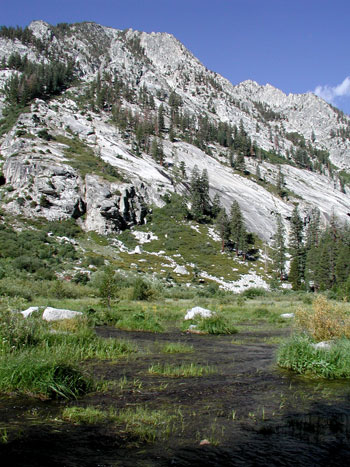
The power of majestic mountain peaks, of tall trees, of sculpted landscapes, is something that rings true in all of us. Other than my son Jim, no human can help but be moved by images such as this:

In my travels this summer, I experienced some difficult times, but the substantial efforts it took to see the monumental peaks of the Sierra seemed worth it to me. Every once and a while I just had to stop and simply look at the awesome scene before me. I had remind myself not to take too many pictures, lest they inadequately replace my real memories.

For the most part, hikers are conscious of the fragility and transience of the national parks. They stay in the designated camping areas, they keep the trail clean, they bury their excrement. Viewed from the trail, this natural world looks utterly pristine. But when I took a step off the trail (which you must do, as noted previously, for certain activities), I discovered quite quickly that everything is not as it seems. A Doritos bag tossed behind a boulder. A can of Coke half-burnt in an old fire ring. The lid to a tin can tossed in the underbrush. A Ziploc bag buried where I planned to dig a hole to use the “bathroom” (I didn’t dig deep enough to find out what was inside this bag).

All this I saw in just four days in Kings Canyon National Park, in a place where hikers are instructed to “leave no trace,” where hiking is so restricted that reservations are necessary at least a month in advance. The park is operating at full capacity; allowing additional crowds in would destroy even the illusion from the perspective of the trail that this is a pristine wilderness.

Yet, according to the recent New York Times Editorial on the subject, Douglas Hoffman, an undersecretary of the interior, has been charged with revising the policies limiting use of our national parks. The article claims that his revised policy would

open up nearly every park in the nation to off-road vehicles, snowmobiles and Jet Skis. According to his revision, the use of such vehicles would become one of the parks’ purposes. To accommodate such activities, he redefines impairment to mean an irreversible impact. To prove that an activity is impairing the parks, under Mr. Hoffman’s rules, you would have to prove that it is doing so irreversibly - a very high standard of proof.

A Ziploc bag buried in the wilderness isn’t technically irreversible, but who’s going to pack it out when they’re already burdened with heavy packs? I suppose gas cans, beer coolers, and, I don’t know, old spare tires don’t cause “irreversible” damage either, but again, who’s going bother to return a park to its pristine condition when they’re busy getting killer air riding their dirtbike off a high Sierra butte? If enviro-conscious hikers can’t be counted on to keep a park clean, can we really expect four-wheelers, snowmobilers, and jet-skiers to “leave no trace”?

Driving across the American Southwest this summer, I saw vast swaths of land that had already been abandoned to the four-wheelers. In Lake Powell, I saw 200 miles of a formerly wild canyon dominated by speedboats. Do we really need to give them the few small areas that have been carefully preserved with at least a veneer of their natural state? Or will there be nowhere an American can go without seeing the footprints of four-wheelers, hearing the roar of dirtbikes, or feeling the wake of a Jet-Ski?

2/7/2006

Another thing about Flight 93

Filed under: — dave @ 2:10 pm

There’s no doubt that Flight 93 is a schlocky melodrama, but it’s good schlocky melodrama, and that’s an important point.

Another point in its favor, mentioned in the Reuters review, is the use of relatively unknown, ordinary-looking actors. This helps humanize the drama, and show that it was just regular folks who defeated these terrorists.

Their success means we’ll never have to fear this sort of attack again, because everyone knows that steadfast passengers, knowing they’ll die anyway, will do everything in their power to take out a hijacker. We’ve also since made some reasonable modifications to airplane design — stronger cockpit doors being the most important — and airport security has been tightened (arguably more than is necessary).

So President Bush, you can stop talking about how “September 11 changed everything.” Thanks to the passengers on Flight 93, we can stop thinking with one-track minds, and start to work on some of our other problems.

Flight 93

Filed under: — dave @ 6:45 am

Last night I went on one of the most harrowing journeys I’ve ever been on. My palms were soaked in cold sweat, and my heart was beating at an astonishing rate. All this while sitting comfortably on my living room sofa.

I was watching the A & E docudrama, Flight 93, which retells the familiar story of the heroic passengers who defeated the terrorists trying to ram their plane into the either the White House or the United States Capitol on September 11, 2001.

Like anyone who follows the news, I knew the story: while the other planes were being flown into the World Trade Center and the Pentagon, the passengers on the hijacked Flight 93 phoned their families and learned that they, too, were on a suicide mission. Figuring they’d probably die either way, the passengers did the only logical thing: they fought back against the hijackers in order to defeat the mission.

I knew all this, knew exactly what was coming, expected to see the distraught phone calls to anxious family members played out in all their melodramatic wonderment, and still, I was completely captivated by the moment.

Flight 93 is high melodrama, playing perfectly on the emotions of its audience. It was also the highest-rated program on A & E, ever. It’s all the Airport movies wrapped into one, with the added bonus of being true. One thing I appreciated about this version is that George W. Bush was nowhere to be found in it. There were no speeches at the end, just a simple list of the passengers and crew of Flight 93. The famous “let’s roll” line was uttered, but it was a subtle afterthought. Much more poignant was the scene where a passenger said the Lord’s Prayer with the Verizon operator over the telephone before he joined the group who stormed the cockpit.

It was a film about humans, doing the only human thing they could in the face of incomprehensible inhumanity. Even though we all already knew exactly what happened on Flight 93, it was good that someone recorded what we know about the flight on film, so we won’t forget.

2/3/2006

Our top ten mass-culture magnets

Filed under: — dave @ 3:16 pm

The CSM has a list of the top 10 “culture magnets,” where in our fragmented world, all of us still somehow manage to connect. I won’t disagree with most of them, but “online hangouts”? That’s like saying we all connect because we all have living rooms. Can’t pick one hangout? Then it’s not a real magnet — it’s part of what’s fragmenting things.

Most shocking to me was this figure: the typical Oprah book club book gains $80 million in sales. I was figuring it maybe gave you half a million additional sales — about $15 million. Still a damned lot of money, but less than a fifth of the real number. No wonder Frey can’t be too terribly upset about all the goings-on. And no wonder Oprah gave it a rest for a while — that’s some kind of pressure. (via Kottke)

2/1/2006

iPods for senators? Why not Hummers?

Filed under: — dave @ 9:50 am

I noticed a post on BoingBoing about giving iPods to Senators. Why should we do that? Well, iPac argues that once the Senators have iPods, then they’ll understand why fair use and other laws are so important, and won’t keep voting in inane new provisions like the Sonny Bono act and the Broadcast Flag.

That sounds great, but I thought one thing we were supposed to have learned from the Abramoff fiasco is that Senators aren’t supposed to accept gifts worth more than $50.

I e-mailed Cory Doctorow with the question, and he forwarded it to Ren Bucholz of iPac. Here’s Ren’s reply:

Great question! Campaign finance laws prohibit gifts to Senators that exceed $50, but they don’t preclude in-kind gifts their *campaigns.* We’ll be sending these to their campaign offices, and we’ll be encouraging them to use the device for “campaign related” activities like watching news clips and learning about important constituent issue like balanced copyright. Hope that helps!

Aha! So all we have to do is give “campaign” gifts, and we’re excluded from such limits. So why stop at iPods? Couldn’t a crafty donor group give, say, a Hummer, to a “campaign,” so Senators could “research” the impact of global warming?

This isn’t to say I don’t support Ren’s cause, but more to suggest that all these lobbying reforms aren’t going to add up to squat if they don’t also address “campaign” donations.

Update: Ren points out that the limit on in-kind donations is a $5,000 cash value for PACs, so a Hummer, apparently, is out. Segway, anyone?

1/31/2006

Should we “just make it all up?”

Filed under: — dave @ 6:50 am

Grumpy Old Bookman has written an absolutely masterful blog post. In it, he points out that few memoirs are 100 percent truthful accounts, and that even most novels have autobiographical elements that might get their authors into trouble. The only possible recourse, he argues, is to fabricate everything:

But if you have genuinely taken the trouble to make up everything, and can demonstrate that you have, with notes and so forth, then at least you are likely to steer clear of legal trouble. And, perhaps just as important, your conscience will be clear.

I had a hard time parsing the fact that this was satire at first, because there are so many bloggers out there who would express this same sentiment in complete naive honesty.

Just think how dull the literary world would be if the first priority of every author was simply to avoid legal trouble.

What would literature be, if there was no truth in it?

1/26/2006

Touring the Technorati Top 100

Filed under: — dave @ 12:43 pm

I noticed a feature on Technorati today — can’t say whether it’s actually new or just new to me — the Top 100.

Taking a long look at this list can be depressing — Kos has 50,000 links? For those of you keeping track at home, that’s exactly 403.7 times more than li’l ol’ Word Munger. Thankfully, I’m cool enough to recognize the top 7 (though the only one I read regularly is BoingBoing). Number 8 I’d never heard of — some kind of blog design site. Boring. Number 9 is a lefty blog I’d also never heard of. From what I can see, for good reason. Number 10 is a foreign MSN Space. Hmmm…. I have no idea what it says, but several of the Top 100 seem similar to this one.

Moving on … Number 13 is the first pure personal blog on the list, an attractive woman who appears to have made a career out of getting fired for keeping a blog.

Number 19 is Think Progress. Maybe I’ve wandered here before, but I don’t think so. This is nicely done — the first top-100 blog that I might consider adding to my blogroll. Good stuff.

Kottke and Fark are shockingly low at 23 and 24. Number 25 is Gawker, which I’ve seen linked but never actually visited. Now I know why. Wonkette is still number 29 without the real Wonkette.

Number 38 is just god-awful. Something is wrong with the world when this reaches 38. That and Number 40 are enough to make me stop this ridiculous venture. No wonder bloggers have such a lousy reputation.

1/24/2006

Should RAs lead Bible study?

Filed under: — dave @ 2:27 pm

Ed Brayton is unimpressed with the University of Wisconsin’s recent decision to allow two of its campuses to continue to prohibit dorm RAs from holding Bible study in their dorm rooms.

The problem with all of this is that their policy doesn’t support their alleged goals. They defend the policy by saying that RAs “must be prepared to fulfill employment-related responsibilities any time they are in their room or residence hall.” But if this is really the reason for the restriction, why don’t they ban all meetings in the dorm rooms of RAs? Wouldn’t an RA having a chess club meeting or even a poker game make them unavailable in exactly the same sense?

First of all, poker is a hallowed college tradition that shouldn’t be tampered with. But seriously, while initially I’m skeptical about Brayton’s arguments, he does have a point. I’m sure I would have been completely weirded out in college if my RA was asking me and my dorm-mates to a Bible study group, but so what? As long as the RA does her/his job, why should the college single out this one activity from a long list of creepy-but-legal things an RA could be doing, like doily making, shovel racing, or, apparently, interofficing dead rats (which, perhaps not surprisingly, comes up first in a Google search for “creepy but legal”)?

College students should be prepared to deal with a little weirdness. It’ll probably help them when they get to that weirdest place of all: the real world.

1/23/2006

My 15 minutes continues

Filed under: — dave @ 2:39 pm

In addition to the recent NYT and BoingBoing mentions, it turns out I got a letter to the editor accepted in The Atlantic. In case you don’t have a subscription, here’s the text of my letter.

Ross Douthat does an impressive job showing how college admissions tend to favor economically privileged students (November Atlantic), offering damning statistics about how kids who are admitted to the best colleges tend to come from wealthier than average families.

However, these statistics have one critical omission: families with college-age kids are by definition not average. For one thing, they are older than average by a considerable amount. The median income for all families in 2001 was about $42,000 per year. But the median income for families with heads age 45 to 54 — those most likely to have college-age kids — was $58,000.

I doubt this explains all of the economic disparities Douthat complains of, but I suspect it explains a lot of them.

Douthat replies that he still doesn’t think it explains much of the discrepancy — a child from a family earning $58,000 only has a 13 percent chance of getting a B.A. by age 24, compared to a 50 percent chance if his family makes over $90,000.

If those numbers are accurate, they are indeed startling. I just wish they’d made their way into the original article.

1/22/2006

Is publishing dying?

Filed under: — dave @ 11:44 am

Vanessa at The Rough Draft is offended by the disillusionment in the publishing industry lately:

The fact that publishing is dying is not new. It’s been dying practically since the printing press was invented. Critics have come out almost every year since, say the 1890s declaring the novel is dead, that no one reads anymore. For some reason, everyone loves to declare such apocalyptic extinctions even though the business is still chugging along. When were there ever more than a distinct elite few writing books, reading them and talking about it?

I think she’s got a point there: when has publishing been anything but a marginal industry? The entire industry has a market capitalization of $34 billion — barely half of Apple Computer. Bill Gates could purchase the entire publishing industry and have enough change leftover to buy out Sergey Brin’s share in Google.

Okay, we’ve established that the publishing industry is dinky. But even tiny things can have a future. Could Vanessa find a future in publishing? Let’s look at what’s involved:

There will always be a need for editors. There will definitely be a need for marketers and salespeople for published work. There will be a need for designers and other production people.

Printers? Maybe they’ll end up declining a bit, but paper remains an awfully convenient and cheap way to present information.

Bookstores? They could possibly decline more, but I could also imagine Barnes and Noble progressively expanding its coffee shop with digital tools for disseminating e-books. They could end up all right.

But what about publishers themselves — basically a financial pool for getting all the above professionals together with writers?

One advantage publishers have is inertia. Self-publishing, though it’s gained traction recently, is still considered a last resort of the incompetent and unconnected. Saying you’ve published a blook with Lulu is still orders of magnitude less impressive than mentioning your new novel will be out with Harper next month. Publishers are the ultimate arbiters of taste.

So who is poised to take that role away from publishers? Blogs? Certainly the A-list bloggers could help publicize a self-published e-book, but no one mistakes an Insta-endorsement for the cachet of a imprint of a respected publishing house. Amazon? Will the largest Internet retailer assume the role of a publishing house? It’s certainly trying, by buying print-on-demand technology. I still can’t imagine the New York Review of Books sorting through thousands of POD titles at Amazon to select what to review, though. Maybe if Amazon started hiring editors to do that job, selecting an A-list of books to promote more prominently, then reviewers would begin to take it seriously. Barnes and Noble could do the same thing. But then Vanessa could just grab a job over at Amazon.

Even so, what print on demand won’t accomplish is getting people to write books. Sure, there are thousands of wannabe authors, scrambling to get published. The public has an insatiable demand for books from people who don’t want to be authors: famous people like actors, athletes, presidents, and business leaders. Those books get published because publishers give them hefty advances and hire ghost writers to do most of the work. If Amazon got into that business, we wouldn’t really be talking about print on demand, because they’d need to sell tens of thousands of copies to make a profit. Amazon would be just another publisher. Another huge portion of the publishing industry is textbooks — and trust me, qualified professors are not exactly banging down the doors of the publishers begging to write the next Intro to Accounting. These people need cash, in advance, in order to be coaxed into writing — and publishers are competing with other (much bigger) industries, who like to hire these same people as consultants. Very few people are interested in writing print-on-demand textbooks, and those who are, aren’t writing books that anyone will be interested in buying.

One thing I could imagine happening is mass-market novelists moving to self-publishing. What if John Grisham started self-publishing? He’s already got a reputation as a writer, so he doesn’t really need the publisher’s publicity engine. Instead of making 15 percent per copy, he could be getting 50 percent or more. If his next book sold a million copies, he could take home $15 million. If we’re talking about e-books, he could take home upwards of 85 percent — give a little commission to e-tailers like Amazon, and pocket the rest.

If publishers lost this gravy train and had to settle for mid-market writers, I wonder if the industry could get squeezed away from both sides — by Joe Blogger at Lulu, and by John Grisham at Amazon. Perhaps eventually, there wouldn’t be anything left for the major publishers except celebrity bios and textbooks.

Then I really do wonder if Vanessa will still want to be working for them.

1/21/2006

More on the NYT ScienceBlogs article

Filed under: — dave @ 8:54 am

I had promised to write more yesterday about the New York Times article that mentioned Cognitive Daily yesterday. Unfortunately, I got bogged down writing two CogDaily posts (here and here). Turns out — at least for now — that “Casual Fridays” are more work than regular CogDaily posts. I don’t expect that will remain true permanently. This week I had to figure out how to download the data from SurveyMonkey and put it into a format that allowed analysis. Then for next week’s survey I had to get Dreamweaver to do a redirect exactly 9 seconds after a web page had finished loading. From here on out, I’ll be using similar methods, so things should go more smoothly.

Anyway, back to the article. It’s not really so much a publicity vehicle for the site as it is an explanation of Seed Media’s strategy in landing advertisers for ScienceBlogs — which makes sense, since it’s in the Advertising column on the New York Times. A lot of ScienceBloggers have taken this opportunity to reassure their readers that they’re not going to be pressured by advertisers to tone down their rhetoric (see here and here). I guess I can see where the more political types might feel some sort of pressure (e.g. if a Lexus ad appears alongside a diatribe against the excesses of the Toyota corporation), but I have a hard time imagining where Cognitive Daily might feel that same sort of pressure. We’ve been tough on violent video games, so I guess we might object if Carmageddon IV wanted to place an ad on our site, but that strikes me more as foolishness on the advertiser’s part than “pressure” on us. If Seed Media asked us to stop writing about video games so they could sell gaming ads, we’d certainly head for the door, but they’ve promised never to do such a thing, and I don’t expect they will go back on their word.

The most important thing advertisers are getting by advertising on ScienceBlogs is access to an audience that trusts the people writing the blogs. They’d be stupid to ask the bloggers to broach that trust, because the trust itself is the primary thing they’re buying. Heck, even if Carmageddon decided to advertise on CogDaily and we wrote a post critical of their games, I suspect they’d still get clicks from our visitors. Every time we write one of those posts, we get linked by all the video gaming forums, and more than a few of those readers would be attracted to the fact that we don’t like the game.

The majority of the NYT article discusses the market analysis Seed Media has done to sell their ads. Apparently they’re going after what they call “Leonardos” — young (average age: 32), mostly male, and, most importantly, affluent people who are more intelligent and more interested in science and culture than the average person. This demographic, according to Seed, is over 20 million strong, and so is a group that advertisers should be taking seriously.

P.Z. Myers has taken offense at the “Leonardo” characterization, arguing that his readers are a more diverse group than that. He’s right, of course — obviously there are a wide variety of people reading science blogs. But I’m not sure that’s the point of Seed’s market research. What they’re interested in is if they can bring advertisers a disproportionately large share of “Leonardos.” I have little doubt that they can.

Now we all we need is for the NYT to do a feature on actual content of ScienceBlogs.

1/20/2006

Cognitive Daily gets a mention in the New York Times

Filed under: — dave @ 6:23 am

There’s an article today in the New York Times that discusses the ScienceBlogs enterprise and actually mentions Cognitive Daily by name. It’s not exactly the sort of mention one hopes for when one imagines getting mentioned in the New York Times ("Dave Munger, one of the great thinkers of our time…"), but still, it’s the New York Times, and it’s definitely not the sort of New York Times mention that clouds one’s nightmares ("Dave Munger, who writes the dullest, most insipid prose imaginable…").

I’ll have more to say later today about the substance of the article, but right now, after I finish revelling in the moment, I’ve got a couple CogDaily posts to write.

1/18/2006

A Crack in the Edge of the World

Filed under: — dave @ 3:32 pm

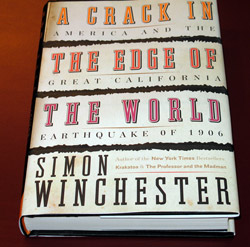
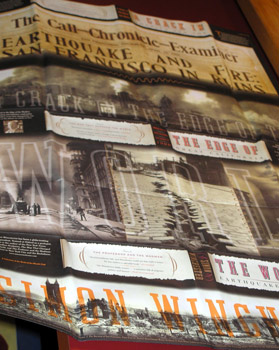
I’ve now finished reading Simon Winchester’s book A Crack in the Edge of the World, and I have to say, I’m still rather divided about it. On the one hand, it’s a beautiful book, elegantly presented and well-written. On the other hand, I still feel like something’s missing.

Winchester has spent a great deal of time studying geology, and spends much of this book regurgitating that knowledge — but to what effect? Why do we need such a detailed description of the San Andreas Fault? Instead, I’d like to know more about the evidence for why we should expect another major San Francisco earthquake, or why, as Winchester predicts near the book’s end, Yellowstone Park is poised to become a massive, perpetually erupting volcano.

The description of the 1906 earthquake itself, though it consumes nearly 100 pages, still left me feeling lacking. Again, as I’ve suggested before, a more detailed map showing the affected areas and what types of damage occurred would have been much more effective than page after page of prose.

Yet there were some charming and heart rending descriptions of the quake’s effects, from a cattle stampede that led to the unfortunate death of a shopkeeper moments before the bull that attacked him was shot by a police officer, to the sketches of the legendary opera star Enrico Caruso, who was on tour in San Francisco with the Metropolitan Opera when the quake struck. Winchester even points out that Ansel Adams, then just 6 years old, acquired his characteristic crooked nose while fleeing from his home during the quake.

I do wish that the book had been written just a year later, when Winchester would have been able to compare the response to the earthquake to the New Orleans hurricane almost a century later. Even as it was, we do learn some compelling details about the San Francisco response. There was the immediate reaction of the presiding military officer, Brig. Gen. Frederick Funston, in mustering 155 troops and complying with the mayor’s order to shoot looters on sight. There was the train arriving from Los Angeles 16 hours after the quake with wagonloads of food. There was the act of Congress authorizing immediate shipment of 200,000 military rations and every tent in the U.S. military’s possession to San Francisco. Within weeks, ten percent of the U.S. standing army was in San Francisco. A century later, with all our technology, our nation’s response to a tragedy that was predicted in advance seems lethargic in contrast.

One of the most fascinating implications of the quake, Winchester demonstrates, was the rise of Pentacostalism. A struggling church on Azusa street in Los Angeles became the center of an explosive religious movement when itinerant preacher Frank Bartleman wrote a tract arguing that the San Francisco Quake was the “voice of God.” Though the roots of this movement can be traced years earlier, back to John Wesley in Britain, Winchester makes a convincing case that the Pentacostal movement would not have become the global phenomenon it is today, with its Swaggarts, its Bakkers, and yes, its Robertsons, if not for the particular resonance the San Francisco Quake struck with a smallish church on an obscure corner in L.A.

But if you’re interested in geology (or perhaps especially if you feel you’ve never acquired a foundation in the topic and want to know the basics), Winchester’s book offers an engaging angle into the science of how the earth works. Perhaps half the book is spent explaining how plate tectonics, earthquakes, and volcanoes work. Since that’s a subject about which I was already reasonably well informed, for me the book dragged in places. But I was entertained enough to stick it out to the end, and I found enough nuggets to feel it was worth the effort.

(My other observations about the book are here, here, and here)

1/16/2006

“Podcast” of “Small Journeys” (continued) (finally!)

Filed under: — dave @ 7:47 pm

I know, I know, it’s taken me forever to make the podcast of Chapter 1 of Small Journeys. I had promised three chapters (plus the Prologue) at a rate of a chapter a week, but here it is, over a month later, and I’m just getting to the second installment.

I have excuses — lots of 'em. It was Christmas. And my microphone broke. I couldn’t find a good replacement mic. The kids were out of school. You try to make a podcast with your whole family rattling around the house.

But the real reason was this: I can’t do voices. Just can’t. I can pitch my voice at different levels, but I certainly can’t make it convincing. Sure, with a lot of acting training, I might be able to make a crude improvement, but I’m never going to be much of a vocal performer. Finally I decided that I’d simply do my best, and my best would have to do. I’ve tried to make some effort at the voices, but it’s still difficult to tell the difference between David’s voice and that of the narrator, or of Luke. Claire’s voice at least sounds different from everyone else — most of the time — but it’s still not a very convincing third-grade girl.

So, if you can stand my bad impersonations, you might enjoy this chapter. If not, I’m afraid things aren’t going to get much better. As always, I’d love to hear your suggestions. In case you missed my original post about the Podcast project, it’s here.

For your benefit, I’ve included links to both the Prologue and this week’s installment, Chapter 1.

Small Journeys, Prologue
Small Journeys, Chapter 1: September, 1975

As always, to listen in your browser, just click on the link. If you want to download to your iPod or similar device, you’ll need to right-click or ctrl-click.

1/13/2006

ScienceBlogs so far

Filed under: — dave @ 4:15 pm

I’ve been officially blogging on ScienceBlogs for three days now, and I wanted to give my first impressions. First off, this is an amazing collection of science writers. I’m familiar with most of them from their previous blogs, but having all of them in the same place just makes a huge difference.

Why? The ScienceBlogs home page is a masterful design, giving just enough of a snippet of each blog post to let you know if you’re interested, but not so much that you can’t see plenty of posts at a time. While I prefer to keep my browser window set about 800 pixels wide (this design is probably closer to 950), the right-hand column is mostly ads, and isn’t usually needed to navigate the site.

Second, the site has a powerful server, so I’m assured that wherever I click, the site will load quickly and correctly. No more clicking on links and trying to decide whether they’re worth a 20-second delay to view the content.

Third, I know each of these blogs has been pre-vetted by the folks at Seed Magazine, so quality is not going to be an issue. These are veteran bloggers with a proven track record.

It’s possible that the bloggers are just showing off for their grand entrance, and that once we get into the grind the quality will drop off, but I think that by being members of this fabulous community of great bloggers, we’re all motivating each other to be better writers. I didn’t visit most of these blogs even once a week before we were joined together at ScienceBlogs.com, but now I notice new posts within minutes after they’ve been made. I know the other bloggers are reading my posts as well, and I don’t want to disappoint them.

Right now, it’s easy to display just the blogs in a certain category (Cognitive Daily is the only “cognitive science” blog so far), or to search one or all the blogs in the group. In the future more interactivity is promised — a way of finding posts within the community relevant to a hot topic, or even searching comments threads, so that discussions can extend across different posts and blogs. I’d like to see a sort of meta ScienceBlog, where a human (or group of humans) distills the posts from across the consortium to bring more even more interactivity to the table. Whether any of that comes to pass, it’s already a remarkable tool.

I don’t know yet how many readers we’re bringing over from the old site — the stats package isn’t installed on the new site — but based on the comments we’ve received so far, I suspect our numbers haven’t declined much. Interestingly, the numbers for cognitivedaily.com haven’t declined at all. Perhaps most people haven’t updated their bookmarks, and so click first on the old site and then follow the handy-dandy link I’ve provided to the new site.

I’ve also done a Technorati search to see what others are saying about ScienceBlogs. Right now, most of these links are just people updating their bookmarks to Pharyngula, but some bloggers have noted that all the “elite” science bloggers have made the move to ScienceBlogs, and worry that a class system may begin to emerge. I worry a bit about that, too — after all, why would I click on an external link when staying within the system has all the advantages I describe above? But ScienceBlogs isn’t through yet — the goal is to have 40 or so blogs, so there’s room for more (but not all) science blogs.

Others complain about the “bland” design, or the small typeface. These aren’t particular issues for me — CogDaily was pretty bland before, but some of the pre-ScienceBlogs did have excellent designs. Most of the complainers say they like the old Pharyngula better — but I have to disagree with them. The new Pharyngula loads faster and looks far better than the old design. There is the issue of dull uniformity — all the ScienceBlogs look the same, and I suppose it could get tiresome after a while. However, I’ve heard rumors that new templates will be made available for the sub-blogs in the coming weeks, so I suspect some of these issues will take care of themselves.

Where I think ScienceBlogs.com will have the greatest appeal is with nonscientists — people who don’t actively surf for science all the time. It’s an easy, convenient way to find exceptionally high-quality science writing online. Now my only problem is finding time for all my other reading.

1/11/2006

2005 Cities meme

Filed under: — dave @ 9:18 pm

Following Jason Kottke’s lead, here’s my list for 2005:

Snowshoe Mtn, WV* (not really a city, but hey…)
Atlanta, GA*
Cherokee, NC
Las Vegas, NV*
Bullfrog, UT
Monument Valley, AZ
Kanab, UT
Primm, NV
Anaheim, CA*
Los Angeles, CA*
Santa Barbara, CA
Kings Canyon NP, CA* (again, not really a city, but a significant stop during our travels)
Barstow, CA
Seattle, WA
Centralia, WA
Washington, DC

Not as exotic as Jason’s list, but still a pretty decent travel year. Asterisks demarcate multi-day stays or repeat visits.

Goin’ Pro

Filed under: — dave @ 10:36 am

I had hinted a couple days ago that I was about to become a professional blogger. Now I am one. Well, technically, I’m a professional co-blogger: Greta and I have signed on with Science Blogs and we’ve moved Cognitive Daily over there. Now, instead of paying a web host, the web host pays us!

We had been making an almost trivial amount of money with Google ads on the old site, but assuming we can get our traffic levels up to at least what we had been doing on Cognitive Daily (we were getting about 90,000 visits a month), we should be earning about five times as much. And if we can double that traffic, then we’ll get ten times as much! Watch out, Alex Tew. (I know, I know — that’s not just counting eggs before they’re hatched, it’s counting omelets before they’re a twinkle in granddaddy rooster’s eye, but I can dream, can’t I?)

Aside from my capitalist ambitions, the new site is actually pretty cool. [Did I mention that I’ll be blogging with P.Z. Myers, of Pharyngula (his new site isn’t up and running yet, so I hope I’m not jinxing things by mentioning this)? Six months ago, I was excited to get an e-mail from P.Z., and now I’m going to be blogging with him! Or at least nearby…] The main site is basically an RSS of all the participating blogs, but you can easily select a category and see just the posts from blogs on the topics you’re interested in. Right now, there are only 11 blogs in the system, but I understand that 14 have signed up, and the eventual goal is to expand to about 40. The idea is to create a hub of conversation about issues in science, and this to me looks like a great format for it.

Every time I’ve joined a blogging network (and most are not nearly as sophisticated as what they’re doing at Science Blogs), I’ve noticed a tremendous increase in the number of visitors; I suspect with the level of interactivity Science Blogs promotes, it is going to absolutely take off. If you’re a science blogger, I’d strongly recommend contacting them about signing up — Christopher Mims, the editor of Science Blogs, has been great to work with. He’s responsive, accommodating, and gives you complete editorial control over your blog. The only thing that will change is the URL and the design. (And if you’re not using Movable Type, you’ll have to learn that. It’s got some little quirks that are a bit different from Wordpress. Everything makes sense, but it’s got its own zen about it that just takes a while to get into.)

The next issue will be moving the archives over to Science Blogs. I’ve found a few Wordpress to MT conversion tools on the Web, but I’d be happy to hear any recommendations. I’d really like to get not only the posts, but also the comments moved over to the new site — they’re a tremendous resource.

The new blog shouldn’t affect my activity here at Word Munger — I expect I’ll be posting about the same amount at Cognitive Daily, which will leave me just about as much time to post here. There’s the possibility of introducing new features on CogDaily over the long term, but even then, I’m still going to need Word Munger as a place to let out whatever non-psychology thoughts I have.

Fear not — Word Munger will persevere!

Now go visit the new Cognitive Daily

1/8/2006

$160,000? Are you kidding me?

Filed under: — dave @ 8:32 am

I’ve always been a fan of the Million Dollar Home Page. This guy is damned lucky, but he’s also damned smart. He’s sold 999,000 pixels of his web page for $1 per pixel. He didn’t take home that much, though — he’s got a publicist, and several others are helping him with the ads. I wouldn’t be surprised if he’s spent over $100K promoting his site. Still, that’s a profit of almost 900 percent. Now he’s auctioning off the last 1,000 pixels on eBay. The going price, as of this post: $160,109. And it’s gone up since I started writing.

$160,109 for a tiny 20 X 50 piece of virtual “real estate,” in the middle of a page full of hundreds of other tiny ads. And don’t think these are a bunch of phonies driving up the price with vaporbids — he’s pre-vetting each bidder.

Of course, the buyer also gets the publicity of being the person who bought the last pixels on the Million Dollar page. At this point, I wouldn’t be surprised to see the bidding go over $300K. Heck, he might even make another million on this last 1,000 pixels.

So, if you thought this guy only had one good idea — that he was a shot in the dark, a lottery winner — think again. He’s had two ideas worth $1.16 million in less than six months, and the value of idea #2 is only growing. Watch out for Alex Tew. If I was a betting man, I’d put down a serious chunk of change that 20 years from now, he won’t just be an Internet footnote.

Update: Apparently now the bidding’s down to $153,000. Still a tidy sum, but apparently the top bidder retracted a bid (or however that works on eBay — I still haven’t figured how that site works).

1/7/2006

Four things meme

Filed under: — dave @ 5:24 pm

Okay, I’m waiting for TiVo to record enough of the Tampa/Washington playoff game so I can watch it commercial free. Just enough time for a meme, courtesy of Michael Bérubé.

Four Jobs You’ve Had

1. Paper boy
2. Dishwasher
3. Data entry clerk
4. Professional blogger (announcement coming shortly!)

Four Movies You Could Watch Over and Over

1. Star Wars (I can’t believe I can still stand that movie!)
2. Did I mention that other than Star Wars, I really can’t stand watching the same movie more than once?
3.
4.

Four Places You’ve Lived

1. Seattle, Washington
2. Chicago, Illinois
3. New York, New York
4. Davidson, North Carolina. And that’s it, unless you count Bronx and Manhattan as two separate places.

Four TV Shows You Love to Watch

1. The Daily Show
2. The Colbert Report
3. I watch way too much TV, but I’m getting sick of all the other shows
4.

Four Places You’ve Been on Vacation

1. Dauphin Island, Alabama
2. Twisp, Washington
3. Carhenge, Alliance, Nebraska
4. Kingussie, Scotland

Four Blogs You Visit Daily

1. The Whatever (John Scalzi)
2. Hit and Run (Reason Magazine)
3. Conversational Reading (Scott Esposito)
4. Political Animal (Kevin Drum)

Four of Your Favorite Foods

1. Pizza, Chicago style, preferably from The Medici, but the stuff Greta makes comes pretty damned close
2. Chicken enchiladas and Spanish rice, based on the recipe I learned as a dishwasher at El Cafe in Seattle, long since run out of business
3. Real French Camembert
4. Saag gosht

Four Places You’d Rather Be

1. Park City, Utah
2. Paris
3. Rome
4. The North Cascades (but not this time of year!)

Four Albums You Can’t Live Without

1. Miles Davis — Cookin’, Relaxin’, Steamin’, and Workin’ with the Miles Davis Quintet (yes, technically this is four albums, but functionally it’s really one)
2. Handel — The Messiah
3. Talking Heads — Sand in the Vaseline (I know, I know, this is a compilation, but if I had to pick just one TH album, this would be it)
4. Billie Holiday — The Commodore Master Takes

Four Vehicles You’ve Owned

1. 1992 Subaru Loyale
2. 1994 Plymouth Voyager
3. 2000 Volkswagen Passat
4. That’s it. Give me a break — I only learned to drive when I was 22, and then I moved to New York!

Four Taggees

1. Anne Fernald (c’mon, Anne don’t you think you’ve vacationed long enough?)
2. Scott Esposito
3. Doug Hoffman
4. Jason Kottke. As if.

1/5/2006

Update your copyrights?

Filed under: — dave @ 4:47 pm

Eric Giguere reminds us to update our copyright notices for the new year.

It’s 2006, so you wouldn’t want your great-great-grandniece to be cheated out of an extra year of royalties from today’s blog post, 70 years after you die (assuming Congress hasn’t extended the term to death plus 140 by then). Actually, the copyright year is completely irrelevant, since the copyright term is computed from your death date, not the publication date.

You should also be advised that the copyright notice is not required. You’re protected, regardless. According to the linked document, my copyright notice on this site is invalid, since it doesn’t actually include the copyright year. But it’s much more accurate than Giguere’s recommendation, since each post is dated, and it’s a simple matter to refer to the date of the post. Given that the notice isn’t required, I’m not going to sweat the fact that it’s not up to snuff.

A Crack in the Edge of the World — Halfway

Filed under: — dave @ 3:17 pm

I’ve been blogging about Simon Winchester’s book A Crack in the Edge of the World for a week or so now. If you’re late joining this party, you can read my earlier posts here and here.

Now that I’m at the halfway point, the design of the book is becoming clear: the first half sets the stage for the great disaster, and the second half is the great disaster. Winchester has a long chapter explaining the geology of the San Andreas Fault, describing in great detail the motions of the various plates involved, and how exactly California got singled out for all the earthquake activity. It’s interesting stuff, but it also cries out for diagrams. Winchester sometimes spends pages explaining how one plate interacts with the next one, when what we really need is a map with a couple of arrows. There are maps, of course, including two especially beautiful and useful ones in the endpapers. Here’s a detail from the “Map of the North American Tectonic Plate”:

I’m not quite sure what the point of the giant volcano threatening to impede the route of the Exxon Valdez is, but it sure is pretty.

Winchester is more effective when he gives the history of San Francisco leading up to the quake. He gives nearly as vivid a depiction of gold-boom era San Francisco as Frank Norris does in McTeague, that classic horror story about the gold-obsessed dentist in 1899 (indeed, one wonders if Winchester has read McTeague — and if you haven’t, you should!). San Francisco at that time was simultaneously a cosmopolitan center of international culture and a home to a half-million roughnecks and factory workers.

At the end of chapter eight, the scene has been set: San Francisco is a hastily built, massive city, perched atop one of the most volatile faultlines in the world, with an inadequate fire prevention system and a corrupt government (sound familiar, New Orleans?). Chapter nine, which I haven’t read yet, is only 11 pages long, and called “Overture: The Night Before Dark,” and Chapter 10, a nearly 100-page doozy, is “The Savage Interruption.” Hmmmm…. I wonder what that’s all about. I can’t wait to find out.

“What was your high school _____ class like?”

Filed under: — dave @ 9:29 am

P.Z. Myers has a great post about high school biology teachers, and how uniformly awful they seemed to be, and what a better experience most people have in college.

I, by contrast, had exceptional biology teachers in high school: Craig MacGowan and Mr. Morrison (can’t remember his first name), at Garfield High School in Seattle. MacGowan was a Seattle legend, a great teacher who taught biology with a passion, and every year took his successful Marine Science students to an exotic local — Hawaii, Florida, even Australia (I never went-I didn’t want to sell the requisite number of candy bars, or whatever our fundraiser was). Morrison was a quirkier, more soft-spoken fellow, except when he threw formadehyde-soaked frogs at misbehaving students. In fact, my college biology experience was much worse: dull, dry lectures and boring, irrelevant labs.

English, on the other hand, went the other way around. I did have a few good high school English teachers, but none that excited me as much as MacGowan/Morrison. I’ve already mentioned my pathetic journalism advisor (who shall remain unnamed). When I had him for 10th grade honors English, I hated him so much that I dropped down into the “regular” English class, just so I could have a better teacher.

But in college, I found my true calling in a course on Edmund Spenser, taught by Michael Murrin. Anyone who can make Spenser exciting is a truly great teacher, and Murrin convinced me to be an English major. Unfortunately, my grad school teachers weren’t nearly as inspiring, so now instead of an English professor I’m a part-time litblogger and full-time psychology blogger. Things could be worse, I suppose….

So I wonder if it all comes down to this: we pick careers based on what kind of teachers we had in college, and especially as they compare to the teachers we had in high school. If we had great high school teachers in a particular subject, then our college experience is likely to be disappointing. If we had crummy high school teachers in a subject, then college courses in that subject will be a treat by comparison.

1/4/2006

Page 123

Filed under: — dave @ 2:15 pm

From Miss Snark:

1. Grab the nearest book.
2. Open the book to page 123.
3. Find the fifth sentence.
4. Post the text of the sentence in your journal along with these instructions.
5. Don’t search around and look for the “coolest” book you can find. Do what’s actually next to you.

Okay, here goes:

In four-dimensional spacetime, the angles in a triangle can add up to more or less than 180 degrees, depending on how precisely the space is curved.

Any guesses as to what it is?

It should be noted that I cheated, three times. The closest book is an ARC that I’ll be reviewing shortly — doesn’t seem fair to quote an unpublished book. The next closest book is “A Crack in the Edge of the World,” and since I’ve been blogging on that lately, it didn’t seem like much of a challenge. Finally, I’m sitting in the kitchen, next to a shelf full of cookbooks, which doesn’t exactly seem to be in the spirit of the exercise.

Update: Come to think of it, I’ve probably cheated four times: I corrected what I think must be a typo in the book, adding the word “than.”

Update2: Does it seem to you that I’m being unnecessarily repetitive in this post? It seems so to me, but I can’t quite seem to figure out why.

Update3: For completeness’ sake, I decided to do A Crack in the Edge of the World too:

These were the trails — from Memphis to California across Texas, from St. Louis to California across Utah, from Hannibal along the valley of the Platte River toward Oregon, and from Chicago up across the peaks of Montana and via the empty rain-shadowed wastelands to the tiny army encampment at Fort Walla — from which the roadbeds for all of America’s future surface links would be formed.

This sentence is illustrative of the quirks of Winchester’s prose: to get to the fifth sentence starting from the top of page 123, you actually have to go halfway down page 124. (Though again, this is somewhat of a cheat — there’s an illustration on 123. But still, the sentence would have ended nearly on the last line of 123, even without the illustration)

1/3/2006

Ventilators for everyone?

Filed under: — dave @ 1:41 pm

Kevin Drum’s up in arms about a Steven Landsburg article in Slate.

I read the article, and I have to say, it’s one of the most tactless and incompassionate pieces I’ve read in a long time. But is it wrong? Landsburg argues that most poor people wouldn’t want “ventilator insurance” — they want the basics of day-to-day life. Would Tirhas Habtegiris, the woman who was removed from life support because of inability to pay, have preferred to get $75 cash from the government before her illness, or would she rather have the insurance?

Landsburg claims that Habtegiris clearly would have taken the money. I’m not so sure he’s right — I think nearly anyone who has a philosophical objection to removal from life support would gladly pay $75 for a lifetime assurance that it would never happen, regardless of their financial circumstances (as an aside: based on my philosophical principles, I’ve paid considerably more than $75 to draft a living will that ensures I will be removed from life support if I have no chance of recovery). Of course, no one actually gets to make Landsburg’s hypothetical choice, so the question is hardly worth asking or answering.

What Landsburg’s argument scratches the surface of, but never directly addresses, are the phenomenal problems that will have to be overcome in order to implement a national health care program. I’m all in favor of nationalized health care, but when we get down to the nitty gritty, if this thing ever gets passed, it’s going to be a pain in the ass. Every medical decision, from getting a wart removed to bypass surgery to keeping vegetables alive on ventilators, will become a political one. Think of how often the deductible on your HMO package is changed. Now multiply that by 300 million angry calls to Congress whenever a national health care decision is made — not to mention all those “I told you so’s” from O’Reilly and Limbaugh.

If I was making the national health care decisions and I had to choose between keeping Habtegiris “alive” and, say, back surgery that might enable someone to go back to work, I’d have no hesitation in pulling the plug on her. Does that make me callous and incompassionate? Maybe, but that’s the sort of decision that will have to be made, millions of times each year, by a government-sponsored health provider.

To me, what’s much less compassionate is the status quo, where millions go without health care, where “minor” conditions become life-threatening illnesses because the uninsured can’t go to the doctor. I realize that national health care might mean that sometimes heroic measures can’t be taken because they cost too much, but I’m willing to admit that’s the right thing do. Are you?

1/2/2006

“Average 8th Grade IQ”

Filed under: — dave @ 8:47 am

One of the things my server stats page tells me is how people got to my web page. I can even learn the search terms people searching on Google used to locate the site. Today I found a doozy over on Cognitive Daily: someone was looking for the “average 8th grade IQ.” Ummm…, I think it’s 100, just like in 7th grade, 6th grade, and so on. You’d think people would improve with age, but it turns out, it’s just not so…

12/30/2005

A Crack in the Edge of the World so far

Filed under: — dave @ 4:43 pm

I’m about a quarter of the way through Simon Winchester’s A Crack in the Edge of the World. Here are my impressions so far.

Winchester is clearly a guy who likes to listen to himself speak. This isn’t necessarily a bad thing — he’s got a confidence about himself that often results in brilliant phrasing — stuff like this:

Since its very beginnings geology has been a field mired in some alluvial quagmire, defined by dusty cases of fossils, barely comprehensible diagrams of crystals, and the different kinds of breaks that were made in the earth’s surface (as well as by unlovely Continental words like graben, gabbro, and graywacke), and explained with cracked-varnish wall roller charts showing how the world may have looked at the time of the Permian Period. To me it remains the most lyrical and romantic of the sciences; but in terms of glamor, and when compared with astrophysics or molecular biology, the Old Geology is somewhat wanting.

Sure, it’s pretentious and showy, but you can’t help but appreciate the metaphorical use of the term “alluvial quagmire,” or the double entendre of “cracked-varnish wall roller charts.” The language isn’t so difficult that it slows reading, and it was with distinct pleasure that I occasionally caught him in a few writerly gaffes such as unintentionally repeating the same word three times in a paragraph.

The first four chapters of the book serve as a refresher course in modern geology, reminding us that it was only at the end of the twentieth century that the theory of plate tectonics gained acceptance. It’s still amazing to me that I was skeptical of the theory when my 10th grade biology teacher introduced it to me in 1981. I had learned geology reading 1950s library books, and the theory, which went mainstream in the 1960s, was new to me then. To realize how little science knew about the very rocks under our feet, during my own lifetime, is nothing short of astonishing.

Nonetheless, little new information new to me was presented in the beginning of this book, save for a few zingers: scientists are beginning to work on a hypothesis that major earthquakes may trigger similar events on opposite ends of the earth. The 1906 San Francisco quake was preceded in the same year by several other major quakes, a massive tsunami in Peru, and the eruption of Vesuvius. The 2004 tsunami was preceded by a massive quake in Iran and followed in 2005 by the enormous Pakistani quake.

I had known about the 1811 quake in New Madrid, Missouri, but Winchester’s description was the first detailed account I had read, and it was brimming with details such as the dramatic impact it had on the Mississippi river, sometimes causing it to flow backwards.

So far, the book has been a pleasure to read, and we haven’t even gotten to the climactic quake in San Francisco. I’ll keep you posted from time to time as I read on.

12/27/2005

Blogging for politics

Filed under: — dave @ 7:44 am

The fact that blogs are becoming influential players in the political sphere is most certainly not news. When CNN has started tracking the phenomenon, you know it’s gone mainstream. In the political blogs I follow, occasionally a persistent commenter gets accused of being on the payroll of one party or another. Maybe it’s true, maybe not — but I suspect politicians hardly need to pay people to play out their passionate debates online (the blogosphere itself is evidence enough of that!).

But recently, I do think I spotted evidence of a concerted political effort to drive “grassroots” interest in legislation. Take a look at this post about video game violence over at Hit and Run. Scroll down to about the tenth comment, and you get this:

There is a lot of talk about this here:

http://www.commonsenseblog.org

Visit the site, and you quickly see that it’s a political advocacy blog, with posters uniformly trumpeting the same agenda, and even the occasional “celebrity” post by the likes of Rob Reiner and Barack Obama. I wouldn’t have thought much of it, until we received this comment on one of our Cognitive Daily posts on video game violence:

Interesting argument from both sides. Did you notice how this research is being used to forge legislation?

Really? I never would have guessed this was a political issue! “Lynne” has taken care to enter the commonsenseblog URL into the commenting engine, so clicking on her name brings you back to the commonsense blog.

If I were a politician or a political organization looking to generate grassroots support for my cause, I don’t think I’d pay anyone to troll the blogs of the opposite party, but I might consider unleashing my minions to go fill the comment forums of relevant blogs with relatively unsubstantive posts that link back to my organization’s homepage.

What the two comments I’ve quoted here have in common is the fact that they have little or no substance, the same commenters don’t participate in the discussion in other areas of the blog, and they don’t obey the standard conventions of blogging — they have no embedded links, and don’t contribute much to the existing conversation.

If I’m correct in guessing that commonsense has let the interns loose on the blogosphere, the two comments I’ve highlighted here reveal a couple of problems with the approach. These commenters don’t have much street cred — they’re not involved in the larger discussion going on at any of the blogs they’ve visited. They haven’t even been taught how to make hyperlinks. In a gigantic political machine, even such a modicum of training is generally not something that’s bothered with. The approach is to get lots of feet on the street with a couple of talking points and hope to generate public interest in those issues.

On the other hand, the scattershot approach can be effective. It did get me to notice the commonsense organization, which seems to be a relatively sane political group. The associated site, commonsense media, offers reviews of movies, video games, and other media, with recommendations of what’s age-appropriate. In fact, commonsense media seems to me to be a much better approach than the political one in helping parents choose appropriate media for their kids. Even though they’ve chosen a somewhat clumsy method of publicizing the site, I’ll probably keep it bookmarked. Just don’t expect me to start advocating censoring video games any time soon.

12/25/2005

Listen at your own peril

Filed under: — dave @ 12:37 pm

Every year the three musically-trained Mungers record a few Christmas songs for family and friends. Now that Nora has played bassoon for a year and a half, Jim has two and a half years’ experience on trombone, and Greta’s been an amateur oboeist for … ahem … considerably longer, they’re starting to sound relatively good.

You can listen to the songs online by clicking on the links — or right-click / command-click to download to your computer for transfer to an iPod or similar device.

O Come, All Ye Faithful

Long-Expected Jesus

Silent Night

Jingle Bells

Enjoy!

12/24/2005

Random quotes

Filed under: — dave @ 8:15 am

George W. Bush:

Freedom honors and unleashes human creativity — and creativity determines the strength and wealth of nations. Liberty is both the plan of Heaven for humanity, and the best hope for progress here on Earth.

The U.S. Constitution:

The right of the people to be secure in their persons, houses, papers, and effects, against unreasonable searches and seizures, shall not be violated, and no Warrants shall issue, but upon probable cause, supported by Oath or affirmation, and particularly describing the place to be searched, and the persons or things to be seized.

The New York Times:

The National Security Agency has traced and analyzed large volumes of telephone and Internet communications flowing into and out of the United States as part of the eavesdropping program that President Bush approved after the Sept. 11, 2001, attacks to hunt for evidence of terrorist activity, according to current and former government officials.

The volume of information harvested from telecommunication data and voice networks, without court-approved warrants, is much larger than the White House has acknowledged, the officials said.

These are just a few random quotes from my wanderings about the Internet today. It’s amazing how much random stuff is out there, completely unrelated to anything else.

12/23/2005

Mer-E-Christmas!

Filed under: — dave @ 9:59 am

Every year we Mungers think about writing a Christmas letter, and every year we put it off so long that it just never happens. But this year it occurred to me that I actually have already written a Christmas letter — I’ve documented our lives here in Word Munger, only peppered in with my rants about politics, technology, and the future of the book. So this Christmas, there will be a Munger Christmas letter, right here at Word Munger, where I link to some of the best personal posts of the year. Here goes!

Dearest friends and family:

Let me start by offering our warmest wishes for Christmas and the New Year. It’s been a great year for the Mungers, and we hope it’s been one for you and yours. And here’s a picture of the whole family, which I’m including for your personal enjoyment even though I look fat in it.

This is the year that Dave and Greta began their career as professional bloggers, with the blog Cognitive Daily. Cognitive Daily has been more successful than even Dave could have imagined (and he can imagine a lot!), with over a quarter million visits in less than nine months. Bigger news for Cognitive Daily is coming — it’s top-secret for now, but it will be revealed sometime in the next couple of weeks!

Greta, being less willing than Dave to devote her entire career to an unproven new technology, has kept her “day job” as a professor at Davidson College.

Jim and Nora are in 8th and 7th grade at Cannon School, where Nora plays bassoon and Jim plays trombone. Here’s a link to Dave’s semi-substantive post about their recent Holiday Concert.

What else did we do all year? A lot.

In February, Dave and Jim played 24 hours of video games — and blogged about it.

In March, Dave and Nora went skiing, and blogged about it.

In April, Word Munger celebrated its first birthday.

In May, Nora was in rehearsal for the Music Man, and we went to Atlanta.

In July, the serious vacationing started. First it was a hike in the Smokeys with Nora. Next, we headed off to the southwest US.

In August, the vacationing continued in earnest. That last hike in Kings Canyon inspired Dave to write this little essay, The social aspects of taking a dump in the woods.

In September, Dave went to his 20th High School reunion. While in Seattle, he went on a plane flight with his newly-licensed pilot dad.

In October, Dave and Nora made an “interesting” coin find.

In November, we had a nice, intimate Thanksgiving with friends, and opened a bottle of Dom Pérignon.

In December, we had a nice ice storm, and we’re looking forward to a wonderful Christmas.

Merry Christmas!

12/22/2005

A new meme — your monthly technology bill

Filed under: — dave @ 7:22 am

According to CNN (via Rebecca Blood), we’re all tech junkies, often spending $200 or more per month on staying wired. One guy in the article spends more than $500 a month. So here’s the meme:

1. What’s your monthly technology/communications bill, itemized? Don’t include new purchases, just recurring charges.

2. What’s the first item you’d cut from that list and why?

3. What’s the last item you’d cut and why?

I’ll start:

1. Wired phone/long distance: $50
DSL: $40
Satellite TV/TiVo service: $45
Cell phones (2, on Virgin pay-as-you-go plan): $13
Pay-Per-View/DVD rentals: $20, more or less
Online subscriptions (Consumer Reports, Writers Marketplace): $6
Web hosting: $17
Total: $191

Hey, that’s not bad. For someone who’s not embarrassed to admit he’s a tech junkie, I spend less than what a third of U.S. households do on technology.

2. The first cut I’d make is a bit of a cheat: I’d get rid of the standard wired phone and sign up for an online service like Vonage. That would decrease the phone bill from about $50 to $30. If I had to completely cut out one of the items, it’d probably be the online subscriptions. But then I’d have to buy the paper version of Writer’s Marketplace, so that’s not really a savings. I guess it’d have to be the cell phones (even though I just cut this bill by about $23 a month). I hardly ever use them anyway, so this cut wouldn’t be too painful.

3. The last thing to go would be DSL. I can use the DSL line as a crude substitute for most of the other items — it’s the most versatile part of the whole deal.

Meme away, netizens!

Update: I suppose I should also include my son’s $15 per month World of Warcraft subscription. He pays for it out of his money, but it’s definitely a “household” technology expense (and the money originates with me anyways). Sigh. That moves us squarely into the top third of technology users. So much for frugality.

12/21/2005

New book!

Filed under: — dave @ 2:20 pm

I just received A Crack in the Edge of the World by Simon Winchester in the mail. Now, I’m not normally the type who preserves book covers, but this one may be a keeper. Take a look:

A first glance, it’s nothing special. But remove it from the book and take a closer look:

It unfolds, accordion-style, into something much grander! Keep going, and you have a wall-sized poster:

Given how much I loved The Professor and the Madman, I’m really looking forward to reading this one. I heard Winchester in a radio interview a few weeks ago, and it definitely sounds like there’s an intriguing story in the SF earthquake of 1906 and its aftermath. Winchester pointed out that the response to this catastrophe, nearly 100 years ago, was much more coherent and rapid than the Katrina response has been so far. I’m sure more comparisons will emerge as I read.

I’ll let you know what I think when I’m finished.

The ice storm

Filed under: — dave @ 1:09 pm

Here are a couple of my favorite photos from the ice storm last week.

12/20/2005

Hey, poetry fans!

Filed under: — dave @ 8:13 pm

Hie thee to the Fishouse, where poets read their poems aloud and you can follow along with the text onscreen. Make sure you check out my friend Sebastian Matthews’ stuff. My current fave: Buying Wine.

Simone a besoin de traduction!

Filed under: — dave @ 6:29 pm

From Alas, A Blog:

U.S. copyright law has enabled Knopf, the original publisher of the English-language version of The Second Sex, to prevent any new translations from being published. This is a problem, because the English translation Knopf uses is both inaccurate and incoherent.

There is an online petition asking Knopf (and its owner, Random House) to allow a new translation to be published.

Clearly someone who’s better at French than me needs to take this on. Please sign the online petition to encourage Knopf to do it!

Hopefully you can also honestly say that (unlike me) you’d buy the new version.

12/14/2005

“Podcast” of “Small Journeys”

Filed under: — dave @ 4:14 pm

This is an experiment — I’ve written a book, Small Journeys, which I’m not sure is publishable in the traditional way. However, whenever I’ve done public readings of the book, people have uniformly told me how much they loved it. Either they’re just being nice, or there’s something about this book that lends itself to the oral form. This experiment — a “podcast” of the book — will help me find out. I put “podcast” in quotes because at this point I’m not willing to invest the time to learn how to do a proper podcast — I’m just linking to an MP3. If I get enough positive feedback, I’ll make it into a real podcast. What I’m offering you, then, is free prose, with only one catch: I hope you will give me feedback in some way — either respond to this post (or the cross-post on Metaxu Café), or send me an e-mail (remove dashes!). Obviously there’s no way for me to enforce this rule, but I’d really appreciate any input.

I’m not just looking for feedback on the writing. Please, also let me know about my voice, the quality of the recording, technical difficulties you may have encountered, additional explanation or commentary that you might want me to add, or anything else on your mind. I’m going to commit right now to three chapters (actually the Prologue and Chapters 1 and 2), about one per week. If I hear that people like it, I’ll do more. Feel free to tell your friends about this “podcast,” (please link to this post rather than the actual source files), but remember, at this point, there are no guarantees. Here’s some background information on the project:

I wrote Small Journeys partly as a way to understand my own childhood, but mostly to express the common difficulties that all kids face as they struggle to understand the world of adults. I had a difficult childhood, but it was difficult in the same sense that all childhoods are difficult: growing up isn’t easy, no matter who you are. Small Journeys is the story of a particularly important period in my life, when the rough grown-up world begins to encroach on the simple, fun world of kids. It’s about a time when divorce intrudes on my efforts to build the world’s longest Lego car, when doughnuts are symbols of approaching death.

The book is a series of chapter-length episodes covering critical incidents in my childhood from age 8 to 11. Each chapter offers a main narrative describing some sort of journey: anything from an expedition up the river behind Grandpa’s trailer to a bus ride to the dentist. This main narrative is fractured by flashbacks that express my memories at the time I experience each journey. These “Small Journeys,” together with the flashbacks, add up to create a vivid picture of a difficult childhood, told from the perspective of the child who lived it, but only reconstructed by the reader.

The stories take place in and around Seattle, Washington, in the late 1970s, when kids wore green toughskins and collected bicentennial quarters, when hippies were still hip. Seattle at that time was a more innocent place: it still seemed safe to let your kid take the bus by himself or play outside alone all day in the park.

Finally, here’s the link to the first installment. (To download to your computer for playing on your iPod or similar device, you’ll probably need to right-click or ctrl-click. Otherwise it’ll just play in your browser.) Hope you like it!

12/9/2005

My reflections on the eve of war with Iraq

Filed under: — dave @ 4:49 pm

Here’s an article I wrote as the U.S. was preparing for war with Iraq. I had intended to build it into a much larger thing, a whole web site with lots of contributions, but I never got around to it. But after I read Jason Kottke’s review of the new DFW book, and in particular, Kottke’s rereading of Wallace’s reflections on 9/11, I thought, hey, someone might like this. So, here it is.

A holiday concert the way it should be done

Filed under: — dave @ 8:01 am

Attending Christmas concerts and the like is supposed to be the bain of a parent’s existence. The sitting through song after simple song, the crying babies, the other parents frantically running into your line of sight so they can get a close-up of Junior playing his viola out of tune, all of these things tend to make Christmas concerts more like a trial to be endured than a truly fun experience.

I can remember a couple years ago when the music director at our kids’ school thought it would be a great idea to use the concert to showcase the school piano teacher’s skills. So in addition to an endless retinue of kids, we were also subjected to this guy’s solo compositions for piano. Some of the songs weren’t bad, but somehow the two-year-olds in the audience didn’t appreciate them. And the parents didn’t appreciate how their two hours of hell was getting stretched perilously close to three. I think our headmaster’s finest moment was when he told the music director that four songs from this guy was enough and made her cut his last three works from the program.

This year, the program was shortened to an eminently tolerable hour and fifteen minutes. There were three separate areas of the “stage” in the school gym (the only place where you can fit this many kids and their parents), so that transition times between the choirs, orchestras, and bands were minimized. There was a good mix of beginning groups and advanced groups throughout the evening. Perhaps most importantly, a professional videographer had been hired to create a DVD of the event sold for $15 in the school cafeteria.

Okay, I lied. The DVD’s not the most important thing. The most important thing is that, finally, my kids are now good enough that they are in the “top” band — the 6th, 7th, and 8th graders. These kids can really play — and they sounded great! After they were finished, there was a rousing ovation, a mixture of proud parents breathing a sigh of relief that all those years of lessons had finally paid off, and the happy parents of the younger kids, who could now GO HOME!

And isn’t that the best Christmas present of all?

Note: Word Munger is a non-combatant in the War on Christmas. But I’ve been checking Sadly No for the latest news from the front line.

12/7/2005

Word Munger’s Christmas wish list

Filed under: — dave @ 12:48 pm

Word Munger doesn’t ask for much. A few readers for his blog, a few incisive comments. In return, he gives you fabulous prose such as this very post. But sometimes, Word Munger needs a little more appreciation. Lately, he’s begun to feel a bit self-conscious about his appearance, so what he’d really like is a makeover. Unfortunately, Dave absolutely hates mucking about with CSS, so what to do, what to do? Wouldn’t it be great if there was a Wal-Mart for blog design? Then Word Munger’s friends could cheaply and conveniently buy him the items on his list:

  • A sidebar stretch. Word Munger really wants his sidebar to stretch all the way to the bottom of the page. Dave’s much too lazy to figure out how to do this.
  • A nicer footer. When Dave designs a blog, he’s usually plumb tuckered out by the time he gets down to the footer. Who’s going to bother scrolling all the way down there, anyway? And if anyone’s going to figure out how to keep the footer from being hidden by the sidebar on shorter posts, it’s not going to be Dave.
  • Comment disabler. Wouldn’t it be cool if comments were automatically disabled on InstaMunger posts? After all, no one ever bothers to comment on them anyway.
  • Greatest hits. Word Munger loves to show off. He’d be all atwitter over a nice sidebar list of his best and brightest posts.
  • Recent comments. Word Munger knows Dave knows how to do this, since he obviously took the time to add that feature to Cognitive Daily. Word Munger wants some love, too!
  • Database hack. Dave foolishly misplaced Word Munger’s original admin password, so there are a few posts and links he can’t edit. Apparently the only way to fix the problem is to hack into the database. Obviously Dave can’t be troubled with a task as challenging as this.
  • More power. How about a new battery for Dave’s iBook? When the computer was new, the battery lasted nearly five hours. Now it’s lucky to last two. How many more Word Munger posts could Dave have written, but for the want of a little more wattage?

12/6/2005

Pinker, research, and race

Filed under: — dave @ 4:20 pm

Steven Pinker has changed. In The Language Instinct he wrote brilliantly about the evolution of language and the means by which humans came to be the only thinking animals. He wrote about how the similarities that bind the different races of humans were vastly more common and interesting than a few paltry racial differences.

A few years later, when he wrote How the Mind Works, the emphasis had begun to show signs of movement. He was writing much more about IQ differences, but still these chapters consisted of just a fraction of the book.

I haven’t read The Blank Slate, but from what I’ve heard, it “progresses” even further in the same direction. Now he’s giving lectures about Jewish intellectual superiority. I understand that in every case, he’s careful to point out that racism is wrong, but still, I wonder why he’s now devoting so much time to those differences he once dismissed as insignificant.

Take a look at yesterday’s post in Cognitive Daily. Like most psychology research, this study found no racial differences. Like many studies, this one actively tried to find differences, but observed none. It found that as we age, whether we’re black or white, emotion begins to color our memory and reaction to faces. Black or white, our behaviors are the same, as they are in countless other studies. But Pinker chooses to focus on one study that tries to explain why there are so many Jewish lawyers and doctors. Did Pinker suddenly learn that Jews tend to score better on IQ tests than other racial groups? I’d submit that he didn’t — he’s just talking about it more now.

And why shouldn’t we talk about it? After all, it’s true.

Well, it’s also true that New Yorkers are better at navigating the subway than Kansans, and that sons of cellists are likely to be better cello players than sons of bricklayers. Maybe we should talk about that. It’s true. Boring, but true.

Even if IQ is largely inherited, and even if IQ really predicts future success, I’m still unclear as to why so many resources get devoted to studying IQ differences. Shouldn’t we be focusing on the things we can reasonably be able to impact? Even if IQ was 100 percent genetic (it’s not), how does that affect the way we should run schools or make hiring decisions? Surely Pinker’s not arguing that we should just do a gene test and slot everyone into their ideal career track at age 4.

Does an 85 IQ really mean you’re slated to be a truck driver, while, say, a 110 qualifies you for middle management? What about football players, or artists? What does IQ say about them? And despite her gloriously high IQ, why is Marilyn vos Savant such a lousy advice columnist? IQ is such a lame, crude measure of ability that it shouldn’t be shocking that so many people with high IQs give it so much credence.

I just wish Steven Pinker was better than that.

12/5/2005

Yet another moment of self promotion

Filed under: — dave @ 3:35 pm

I usually don’t have this much self to promote, but today is an embarrassment of riches. I’ve written an article on psychology and usability over at Tree House Magazine. Read it while it’s hot! $3, cheap!

A moment for self-promotion

Filed under: — dave @ 1:46 pm

The new issue of The Quarterly Conversation is up, and it includes a review of Between Two Worlds by someone whose intellect I have unparalleled respect for.

12/1/2005

How can we end racism today?

Filed under: — dave @ 4:51 pm

One of the major plotlines in Commander in Chief is when President Mackenzie Allen (played by Geena Davis) is given an old film of her archrival, Speaker of the House Nathan Templeton (played by Donald Sutherland), who, as a young congressional candidate in the 1960s, spews talk of black racial inferiority to a group of potential campaign contributors.

Allen could use the tape to ruin her rival’s career, and she does indeed show Templeton the film (by the way, is that Keifer Sutherland playing a young Nathan Templeton?). Templeton claims that he never believed what he said in the film, and that he was just doing what it took to get elected in those days. If we’re to believe this TV portrayal of racism, then in just 40 years, we’ve progressed from a society where overt racism, at least in political backrooms, was a requirement for office, to one where it’s political suicide, even in the deep south.

But surely racism exists in America today: we’ve seen it in the faces of armed police officers blocking the exit of New Orleans flood victims across the bridge into lily-white suburbs. We know how hard it can be for an African American to hail a taxi, and sometimes, even to get a job. The FBI recorded over 7,000 hate crimes as recently as 2004. If racism is such a taboo, why does it persist?

Unfortunately, I believe it’s because of human nature. We naturally group together with people like ourselves. Don’t believe me? Take a look at your neighbors. Whether or not they’re the same race as you, they are very likely in the same income group. Your friends probably all have similar levels of education and income. It makes sense that we may have evolved that way — after all, binding together in social groups is a great way to defend against predators. As humans became more successful, they also had to defend against neighboring tribes. The more successful tribes could very well have been the ones who learned to hate the other more.

This is not to say that a million-year-old survival instinct justifies hate crimes. The fact that America has progressed so far in just forty years in its attitudes toward racism is evidence that we can overcome this part of our nature.

We restrain ourselves from grabbing a tasty-looking candy bar from the lady sitting next to us on the subway, even though our instincts tell us it would taste oh, so good. We don’t do it, because we know that stealing is wrong. If we can do that, then surely we can also ignore someone’s skin color when we make a hiring decision.

We’ve come to the point where nearly everyone recognizes lynching is wrong. When will we stop clutching our purses tighter when a black man walks by? When will we stop assuming that a job applicant named LeVon Jameson is less likely to be qualified than, say, Nathan Templeton (unless he’s trying out for a basketball team or a jazz band)?

Ending racism today means realizing that these less overt acts and thoughts, too, are wrong, despite the primal urge we might have to let them slide from the unconscious to the conscious.

Ending racism today means moving beyond instinct to truly thoughtful acts, in everything we do. It just might be the the most challenging intellectual activity humanity ever engages in, but if we succeed at it, it will be worth it.

This post is part of a multi-blog effort to blog against racism on December 1, 2005. If you didn’t have a chance to blog against racism yourself today, why not consider doing it tomorrow?

11/29/2005

Is Narnia being profaned?

Filed under: — dave @ 6:41 am

So apparently C.S. Lewis was opposed to the idea of a live-action version of his Narnia books. The reason: “Anthropomorphic animals, when taken out of narrative into actual visibility, always turn into buffoonery or nightmare.”

I wonder if Lewis ever imagined what’s being done these days with CGI. Do you think if he’d seen Jurassic Park, he might have changed his mind? It’s not like Aslan is going to be the Cowardly Lion. (via Boing Boing)

Update: This has now been picked up by Reuters/CNN. I know it’s not the first time a blogger has broken a major news story, but the speed with which the MSM picked this one up is impressive.

11/28/2005

College, Reading, and the Internet

Filed under: — dave @ 5:19 pm

I heard a good interview with a father who paid $12,000 for a college admissions counseling service after his daughter was waitlisted (in October [!] of her senior year) at the University of Chicago. The father claimed that his daughter had grades that ranked her second in her high school class, combined with excellent SAT scores (which he didn’t reveal in the interview). His investment paid off — his daughter got into 7 of 8 schools she applied to, and is now attending the University of Pennsylvania.

The question at hand was this: if college admissions have come down to this — a rigged process where the rich pay for consulting services to get their kids into elite universities — then has the purpose of higher education been corrupted?

The second half of the interview was with Lloyd Thacker, the founder of the Education Conservancy, an organization that seems to have been formed with the important goals of promoting Thacker’s book and consulting service removing the corrupting influence of corporate greed from education and restoring its original, pure motives.

Thacker was remarkably vague about how these goals would be achieved, or even why the admissions process has anything to do with education. I can think of some reasons, such as the idea that we don’t want our institutions of higher education to merely become a way to ensure that the rich continue to become richer, but I don’t want to put words in Thacker’s mouth.

Now I want to bring in another, seemingly unrelated thread to this discussion. Kevin Drum points us to an article in the L.A. Times lamenting the fact that kids these days don’t want to be troubled to read those archaic, obtuse relics of a bygone era known as books. Why bother, they say, when we can find convenient summaries of almost everything important online (or, failing that, in Spark Notes)?

So college kids these days are lazy slobs, and school kids these days are busting their butts for twelve years, then spending tens of thousands of dollars just to improve their chances of spending $100,000-plus on a college education. Both of these seemingly contradictory trends apparently signal the demise of American higher education, or at the very least a rewarding book deal for authors looking to cash in on the latest trend.

Let’s assume both of these trends are true. That begs the question: if kids are so motivated to get into the most challenging schools in America, why aren’t kids motivated to actually meet the curricular requirements of those schools? Is it that today’s professors are just living in the past, thinking the stuff they had to learn 20 or 30 years ago is relevant to today’s students? Or is it that the college admissions process has failed to identify the students who can actually succeed in college, instead simply finding those who can game the admissions process?

I suspect it’s a little bit of both, and a little bit of neither. To game the admissions process, you need to be able to score well on a standardized test, amass an impressive array of extracurriculars, snow your high school teachers into giving you good grades, and write a snappy short essay. Now, a real genius who has the patience to slog through War and Peace might be able to do all of that, but it’s just as likely that an ambitious parent can coach his or her slightly-above-average kid to imitate the real thing even better. So does this mean the admissions process is all wrong?

In some ways, probably yes. Maybe it’d be better if there was some kind of admissions boot camp — perhaps in the high school junior summer — where real profs could put promising students through their paces and see who has the Right Stuff for college. But even assuming professors would be willing to do this (they wouldn’t), wouldn’t the competition just move back another couple of years, with wealthy parents enrolling their kids in expensive pre-boot camps so they can learn to impress the profs?

One thing Thacker did point out in his interview is that the admissions industry is fed by the press, with its infinite supply of college rankings, its emphasis on the horse race between the elite institutions. But surely no one’s career prospects are ruined simply by getting into #27 instead of #1. Surely everyone’s time would be better spent on simply acquiring an education and letting the chips fall where they may instead of devoting so much time and resources to getting in to college. Why can’t the media just leave well enough alone?

Well, why can’t parents? Aren’t they the ones pressuring (and paying for) their kids to get into the top institutions? Don’t they realize that the education junior will get at Harvard isn’t appreciably better (and is possibly worse) than a second- or third-tier liberal arts college?

And aren’t colleges gaming the admissions process as well? They know that perceived “selectivity” and the percentage of accepted students who enroll affect the rankings, so they then do things like reject more-qualified students who are unlikely to attend their school. Thacker even suggests that some colleges suss out over-coached applications that seem “too polished” and put them on the bottom of the stack.

Perhaps the biggest injustice the admissions process does isn’t so much to “education” or “students,” but, most ironically of all, to corporate hiring departments. If corporations buy into the notion that the current media darling university is “number one” because of a list published in a magazine (and clearly manipulated by both parents and schools), then aren’t they missing out on qualified job applicants from “lesser” schools?

Meanwhile, the students that really do have the patience and perseverence to plow through a difficult text and appreciate its importance get lost in the shuffle. What does this mean for education? I don’t know now, but I bet there’s a book deal in there somewhere.

The Champagne of … Champagnes

Filed under: — dave @ 6:51 am

A few years ago, an old friend stopped by with a gift. Last Saturday night, in our living room with some even older friends, we opened it.

It was a 1995 Cuvée Dom Pérignon.

I love wine, but I don’t love paying a lot for it. My goal when I go to the wine store is to average less than $10 a bottle. I’ve spent less on a case of wine than what this bottle cost. I’ve probably spent less on two cases. Of course, those other wines don’t come with their own individual boxes, or a pamphlet explaining the significance of the particular vintage (1995, it appears, had a dull spring but an exceptional summer).

Was it worth it? Well, I didn’t actually pay for it, so in that sense it was definitely worth it. Would I do it again? I’m not sure. I’m certainly not opposed to splurging for a special occasion, but I don’t know if a single bottle of wine would be the way I’d choose to spend $100-plus. I’d always figure that there were two $50 bottles that were nearly as good, but would offer more total pleasure (or, for that matter, four $25 bottles, or …).

That said (and this is coming from a guy who doesn’t generally much like champagne), this wine was amazing. It had a smell that hinted at the labor and effort that had gone into crafting it, but without the must you sometimes associate with a 10-year-old wine. It was peachy with hints of vanilla, and the bubbles weren’t so frothy as to be obnoxious — instead they just added to the luminescence as it slid down your throat.

So now when I go back to my $10 merlots, my occasional indulgence on a $12.99 pinot noir, or my guilty pleasure in a $16 priorat, I’ll know what I could be drinking. Of course, more valuable still was a great long weekend with wonderful friends. As a new workweek begins, I’m truly sad to see them go. I’d definitely spend well over $100 for more good times with them!

11/24/2005

Happy Thanksgiving!

Filed under: — dave @ 10:17 am

I’m currently stale-ifying bread for stuffing using the oven. Oh, for the good old days, when we just went to the store and bought pre-made croutons. Or the really good old days, when people just happened to have stale bread lying around.

We’re having some great old friends in from out of town, and some great new friends from in town. None of the extended family is coming (it’s a minimum of 2,000 miles for them), but they’ll be in our thoughts.

Happy Thanksgiving!

11/22/2005

Our two choices in Iraq

Filed under: — dave @ 7:47 am

I finally finished reading James Fallows’ long cover story in this month’s Atlantic. Unfortunately, if you don’t subscribe, you can’t read it, but let me give you the two-cent summary (or, alternately, you can read Brad DeLong’s extensive excerpts here).

Basically, we’ve done a lousy job training Iraq’s army, and so we can’t leave now without causing big trouble there. But turning around the training system there will require a massive new infusion of money, and a major, long-term commitment, including much longer tours of duty for individual soldiers (you see, when a soldier finally gets his bearings and begins to make some contact and headway with the Iraqi people, his one-year tour is over and he gets sent home and replaced with a newbie).

So we really have two choices: we can cut and run now, or we can spend hundreds of billions more dollars and possibly thousands more lives on the possibility that we might be able to improve our training system in the future. Fallows argues that cutting and running would be disastrous, because we’d end up with three states in Iraq, with the middle “Sunnistan” being the equivalent of Afghanistan before 9/11 — a terrorist training ground.

I say, that’s what we’re probably going to end up with anyway, because no one in America has the resolve to do the job right in Iraq. We might as well get out now.

11/21/2005

Is there a “beyond atheism”?

Filed under: — dave @ 4:45 pm

Penn Jillette gave a funny little spiel on NPR this morning (follow the link for the complete text).

Jillette says he’s not just an atheist; he’s “beyond atheism.” Atheism, for Jillette, is just “not believing in God.” Jillette, by contrast, believes that there is no God.

Excuse me for seeming a bit dull, but how are these two things different? If I don’t believe in God, then I’m not saying there’s a God out there somewhere, and I just don’t happen to believe in him/her.

As an atheist, I’m not saying it could go one way or another — I’m not an agnostic; I’m saying God doesn’t exist. Now Jillette is trying to argue that I’m not hard-core enough for him. (Semi-related aside: the other day we had a couple over for dinner — they’re new in town — and they asked where we went to church. Greta casually said “well, I’m a Presbyterian, but Dave’s an atheist.” As if there’s some kind of church where the atheists go. That doesn’t seem quite right to me either.)

Let’s assume there’s something different between an “atheist” and someone who believes there is no God. Do we have to come up with a new name for such a person? When we come up with the name (antitheist? notheist? notgoddist?), who will want to be called an atheist? What percentage of the population that’s not “agnostic” will want to claim that they don’t believe in God, but aren’t quite willing to take that extra step and say there is no God?

11/18/2005

Should blogs count as scholarship?

Filed under: — dave @ 5:17 pm

Robert Boynton has an interesting article over at Slate on how blogs impact professors’ chances for promotion (via if:book).

Boynton’s article is one of the more restrained responses to the uproar in the blogosphere over Dan Drezner’s tenure denial at Chicago. Chicago’s reasons for denying Drezner tenure are really beside the point here — after all, Chicago is in that league of schools that seems to believe that their reputation is made more by who they deny tenure to than who they grant it to, so using that line of thinking, they’d only diminish their reputation by giving Drezner tenure. What Boynton suggests is that we may want to consider some ways in which blogging can be considered scholarship, such as some sort of peer review system for blogs.

Personally, I think blogging in itself isn’t really scholarship. It’s a tool for scholarship, much like a research notebook, or the ability to program computers. Just as you can be a great programmer and still not be a great scholar, so you can be a great blogger and still not be much of a scholar. But the converse can also be true: just as a great programmer can use her skills to design a great experiment, so a great blogger can use blogs to develop great ideas. In Drezner’s case, I have no idea whether he’s even a good blogger — apparently I’m one of the few people in the blogosphere who’s never read him.

But blogging is different from programming — it’s public. And there’s no denying that a blog could be used to publish great scholarship. If I’m somehow divinely inspired to develop the grand unified theory of physics, I could publish it on my blog tomorrow. The “problem,” according to Boynton, is that I’d get no credit for my contribution. If I was a physics professor, however, it’d be idiotic for me careerwise to post my complete theory on my blog — I’d seek publication in a peer-reviewed journal. Even if I did decide to publish on my blog despite the possibility of greater glory elsewhere, that doesn’t mean that the blog is the ideal medium for publishing such a work. In other words, the scenario of truly remarkable scholarship going unrecognized due to publication on blogs is less likely than it seems.

Blogs are more valuable as communications tools than they are as publication tools. They’re a great way to toss ideas out there to see what the response is. They’re also a great way to just organize thoughts. I can’t easily search through the text of my written work on my computer, but I can on my blog. That’s why I kept a research blog when I was a grad student, and that’s the main reason Greta and I started Cognitive Daily — to organize our research notes. Now if we want to pitch an article, or even put together an entire book, it’s easy for us to find the information we need, written in our own words. So the blog itself may not be scholarship, but it most definitely enables scholarship.

If I was to try to suggest a way for blogs to become part of the tenure/promotion process for faculty, it wouldn’t be so much based on the scholarship value of day-to-day posts. Instead, I would consider the leadership role that a professor’s blog plays. There is no doubt that P.Z. Myers, author of Pharyngula and the force behind Tangled Bank is an asset to his institution because of his contributions to the blogosphere. But that’s a different thing from saying that Pharyngula contributes to scholarship. It contributes to scholarly discussion, no doubt, and it helps inform the public of the role of science in policy-making, but compared to say, the journal Nature, its contribution to the general body of knowledge, of original research, is not very great.

And, as I said before, his own work on Pharyngula may make Myers a better scholar. But is it scholarship in itself? I don’t think so.

11/16/2005

What research should we fund?

Filed under: — dave @ 4:32 pm

A commenter over on Cognitive Daily suggested that some of the research we report on isn’t practical and therefore shouldn’t be funded. I won’t single him out, but if you’re really interested, it shouldn’t be too difficult for you to find the original comment and my response.

The point seemed to be that if a research project seems frivolous, or if there’s not a readily apparent application that any layperson can understand, the research shouldn’t be funded. That’ll show those lazy scientists who’s boss!

You know what? I doubt this research was funded. Many of the best psychology experiments require only a computer and a few volunteers (and the computer is often optional as well). You’d be better off buying lottery tickets than applying for grant money for a project that doesn’t have a budget over $50,000. Granting agencies don’t have the time to mess with small-potato projects requiring, say, $1,000 to pay participants, or $3,000 for a summer research assistant.

In most cases, it’s easier to get a $100,000 grant than a $1,000 grant (unfortunately, granting agencies do actually read those applications, so no, you can’t budget $90,000 for your grand tour of Europe and $10,000 to pay a grad student to run the lab while you’re gone). People like their science the way they like their kitchens, plasma TVs, and SUVs: the bigger and more audacious, the better. Why spend $1 million on microgrants when you can spend $100 billion to send astronauts to Mars?

It’s a shame, though, because even though some of the most innovative research out there isn’t funded at all, there’s undoubtedly lots of great work that’s not getting done because it costs somewhere between $0 and $10,000. Is it worth turning down 10 million smaller projects in order to fly to Mars? We’ll probably never know, because a million little projects will never capture the public’s imagination the way one really big one will.

11/11/2005

Do we really only need to teach rhetoric and critical thinking?

Filed under: — dave @ 11:07 am

Kevin Drum has a query up asking his readers to recommend a good education blog. I’d like to find one or two good edublogs myself, but more interestingly, the thread was hijacked by a debate about whether all we need to teach the kids these days is rhetoric and critical thinking — since math, science, technology, and all that other boring stuff is so easy that they’ll just pick that up on their own.

I’m all in favor of teaching rhetoric and critical thinking (which I’ll henceforth abbreviate as RCT), but I do have a question: what about the RCT of math and science? The implication in saying that all you need to learn is RCT, to the exclusion of “hard science,” is that RCT is not a part of those fields.

I suppose the response to that is that RCT is a part of science, but by teaching RCT in isolation, you’re preparing people to learn science — you’re giving them the basics they’ll need to figure it out for themselves. This strikes me as the rantings of someone who’s delved no more than cursorily into hard sciences. To take my own example, I’m someone who’s been well trained in RCT: I have a master’s in English, specializing in rhetoric and composition. So I should have no problem critically analyzing any scientific argument, right?

Now, I do manage to read and analyze psychology journal articles for Cognitive Daily, but I’ve got an unfair advantage. In addition to my RCT training, I also have a master’s in science education, and my wife is a psychology professor. Not only can I ask her whenever I’m perplexed by a statistical analysis or method, I’ve had the benefit of talking with her about her own teaching and research for the past 17 years (not to mention proofreading every journal article she’s written). That’s got to be worth at least a master’s in psychology.

There is absolutely no way, with my training, that I could produce a Physics Daily, or a Chemistry Daily — and I seriously doubt I could even manage a Biology Daily. In fact, there’s no way I could produce Cognitive Daily without Greta. She points me to good articles, writes some of the posts, offers both moral and technical support, and fixes my goof-ups. For all my RCT training, and for all the reading I’ve now done on my own, I’m competent, but nowhere near an expert in cognitive psychology.

Take yesterday’s article, for example. I was ready to make a strong argument that Evans and Saint-Aubin were overstating their case — surely, since reading to kids improves vocabulary, it also improves literacy. Greta pointed out to me that a lay person might see it that way, but in psychology research, literacy and language ability are two separate fields. This specific scientific knowledge changed my understanding of Evans and Saint-Aubin’s rhetoric. RCT skills alone weren’t enough — I couldn’t have successfully understood the article without scientific knowledge as well.

The inevitable reply to that is that the Average Person doesn’t need to know how to produce Cognitive Daily, or Physics Daily, or whatever — they just need to know how to do their jobs, and how to be good citizens. Armed with the tools of rhetoric and critical thinking, good citizens can suss out pseudoscience and elect good leaders.

So is that what happened in Kansas: it’s not that the people of Kansas elected a bunch of idiots to run their school board because they aren’t educated in science, but rather because they haven’t gotten enough RCT training? Here, I think, is where we get to the heart of the matter. The “Intelligent Design” community has plenty of RCT training — they’re masters at manipulating public opinion, and they realize that without a basic general public understanding of science, they can patch together a support base of religious zealots and the generally ignorant.

Perhaps it’s true that if the general public had a better RCT background, they’d realize what a bunch of hooey the IDers are peddling. Somehow, however, I think if the general public had a better grasp of biology, there’d be an even better chance of getting these wackos out of office.

11/10/2005

Health care — and you!

Filed under: — dave @ 7:51 am

Last night Greta and I tried to sort through her employer’s new health care plan choices. Choice 1 was the same old plan, only costing us more money. Choice 2 was a “health savings account.” I’ve talked about how much I hate these things before, but heck, if it saves us money in the long run, I suppose I’m game.

Now … how to figure out if it saves us money in the long run … let’s see, what are the premiums on this thing? (flips through the literature we’ve been sent, describing a number of different scenarios) Premiums? I don’t see any mention of premiums. There’s something about an “underlying health care plan.” Is the underlying plan any different from what we’ve got now? Damned if I can figure it out. Maybe the health savings account is just an add-on to our regular coverage. Other than that, there’s no choice. Woohoo! We get to sock money away in case we get sick some day! Isn’t “choice” great? Or maybe there’s more to it than that. In the end we just signed up for the same old (but more expensive) plan. Why should we be “saving” when we have no idea how much we’ll be paying out-of-pocket in the future?

Kevin Drum has a great post on how conservatives are now advocating portable health care plans — so that individuals don’t have to worry about employers suddenly shifting health care options, or losing health coverage during a period of unemployment.

Drum thinks this is a great idea, but wonders why they don’t take it one step further and advocate a national health care plan. He suspects it’s because people don’t like the idea of giving health care as handouts to welfare cheats. The irony here is, of course, that we already give health care to the poorest Americans — an impoverished person need only head to the nearest emergency room for care. The hospital’s not going to turn them away, and you can’t get broker than broke, so there’s no worry of these people being forced to pay later on.

The people who really get hurt by lack of a national health care plan are the middle class — the people with something to lose. When they lose health coverage due to a lost job, or whatever, and then suffer an illness, they can lose everything. As Drum points out, we should be marketing national health care to these people, not the poorest of the poor.

11/7/2005

So let me get this straight…

Filed under: — dave @ 4:30 pm

We have enough oil to last until 2030 … in the best case scenario … and this is supposed to be good news? This is what Forbes — the “capitalist tool” — is reporting. Why are we not quaking in our boots, scrambling to find every additional potential energy resource?

Wouldn’t a decent capitalist be concerned about this? We’re talking about an optimistic projection of running out of fuel before a long-term bond matures, before the mortgage is paid off, before the Baby Boom has finished retiring, and this is supposed to be okay?

I thought the conservative take on all this was supposed to be that we don’t need to start worrying yet because we’ve got fuel for the next century. Apparently, that’s wrong, and yet still no one is concerned. Big Oil is surely aware of this, and yet instead of reinvesting its record profits in new energy technologies, it’s trying to keep those profits quiet, passing the proceeds on to investors, and marching on toward its inevitable doom.

If this is what the conservatives are projecting, what should the moderates be doing? Clearly the liberals should be calling for impeachment of their oil-baron president, and indeed, that’s what they seem to be doing, but shouldn’t the moderates be doing something as well, besides, I don’t know, buying a Prius? Last time I checked, a Prius still needs gas.

11/2/2005

Discussing copies right

Filed under: — dave @ 11:55 pm

One of the most common responses I get when I try to discuss copyright issues with friends (aside from their eyes glazing over) is what I call the c’mon defense. As in “C’mon, isn’t all this hoo-ha about freedom really just a bunch of pirates trying to keep the copyright cops off their backs?” Or a slightly more nuanced response, like “I understand the idea of ‘fair use’ but, it’s not like we’re headed towards some sort of Orwellian nightmare. I mean, jeez, you guys are acting like the sky is falling or something. C’mon! It’s just a bunch legal mumbo-jumbo that applies mainly to big corporations.”

The c’mon defense is hard to defeat. If you play it too subtly, you risk devolving to the eyes-glazing-over phase, which is insurmountable. If, on the other hand, you start to spin dire tales of crippled cell phones and camcorders, of banned Xerox machines and VCRs, of Big Brother closing all the libraries, then you are going to be quickly spotted as a zealot, and your conversation mate will be thinking more about how to get out of the room than how to respond to your arguments. Either that or he/she will reveal him/herself as the other sort of zealot: “Copyright must be protected at all costs! My employer, Microsoft, told me so!” Now you’re the one looking for the exit.

Even if you manage to play the middle ground and have a reasonable debate, you must constantly be aware of the potential for the c’mon defense to return. “Okay, I see your point about fair use, but c’mon, how are we going to deal with these pirates?”

A lot of copyright activists have noticed that part of the problem is that the deck has always been rhetorically stacked against them: it’s “copyright” against “pirates.” Who can argue against a right? Isn’t protecting our rights the American Way?

Yet try to redefine the terms — use the more accurate “copy restriction,” for example — and now you’re some kind of commie pinko radical. My least favorite term of all in this debate is “intellectual property” — what it describes is nearly always not intellectual and is never property. The idea that someone can “steal” “intellectual property” is not just ridiculous, it’s impossible.

What we really are talking about is not “intellectual property,” it’s rewarding creativity. Imagine how the debate would change if instead of talking about “my” property or “your” property, we talked about how to best to compensate those who create ideas. Isn’t the point of all this for artists, scientists, and inventors to be rewarded for their work? Isn’t creativity the thing we want more of, not “property”?

If we’re discussing how to reward creativity, then deciding whether to extend Disney’s copyright on Mickey Mouse another 20 years becomes a no brainer. That creativity has already been well-compensated. If we want to encourage more creativity, it’d be better served by moving Mickey into the public domain so others can use him in as-yet undreamt ways — just as Disney itself has done with other public domain characters like The Little Mermaid or Aladdin.

This doesn’t mean that all copyright laws should be overturned, just that the reasoning behind them should be approached from the standpoint of rewarding creativity rather than protecting property. Does restricting playback on my TiVo reward creativity? It certainly doesn’t reward the people who created the idea of TiVo, and its benefits to the people who created the TV programs I want to watch are marginal. But if we view the TV programs themselves as “property,” then why shouldn’t the shows’ creators be able to decide what happens to them?

Similarly with the case of Google Print. From a pure copyright perspective, Google Print is wrong — after all, Google is copying entire books without the “owners’” permission. But from the perspective of rewarding creativity, the issue becomes more complex. Google’s idea of indexing all books in print is certainly creative. Others can use Google Print for creative purposes, too — to find ideas that inspire them to create even more. Does it hinder new authors from writing books? Only to the extent that those authors believe that if anyone in the world could read a few sentences of their writing, then they would decide not to buy their books. Google Print doesn’t allow people to read entire books for free — just short snippets. Since people can do this (and more) already, in bookstores, or waiting in line at the grocery store, or at the library, and yet still authors write books, it’s doubtful that Google is doing anything at all to hinder creativity. Google Print is a good idea — just one that may be illegal according to current copyright laws.

The c’mon defense doesn’t work very well against redefining “intellectual property” as “encouraging creativity.” I mean, c’mon! who in their right mind is against encouraging creativity?

10/28/2005

Panic in the schools

Filed under: — dave @ 8:27 am

panic in the schools

North Mecklenburg high school, the nearest high school to my house, was shut down yesterday because some kids got in a fight. This is the kind of thing that drives parents to private schools. Now, my kids are in a private school, and one thing that creeped me out a bit when we were visiting the school was the emphasis on how “safe” the school is — the clear implication being that your kids won’t be safe in the public schools. Safety was the least of our concerns when we chose our kids’ school: we were much more concerned about student-teacher ratios, curriculum, and opportunities for involvement in the arts.

But for many parents, “safety” is what it’s all about. Safety from what? Kids are going to get in fights. Generally they’re not going to kill each other, but I doubt any school can keep kids from getting into fights, and most fights don’t result in serious injury — the fights at North Meck yesterday certainly didn’t. Arguably, it’s more dangerous to give your kid the keys to the car than it is to send her to school.

What bugs me about the “safety” issues at public schools isn’t so much what the kids are doing, but what the parents are doing. Yesterday at North Meck, hundreds of kids called their parents on cell phones (which they weren’t supposed to have at school) and asked them to come pick them up. Hundreds of parents showed up at the school, which was in lockdown, and banged on the doors, demanding to see their kids. The administration was overwhelmed — not by the kids, but by their parents. If any parent showed up at school that day, it shouldn’t have been to take the kid home, but to take her cell phone home.

I went to a public high school, and there were fights all the time. Nobody ever called their parents to be taken home, and if they had, the parents would have told them to stay at school. The fights were generally between thugs or jocks and didn’t involve the kids who were there to learn, so life went on. I doubt things are much different at North Meck today — what’s changed is the parents.

I suspect many of those parents will remove their kids from North Meck permanently and enroll them in “safe” private schools. I just hope not too many of them will show up at my kids’ school. We don’t want 'em.

10/27/2005

The Shawon-o-Meter shows its superiority

Filed under: — dave @ 9:35 am

Thankfully, the Miers-o-Meter couldn’t predict this!

Nazi treasure?

Filed under: — dave @ 8:59 am

My daughter found a coin in the change bin of our car.

“Dad, what’s this?” she asked as we drove down the highway.

I took it from her and glanced at it quickly, trying to keep my eyes on the road. It was about the size of a penny, but I could make out the letters D — E — U — T — S — C — H. “I think it’s German. How did that get in here?”

Nora took it back from me. “Let me see. It says '1940'.”

But that would be …

“… and it’s got a swastika on it!”

… it couldn’t be. How could it? I needed to get a closer look at it, and I had my chance at a red light a few minutes later. Sure enough, there was the familiar German eagle, perched regally above a little swastika. On the back it said “5 Reichspfennig.” How did that get in my car? I mean, it is a Volkswagen, but somehow I don’t think Nazi coins are part of the standard options package.

Generally I only ever put anything in the change bin when I went through a drive-through of some sort. Could I have gotten it in change at the Taco Bell? Could someone have mistaken it for a U.S. penny? Here’s what it looks like:

When we got home, we looked the thing up on the Internet. Turns out 5 Reichspfennig Nazi coins are a dime a dozen. Well, actually more like $8 for 10, but you get the idea.

I still have no idea how this thing got into my car. I feel like I should save it or something, but on the other hand I don’t really want it. Anyone got any creative ideas for disposal of an offensive bit of WWII memorabilia?

10/26/2005

The Washington Post versus the New York Times

Filed under: — dave @ 8:41 am

In case you haven’t noticed, I’ve been engaging in a subtle protest for the past few weeks. Probably you haven’t, because it’s probably a bit too subtle: I’ve stopped linking the New York Times. It’s not just about their new paid subscription policy, which is definitely annoying. Actually, now that I think about it, it is just about the paid subscription policy — it’s incredibly annoying.

I understand the idea of paying for quality reporting, but blogging is something different. The point is to share a conversation about ideas, and if I link to an NYT article, then many of my readers aren’t going to have a subscription, so they’re not going to be able to participate. So the subtle protest part is that I’m now not linking to any NYT article, paid or not. You want to withhold the good stuff, then I’m not going to play with you at all.

The result is that I’ve had to change my online newspaper of record. In case you haven’t noticed, I’ve settled on the Washington Post. Now there are several differences between WaPo and the NYT, and it’s taking me a while to decide whether these differences matter, or whether I can begin to live with them. One stylistic aspect of the print edition of the NYT that turns out to be handy online is that the Times generally has long headlines. For example, the WaPo Wilma headline is “Wilma Surprises Fla. Residents.” The NYT version is “Florida: Millions Are Still Without Power and in Need of Basic Supplies.” While the WaPo headline offers more opportunity for a snarky retort (what, five days’ warning wasn’t enough?), I get much more information from the NYT headline. I can scan the NYT front page and have a good general idea of what’s happened across the nation (as well as what subway lines are down). With WaPo, scanning the front page involves more guesswork.

On the other hand, I do like the fact that WaPo is now linked to Technorati. Any blog commenting on a Post article gets indexed by Technorati within 30 minutes or so, and there’s a link to the most recent three right next to the article. All I have to do is link to an article — say, this one, and BAM! Word Munger is on the Post! Well, at least until three other blogs link to the same article.

What about the reporting? Much difference there? I don’t think so. Both papers seem to go about the same level of depth, and report on the same issues. Maybe the Times articles are a bit longer, but I haven’t been feeling like I’m missing out on the news since I switched. The Post’s Op-ed section does seem to have a higher proportion of screwballs, but I think I actually like this feature. I’m glad to see more voices that I disagree with.

Overall, I’d say the Times’ switch to charging for its content has been a big plus for me — it’s forced me to look at other news outlets, and learn that what the Times is selling ain’t worth it.

10/24/2005

The end of InstaMunger?

Filed under: — dave @ 6:39 am

I’ve completed my InstaMunger experiment — an entire business week of nothing but pithy, snarky posts on whatever I happened to be reading. Of course, by Saturday I was feeling the effects of not being able to write out an extended thought so much that I felt compelled to write a bonus, non-InstaMunger post.

Since a couple commenters have asked why I did it, I thought I’d take a moment to explain. I was feeling in a bit of a rut with the usual WordMunger posts — like if I didn’t have 500-plus words to say on a topic, I shouldn’t be saying anything at all. And so I found that, more often than not, I was saying nothing at all.

The reason I started Word Munger in the first place was to help me with my other writing — it’s a place where I can get whatever I’m thinking about off my chest so that it’s not polluting my thoughts as I work on other, more extended writing projects. In short, if I’m not posting in Word Munger, it’s going to be negatively impacting my other writing.

So InstaMunger was a way of freeing up my thoughts by removing that bit of censorship from what I was doing here. I decided to give myself a week to not worry about quality, just quantity. And it worked. Not only did I write a lot more Word Munger posts, I did more writing outside of Word Munger — the kind of writing that pays the bills.

I think I’m going to keep InstaMunger around. I’m not sure if Word Munger is going to turn into a Kottke or Rebecca Blood, where every day there’s an assortment of long and short posts, but I do like the idea of not always feeling constrained to write a mini-essay with every post. If you don’t like the InstaMunger posts, they’re short enough to skip over. I’ll definitely be writing some meatier posts, so there should be a little of something for everyone. Hope you like it.

10/22/2005

Is Google taking over the government?

Filed under: — dave @ 10:46 am

The Washington Post has an interesting pair of articles on the Google lawsuit. One is written by the University of Michigan head librarian, defending Google. The second is by the president of the Authors Guild. Since they’re the ones doing the suing, you know where they stand.

Now neither of these articles is particularly long on substance, but I did want to clear up one bit of misinformation in Nick Taylor’s article:

Google contends that the portions of books it will make available to searchers amount to “fair use,” the provision under copyright that allows limited use of protected works without seeking permission. That makes a private company, which is profiting from the access it provides, the arbiter of a legal concept it has no right to interpret. And they’re scanning the entire books, with who knows what result in the future.

Taylor seems to be claiming that Google is taking the law into its own hands, deciding for the rest of us what “fair use” is. If you believe Taylor, by scanning books Google is usurping the role of the U.S. government itself.

I think what Taylor has done here is far more than a rhetorical sleight of hand — it’s hypocritical as well. Google has done anything but usurp the role of government, because copyright law doesn’t give government the role of determining whether a specific use of copyrighted material falls under the fair use guidelines. The only way for that to be achieved is by filing a lawsuit. This is one of the ways copyright law was crafted by the big guys in order to crush the little guy. If an average Joe publishes an excerpt critical of a big company on his Web site, the big company can slap Joe with a lawsuit, and unless Joe can afford to hire an army of lawyers to defend himself, he has no recourse but to remove the material. That’s the way the corporate hacks who wrote the copyright laws want it (if you don’t believe this, please read Jessica Littman’s book Digital Copyright and then get back to me).

So far from usurping the role of government, Google is doing the only thing the little guy can do to challenge corporate-sponsored copyright law. The scary thing is, the law may still be on the Authors Guild’s side (and now the Association of American Publishers). No one said the publishing companies don’t have good lawyers. But as I’ve said before, I think Google’s got a better chance of winning this lawsuit than changing copyright law to allow their new version of fair use.

So here’s the prospect we’re faced with: if you don’t want easier access to published information, if you don’t want to be able to locate critical bits of knowledge — even in the 60 percent of all books that are still copyrighted but now out of print — then you should side with the authors.

But the authors themselves should also realize something. Starting up lawsuits such as this one, which stifle the ability to find their works in an increasingly electronic age, will only hasten the demise of that thing they so cherish — the printed book itself.

Update: There’s a rather lively debate on this post going on over at MacRumors. Feel free to chime in there, or add a comment here with your thoughts.

Update 2: Kevin Drum has picked up on the story over at Political Animal. And Ben Vershbow has some interesting things to say at if:book.

Update 3: Drum pointed out to me that Google isn’t exactly the “little guy” in all this. And in some ways, with the li’l ol’ Authors Guild suing them, it does seem that way. But technology companies have typically been the ones left out of the loop in copyright law — Google didn’t even exist when the most recent laws were passed. Still, with its stock passing through the stratosphere, and with its hands seemingly on every aspect of contemporary life, should we really let Google get away with this usurpation of individual freedoms? Vershbow, too, seems be worried about balance. We can’t let Google become the next Microsoft, can we?

Certainly that’s a concern in the long run, but right now, I don’t see it. What Google’s doing with its search engine and other tools is nothing like a monopoly — it’s not a Big Guy like Microsoft is — its products, for now, are simply better than the other ones out there. There’s nothing about what Google’s doing that can’t be duplicated by someone else — it’s not like an operating system, where you need to worry about whether your computers will be compatible. If Google’s search engine starts underperforming, I can just head over to Yahoo or MSN (as I often do when searching for individual blog posts). But if I have thousands invested in Windows software (or Apple software, as the case may be), the decision to switch to the competitor becomes a much more expensive proposition. So yes, in some senses, Google is becoming a big guy — but for the time being, let’s spell it with a lowercase “b.”

10/21/2005

Did blogs save Social Security?

Filed under: — dave @ 6:48 am

Kevin Drum thinks so.

10/14/2005

Blogs and peer review

Filed under: — dave @ 7:52 am

If:book has an interesting post about blog carnivals. Ben Vershbow calls them a “looser, less formal peer review” — a way to preserve some of the institutional authority we might find in journals without the long delays of a publication process.

As I pointed out in the comments, I’m not sure how much real “peer review” actually goes on in the world of blog carnivals. I’ve hosted Tangled Bank before, and it was a radical move for me to separate more actively political posts from more standard science posts. Other than that, I didn’t do a whole lot of rejecting. That said, generally the submissions I got were pretty high quality. Journal quality? Not really. After all, no one’s going to publish their original research on a blog. At their best, science blogs are really not much more than lit reviews. They might be inspiration for real research down the line, but they’re not real research.

I’ve spent less time looking at academic blogs from other disciplines, but as far as I can tell, it’s more of the same. People might toss around some ideas, but they’re never going to publish a fully formed, journal-quality argument. The best English blog posts I’ve seen are better than a lot of conference presentations — but that’s a pretty low bar to leap over.

Ben believes that eventually, scholars may look to blogs before they consult peer-reviewed journals. Why not? After all, your research gets out there much faster; science can proceed much more efficiently. It can take months — years — to publish in a journal, but blogs can be up the same day the result is found. What could be better than that?

The problem is, how to distinguish between really good research and the stuff that’s not much better than data noise. If blogs became the currency of academic research, how would we know when an article is Nature or Science quality? How would we distinguish between something publishable in PMLA versus, say, Bulwer Litton Notes? Just because a blog becomes popular doesn’t mean its author is always doing great work — just that they’re more likely to (and better connected).

One possibility would be to add a peer review “layer” to a group research blog. Posts would be private — only available to preselected board of experts — until a consensus was arrived at. Then, when a post was determined to be of acceptable quality, it would be posted publicly. But again, how would we distinguish between the different research blogs? Where would reputations be built? A journal might consider creating a separate research blog of short reports that builds on its good name, but why would it want to do that? The blog is a disruptive technology, and in this scenario, it threatens to subsume the journal itself. Why would a journal give away something it used to charge hundreds, even thousands of dollars for?

The other problem with such a system is that it threatens to get bogged down the same way journals do. Peer review is work. Finding good reviewers takes time. Why should active researchers review potential blog posts at all? I can imagine a system, similar to what many journals do, where a certain number of reviews are required before posting is allowed, but still, these journals spend a lot of money working to find reviewers and analyze their work.

A peer-reviewed blog might be doable, and it might even be better than the current journal-publication system. But it’s probably not going to be any easier.

10/4/2005

What the anti-sexers have done to us

Filed under: — dave @ 8:57 am

It’s bad enough that they’ve created a state of moral paranoia about sex, it’s bad enough that they’ve infiltrated the pharmaceutical profession, it’s bad enough that they’ve turned women’s clinics into battle zones, but what the anti-sexers have done to the highest court in the land is an absolute mockery. (If you don’t know who the anti-sexers are by now, look here.)

Supreme court justices used to be governors, senators, god forbid, even judges. Now we get some second-rate political hack who’s never held a significant political office? All because of fear of sex? Now, I realize sex is important, let’s think about it rationally: how much do we really care about sex? I can’t find the link right now, but One of the conservative blogs’ response to the Miers nomination was this: “Mr. President, you’ve got some explaining to do. And please remember - we’ve been defending you these five years because of this moment.”

So let me get this straight — Iraq, Katrina, budget incompetence, fiscal irresponsibility, tax cuts upon tax cuts for the uber-wealthy, all that would have been justifiable, if only Bush had appointed an anti-sex justice? Is that really what it’s come down to? Apparently there is a substantial portion of America — a minority, still, but influential enough to sway the presidential vote — for whom nothing matters more than what someone else is doing in their bedroom (or in their car back seat, or on their bearskin rug, or in an airplane lavatory, or, I don’t know, in their scuba gear. Use your imagination! Or don’t, depending on your politics.).

I wonder how many Americans actually vote solely based on the pro-sex/anti-sex issue. I bet it’s at least 30 percent. Think of it, 30 percent of Americans think someone else’s sex life is more important than universal health coverage (pro or con), war, taxation, justice, homelessness, education, the environment, the looming energy crisis, the social security disaster, and terrorism. In my book, from that list, only terrorism is less important than the pro/anti sex debate (but that’s a topic for another post).

The result, in this case, is not only the current disasters in domestic and foreign policy, but also the potential (probable?) future legal disaster created by having a Supreme Court full of no-names with undistinguished records of public service.

I’m wondering — and this is just a thought experiment, I’m not proposing anything — what would happen if Supreme Court justices were elected instead of appointed. We could take this whole imaginary morality concept completely out of the office of the President and place it directly in the hands of the people. If we did it that way, we might also have some kind of a minimum requirement for serving — maybe 10 years of experience in a state supreme court or federal appellate court, or perhaps a term in office as a governor, senator, or president. Then we’d get to pick our own justices, based on a real record of service. And more importantly, we’d pick our presidents based on what they’d actually do in office, instead of who they might pick if someone happens to die or retire.

9/26/2005

A story

Filed under: — dave @ 11:48 am

About a week ago, I return home from my high school reunion. You know the drill: get up early in the morning, have coffee and maybe a donut for breakfast, fly across the country without even so much as a peanut to eat, arrive home exhausted at 9:00 p.m., STARVING. Your wife gives you that you’re-lucky-the-children-and-I-don’t-have-any-broken-limbs look, and so you poke your head into the pantry, looking for something salty and quick.

Aha! Leftover Tostitos! These couldn’t be more than a couple weeks old. I wonder if we have any grated cheese. Toss ‘em together and throw ‘em in the microwave and you’ve got 2-minute nachos! Sounds like a meal!

But even in my jet-lagged stupor, it doesn’t take long for me to notice something is awry. A two-inch hole has been cut — chewed? — into the side of the bag. I peer hesitantly back into the pantry. The shelf is littered with Tostito-bag shavings, neat little one-inch strips of plastic strewn hither and thither. A little stash of Tostitos has been carefully placed in the corner behind a 24-pack of Aquafina. Tiny turdlets, even smaller than Tostito-bag strips, cover the shelf and the floor of the pantry.

“Um, Greta,” I offer hesitantly, not wanting to give any hint that the housekeeping while I was away has been anything less than impeccable, “I think we have a mouse.”

“A MOUSE?” Greta is outraged. Clearly this is a disaster of epic proportions. “Are you going to get a mouse trap?”

Actually, I’m thinking more about getting something to eat. “Can it wait until tomorrow?” I can tell from the look on Greta’s face that there’s no question who’ll be getting the mousetrap tomorrow.

I settle for quesadillas on fat-free whole-wheat tortillas (add a Diet Coke and you’ve got a meal!), then drink a couple glasses of wine and head up to bed, trying not to think about the vermin crawling around in the dark downstairs.

As I drive to Lowe’s the next morning, I recall a conversation I had recently with someone at a party about their mouse problem. “You don’t want to poison them, because then they just go into the walls to die and stink up the whole place. And those sticky platters are absolutely inhumane. No, the only way to catch a mouse is with a good old-fashioned mouse trap.”

However, Lowe’s doesn’t have good old-fashioned mouse traps. The closest thing is a wooden trap with some kind of plastic bait thingy where you’d normally put a scrap of cheese or peanut butter. Do mice really fall for a lousy a hunk of plastic? And what happens when the trap is sprung? Do you just throw the trap away? Or do you clean off the mouse blood and figure the next mouse won’t mind his bait tainted with the aroma of cousin Mickey? They have the mouse poison, and the sticky mouse trays, but those won’t do. They even have “humane” mousetraps that don’t actually kill the mouse — you just release them outside when they’re caught. Finally I settle on this contraption:

It’s made of plastic, and I’m not really sure that arm’s going to come down with the force necessary to dispatch a rodent. But surely they test these things, right? If you use too much force, you end up spattering your entire pantry with mouse brains. Surely the engineers at whatever Chinese corporation manufactured this thing have sacrificed many mice to ensure my pantry will remain clean but also mouse-free, right?

I set up the trap and wait. I don’t expect anything to happen during the day, and I’m right — I check the pantry right before bedtime and the trap is still in the “ready” position. The next morning I come downstairs and see the trap has sprung — but there’s no mouse there! What kind of lousy engineers … wait a minute … there he is! … the force of the trap must have sent the sucker flinging two feet across the pantry floor. Now all I have to do is dispose of him. I protect my hand with a wad of paper towels and approach the body. I’m within six inches of picking it up when … it moves! It’s not dead! Stupid engineers!

Now I’ve got a numbed, dazed mouse wandering around in my pantry. I close the pantry door and ponder my next move. I go into the living room and read the paper for 15 minutes. I come back and look. He’s still there; he’s barely moved since I left. Maybe he’s too stunned to run away. I decide to try to catch him the same way I’d catch a spider. I put a plastic bowl over him and slide a manilla folder underneath it to pick him up. He doesn’t start scrambling around until he’s completely trapped. As I emerge into the kitchen, my daughter Nora walks in.

“Is that the mouse?”

“Yes.”

“He’s cute!”

He is kind of cute. Nora helps me dump him in the bushes in the back yard. He hits the ground with a thud and doesn’t move. Hopefully the cats or the birds will get him soon.

We leave the trap in the pantry for a couple more days, but no more mice take the bait, so I clean it out and put it in the garage with a second, unused trap.

Fast-forward to last night. Greta and I are having our usual glass of wine in the living room before bed when I see something moving near the front door. Then Greta and I both see it scramble under the couch she’s sitting on — it’s definitely a mouse. Not again! Greta thinks they’re getting in through the heating register in the kitchen — it does seem to be cracked open wide enough for a determined mouse to squeeze through. We set two traps, one by the register and one in the pantry.

This morning, the trap by the register has been sprung, but there’s no mouse in sight. Damned engineers! We have breakfast, send the kids off to school, and I go for my run while Greta takes a shower. She greets me at the door when I’m finished with the run. “Dave! There’s a mouse sitting right out in the open in the hall!”

We look, and sure enough, it’s still there. “What, do these traps just make the mice stupid enough for us to catch them?” Greta asks. The mouse sits there patiently while I find a plastic jar to catch it with. It struggles even less than the first one.

Needless to say, I’ll be heading back to Lowes this afternoon. I’ll be picking up some duct tape to seal up that register, and maybe some of those old-fashioned wooden traps with the newfangled plastic bait.

9/23/2005

Flight

Filed under: — dave @ 6:49 am

When my dad told me he was learning to fly, I had reason to be skeptical about the project. Over the years, just about every endeavor my dad and I have attempted has nearly been disastrous — hiking 130 miles across the Pasayten Wilderness (and nearly running out of food), getting caught in a massive squall on his sailboat in Puget Sound, climbing the second tallest peak in the Olympic mountains (and nearly sliding all the way down on my ass). Add to that equation a machine that’s prone to fail at an elevation of 10,000 feet, and you’re asking for disaster.

But I think my dad also knew of his tendency to get into dicey situations, so he took it slow. He’s been taking flying lessons for over two years now, and has logged over 200 hours of flight. Some people actually qualify for their pilot’s license in less than a month, but dad just got his a couple weeks ago. This means he’s now qualified to take people flying, and so when I came for a visit, he asked me if I wanted to go.

Sure. I mean, what’s the worst that can go wrong, other than running out of fuel and plummeting into the icy waters of Puget Sound, or flying into the side of a mountain, or flipping the plane when an unexpected gust hits us during the final approach for landing? The last time I’d been in a small plane was with my dad — we’d been attempting to hike 450 miles along the Pacific Crest Trail from Oregon to Canada, but had to abort it about 70 miles in when Dad injured his leg. We found ourselves stuck in Trout Lake, Washington, which just happened to have a small airport. Dad had enough cash to get us about halfway to Seattle in a small plane, and then we bussed it the rest of the way home. You see, my Dad’s just the responsible sort of person you’d like to trust with your life when you’re literally up in a small plane with no parachute.

This time, we were taking off from the Renton airport, south of Seattle. The first thing you have to do is clean off the windows with Pledge. Pledge? See for yourself.

Apparently pilots like Pledge because it not only gets their windows clean, but there’s no waxy buildup. Or something. Anyway, it wasn’t long before we were lined up ready to go at the end of the runway. Renton’s a huge airport because it’s right next to a big Boeing plant, so it’s got to be big enough to take up and land full-size jetliners. We practically could have taken off sideways across the runway. But Dad was being careful, so he decided to take off in the standard direction:

What do you know? This thing actually works!

I think Dad got his buzzcut because it gives him that rakish Chuck Yeager pilot look. He really does look the part, doesn’t he? One thing I hadn’t really known about flying is how much time pilots spend making sure they don’t run into other airplanes. Even growing up in a relatively large city, it was always kind of exciting when a plane flew overhead. It didn’t seem like you saw a small plane more than once or twice a week. Yet they were all over the place. Dad had to radio in to Sea-Tac airport and have them advise him whenever another plane was nearby. A few weeks before, a couple planes had collided over Lake Washington and — amazingly — just one of them crashed into the water — the other one landed safely. Over the course of our flight, we were constantly warned about planes in the vicinity, though the closest we ever got was about a mile or so from another plane. Here we’re flying over Lake Union, where dozens of seaplanes take off and land every day. Unfortunately, the day was a bit hazy, so this is the best shot I could get of downtown Seattle:

Next, we flew over Puget Sound and headed up Hood Canal. Apparently the U.S. government has no problem with anyone flying over a fully armed Trident nuclear submarine:

After a brief stop in Port Townsend for some excellent blueberry and peach pie, we continued north across the Strait of Juan de Fuca. This path takes us through the flight pattern for a naval air station, so we had to radio in for permission to continue. No problem. Just watch out for the bombers flying at Mach 2. In no time, we were coming in for a landing at scenic Friday Harbor.

We wandered around town for 45 minutes or so, resisting the urge to head to one of the bayside bars for a drink. After all, we still had to fly home. The fact that you can go to all these spectacular places but can’t have a glass of wine with your dinner when you get there is probably enough to prevent me from ever attempting to get my pilot’s license.

About 40 minutes later, we had flown the distance a car might have covered in 5 or 6 hours, counting ferry time. Here’s our final approach into Renton:

And we lived to tell about it:

9/21/2005

You’re looking good! No, YOU’RE looking good!

Filed under: — dave @ 7:47 am

I was prepared for my high school reunion to be disappointing. I had expected that I’d have nothing in common with these people after 20 long years. I went to high school in Seattle, at Garfield High, in the 1980s. Now I live on the other side of the country. Instead of the central city, I live in a homogenous suburb. I’ve been married, had kids, moved thousands of miles away, had nothing to do with my high school or anyone associated with my classmates. I hadn’t been in contact with anyone from my graduating class since 1989, and even the people I was in contact with then wouldn’t be at the reunion.

But, on the other hand, I did enjoy the social aspects of high school. I liked going to the dances, the football games, hanging out in crappy diners with my friends. I even liked some of my teachers. Maybe it wouldn’t be so bad. There were some people who I knew would be there that I really wanted to see. My locker partner, who had written me hilarious letters in college and then somehow fallen out of touch. Of course, I wanted to see all the girls I had dated, and others I had had crushes on.

The reunion took place in a swanky catering joint on Seattle’s Lake Union, with stunning views of the downtown skyline — not that anyone noticed. We were all much too busy scoping out our former classmates. My old locker partner looked the same as ever — except that he, like I, had sprouted a beard. Unlike me, he hadn’t lost any hair elsewhere to make up for it.

I was expecting everyone to have declined a bit in looks, but as it turned out, few of us had. Perhaps this effect was due to the subdued lighting of the setting, or to our inaccurate memories of how good we looked back then. But I suspect it mainly had to do with our changing tastes — we spend most of our time looking at people our own age, and so now that’s who we find attractive. Regardless of the cause, I spent the evening steeped in the illusion that, with very few exceptions, we had all miraculously improved with age. It was almost a disappointment — how could it be that so many of us had done so well?

Then it hit me: most of “us” weren’t actually there. Out of 450 in our graduating class, perhaps 100 managed to show up. Maybe some of those people were simply so successful that they couldn’t take any time out of their busy lives to meet up with their old friends, but isn’t it also possible that a lot of my classmates were more than a bit embarrassed at how they turned out? Or maybe that’s just a vain assumption on my part, and it really is true that most of us are doing much better than we were back then.

The most surreal moment of the evening came when a woman approached me and told me how I kissed her under the mistletoe at a New Year’s party the year after we graduated, telling her “I always wanted to do that.” I told her (honestly) I had no recollection of ever kissing her. Which is quite surprising to me, because I can probably count the number of girls I actually kissed in high school on one hand. Later that evening, I wondered what she thought I’d meant by it. Did she think I’d always wanted to kiss her, or just to do the mistletoe thing? I can almost imagine the latter as an explanation for the whole incident, but I still can’t remember it happening.

Later in the evening, we all danced to the music of the ’80s. I’m sure the music we listened to back then is no better than whatever trash the kids are listening to these days, but it sure seemed like great music. I wonder if we’ll still like that stuff at our fiftieth reunion. I wonder if we’ll still think we look better than we did back then.

The next day was the other reunion event — the “family picnic.” The same people from the night before showed up, this time wearing jeans and t-shirts, and toting babies in baskets and toddlers in strollers. Now, under the harsh light of the Seattle afternoon, we began to show our age. The kids clung to their parents legs and tugged at their wrinkled shirts. Without wine to lubricate them, our conversations stagnated. We all had lives we’d soon be getting back to, and the children were an ever-present reminder of that fact. My kids were still in North Carolina, but I had dinner planned with my sister and nephew. I had closed the reunion the night before, but this day, I slipped away early. Maybe we weren’t any better than we had been. Maybe we were just regular folks who knew how to get dolled up for an evening. Maybe. In another ten years or so, maybe I’ll find out.

9/13/2005

(Not) Writing about Katrina

Filed under: — dave @ 6:53 am

Ever since August 29, every blog and his brother has been writing about Katrina. Heck, even if:book has gotten into the act, and if ever a blog has been known to stay on-topic, it’s that one.

Have I been reading about it? Hell, yeah. So why haven’t I been writing about it?

Well, most blogs have been merely recycling the news about the incompetence behind the recovery and evacuation efforts. Everyone already knows what a dick our president is, what an oaf the head of FEMA is (was), and how lousy New Orleans’ plans for dealing with the tragedy everyone already knew was coming were. We’re beginning to learn what bastards the neighboring parishes were, what a shell of its former self New Orleans will be, and how much it’s going to cost to inadequately repair the damage. I really don’t feel like I’ve got much to add to all this.

Of course, it’s possible to create an original response to all this, but somehow I was just never inspired to do so. Too much disgust, I suppose. In fact, I’ve barely been inspired to do much of anything since this whole nightmare began. On a normal day, I write my Word Munger post, a Cognitive Daily post, an article query, and a couple pages for the book I’m working on. The past couple weeks, I’ve been lucky to dribble out a post for CogDaily every couple days. I’m loathe to complain about it, because so many others clearly have much bigger problems than I do.

I’ve never really used Word Munger the way many people use their blogs — as just a way to let others know what they’re reading. Sure, there’s the obligatory link or two, but generally I find the more I’m reading blogs, the less I’m writing. If I posted a link here to everything interesting I read, I’d be posting fifteen or twenty times a day — but I’d also be duplicating the efforts of hundreds, even thousands of blogs already out there. Plus, I doubt I could ever do it as well as Jason Kottke. No, I think I’ll just stay a Word Munger. I hope you can live with that.

So that’s why I haven’t been writing about Katrina.

9/1/2005

(Not) Protecting our National Parks

Filed under: — dave @ 6:56 am

America’s national parks present an amazing veneer of pristine eternal beauty. Sometimes we are so overawed by their breathtaking enormity that we forget how fragile they really are.

The power of majestic mountain peaks, of tall trees, of sculpted landscapes, is something that rings true in all of us. Other than my son Jim, no human can help but be moved by images such as this:

In my travels this summer, I experienced some difficult times, but the substantial efforts it took to see the monumental peaks of the Sierra seemed worth it to me. Every once and a while I just had to stop and simply look at the awesome scene before me. I had remind myself not to take too many pictures, lest they inadequately replace my real memories.

For the most part, hikers are conscious of the fragility and transience of the national parks. They stay in the designated camping areas, they keep the trail clean, they bury their excrement. Viewed from the trail, this natural world looks utterly pristine. But when I took a step off the trail (which you must do, as noted previously, for certain activities), I discovered quite quickly that everything is not as it seems. A Doritos bag tossed behind a boulder. A can of Coke half-burnt in an old fire ring. The lid to a tin can tossed in the underbrush. A Ziploc bag buried where I planned to dig a hole to use the “bathroom” (I didn’t dig deep enough to find out what was inside this bag).

All this I saw in just four days in Kings Canyon National Park, in a place where hikers are instructed to “leave no trace,” where hiking is so restricted that reservations are necessary at least a month in advance. The park is operating at full capacity; allowing additional crowds in would destroy even the illusion from the perspective of the trail that this is a pristine wilderness.

Yet, according to the recent New York Times Editorial on the subject, Douglas Hoffman, an undersecretary of the interior, has been charged with revising the policies limiting use of our national parks. The article claims that his revised policy would

open up nearly every park in the nation to off-road vehicles, snowmobiles and Jet Skis. According to his revision, the use of such vehicles would become one of the parks’ purposes. To accommodate such activities, he redefines impairment to mean an irreversible impact. To prove that an activity is impairing the parks, under Mr. Hoffman’s rules, you would have to prove that it is doing so irreversibly - a very high standard of proof.

A Ziploc bag buried in the wilderness isn’t technically irreversible, but who’s going to pack it out when they’re already burdened with heavy packs? I suppose gas cans, beer coolers, and, I don’t know, old spare tires don’t cause “irreversible” damage either, but again, who’s going bother to return a park to its pristine condition when they’re busy getting killer air riding their dirtbike off a high Sierra butte? If enviro-conscious hikers can’t be counted on to keep a park clean, can we really expect four-wheelers, snowmobilers, and jet-skiers to “leave no trace”?

Driving across the American Southwest this summer, I saw vast swaths of land that had already been abandoned to the four-wheelers. In Lake Powell, I saw 200 miles of a formerly wild canyon dominated by speedboats. Do we really need to give them the few small areas that have been carefully preserved with at least a veneer of their natural state? Or will there be nowhere an American can go without seeing the footprints of four-wheelers, hearing the roar of dirtbikes, or feeling the wake of a Jet-Ski?

8/30/2005

Finally, some reasonable arguments from the NYT on ID

Filed under: — dave @ 7:20 am

After an awful series on the evolution “debate,” the New York Times has finally published a sane argument on the topic. Now, I don’t know how many IDers are going to read all 2,400 words of Daniel Dennet’s article, but Dennet does an admirable job of dismantling some of the key “arguments” of the intelligent design community.

He slays the argument that we should “teach the debate” thusly:

The proponents of intelligent design use a ploy that works something like this. First you misuse or misdescribe some scientist’s work. Then you get an angry rebuttal. Then, instead of dealing forthrightly with the charges leveled, you cite the rebuttal as evidence that there is a “controversy” to teach.

Note that the trick is content-free. You can use it on any topic. “Smith’s work in geology supports my argument that the earth is flat,” you say, misrepresenting Smith’s work. When Smith responds with a denunciation of your misuse of her work, you respond, saying something like: “See what a controversy we have here? Professor Smith and I are locked in a titanic scientific debate. We should teach the controversy in the classrooms.”

To the contention that intelligent design is being treated unfairly, unlike other “theories,” Dennet offers a whole assortment of unproven hypotheses that have yet to filter into the high school curriculum:

Get in line, intelligent designers. Get in line behind the hypothesis that life started on Mars and was blown here by a cosmic impact. Get in line behind the aquatic ape hypothesis, the gestural origin of language hypothesis and the theory that singing came before language, to mention just a few of the enticing hypotheses that are actively defended but still insufficiently supported by hard facts.

And he turns the favorite ID prod at Darwinism on its head — the “argument” that the eye could never have evolved — by pointing out that while there are obvious cues to how it did evolve, its design is exactly the opposite of what a truly intelligent designer would have come up with:

Brilliant as the design of the eye is, it betrays its origin with a tell-tale flaw: the retina is inside out. The nerve fibers that carry the signals from the eye’s rods and cones (which sense light and color) lie on top of them, and have to plunge through a large hole in the retina to get to the brain, creating the blind spot. No intelligent designer would put such a clumsy arrangement in a camcorder, and this is just one of hundreds of accidents frozen in evolutionary history that confirm the mindlessness of the historical process.

The only part of Dennet’s article that troubles me a bit is this one:

The fundamental scientific idea of evolution by natural selection is not just mind-boggling; natural selection, by executing God’s traditional task of designing and creating all creatures great and small, also seems to deny one of the best reasons we have for believing in God. So there is plenty of motivation for resisting the assurances of the biologists. Nobody is immune to wishful thinking.

The idea that evolution denies “one of the best reasons we have for believing in God” is not only a terrible stretch, it plays right into the hands of the IDers, who want to pander to the fears of religious extremists. Convince them that the biologists are out to destroy God, and you don’t need to mess with the ugly details of science at all. Instead of assuaging the fears of the religious right, Dennet calls religion “wishful thinking,” which again, is walking into a rat’s nest of criticism.

As an atheist myself, I don’t have any easy answers for how to avoid inciting such fears, but certainly the rhetoric used by biologists could be toned down when issues of religion come up. I do think a better approach here would be to say, “we’re just scientists, and many of us are people of faith — while we have a lot to say about science and how it works, we can’t say much about religion, especially in the context of science. Religion and science work in different ways, but that doesn’t mean they are incompatible. After all, why wouldn’t God want us to try to understand the world he /she made?”

8/28/2005

The answer

Filed under: — dave @ 12:52 pm

Wow, I didn’t realize how hard this would be.

Friday’s “contest” asked readers to guess the origin of a list of words. Since no one got it, I decided to have mercy on y’all and give you the answer. If you haven’t seen the contest yet and would still like to play, here’s your chance. I’m inserting a bunch of blank lines so you won’t accidentally see the answer.

Blank line

Blank line

Blank line

Blank line

Blank line

Blank line

Blank line

Blank line

Blank line

Blank line

Blank line

Blank line

Blank line

Blank line

Blank line

Blank line

Blank line

Blank line

Blank line

Blank line

Blank line

Blank line

There. Now for the answer. Let me start by explaining the hint. It was taken from wordcount, a beautiful, elegant site where you can find the rankings of the top 86,800 words in the English language. If you haven’t seen it yet, rather than read about it here, you ought to just check it out on your own.

I played around with it for a half hour or so, amusing myself by typing the most obscure words I could think of and seeing how low they rank. The worst I got was in the 70,000s. Then I noticed I could simply type in a ranking and see what word placed last: “conquistador.” Conquistador? I’ve known that one since I did a report on Coronado in the fourth grade. Surely there are more obscure words than that. So I clicked on the little “about” link in the bottom corner of the page and found out that the site is based on the British National Corpus, a database of about 2 billion words designed to approximate actual English usage. Clearly they weren’t sampling enough fourth-grade social studies reports.

Anyway, back to the topic at hand: the answer. Once wordcount was designed, it was a simple enough matter to track what words people were searching for. This was soon placed in the identical format to wordcount itself: querycount. And now I bet you can guess the answer without even visiting the site.

Thanks for playing!

8/26/2005

Contest o’ the day

Filed under: — dave @ 2:39 pm

Ten points for the first commenter to guess the significance of the following list of words:

fuck
sex
love
the
shit
god
I
cunt
ass
pussy
jesus
dog
hate
john
vagina
bush
hello
me
bitch

UPDATE:
Okay, people clearly seem to be having trouble with this. Here’s a massive hint — it’s related to this list of words:

the
of
and
to
a
in
that
it
is
was
I
for
on
you
he
be
with
as
by
at

Maybe this will get you on the right track.

8/24/2005

Evolution versus Intelligent Design

Filed under: — dave @ 2:25 pm

Over on Cognitive Daily, we’re hosting Tangled Bank, a collection of blog posts about science.

However, we were uncomfortable posting some of the submissions on what’s supposed to be an objective site, so rather arbitrarily, we decided to move those more overtly political submissions over here, where I have no such qualms. Some of them are quite good. I hope you enjoy them!

Eva Young has two posts about the ID/Darwinism debate. In the first one, she takes on some of the standard arguments against evolution. In the second, she talks about how gay blogs are addressing the issue

Grrlscientist has written a thought-provoking essay on the role of science blogs in public life. She argues that more than just outlets for disseminating scientific information, they should actively argue against political- and faith-based movements such as creationism and ID.

Mike Dunford has written a detailed explanation of a problem that’s been plaguing Hawaii recently: the invasive gall wasp that destroys the culturally significant wiliwili tree, citing it as an example of the power of using evolution to solve real-world problems.

Orac Knows offers a critique of politicians who try to claim science education should be “balanced” with “faith-based” perspectives.

The Bad Astronomer has written an extended response to Bush and Frist’s suggestion that Intelligent Design be taught in schools.

Stephen Frug has crafted an interesting argument against teaching ID in schools: that, like many new developments in science that aren’t currently being taught, it’s not established enough to warrant inclusion.

From the Rachel highlights an episode in Darwin’s life (with some quotes from Janet Browne’s biography) in order to make the point that there exists a kind of authority for scientific judgement, analogous to the diagnostic authority that doctors have. Pseudoscience is so prevalent these days because a large portion of the public fails to acknowledge the authority of scientists.

An extract from an 1850 speech on quackery by Joseph Henry. Pay particular attention to the links, added by contemporary annotator Doran.

Daryl Cobranchi describes his submission thus: “It’s short but that’s about all I can stomach of ID.”

Finally, on a related but separate subject, P.Z. Myers explains how the process of becoming human is much more complex than simply fertilizing an egg.

I’d like to make a bit of an editorial comment of my own about all this. I think one of the biggest problems the scientific community faces regarding the ID/abortion debates is simply this: most people don’t like science. I think one of the reasons the average Joe is so difficult to convince on these issues is because Joe’s eyes glaze over at the mere mention of science. In order to explain to Joe why his cockamamie ideas are all wrong, we first have to convince Joe that science doesn’t have to be boring. A tall order, I know, but perhaps some of the folks I’m citing here are headed in the right direction.

8/23/2005

Peak Oil, and other random thoughts

Filed under: — dave @ 5:03 pm

I’m still not quite fully home yet. It just takes a while to get back into the routine. What this means is that my thoughts tend to be a little less complete than usual (I do hope this is just a temporary phenomenon).

That said, I do have a few snippets of thoughts that may be worth mentioning. First off, Peak Oil. The link is to a big NYT Mag article on Saudi Arabia, but Kevin Drum has been quite vocal on the subject recently as well. I want to focus in on one part of the Maass article, though, on the effects of triple-digit per barrel oil prices:

The impact on the American way of life would be profound: cars cannot be propelled by roof-borne windmills. The suburban and exurban lifestyles, hinged to two-car families and constant trips to work, school and Wal-Mart, might become unaffordable or, if gas rationing is imposed, impossible. Carpools would be the least imposing of many inconveniences; the cost of home heating would soar — assuming, of course, that climate-controlled habitats do not become just a fond memory.

Now let me get this straight: because the price of oil goes up, home heating goes up? But my home is heated by natural gas. Do high oil prices necessitate high natural gas prices? I thought this was an oil crisis, due to difficulties in extracting crude oil beyond a certain point. How does that affect gas? It’s an honest question. And why would climate control become a “fond memory”? My climate control is powered by electricity, which comes from coal, not oil. Why does peak oil affect that? Last I heard, we’ve got enough coal to global warmify us all to saharan levels. I’m not saying peak oil isn’t something we should be worrying about, but I’m not sure it’s the armageddon some of the hype might lead us to believe. Sure, there might be a waiting list for electric cars as the crunch hits, but in the long run, I’m not sure the transition away from an oil-based economy is as scary as some of the die-hards are predicting.

Moving on now. How’s about this e-publishing thing? If:Book’s got a couple of great posts about some new ventures into e-publishing. The first is about a podcast of a science fiction book (Earthcore), and the second discusses the efforts of Warren Adler (War of the Roses) to reclaim the rights for his 27 novels so that he can self-publish them electronically. He claims that publishers don’t get it, and so he’s doing it his way. Of course, the guy’s already made a fortune selling traditional books and film rights, so it’s not exactly a massive risk he’s taking. The Earthcore project, by contrast, is a bit more daring. Author Scott Sigler isn’t a major name, and he decided to podcast his entire novel for free, presumably in the hopes of attracting the notice of publishers. Now that’s a risk! Interestingly, I think it might be more of a risk for the second and third (or two- and three-hundredth) authors who try it. Instead of being a public interest phenomenon, it’s just another bunch of starving authors trying to get noticed. But maybe the idea will gain ground, and people will start looking for interesting new authors in this format. I suppose we’ll have to wait and see.

Finally, what about this recent series in the NYT about the creationism movement. They start with an article on the Discovery Institute, with hardly an indication on what wackos they are. Next they cover the “debate” over Intelligent Design by giving the lead to the IDers. Finally, they have an article about how scientists are all a bunch of atheists. Way to show some balance to the debate. What I’d love to see is some coverage of how grassroots blogs like Panda’s Thumb are working to combat this well-financed nonsense from the religious right.

8/22/2005

The social aspects of taking a dump in the woods

Filed under: — dave @ 8:15 am

When does one of the most private acts become a social activity? Ironically, when you go to an isolated place to do it. Even in a large public restroom, taking a dump is largely a private activity. There are stalls with high walls, and a toilet to easily dispose of all the evidence. Yes, there are noises that everyone can hear, but for the most part these are easy to ignore.

In the woods, however, the entire dynamic is changed. You are warned before you even enter the woods that you have obligations to others: “ALL HUMAN WASTE MUST BE BURIED AT LEAST SIX INCHES UNDERGROUND.” What, are there shit police in the woods, running around measuring this stuff? If you only bury it five inches deep, will your wilderness permit be revoked? And why only human waste? The horses make ample use of the trail itself, and nobody’s pressuring them to bury anything. Of course, there are no shit police, and everyone acknowledges that horses really are exceptions, but somehow we all feel obligated — for the sake of others — to bury our own waste, six inches deep. You certainly don’t want to be wondering around the woods and come across someone else’s steaming pile of crap. You see, taking a dump in the woods has become a social activity before you even hit the trail.

So you prepare a “bathroom kit,” a stuffsack with toilet paper (in a ziploc bag), a small shovel (really just a plastic trowel), and God forbid, a flashlight, which you will strive to never require for the purposes of taking a dump in the woods. Dealing with all of this in the daylight is bad enough. The other secret dread of all hikers is running out of toilet paper. You know that toilet paper is a rather recent innovation, replacing the Sears Catalog, the sunday paper before that, and before that, I don’t know, leaves. But now we’re all very attached to our nice, soft, two-ply tissues. Our asses have become soft, too, and you recoil from your backup plan of ripping up our hiking guide and cleaning up with its unused pages (after all, you brought the whole book of 97 hikes, but you’re only going on one of them right now).

When you’re not in the woods, there are delicate ways of announcing to your companion that you need to take a dump. You can simply say “excuse me,” or in many cases, just head to the bathroom without even a word. Your partner will never know what you’re doing in the bathroom, either. You might just be combing your hair. But when you’re hiking along the trail, and your partner is the one carrying the bathroom kit, you have to announce your intentions. Your partner will even know what type of bathroom event is occurring, based on whether or not you request the bathroom kit — and if you do request the kit, your partner will secretly start worrying that you will use too much toilet paper. Even if you’re at camp, resting, the announcement must still be made, because one camper must always remain near the food to protect it from the critters. Taking a dump in the woods is a social event long before it even occurs.

When you’re taking a dump in the woods, selecting the site, too, is a social event. First, you must balance the urgency of the situation with the proximity of other hikers. Hikers tend to congregate near certain natural features — they must camp near a water source, on flat ground, where there’s not too much underbrush. There is social pressure from the park management service not to create a new campsite, but to camp where others have camped before. You’re not supposed to build a new fire ring, for example, or pitch your tent where vegetation is growing. Even in the vast wilderness, it’s quite likely that you’ll be camped near others. It’s not terribly improbable that they’ll be looking for a spot to take a dump at the precise instant you are, and even that they’ll be headed in the same direction. After all, you’re supposed to take a dump at least 100 feet from the campsite, and 100 yards from any water source. If everyone’s camped along a creek, for example, they’re going to be heading away from it to find a place to take a dump. Already, half of your 360-degree search has been eliminated. Obviously, you’re going to avoid open spaces, or spaces with stickerbushes and other nasty undergrowth. By this time, while the number of suitable sites within a reasonable distance has diminished, the necessity of taking a dump has likely become quite immediate: given the social issues we’ve already discussed, and others yet to come, you’ve probably put it off as long as possible.

So the balancing act begins: you find a relatively flat bit of ground, but it’s exposed from three sides. Will some other hiker spot you in the act while searching for her own spot? Better not risk it. You find another spot, well protected from view, but it’s so rocky that you wonder whether you’ll be able to dig the requisite 6-inch hole. As your search progresses, you begin to realize you’re not going to be able to hold out much longer. Now spots you never would have considered before start to seem like viable options. When you finally do find a place to take a dump, there’s no possibility of digging the hole in advance: it’s all you can do to pull down your pants, squat, and hold your underwear out of the way. Though you believe you’ve found the most private spot within six miles, mosquitos and flies find you almost instantly. Now you must decide whether to keep holding your underwear or swat at the bugs. You decide to swat only if they threaten to bite your private parts. Mercifully, they don’t.

The act of taking a dump itself is easier than you think it will be, and considerably quieter than you’re used to. Noises which normally are amplified by porcelain of the toilet are quickly muted by the pine needles and dirt of the forest. You remind yourself that even if someone does spot you, they’ll probably quickly turn away, instantly recognizing what you’re doing and wanting to respect your privacy. You wipe, using as little toilet paper as possible, and then begin digging your ex-post-facto hole. You worry that you’ve chosen a spot someone else has used recently — dealing with your own shit is bad enough, but dealing with someone else’s shit is downright revolting. After all, you’ve located the best spot within 400 yards of the campsites. Isn’t it possible that someone else might have chosen this same spot? Again, mercifully, they haven’t. Naturally, about four inches down, you run into a rock. Surely four inches is deep enough, you tell yourself. But then you think about the possibility of someone else running into your shit. You have an idea. After using your soiled toilet paper to scoot your pile into your marginally adequate hole, you cover the evidence with dirt, and then, in a stroke of genius, place a large rock over the whole project. No one would think of digging a hole where there’s already a large rock, would they?

Finally, sheepishly, you return to the campsite with your bathroom bag. You hope your companion isn’t the type to ask you how it all went. And then you begin thinking about how long you’ll be able to put off taking your next dump in the woods.

8/20/2005

Back in Carolina

Filed under: — dave @ 11:30 am

Well, I’m finally home from the desert southwest. You know what? It’s hotter here in the muggy southeast. A lot hotter.

Just one more set of pictures to share, from my hike with Nora in Kings Canyon National Park. This is the trip we were warming up for about a month ago in the Smokeys. Now we were going to do the real thing. The hike we had planned would follow the path of Bubbs Creek, which would probably more aptly be called Bubbs Waterfall. The creek descends 5,000 vertical feet in perhaps 8 miles of creek flow. The trail following the creek requires dozens of switchbacks, and so takes about 14 miles to cover the same distance. So our hike would cover 28 miles horizontally, one mile straight up, and another mile straight down.

When we arrived at Kings Canyon, we were somewhat alarmed to learn that there was an active forest fire about 5 miles from our trailhead. We camped about 30 miles from the trail (in the closest campground with vacancies), and then drove at sunrise to the start of our hike. This drive was much more dramatic than we had anticipated, and not just because we would be driving the length of Kings canyon itself. The sun actually rose right through the smoke from the forest fire, creating a most stunning effect:

Contrast this to the photo I took four days later from nearly the identical vantage point:

Fortunately, the fire didn’t really affect our hike much at all. It was a bit smoky for the first 3 or 4 miles, and after that the smoke wasn’t noticeable at all. What was noticeable, about 2 miles into the hike, was a large black bear, about 100 feet ahead of us on the trail. Unfortunately, I didn’t get any pictures, but this was the most beautiful, close-up sighting of a bear I’d ever experienced. Shortly thereafter, we saw two different rattlesnakes, one with full rattle and poised to attack. Sorry, no pictures of the rattlesnakes either. We were too freaked out to do much but give them a wide berth and move on. How about a nice picture of Nora along Bubbs Creek instead?

Kings Canyon and Sequoia adjoin each other and pretty much operate as one unified park. There are big sequoias in both parks. These trees are so big that they are difficult to capture in a photograph. To give you some idea of just how big they are, here’s Nora with a couple of the pinecones:

Day 2 was rainy, a long, hard uphill slog. We didn’t much feel like taking pictures that day. Victory was at hand by the end of the day, however, when the rain tapered off, and we reached our campsite at Vidette meadow, at an elevation of nearly 10,000 feet. We set up camp and hiked up the trail another mile or so, to reach the 10,000-foot mark. Unfortunately, here our view was partially obscured by trees, so there are no good photos. We did try a new thing, however: freeze dried ice cream (which begs the question: how do you freeze dry ice cream? Isn’t it already frozen?). Nora thought it tasted rather like cotton candy.

Day 3 was glorious: clear skies, downhill hiking, and spectacular views. It’s difficult to capture the vastness of the high Sierra on film, but here are a couple of efforts:

and

We probably could have hiked all the way out on day 3 — downhill is so much easier than uphill! But we resisted, stopping 4 miles from the trailhead for our last night. On the last day, it took us just two hours to hike out — success! Here’s Nora about an hour and a half from civilization:

What did we want to do when we finally reached civilization? Apart from the obvious (toilets with seats, real beds), what we wanted first was ICE CREAM!

Next we had to drive six hours, in order to get within striking distance of our flight out of Vegas the next day. Fortunately there were a few distractions on otherwise boring, flat highway 99. The best one was the Sun Maid store, in the middle of friggin’ nowhere California. Who knew there were so many different kinds of raisins? My favorite was the dark chocolate covered Muscat raisin, about halfway between a raisin and a prune in size. According to the store clerk, this was the only place in the world you could get them.

8/11/2005

Now, that’s a museum!

Filed under: — dave @ 11:40 am

After my disappointment with the King Tut exhibit a couple days ago, I was a bit tremulous about the L.A. museum scene. We were actually considering leaving town a few days early, but then we realized our hotel was prepaid, so we proceeded forth undaunted. Yesterday, our persistence was rewarded with a visit to the J. Paul Getty Museum.

I had heard good things about the place — about its stunning hillside location with spectacular views of the city — about its impressive architecture. What I wasn’t prepared for was the incredible attention to every detail of the museum visitor’s experience.

Anyone who’s spent any amount of time visiting art museums is familiar with the museum shuffle: you look at each picture for a respectable amount of time, then shuffle on to the next one, gradually decreasing the amount of time you spend with each picture until you collapse from exhaustion or your visit is complete. The museum visiting experience becomes more about “making it through” or “seeing everything” than it is about actually enjoying the art.

The J. Paul Getty Trust actually went into the construction of its billion-dollar museum aware of this phenomenon — and then did something about it. First of all, admission is free, so there’s no need to rush yourself in order to get your money’s worth. You can come back as often as you like. There’s not even a hint of begging for donations. Instead of feeling shaken down, you’re comfortable knowing that Getty had plenty of money and this is what he wanted to with it. Next, the museum’s architecture and site make it a genuinely nice place to be. Even with its seven-story parking lot full to the brim, it never feels crowded — the pictures are appropriately spaced, and the museum is in five separate buildings, with wonderful bridges (and incredible L.A. skyline views) connecting them.

As the nice lady giving us the “architecture tour” pointed out, architect Richard Meier designed the museum with generous spaces for visitors to take a break from looking at artwork after artwork. Most museums have a chair or bench in the middle of each gallery, and the Getty is no exception. But Getty also has lots of benches, and even tables with shaded umbrellas, in the spaces between galleries. And unlike ordinary museums, these spaces are beautiful outdoor spots, with lush gardens and views of the city and the Santa Monica Mountains.

The other thing I’d heard about the Getty is that its actual collection of artworks was exceeded by the gallery space itself, and this may be true. There’s no monumental work like, say, Botticelli’s Venus at the Uffizi or Seurat’s La Grande Jatte at the Art Institute of Chicago that brings cachet to the collection. There are plenty of minor works by many of the big names, from Monet to Titian, but no real blockbusters. In some ways, I’d almost consider this an advantage — that way none of the works is overshadowed, like the way patrons stampede through the Louvre to get to the Mona Lisa, and visitors can focus their attention on enjoying the many wonderful works that are present.

My favorite exhibition was probably the illuminated manuscripts. Again, while there was no Book of Kells or Tres Riches Heures, there was an impressive collection, arranged around a theme: textiles in illuminated manuscripts. Each book was opened to a page that highlighted the use of textiles in different ways. There were examples of physical curtains literally stitched into the books to protect or cover important illustrations, but also depictions of textiles, to highlight the importance of a particular character or section of the books. Apparently the curators regularly change the theme of this exhibit, changing the pages of the manuscripts displayed to highlight a particular theme. It’s a wonderful way of exhibiting materials that, by their very nature, cannot be displayed all at once. And since the museum is free, it is also a way of encouraging visitors to return.

One final word on the Getty — it’s also got the best museum cafeteria I’ve ever visited. Even though it’s clearly designed to serve thousands of people, like the rest of the museum, it never felt crowded. There were plenty of tables, all with a stunning view of the mountains and skyline. Even if the indoor seating area did fill up, there were plenty of other tables located all around the property to take up the slack, none of them lacking something beautiful to look at while dining. And, at $3.95, the chicken soft tacos are probably the best bargain in museum dining anywhere in the world.

8/8/2005

Born in Arizona, moved to L.A.

Filed under: — dave @ 7:28 pm

I never saw the King Tut exhibition when it toured in the 1970s, even though it came to my hometown of Seattle. There was no end to the hype for the exhibition back then. There was that eminently hummable Steve Martin song, and the special issue of National Geographic, and T.V. specials, and Tut dolls, posters, paperweights, and halloween costumes. We even had a whole King Tut unit in class (though, unlike nearly every other class in the Seattle school district, we didn’t get to go on a field trip to the exhibition itself).

So this time around when I knew we’d be in L.A. during the new King Tut Exhibition at the LA County Museum of Art, I didn’t want to miss it. We reserved tickets online a couple months ago, and today was the lucky day when we’d get to see the exhibit. Was all that fuss back in the ’70s a bunch of pointless hype, or was it really as astonishing as it sounded?

I must say, there were indeed some astonishing artifacts at the exhibition. And King Tut scholarship has most definitely progressed from the fifth grade version I remember from 1979. The consensus back then was that Tut wasn’t a particularly important king because he had married in to the dynasty. Now the prevailing view seems to be that he was Akhenaton’s son, by a secondary wife, not Queen Nefertiti.

However, overall, the exhibit was unsatisfying. There was a lavish animation showing how all the sarcophagi fit together, but none of the sarcophagi themselves, or even the splendid death mask from the first exhibition were present at this exhibition. The giant image from the front of this year’s special National Geographic issue and the exhibition Web site suggests a spectacular sarcophagus:

But in fact, this is actually a close-up image from a miniature coffin used to store the young king’s embalmed liver. In person, it looked more like a prop from a Legoland pyramid than a king’s treasure.

And certainly, at an exhibition of this stature, crowds are expected, but there was no excuse for how closely the individual pieces were placed together. There were extended corridors with no exhibits at all, punctuated by tiny rooms crammed with artifacts. Since most of the visitors were clearly not experienced museumgoers, they hunched close to the exhibits, blocking the view for everyone else attending the exhibition. For some of the works displayed, the exhibit designers had wisely placed explanatory texts in two places, both above and below, so that more people could read at the same time, but when we reached the most crowded rooms, this measure was inexplicably abandoned.

I did learn a few new facts about ancient Egyptian art and culture, and I was especially impressed by the portion of the exhibit showing the artifacts from the tomb of Tut’s grandparents, Yuya and Tuyu, including a most spectacular sarcophagus and death mask. In fact, it would have more honest to advertise this show as an exhibit on Tut’s ancestors, with a bit of Tut sprinkled in, instead of going for the home-run hype of King Tut II. Such an exhibit would have admittedly attracted smaller crowds, but those who did attend would have been pleasantly surprised, instead of monumentally disappointed.

8/7/2005

As the vacationblog turns

Filed under: — dave @ 1:06 pm

What can I say about Disneyland? I have a love/hate relationship with all things Disney. As a child in the 1970s, the few Disney cartoons that were being produced were hardly worth watching. Then in the 1980s, Disney underwent a revolution, and started producing some really great stuff — the Little Mermaid, Beauty and the Beast, Aladdin — fascinating, innovative cartoons, all of them. Even before I had kids, I went to see every one. Despite our best efforts, my kids were brought up on Disney. Jim was given an Aladdin videotape for his first birthday, and begged us incessantly to let him watch it. I think “Watch Aladdin” was probably his first proto-sentence. The first movie Nora and Jim saw in the theater was Lion King, and they now have a video collection that includes all the great 1990s Disney hits — not a single one of them, I believe, purchased by me.

Through marathon creative efforts and ruthless lobbying, Disney has built up a copyright-protected stockpile of entertainment products capable of keeping a toddler from whining for weeks on end. This power does not go unappreciated by the parents of the aforementioned toddlers, who gladly shell out thousands of dollars for the prospect of a few whine-free moments.

Our kids aren’t toddlers any more. Jim is 13 and, at 5 feet 10 inches, is taller than his mother and gaining quickly on his dad. Nora is 12, with the fashion sensibility of a 21-year-old, but without the hormones. But when they were toddlers, we tossed more than our fair share of dollars at the Disney idols, taking them on several trips to Disney World. Now that their cousins are old enough, they want to share the wonders of Disney with them. So we all met at Disneyland for four days of full theme-park immersion.

If you’re going to do Disney, you might as well do it all the way. There’s no point in going to Disney if you’re going to cook your own all-organic meals in your hotel room. So of course, we indulged in a meal at Medieval Times, where you can root for your own heroic knight while “wenches” serve you a vat of soup, a half a chicken, a pile of ribs, and various other finger foods. There was no silverware in the Middle Ages, you see. Fortunately, there were glasses, and Jim spent some of his own money to buy this $13 goblet filled with some sort of sugary substance:

Clearly his cousin Briar thinks it was a worthwhile purchase. Back in the hotel room, Jim was finally willing to interact socially with his traveling companions, engaging in a spirited wrestling match with his 3-, 5-, and 8-year-old cousins.

Finally, we made it to the park. Since you’ve seen all the rides before, I’m not going to show a lot of pictures. Perhaps the most interesting aspect of some of the rides was trying to decide whether to enjoy the ride itself or work to get a good picture. Here, Nora and Greta (who took this one) both decided on the second option:

For our final day, we decided to travel to San Diego to visit yet another theme park: Legoland. When I was a child, Legos were pretty much the best toys out there, and so naturally I assumed my kids would agree with me. I’ve bought them twice as many Legos as I ever had, and they’ve probably built less than half as much with them. Nonetheless, they were still excited to go to Legoland, and we weren’t disappointed. The most amazing aspect of this park is the Lego models — and clearly most of the rides were designed as an afterthought. The main area of the park is simply an outdoor museum where you can see what you could build if you had infinite time, an infinite supply of Legos, and much more talent than you actually possess. There was a model of New Orleans, complete with a working Mardi Gras Parade. There was a seaport, with working cranes, trucks, and ferries. The trucks even drove on to the ferries and were automatically transported across a 10-foot canal. The lego designers even built a 1/70 scale model of the New York skyline:

The building to the left is a rendering of Liebeskind’s proposed (and since scrapped) design for a replacement to the World Trade Center.

Though the rides at Legoland were most definitely an afterthought, there was one ride that was perhaps the best of our entire trip. It was a robotic arm that flung its passengers in unpredictable and awkward directions (for some reason, this ride was called “Medieval Tournament”). You get to choose your level of abuse, from “1″ (only for wusses) to “3″ (which is as high as sane people will go) to “5″ (which is guaranteed to either leave you sterile or qualify you for Social Security Disability). Nora and I chose 4. First, it did this to us:

Then it did this:

This ride is why they make amusement parks. What a blast! Did I say I had a love/hate relationship with Disney and its ilk? This ride was enough to make me forget all that for a good thirty seconds. It’s amazing what we’ll put up with for that thirty seconds utter abandon, isn’t it?

Vacationblogging: Continued

Filed under: — dave @ 1:03 pm

Los Angeles, California

I’m slowly catching up to the present of our vacation. Monument Valley, that site of all those great Westerns, is actually on Navajo land. The tribe has a different approach to showing off its national monuments than the U.S.A. does. First of all, the valley is clearly an income center. While national parks drain America’s coffers due to the expense of preservation, at Monument valley, they charge admission. They also allow vendors at nearly all the points of interest, and $40 jeep tours can be arranged from the visitor center. We chose the $10 self-drive option. You take a rough dirt road on a ten-mile loop through all the monuments, and then stop at various pre-marked points to take photos. If we’d paid for the jeep tour, we’d have gotten a closer look at the monuments by riding on “restricted” jeep roads. However, we got plenty close on the cheap tour. Take a look at this monument that Jim and Nora thought should be named after our current president — the “Dubya.” For some reason, that logic didn’t impress the Navajo nation, who chose to call it the “Three Sisters.”

Nora had a lively interest in the monuments, even taking some photos herself, and hopping out of the car at every stop:

Jim had a different approach, preferring to enjoy our expensive vacation from inside the dusty tinted windows of our rental car:

After our day in Monument Valley, we needed to head toward Southern California and our appointment with Mr. Disney. We did have time for a quick stop in Zion National Park. The main attraction of Zion is its narrow central canyon, with steep walls that are at sufficient elevation to support a different sort of plant life from what we’d seen during the remainder of our trip. We hiked up a 1-mile trail to a “hanging canyon”: a small side canyon that empties into the main canyon 800 feet above its bottom. Fascinating geology here:

Hiking in about a quarter-mile, we found a small arch, which Nora decided to climb:

On the way out, at the end of the hanging canyon, I finally managed to get a picture that adequately demonstrates the verticality of Zion:

A beautiful place, so different from what we had seen before. This was to be our last breath of wilderness for about two weeks. Next stop, Disney.

$*@%*@@^ technology!

Filed under: — dave @ 12:59 pm

A few days ago, we were in what was once one of the remotest towns in America, Kanab, Utah, in the wilds of the Colorado river canyon system, just 40 miles from the impenetrable Grand Canyon. Now that there’s a road there, it’s become somewhat of a crossroads, but still, there’s not much human activity outside the town itself. Yet, in Kanab, Utah, our hotel had free wireless Internet, with a nice, high speed connection.

Today, we’re in one of the most crowded metropolitan areas in the world, in a much nicer hotel, near the birthplace of computer technology, and wireless internet costs $10.95 a night. Not only that, the service is hideously slow and unreliable. Downloading a single Web page can take five minutes, and you’re liable to lose the connection halfway through. I’ve been reduced to using my backup dialup service, calling an 800-number across the country to connect, and still getting better connection speeds than my hotel’s “high-speed” service. What’s up with that?

8/2/2005

Yet more vacationblogging

Filed under: — dave @ 10:24 am

Luxor Hotel, Las Vegas.

Yes, we’re in Vegas, but just for one night. We thought we’d stop in Disneyland for grown-ups before we headed to the real Disneyland tomorrow.

But right now, I want to write a little bit more about Lake Powell. When we first mentioned to friends that we were going there, we typically got two reactions: either “why would you go there — the water level is low?” or “why would you go there — it’s an abomination on everything environmentalists stand for. The government dammed up one of the world’s most spectacular canyons so a few rednecks could have more room for waterskiing.”

Both reactions assumed the only thing the lake was good for was a gigantic water playground. And oh, yes, the waterskiers, wakeboarders, barefooters, and every other item you could possibly imagine towing behind a boat at high speeds were there in abundance. But the low water level also meant that much of the previously unexposed canyon was now visible. Take a look at this little spot where we stopped for the night.

The area in white is what the lake covers when it’s full. Basically, the entire side canyon — including the spot where Jim is standing — would have disappeared had we come there at full pool. Exploring further, we came to some fascinating rock formations:

Climbing to the top of a small butte, we tried to imagine what the canyon would look like with only a small ribbon of water flowing through the bottom.

Climbing back down was a bit difficult, with poor footing and a sheer dropoff to our left, but the experience was worth it:

The next day, in the San Juan River Arm, Nora and I had to climb up 100 feet to even reach the mouth of this side canyon.

There, we found an area lush with life, including lots of small rodents — perhaps some sort of squirrel — that we’d never seen at lake level. We also found evidence of its predator — footprints of a small cat, we guessed bobcat. There were trees, and many birds we hadn’t seen before. While we had seen plenty of the top of the canyon, the main thing missing from Glen Canyon after Lake Powell was built was its bottom, thriving with life.

Still, we couldn’t resist climbing another butte to see what the top looked like:

It was as if we’d entered yet another world. Again, the climb down was rather harrowing:

Now, here in Las Vegas, we’ve entered yet another world, powered by electricity from Glen Canyon Dam and Hoover Dam. Sitting in our air-conditioned room on the side of a glass pyramid, we can look out at thousands of lights, all powered by the water that has drowned the great canyons of the Colorado River. On the one hand, without Lake Powell, we probably wouldn’t have had the ability to even see the fraction of Glen Canyon we did see — before the dam, it was one of the remotest parts of the country. I’ve heard that only 300 white people had visited the canyon before the dam was built. Now over 3 million people a year go there. Even as it is, I most definitely prefer Lake Powell to Las Vegas. But that said, I like my air conditioning, my car, my gourmet meals. I’m not a die-hard environmentalist, and I don’t know how to provide the comforts I enjoy without destroying some of the environment. I do hope we’ll be able to preserve some of what’s left, so some day my kids can enjoy it with my grandchildren.

7/30/2005

More vacationblogging

Filed under: — dave @ 7:42 pm

It’s sunrise at Monument Valley, on the Utah-Arizona border. The sun comes up behind the monuments, silhouetting them in a beautiful orange glow. We’re staying a Goulding’s lodge, which elevated itself from a struggling trading post to a tourist mecca when its proprietor convinced John Ford to come here and film Westerns in the 1930s. At the restaurant, they still serve John Wayne’s favorite dishes, and the motel lobby rents all the classic John Ford films. Last night, we rented She Wore a Yellow Ribbon, which I wouldn’t say was exactly John Wayne at his best. It was, however, fascinating to watch him lead his cavalry troop back and forth across the identical stretch of Monument Valley in a plot that was supposed to have him ranging miles across the southern desert.

Last night’s sunset here was also quite impressive: at sunset, the monuments are illuminated directly, and the view from in front of our cabin was astonishing. Unfortunately, I wasn’t able to get much of a photo, so you’ll have to live with just the sunrise pic.

We’ve spent the last several days on a houseboat on Lake Powell. While Monument valley is a destination for tourists from across the globe (last night at dinner, for example, we saw a tiny Japanese woman polish off almost three entire entrees — a “Navajo taco” — a cholesterol-farm of chili smothering a plate-size piece of Navajo frybread, a plate of spaghetti, and half of her mother’s meal. For some reason she didn’t touch her French fries.), Lake Powell is redneck heaven. Three million visitors descend on the desert lake every year, most of them towing speedboats in pickup trucks. While they sought the water as a race-track for their jet-skis and power boats, we were there for the opposite reason. The water was at historically low levels, exposing much of Glen Canyon that had been drowned by the Glen Dam for nearly forty years.

Unfortunately, last winter’s historic snowfall in this part of the country has caused the lake to rise more than 75 feet, so we were only able to see half as much as we would have last season, when the water was 150 feet below full-pool. Nonetheless, we did get to see some amazing canyon scenes that have been exposed during the drought of the last five years. Here’s a typical view of the main canyon. The whitish area gives an approximation of the lake level at full pool. See how much less of the canyon we would have seen had the lake been full?

The impact is even more significant in the hundreds of side canyons. Here’s a spot where we stopped for the night. This canyon wouldn’t have been much more than an inlet at full pool:

About half of our days were consumed with putting up and down the river. Our rental houseboat could do about 10 miles per hour at top speed, and with over 3000 miles of shoreline and a 140-mile-long main canyon (not to mention those side-canyons, some of which are over 50 miles long), we were able to explore only of the fraction of the canyon. This did give Nora plenty of time to catch up on her summer reading — Tom Sawyer, perhaps the ultimate lazy river book.

The rest of the time, when we weren’t sitting on the deck of our boat enjoying our friends’ powerful pina coladas or a cooling glass of white wine, we were hiking up the side canyons. Here’s Greta on her way to Rainbow Bridge:

As we approached, the monument loomed overhead, dwarfing us even from a respectful distance (due to the sacred nature of the ground for many Indian tribes, we were requested to stay about 200 yards away):

I’m finishing up this post in Kanab, UT, where we’ve found a Holiday Inn Express with free wireless Internet. Kanab is a sort of crossroads for tourists, halfway between Zion National Park and the Grand Canyon. I’m going to try to post more on Lake Powell, and other updates a little more frequently over the next couple weeks as we head toward more commercialized regions of the southwest, with more free wireless, but for now I’m going to enjoy our last day in semi-wilderness. Even here, the view from our hotel is canyons on a smaller scale — albeit with tract housing rather than lake or creekbed in the foreground. What an amazing, quirky place, this Southwest.

7/22/2005

High school

Filed under: — dave @ 8:35 pm

A few weeks back, I was contacted by my high school’s 20th reunion committee. Somehow, I got roped into designing our class web site.

Yes, I do think I’ll go to the reunion, if only to see that the girls I had huge crushes on don’t look so hot 20 years later. Seriously, I had some pretty good friends back in those days, people I literally haven’t seen in 20 years. It could be interesting to see what happens.

But 20 years? Perhaps the most shocking thing is the fact that I still like the music.

7/18/2005

Vacationblogging

Filed under: — dave @ 11:18 am

We’re heading into serious vacation blogging season. In less than a week I’ll be in the canyons of Utah, exploring the majestic geological formations created by millennia of erosion and movements in the earth’s crust creations of God [this assertion has been moderated by your friendly neighborhood creationist ID activist — we don’t ken to that pseudoscientific mumbo-jumbo here].

Anyway, this is a bit of a warning that, light as the posting has been the past few weeks, it’s due to get even a bit lighter, and when it appears, it’s more likely to include vacation photos than the serious, thoughtful fare you’ve come to expect from Word Munger.

That said, I took a nice little hike with my daughter this weekend in preparation for the larger ones to come. On Saturday, we drove up to Clingman’s Dome in the Great Smokey Mountain National Park. Unlike most hikes, this one begins in a gigantic, paved parking lot. There’s a paved trail up to the lookout tower, where chilly southerners are stunned into the realization that beachwear isn’t generally appropriate for an elevation of 6,400 feet, no matter what the weather’s like 5,000 feet below.

This was actually the one and only time we got lost: in the parking lot! We couldn’t find our trailhead: there were only two trails — the one leading up to the dome, and the other heading down to Forney Ridge. There was no “Siler’s Bald” trail, which was the one we were supposed to be taking. A quick consultation with our map revealed another way to get where we were going: head up the paved trail to Clingman’s Dome, then join the Appalachian Trail at the top. There is nothing more humiliating than being passed by mothers pushing strollers as you struggle up a steep albeit paved path hauling your 40-pound backpack.

We were relieved to finally get off the pavement and onto the trail, even though it was one of the muddiest I’ve ever hiked:

It was foggy and drizzly all day. Here’s about the closest thing to a “view” we got for the entire trip:

It wasn’t exactly what the Great Smokeys were supposed to look like (see here for what I was hoping for), but it was beautiful in its own haunting way:

We arrived at our shelter as the drizzle began to increase to the torrential downpour that would be with us all night. It was the first time I’d ever stayed in one of these park shelters, which wasn’t much to look at, but did offer a lot more protection from the rain than our tent would have. The area in front of the shelter you see here was one giant puddle by morning:

And that was our trip to the Smokeys! It was a great trip, but still a relief to get back to our car, to mud-free shoes, and a giant hot fudge sundae at the bottom of the mountains in the town of Cherokee.

7/13/2005

Cute animation on Social Security

Filed under: — dave @ 4:55 pm

I got e-mailed this link to a cute little animation about Social Security. It’s interesting, and it does present a nice summary of the of the Bush plan to “save” Social Security. I’m not sure about the rhetoric, though. I think red-staters might just think of it as more liberal smoke and mirrors. I wonder if it will really convince anyone.

With complicated issues like this, I think voters’ eyes tend to glaze over and they just end up playing the party line (or with Social Security, tend to think it ain’t broke, so why fix it). I suppose it’s a good idea to keep up the pressure, so people don’t decide to “compromise” with some half-assed Republican plan to semi-implement private accounts.

But who knows, it just might change some minds, so I’m putting it out there. If you like it, link to it, and maybe it’ll make a difference. Someone definitely put a lot of work into it.

7/8/2005

Two responses to the London attacks

Filed under: — dave @ 7:15 am

John McGowan has a thoughtful and moving post about the “war on terror” and whether a violent response is the best response. It’s quite a radical statement, and it may actually be true. Unfortunately I don’t think you’re ever going to convince a majority of Americans to behave so responsibly. When they’re hit, Americans like to hit back, even if that’s not the best way to solve the problem.

Meanwhile, over at Reason, they’ve got a great interview with John Mueller. Mueller makes the case that with most acts of terrorism, what’s needed is a police action, not a military action. September 11 was the exception, because there was an obvious state sponsor, so it made sense to go and invade Afghanistan (though obviously not Iraq).

Since that worked so well (yes, I’m saying it sarcastically), the kneejerk reaction now when there’s another act of terrorism is to go find another country to invade. But Mueller would argue that in most cases, an invasion is not what’s called for — instead, a police-style investigation to find the actual perpetrators is all we can really do. Just as we can’t stop all crime, we can’t stop all terrorism.

I think Mueller’s approach might be more palatable with more people than McGowan’s. Especially with the decline in popularity of the conflict in Iraq, a politician could get somewhere by saying that we’ve got to go after the terrorists, but we can’t do it by starting a war every time a bus is bombed. That’s doing what the terrorists want — they want us to overreact, but we’re not going to do that, because we’re better than them. We’ll coldly and cooly find out who did it, and hunt them down, no matter how long it takes. It may not be as sexy as a war, but it’s more effective. And isn’t that what we really want — something that really works, instead of something that looks good on CNN?

7/6/2005

In case you haven’t seen it yet

Filed under: — dave @ 9:36 am

You should head over here and see the most amazing array of Nigerian spammer-inspired poetry to date (there are DOZENS in the comment thread). It’s a game, too — guess which poetic form each satirist is using. I’ll give a buck to anyone who can put the Nigerian spam in Spenserian stanzas.

7/5/2005

On vacation

Filed under: — dave @ 2:53 pm

No, I’m not on vacation now. I’m writing about vacation, as Jane Galt and Kevin Drum have also done recently.

Jane’s point is an interesting one. Sure, Europeans have more vacation than Americans, but only because the government forces them to. Since they make less than Americans, they often don’t really vacation during their vacation, but instead spend time grouting tile, or some such. Rich Americans just pay people to do that stuff for them.

Kevin’s argument is that most Americans, given the choice of making less money and taking more vacation, would do it. And he’s got a point, too. The problem is, as Jane points out, that very little gets done in European offices over the summer, because someone’s always on vacation. If Americans were like that, we’d lose what small precious competitive advantage we have over them, and soon we’d all be speaking Mandarin.

I have taken Kevin’s solution one step further: I’ve taken a near 100-percent pay cut in order to have as much vacation time as I want. My wife’s a professor, so she has the opportunity to take lots of vacation, and we typically do four or five weeks a year. Since Greta runs a lab over the summer, that’s about the most we can muster. I’d be happy taking even more vacation! But most people can’t afford my luxury, and so they work in regular jobs with 2 weeks off a year.

I’d also be happy to take a job that offered my vacation terms — at least 5 weeks off a year, with workdays that corresponded in length to school days during the school year. Unfortunately, the only job like that is school teacher, which I’ve tried and rejected as perhaps the most degrading occupation known to humankind (it’s possible that some people don’t feel degraded doing it, but they’re probably much better teachers than I am).

Putting Kevin’s analysis together with my anecdotal experience of my own working situation, I’d be willing to bet there are a lot of people like me — highly skilled individuals who also value their non-working time, and end up being underutilized from an economic perspective. I think if corporations were willing to be more flexible in their work requirements, they could find a new labor force that was willing to work for considerably less money than the standard 40-plus-hours-a-week, 2-weeks-vacation business schedule.

7/4/2005

Flag desecration?

Filed under: — dave @ 12:26 pm

Our local real estate agent is at it again, peppering the neighborhood with free advertising for her firm by planting flags in everyone’s lawn:

I suppose they’re kinda cute, in a blatant-self-huckstering-at-the-expense-of-the symbol-of-freedom way, but I do wonder if this sort of thing will be permitted if the new flag-protection amendment is passed. After all, here’s the relevant line of the Federal Flag Code [section 4(i)]:

The flag should never be used for advertising purposes in any manner whatsoever. It should not be embroidered on such articles as cushions or handkerchiefs and the like, printed or otherwise impressed on paper napkins or boxes or anything that is designed for temporary use and discard. Advertising signs should not be fastened to a staff or halyard from which the flag is flown.

In case you weren’t sure this particular instance was a violation, note the advertisement, clearly fastened to the staff from which this “flag” (if you can call a made-in-China piece of plastic a flag) is flown:

(Again, one year later, our agent has not yet discovered the miracle of permanent ink.)

Noting, with a bit of irony, that the proper method of disposal of said flag is “preferably by burning” [section 4(k)], I wonder what Chinese plastic looks like when it burns….

6/29/2005

Ugh

Filed under: — dave @ 11:21 am

I have to say, I don’t like it. I suppose whatever we build is going to be a giant bullseye for terrorists, but I just think the original design was a lot more inspired. The first 20 stories are going to be practically windowless, the better to withstand truck bombs. Why not just slap down a giant concrete block and be done with it?

At least it’s still reasonably big, but still, this is supposed to be the statement to make to Osama? “You terrorists! You won’t scare us! We’ll just build a fort so ugly that no one will want to work there! Just try to kill innocent civilians when not a soul will want to go within half a mile of our new ugly monument! Take that, terrorists!”

6/23/2005

Rhetoric versus action

Filed under: — dave @ 1:00 pm

Excuse me if I’ve come a little late to noticing this, but isn’t this latest pattern a bit alarming?

-Congress is moving toward approval of a constitutional amendment barring the desecration of the flag

-Dick Durbin is criticized and apologizes for comparing the torture techniques used at Guantanamo Bay to those used by Nazis and tyrannical communist regimes

What’s the suggestion here? That the protection of a piece of cloth is worthy of a constitutional amendment? That Durbin is doing more harm by criticizing torture than the torturers are by inflicting it? Why wasn’t there a similar uproar when the evidence of the torture was revealed? I’ll tell you why — because it’s all about the rhetoric, baby.

Was it wrong that the Koran was “mishandled” by interrogators at least five times at Guantanamo Bay? No, it was wrong when Newsweek might have misreported a single such incident.

Was it wrong when hundreds of prisoners were abused at Abu Graib? No, it was wrong when the photos of the abuses were released in the press.

Why do we remember the World Trade Center disaster when arguably the attack on the Pentagon was a more significant blow to the nation? Shouldn’t we be more concerned when our national military headquarters are attacked than when a couple of ugly office buildings are? Certainly, more people died at the WTC, but wasn’t it also the visual image that hurt even more: the fact that these giant monuments could be brought down by a few zealots with boxcutters? After all, if we were only worried about saving lives, wouldn’t Darfur, or automobile safety, or heart disease be a more obvious target of our national attention?

Americans are moved by the power of rhetoric every day, and they grasp futilely at ways to restrain its power: chastising Durbin, banning flag burning, literally fanning the flames of the phenomenon they’re trying to control, instead of exerting their influence to solve real problems. We can’t stop rhetoric, but we could probably stop torture.

Or at least we could stop our government from using torture to preserve the “freedom” we so readily give up in order to tame the untameable beast of rhetoric.

But fuck that, let’s go after those bastard flag burners.

6/21/2005

Life as a coffeeshop vagabond

Filed under: — dave @ 1:37 pm

There are just a few types of people who frequent coffee shops from about 9 a.m. to 11 a.m. on a weekday. There are the mothers with small children. These women just seem to need to get out of the house, to get a break from their daily routine. The number who buy their kids sickeningly sweet treats is astounding. It’s a wonder there hasn’t been a massive increase in tooth decay since the advent of a Starbucks on every corner/in every strip mall.

There are the retired couples. These people probably come every day, about the same time, reading the newspaper, not saying a word to one another, just passing time. I suppose every once in a while they wonder why they retired, since this is all they can think of to do with their lives.

So far I haven’t seen any other writers — probably a function of where I am, in suburban Charlotte. If I was near a college campus, maybe, or downtown, maybe I’d see a writer or two. The few people surfing the Web around here seem to be businesspeople checking their e-mail.

Then there are the contractors. These are swarthy, darkly tanned men in polo shirts who seem surgically attached to their cell phones. They’re generally just sitting there reading a paper or doing the crossword, but every few minutes the phone will beep and they’ll assume the manner of someone who’s genuinely busy. In their calls, they’ll promise to do five or six things, but they’ll never write anything down. I suspect this contractor class is a result of the recent real estate bubble. These are probably the same guys who spent the years from 1998 to 2000 glued to their computer screens day-trading Iomega stocks. Now they’re just caught up in the Next Big Thing.

Speaking of cell phones, I’ve been noticing more and more of these around lately. Now not only do people have cell phones clipped to their belts, they wear them, constantly, in their ear. It’s a hands-free head set that looks like something out of a science fiction movie. When they talk, you don’t know whether they’re speaking on the phone or asking you a question.

I suspect it’s only a matter of time before these things really are surgically implanted in the body. Then it will be impossible to forget your cell phone, wherever you go. People will be able to call you 24 hours a day! The only problem will be when you arrive in the real Hell: you won’t be able to tell the difference from the world you just left.

6/20/2005

Where I’ve been…

Filed under: — dave @ 1:29 pm

Sorry for my little blogging hiatus last week. Things should be back to normal this week. If you must know, last week I was rendered practically immobile by a horrendous rash, which I’m just now recovering from, thanks to steroids and a miracle cream called Elidel (which ain’t cheap at $55 for a 30-gram tube. It’s almost as expensive as printer ink!). I have no idea where the rash came from, but I’m awfully glad it’s starting to go away.

I will be spending this week as a coffee shop vagabond. I’ve enrolled my daughter in a rock-climbing camp that’s a one-hour drive from my house. So rather than spending four hours on the road every day driving her back and forth, I’m going to cut it down to just two hours and while away my days in bagel shops and public libraries in Charlotte (and hopefully, I’ll get a mother lode of writing done in the process).

Fortunately, the Panera Bread Company where I’m having lunch today features “free” Internet access (though actually it cost $7 when you count the cost of my half turkey sandwich and caesar salad). One question: why must every coffee house in Charlotte be air-conditioned to 68 degrees? Don’t they realize that it’s SUMMERTIME and people are wearing SHORTS?

6/10/2005

NY Times on Paperless Ballots

Filed under: — dave @ 7:50 am

I know, I know, I’ve mentioned this before, but since the NY Times has an editorial on Paperless Ballots today, I think I’m going to have to go over it one more time.

The Times is perfectly correct to point out that computerized ballots are vulnerable to any number of fraudulent activities, but they are wrong when they suggest that “the solution is to require that each machine produce a paper record that can be inspected and verified by the voter.” This “solution” has many problems. First of all, it requires that polling places buy expensive computers and printing systems just for people to place their votes. If the polling places don’t buy enough computers, we are vulnerable to long lines that send voters home. That vulnerability is compounded when computers crash and printers malfunction. Second, it adds an additional level of complexity to the problem: voters must not only be able to operate the computers, but they also need to be able to check their votes on the paper printout. Poll workers need to be able to correctly program the computers.

Paper ballots can be accurately counted by machine: the technology has been there for years (think SAT test). The record of the vote is the physical item the voter marked. Paper ballots can easily and cheaply accommodate even the largest turnout of voters. The computer is no longer a bottleneck between the voter and the vote. If there is a problem with the computer, instead of spoiling the election, it will simply delay announcing the results.

The only way to ensure a fair election is to adopt a national system requiring paper ballots that are physically filled in by the voters. Get with the program, NYT!

6/9/2005

A little more on reading

Filed under: — dave @ 2:22 pm

My first full-time job after I dropped out of my first stint in grad school was as an editorial assistant at HarperCollins publishers. My boss was the acquisitions editor for readers for college freshman composition courses: those giant anthologies of essays that freshmen are supposed to emulate/be inspired by (according to the latest trend) as they learn to write essays of their own. When things slowed down, or when the boss was out of town, or when I just needed a break from typing up the boss’s memos and letters (yes, on a typewriter), I would pull one of our books (or one of the competition’s) off the shelves and just read.

I read essays by C.S. Lewis and George Orwell and Joan Didion, by Annie Dillard and Toni Morrison and Edward Abbey, by Jonathan Swift and Virginia Woolf and Amy Tan. I read them by the hundreds. Boredom is a powerful motivator.

I think that tiny cubicle in midtown Manhattan was where I formed my current reading habits. We didn’t have the Web, but we did have an amazing collection of brief writings on nearly any topic you could imagine. We had thematic readers with whole chapters on language, or capital punishment, or education, or gender (heck, we had entire readers on gender!). Most people only ever read one reader: the one assigned by their freshman composition instructor, but I had read dozens of them, cover to cover.

I’m now listed as “author” of three different readers, which means, of course, that I simply picked the readings I liked best and wrote a snippy little introduction for each of them. The hardest part was probably clearing copyright for the readings.

In a sense, keeping a blog is a little like making a reader. You find articles you like on the Internet, then write snippy little introductions for them. A composition instructor could do worse than assign her students to follow some of the better blogs out there for a lesson in how to write. Plenty of teachers now require that their students keep their own blogs.

Now Bob Stein has written a blog entry about how his reading habits have been changed by the Internet. Where he used to read at least two dozen books a year, in 2004 he read only one.

I’m not sure my reading habits have been changed so much as the means of delivery has changed. I still occasionally embark on the more sustained effort of reading an entire book, but I view that as a completely different experience from reading online (except, of course, for the Moby Blook). A book is like a journey, to be prepared for and embarked on with care. Reading an essay is like taking the bus across town. Reading a blog, I suppose, might be more like talking to your neighbor across the fence — except now we have access to millions of neighbors, all over the world, and we get to pick which ones we want to talk with. (That’s the cool part. The sometimes frustrating part is that they also get to choose whether to talk back to us.) Occasionally I want to embark on a journey, but with so many really interesting neighbors, I’m not inclined to do so quite as often as I had been in the past.

So why do I want to write books? I suppose it’s partly precisely because so many experiences are so easily available to us through blogs. The challenge of creating a journey that others would actually want to embark upon when they’ve got so many interesting people living right next door is simply irresistible.

6/8/2005

How much should a writer read?

Filed under: — dave @ 1:11 pm

A few months ago, I played poker with a Famous Author (he was a guest of one of the usual assortment of schleps I play with). He had written a book that Everyone had read, a real Visionary Work of True Genius.

Of course, I hadn’t read his book, but that didn’t stop me from engaging the Famous Author in a conversation about writing. “Do you think you have to be an avid reader in order to write?” I asked him.

“Absolutely,” he replied. “I can’t imagine a writer who doesn’t read broadly. I’m reading all the time.”

“That’s interesting,” I said, “because I’m a writer and I don’t read nearly as much as, say, my wife does. But she doesn’t enjoy writing at all.”

I could see a look forming on this guy’s face that seemed to say that I must not be much of a writer (and certainly, in comparison to him, I wasn’t). “Well, I think it would be very hard to do,” he hedged. “You have to love reading in order to write well.”

I saw a similar point of view in a recent post by Dan Wickett on Conversational Reading. Wickett reads so much that he has to keep several boxes of unread books in order to ensure he has plenty to read. He actually has a system for determining the order he’ll read his books in. The substance of his post was to ask other readers how they prioritize their stacks of reading.

Let’s see… how do I prioritize my reading? Well, if I have a book, then I’ll start to read it until I get bored with it. Then it gets buried in a stack somewhere and I’ll probably never get back to it. Occasionally I find a book I like and I actually read the whole thing all the way to the end. This generally happens less than once a month.

Hmmmm….

Clearly I’m never going to be much of a writer.

In fact, I do read, all the time. It’s just that mainly my reading consists of blogs and newspaper, magazine, and journal articles. Oddly, though, what I’m generally inclined to write is books.

Am I a hypocrite? I don’t think so. The books I’m working on now actually read more like a sequence of magazine articles than a sustained narrative. It’s not that there isn’t a continuous thread through the text, it’s just that the books owe more to the journalistic tradition than the literary tradition. In some ways, then, I am writing the same kind of stuff I like to read. So maybe I’ve got more in common with Dan Wickett and that Famous Writer than I’m initially willing to admit.

6/7/2005

The perils of going with the lowest bidder

Filed under: — dave @ 11:57 am

I’ve just hired a painter to paint our very large house. He gave a very low bid. An almost impossibly low bid. Now I’m beginning to understand why.

In less than a week of painting he has already:

1. Asked for an advance.
2. Been arrested.

The arrest is perhaps fortuitous, because I haven’t had to give him the advance yet.

6/2/2005

More evidence that I am not completely unproductive

Filed under: — dave @ 1:56 pm

My review of Everything Bad Is Good for You is up over at Conversational Reading.

6/1/2005

What I want to know now is, how can Amazon possibly stay in business?

Filed under: — dave @ 12:06 pm

5/31/2005

A weekend in Atlanta

Filed under: — dave @ 9:37 am

I spent the long weekend in Atlanta. I hadn’t planned to do a lot of Memorial-Day-specific activities; somehow it just turned out that way. First, we went to the Atlanta History Center. We arrived late in the day, so we only had time for one exhibit. We chose the Civil War section. The section opens with a little computer kiosk display explaining the reasons for going to war. The display explained that from a northern perspective, the war was all about slavery, but from the Southern perspective, it was about states’ rights. This was juxtaposed with series of maps demonstrating the key conflict in American politics leading up to the war, representing rancorous battle after rancorous battle in Congress about whether each new state to be added to the union was a slave state or a free state. Finally these conflicts reached a boiling point when Lincoln, thought to be sympathetic to abolitionists, was elected President. But the war was about states’ rights. Uh-huh.

Moving on, there was an extensive display of Civil War artifacts: guns, cannons, uniforms, letters sent by soldiers, battle maps, and a fascinating year-by-year discussion of Union and Confederate strategy: what the plans were for each year, and how well each side succeeded. There were also examples of the state-by-state differences in uniforms. South Carolinians may have been wearing Confederate Gray, but they had different buttons and belt buckles from North Carolinians. Because this war was about states’ rights. Yep.

In fact, the war was so clearly about states’ rights that the Atlanta History Center didn’t see fit to include a single shred of documentation about the slave experience during the Civil War. Wow!

The next day we went to the Cyclorama, the “world’s largest painting,” depicting the Battle of Atlanta. This massive painting, 360 feet long and 40 feet tall, displays thousands of Confederate and Union soldiers engaging in a battle of colossal scale. There is exactly one black person in the painting, about 6 inches high, carefully pointed out by our black tour guide. The painting is displayed in a circular room, and viewed by sitting in a rotating set of bleachers while the battle scene gradually unfolds before you. The recorded narration accompanying the painting repeatedly describes the valiant efforts of the thousands of soldiers fighting a vicious battle. For states’ rights.

Next we visited the Carlos Museum. Woohoo! Not a Civil War General in sight. And lots of Africans! Well, Egyptians, anyway.

Finally, it was off to Stone Mountain Park. After all, we’d seen the world’s largest painting, so why not witness the world’s largest relief carving? Carved into over three acres of the side of the massive granite mountain, the figures of Robert E. Lee, Stonewall Jackson, and Jefferson Davis are a sight to behold. Gee, states’ rights sure inspire some monumental works of art. Funny that nowhere in the park does it mention that the whole thing was financed by the Ku Klux Klan.

At the bottom of the mountain was an authentic representation of an 1870s southern village, complete with gift shops, genuine southern folk, and a puppet show for kids. And since it was the “1870s,” there was no need to confront that pesky slavery issue. Visitors to the park can take a train around the mountain, ride a tram to the top, or tool around Stone Mountain Lake on the 150-foot steamboat Scarlett O’Hara. If we had stayed until the evening, we could have seen a laser show projected onto the representations of the southern heroes on the side of the mountain. I kid you not.

Despite the South’s passion for states’ rights, the whole place was littered with American flags. There were flags everywhere you looked. There was even a U.S. Navy recruiting station (naturally, it had its own 3-D virtual reality ride for the kids).

During the ride home to North Carolina, I was at least glad for one thing. At least the North won.

5/26/2005

Is society really more depraved than ever?

Filed under: — dave @ 5:46 pm

The CSM has an article about how hard it is for kids these days to find decent clothes to wear (via Hit and run).

I don’t know… I just don’t know. I seem to remember seeing girls in string bikinis, tight T-shirts, spaghetti straps, and mini-skirts back in the “good old days” of the 1980s. 20 years before, in the “good old” 1960s, girls were burning their bras, nudity was cool, and pot was the subject of pop-music songs. Head back to the “good old” 1930s, and “evil” jazz singers crooned about “cocaine” and “flying high with some guy in the sky.” Fortunately, back then the “good old” 1890s weren’t lost to memory, when deviant pedophiles like Oscar Wilde were dealt with post-haste.

So, sure, it’s hard to find decent clothes to wear today, especially with online outfits like Victoria’s Secret peddling their filth every which way. Of course, you can also find plenty of modest apparel at other online outfits like Lands’ End, but that wouldn’t make much of a story for CSM, now, would it?

So what’s the point, then? That kids have more temptations these days, and therefore they dress like tramps? But aren’t the parents the ones buying the clothes? Are parents so vulnerable to the lure of the InterWeb that they can’t resist clothing little girls in see-through teddies and spiked heels? That’s right, it’s all technology’s fault. First technology gave us evolution, and now it’s given us naughty clothes. Oh, for the good old days, when technology didn’t go around messing things up all the time. It makes me so angry, I just want to -

- oh, excuse me a moment, I’ve got to go program my TiVo to record Jerry Springer.

5/25/2005

Just-right scheduled?

Filed under: — dave @ 6:15 pm

So my daughter’s in the local community theatre’s production of The Music Man. Meanwhile, it’s the end of the school year, final exam season. Then there’s piano lessons, practice, and bassoon, and my son’s piano and trombone, and orthodontist and dentist appointments — and thank God choir, track, and softball are over, because then things would be really crazy. Today’s about as crazy as it gets for me.

As I write this, I’m sitting in a coffee shop with no Internet access while Nora’s at bassoon lessons. When that’s finished, at 5:00 we’ll go get hot dogs for dinner and then it’ll be off to dance rehearsal for The Music Man at 6:00. At 7:00 she’ll call me to get picked up from rehearsal, and she’ll be ready to have a (relatively) stress-free evening at home. At the same time, Greta’s going to (separately) take Jim out for dinner before her 7:30 meeting at church. It all sounds rather complicated, but it’s actually about as complicated as it gets for us; we’ve managed to limit our kids to just a few activities each, most of which only meet once a week. They each participate in just one sport per year, and while the music lessons are perhaps more than average, that’s about it. Even during the month of theatre rehearsals, we’re able to have dinner as a family nearly every evening.

The way I see it, our lives are just busy enough not to be boring.

Nora’s got friends who, on top of being on the middle school softball team, also participated in separate rec-league softball and ran track. In the fall, it will be volleyball and more rec-league softball, followed by basketball in the winter. Daily sports practices, year-round, and these are families with three kids. I don’t know how these moms and dads manage to think, let alone work enough to afford private school tuition.

My kids have 8.5 × 11 calendars to keep track of their schoolwork, and I’ve got a computerized calendar to manage their after school activities. I’ve never used a calendar to manage my own schedule — even when I owned a business with five employees — it’s only when I had kids that I finally had to learn to use one. With a computer to regularly remind me of events, I’m almost able to keep track of them all. Except yesterday, when I missed the kids end-of-year piano party. Fortunately, they had lessons that day, so their teacher was able to remind them.

Despite what I’ve said here, my life really doesn’t revolve around the kids. I have the entire mid-day clear for reading and writing, and I usually spend the evenings with the family and nights with Greta. Our lives aren’t so complicated that we need personal cell phones (we have just one for the whole family, and it sits unused 99 percent of the time). When I was my son’s age, my life might have been a bit less complex than his is, but I still had to do a paper route every day and keep up with homework. I suspect his extracurricular activities take up less time than my paper route did — and he doesn’t have to get up at 5:00 on Sunday morning and deliver 300 pounds of papers.

I think it just might be possible to raise kids in today’s hyperconnected society without making their brains gradually implode from stress. I only hope it will be possible when it’s time for them to raise kids.

5/23/2005

This is gonna be ugly: My musical tastes

Filed under: — dave @ 2:13 pm

1. The person who passed the baton to you.

Scott, because he can talk me into just about anything.

2. Total volume of music files on your computer.

Here’s where my tech-geekiness comes through. I have actually installed a central music server in my house. Upstairs, we have an old PowerMac Cube that does the job quite admirably. As of now it has about 4,800 songs on it.

3. The title and artist of the last CD you bought.

I can’t actually remember. I’ve been all digital for some time now. The last complete album I bought (from Apple’s iTunes Music Service) was The Name of this Band is Talking Heads, which never came out on CD. The last song I bought from iTMS was “King Tut” by Steve Martin. I told you this was going to be ugly.

4. Song playing at the moment of writing.

None. I rarely have music on during the day.

5. Five songs you have been listening to of late (or all-time favorites, or particularly personally meaningful songs)

Most of the time I just put the server on “shuffle” and see what comes up. I typically select a genre like “Jazz” or “Classical,” but none of the songs really pop out in my mind. So here are some all-time fave rock/pop-type songs:

“Rock Lobster” by the B-52s. It’s got a beat, you can dance to it. I give it a 10.
“Life During Wartime” by Talking Heads, probably my all-time favorite group.
“Piece of my Heart” by Janis Joplin
“Are You Experienced” — can’t decide if I prefer the DEVO or Jimi Hendrix version
“Five Minutes of Funk” by Whodini. Probably not really in my top five, but I needed to put some old skool rap in there for Scott.

6. The five people to whom you will ‘pass the musical baton.’

Anne because I think she could put a unique twist on this meme.

John Scalzi because my son Jim recommends Old Man’s War to his friends

Chad Orzel because this is his sort of thing.

Okay, that’s enough. You didn’t really think I’d cooperate fully, did you Scott?

An amusing moment in blogville

Filed under: — dave @ 6:51 am

So Douglas Hoffman posted a summary of his wife’s objections to John Scalzi’s book Old Man’s War. That’s not the amusing part.

Then Scalzi posted a point-by-point rebuttal in the comments thread. Surprising, but still not amusing. What’s amusing was Doug’s reply:

I’d say something erudite, but right now all I can think is — My God! Scalzi’s following my blog!

Which was followed shortly by another commenter’s reaction:

WOW, Doug - Now I have to go critique To Kill a Mockingbird on my blog so Harper Lee will visit me!

I’ve occasionally had a “famous” blogger descend from on high to comment on one of my posts, and I have to say, Doug’s reaction was always my initial instinct. I never had the balls to actually say it, though!

5/19/2005

I know the difference between “it’s” and “its”! I really do!

Filed under: — dave @ 11:43 am

Oh. My. God.

I just fixed TWO typos of the aforementioned variety in this morning’s post.

For every time I mocked the local Chinese restaurant’s menu or church placard for errors of this ilk, I apologize 100 apology’s.

Please forgive me! Its about time we understand that when people make typo’s like this, its not necessarily that there uneducated. They might just be in a hurry, and typing on autopilot.

I’m so confident you’ll forgive me that I’m not even going to proofread this post.

So they’re.

Trouble in litblogland

Filed under: — dave @ 6:56 am

The Litblog Co-op has announced its first Read This! selection: a lesser-known work that the 20 members of the co-op believe hasn’t gotten the recognition it deserves in the mainstream media.

The idea was simple: literature blogs are beginning to have some influence on the literary world, but each one individually isn’t going to make or break a book. But if they all got together, and with a unified voice said “this is good,” well now, maybe that would begin to make a difference.

Their selection, Kate Atkinson’s Case Histories, was certainly a book I’d never heard of. Indeed, I’d never heard of Atkinson. When I first saw the selection, I thought to myself, “well, that’s interesting. Here’s a book I never would have even considered buying, and now I’m thinking about buying it because a bunch of bloggers recommended it.” I didn’t think much else about it, and the book slipped out of my consciousness for a couple days.

Then, trouble began brewing. Since I’m only an occasional litblogger, I didn’t notice it at first, but then Scott Esposito made this post. Uh-oh. Apparently there was some sentiment that Case Histories was too mainstream. I checked back at LBC, and sure enough, there were now dozens of comments on the “Read This!” post, many of them highly critical of the selection. Atkinson’s book had been widely reviewed. Atkinson had won the Whitbread award. Case Histories ranked as high as 1300 on the Amazon sales list. Case Histories was just a mystery novel, not serious literature.

So what does make something mainstream? It’s the question Scott Esposito’s asking on his blog right now. If a lot of people like it, is that all it takes? Because if that’s the definition of “mainstream,” then I’m wondering how LBC could ever make a selection — as soon as 20 prominent bloggers agree on something, then suddenly I think we’re talking about mainstream. Since I think it’s worthwhile for LBC to try and promote a non-mainstream book, I think we’re going to have to discard that as a possible definition.

I think a better definition might be this: it’s mainstream if people who aren’t paying attention are aware of it. I’m not talking Da Vinci Code here, but I am talking about people who don’t necessarily read the NYT book review every week. Look, before this little controversy erupted, I hadn’t even heard of the “Whitbread prize.” If you had mentioned Whitbread to me, I would have thought it was some kind of sailing race. My wife, who’s a much more avid reader than I am, had never heard of Atkinson.

So how do we hear about books? We hear about them if they make the non-book review section of the paper, or if their author shows up on NPR when we happen to be listening, or if we see them on one of the main tables at Barnes and Noble, or if their author writes an article in the Atlantic or some other magazine we read. And we don’t listen to NPR all the time, we’re not in Barnes and Noble every day, and sometimes our copy of the Atlantic gets buried under stacks of junk mail, so if we’re going to hear about a book, it’s got to be in the media a lot. Just one mention isn’t going to do it. Certainly by that measure, Atkinson qualifies. She’s currently ranked #2754 in Amazon’s bestseller list. I’d be lucky if I could name 27 current books, let alone 27 hundred. I think this is exactly the sort of book LBC should be recommending: it’s a book that hasn’t reached a typical smart, educated person’s consciousness, but if it did, it would probably appeal to them.

I also think this controversy is good for the LBC. If they had all smilingly picked the same book, with no controversy whatsoever, I would have wondered if they were book reviewers or marketing reps. Isn’t that what litblogs are supposed to do — discuss literature, and sometimes even disagree? It’s a controversy that’s intrigued me, and if it intrigues me, that means they’ve brought a new reader into the fold. I’m not a big reader of current fiction — I probably read 3 or 4 novels a year. I read a lot more nonfiction than I do fiction, and even then I wouldn’t consider myself an avid reader. So if I’m talking about Atkinson, then the LBC is doing its job.

5/16/2005

Now, this is well-done

Filed under: — dave @ 6:58 am

Congratulations to the New York Times on their wonderful graphical feature, “How Class Works,” from yesterday’s paper. Here’s an example of a feature that works better online than it does in print.

It didn’t take me long to figure out that I’m horrendously over-educated and woefully underpaid. With two graduate degrees, I have more education than 97 percent of Americans. There are just as many adult Americans with less than a 4th grade education as there are Americans with a master’s degree or higher.

My favorite graphic has to be this one, showing the relationship between education and income level, which can then be broken down further by career type. Consider, for example, the two opposite extremes of the career spectrum. First, farming:

Normally I dismiss this sort of three-dimensional graphic as pointless eye-candy, but in this case, the third dimension is actually being used informatively. Although one column is obscured by the towering data point at the bottom of the chart, even this omission tells us something, since it shows us quite clearly how farm workers are at the bottom of the economic/educational barrel. Next take a look at the other end of the scale:

Now if lawyers have the equivalent education to lil’ ol’ me, how come I’m not getting paid like them? There’s not room on the chart to show how overpaid lawyers are! And to think … I was very close to going to law school — I took the LSAT, I had the applications in hand, but at the last minute, I decided to go to English grad school instead. If only I hadn’t changed my mind, six-figure salaries and three-figure hourly work-weeks could have been mine! This chart also shows that if you’re interested in a legal profession but not law school, you’re better off with a 2-year degree than a 4-year degree.

Never have I had a clearer demonstration that I’m not nearly greedy enough. Anyway, the whole feature is tremendously enlightening. For my readers, who likely are almost as overeducated (but hopefully not as underpaid) as me, it’s a good lesson in the success of Wal-Mart. It’s not just that millions of Americans have no taste, it’s that they couldn’t afford it if they did.

5/12/2005

Re-vamped links list

Filed under: — dave @ 12:30 pm

I’m a lazy blogger. I don’t like to traipse about all over the Net, finding the latest and greatest links about just about everything. I’m a blogger of habit, reading and responding to the same few dozen sources, week after week.

Sorry if you don’t like that, but that’s just the way I am. Anyway, I’ve recently noticed that there were a few links on my list that I tended to skip over: they’re either too infrequently updated, too bizarre, or too obsessed with some sort of trivium that I couldn’t care less about.

So after six months or so of procrastination, I finally decided to re-vamp my list. In typically lazy fashion, I did it by going through Scott Esposito’s list and picking the blogs that appealed to me.

What do I like in a blog? Most importantly, it must be well-written. I’m not going to wade through clunky prose waiting for some know-it-all to make his point. It can’t be too “newsy” — I’m looking for something a little meatier than that. Other than that, I really can’t say. I do think I’ve picked some good ones.

I’ll leave you to suss out the blogs that got cut, but here are the new ones (Remember I’m a lazy blogger, so I’m not putting these in link form. You can use the list to the left for that.):

Chekhov’s Mistress
EarthGoat
Ghost Word
Pseudopodium
Return of the Reluctant
The Valve

This is depressing

Filed under: — dave @ 6:57 am

I don’t sort my e-mail this well.

Of course, that’s not saying much. I currently have 901 messages in my inbox, 78 of which I haven’t even read. It’s not actually quite as bad as all that. Most of the unread messages are spam — I’m just too lazy to mark them as such and move them to the spam folder.

Then there’s the semi-spam: spam from people who you know, such as my kids’ school’s weekly Wednesday letter. Most of the information is truly spam, but then there’s the occasional non-spam message, such as all students in sixth through eighth grade must bring swimsuits to school tomorrow. So at some point, I’d better slog through it.

Meanwhile, in Japan, people dispose of the unused lipstick separately from the lipstick tube.

Semi-spam includes notices of sales from stores I occasionally shop at: I do need new running shoes, so perhaps I ought to look through the 30 or so e-mails from runnersworld.com to see if there are any bargains to be had.

There’s also the real spam with intriguing subject lines. I have an unopened message from “cat” entitled “wetsuit.” I certainly don’t have any friends named Cat, and I’ve never even tried on a wetsuit, but such an enigmatic piece of spam might just warrant three or four seconds’ worth of consideration.

There’s the real messages from real people where the entire substance of the message is conveyed in the subject line: “pick the kids up at 4,” or “meeting tonight cancelled.” I probably shouldn’t just trash these messages, because sometimes people put extra little tidbits of information in them, but somehow I haven’t gotten around to reading them.

In Japan, there are trash inspectors who leave notes when your garbage is sorted into the 34 possible categories incorrectly.

I have 137 unread messages that have been automatically placed in the wordmunger.com mailbox. These are notifying me of new trackback or comment spam. Or there might be a legitimate comment or two there — perhaps a real commenter is named “video poker” or “Cortisone.” Every day the pile of unsorted trash in my inbox gets bigger.

At least I don’t live in Japan.

5/5/2005

Complete and utter bull**** from Airbus

Filed under: — dave @ 1:04 pm

Will this be the airplane of the future? According to Airbus’s propaganda site on National Geographic, it will:

A model of a bar area in an Airbus A380 shows how the plane’s “superjumbo” proportions may benefit some passengers. The plane’s main and upper levels will serve as passenger areas. The lower deck will be for freight—or additional passenger facilities such as sleeper cabins, child care, gymnasiums, casinos, or business centers, at the discretion of the airlines that purchase the planes.

Operational definitions for the terms “may” and “some” from the passage above: won’t and any.

Right. Like anyone’s going to pay an extra 20 percent for their plane ticket so three lucky passengers out of the 800 the plane carries will get a seat at the bar. Don’t look for gyms or casinos on board anytime soon, either.

(via BoingBoing)

5/4/2005

Blooks: the next big thing?

Filed under: — dave @ 10:54 am

As I was finishing yester-hour’s post, I got to thinking. If blogs are such a great way to read texts, why not model an e-book after a blog? Why not make a blog book — a “blook”?

A couple reasons, actually. The first is that a book is a fundamentally different thing from a blog. As Scott Esposito has pointed out, you can’t just take a blog and make it into a book. Blogs are meant to be followed along day to day, not read from cover to cover like a book. And, typically, if you go back and read old entries, you’ll read them newest-to-oldest, instead of the other way around.

I had this problem with the vidsanity diary. If people found out about it after it was all over, they had to either read backwards or have a backwards experience of the event. I tried making a chronological post of the event afterwards, but this was unsatisfying because the original comments were lost, and there wasn’t space to interject comments along the way.

But what if the blog concept was applied to a book as a whole? How difficult would it be to take a public-domain work like, say, Huckleberry Finn, and post it like a blog? Instead of organizing the entries by date and posting them in reverse-chronological order, they could be numbered like chapters and posted chronologically. Then readers could comment individually on each chapter (or on smaller divisions if the chapters were longer than 5 or 6 pages), and experience the book in the order it was written.

Searching through the text would be a breeze, and the comments section would invite not only individual notes, but discussion about each chapter. There would be no problem comparing different chapters or parts of the book: just open up a new browser window or tab.

Another problem would be portability. The book could only be experienced where there was Web access. These days, that’s becoming less and less of a problem. Sure, I couldn’t take it with me on a hiking trip, but I could read it in bed on my laptop, probably more comfortably than a standard book, because the laptop stays open on its own. I’ve been through issues of screen legibility before, but given that I’m already comfortable reading online text for hours at a time, perhaps this isn’t as big of a problem as it seems.

I’d like to try such a project, as a sort of experiment to see if the experience of reading a book this way is as satisfying as (or perhaps more satisfying than) reading it on paper. I can get a text from project Gutenberg, then design a WordPress interface for it, and launch it as its own blog — I mean blook. It’d have to be a book I’ve never read before, so I that could consider the blook as its own experience, rather a second reading of a traditional book.

So, whaddya think? Could it work? Any suggestions for books to convert into a blook? Anything published before 1923 that I haven’t read should be fair game.

Yet more on the future of sustained narrative

Filed under: — dave @ 9:51 am

Anne asked a great question in response to my post on Monday. I predict the demise of printed books within 20 years. On Monday, I qualified that prediction, saying that books will still exist, but they will be collector’s items, purchased more for their significance as objects than for the information they contain. Anne asked “What do you think will happen to the sustained grappling with texts that are beautiful or difficult or both?”

The answer is, I think we will continue to grapple with them, onscreen. There is nothing sacred about the physical word on the physical piece of paper. Paper itself has gone through some interesting transitions in its own history. I’m not going to pretend I’m a scholar in the area, but it’s only been quite recently that paper was the preferred medium for text. Papyrus was preferred until well into the first millennium, and machine-made paper from wood pulp didn’t come onto the scene until the 19th century. Important documents were not written on paper but parchment, made from animal skins.

You can argue that our experience with books has been largely the same since Gutenberg, a legacy of over 500 years, and that is true, but for centuries before that people still grappled with important texts. The change of medium did affect the way in which people prefer to approach a significant work: they approached many more of them; they grappled with them less seriously. I see no reason, assuming (as I expect they will be) e-texts are more readily available than printed texts, for that trend not to continue.

I’m not sure that’s a bad thing. It’s a different thing, but is it a bad thing? When scholars finally had the Gutenberg Bible, I suspect that at first they rejected it: their handwritten bibles were more beautiful, more authoritative, written as they were in the church’s latin. But eventually those hand-copied works were set aside: either put in museums or forgotten, because of the increased usability and legibility of a printed book.

There is no reason to believe that printed books are the pinnacle of usability and legibility. With print books, I’ve always found a trade-off. The most usable books allow me to easily write in the margins; they include more informative running heads, and plenty of cross-referencing. These aids actually detract from legibility. Paper that’s easy to write on is not the best for holding printed type. The most legible printed page is probably some sort of glossy, coated stock, likely to repel the pencil and make my ink clot up or run. Running heads detract from the balance of the page and consume precious margin area. Cross-references detract from the reading experience, as do the very written notes that clutter the margins of my books. My copy of Herodotus has so many notes that I can barely see the printed text any more. I think now, if I was going to reread Herodotus, I’d have to start with a fresh copy.

A well-designed e-book reader can be better than a well-designed book. Of course it would come with a stylus, for manual note taking and highlighting. It could display the text with or without my notes. Certainly the resolution and brightness of the screen would have to be improved; e-ink seems to be the most likely candidate so far.

But designing a proper screen is only half the battle. The interface for reading would have to be improved as well. One of the best e-book readers, TK3, still has plenty of room for improvement. While there are many ways to take notes, it only allows viewing of a single page at a time, which makes it difficult to compare passages. The Macintosh version still doesn’t anti-alias the text, making the fonts jagged and difficult to read. And I’d like to see a better way to “thumb through” a text. For simply reading an e-text, I prefer Apple’s Preview, but it falls apart in the note-taking department. Worst of all is Adobe’s ungainly, bloated Acrobat Reader, which bogs down even my six-month-old computer, and doesn’t allow note-taking in its free version.

None of these tools offer a good way for readers to locate themselves within a document. TK3 offers a progress bar that gives a good visual sense of location, but this bar offers precious little information otherwise. Apple and Adobe use the vertical scroll bar in the same way, and offer the additional device of thumbnail images of each page. But why not include some useful information along with the thumbnails, such as chapter titles, or even subheadings? The thumbnails themselves are too small to be legible. Acrobat and Preview do offer a contents view in their sidebars, but again, these provide few clues as to the size of the sections they refer to.

Interestingly, blogs offer many of the features that are lacking in e-book readers. Good blogs offer an intuitive organizing principle: the calendar. Every blog entry has a title, and many blogs also list the most recent posts by title. I can also display all the entries on a certain topic, search the entries, or use the graphical calendar to locate entries. There is a comments section for notes, and an easy and unobstructive way to cross-reference blog entries and comments: links.

This gives me an idea.

Which I’ll cover in my next post.

5/2/2005

More on the future of sustained narrative

Filed under: — dave @ 2:23 pm

I was wavering yesterday on whether to predict the book’s demise in 20 or 30 years. I decided to go for it, and chose 20. What the heck, let’s be controversial!

Scott Esposito called me on it right away. I was asking for that, I suppose. I should probably clarify. I’m not predicting the complete demise of the printed book. Of course people will still want books. People still own horses, over 100 years after the introduction of the automobile. Collecting books will be more like a hobby, like buying old ’78s, or, yes, horses. People will buy books more for their significance as objects than for the information they contain. There are still going to be printed books, but they will be an insignificant part of the market compared to the sum of their replacements. What will be difficult is quantifying exactly what those replacements are.

Here’s an interesting question: what proportion of the reading Americans do today is done on printed paper, compared to electronic texts? I would say that I personally have already crossed the fifty percent threshold — I do more than half my reading on the computer. I wonder how many others are like me? This is not to say that I never read printed text. When I’m reading something especially difficult, even if it’s a PDF, I’ll print it out. This allows me to take notes more easily and take advantage of the increased legibility of paper. If I have a choice of an online versus paper text, I invariably choose the paper version for the same reason: I read my Atlantic Monthly in print, even though my subscription also entitles me to read the online version. Certainly in 20 years, we’ll have cheap electronic displays that are better than an inkjet printout, so my proportion of print reading will decrease even more.

In 20 years, my kids will be in their 30s — a generation raised on electronic textbooks, who don’t know a world without the World Wide Web. Do you think they would prefer a printout to an e-text? The median age worldwide today is 26. That means that half the world was born after the personal computer was invented and under age 14 when the Web was invented. In 20 years, no one under 50 will remember a time without the Internet.

My 11-year-old daughter groans when a research assignment requires her to use a book as a source. She barely knows how to find a book in the library, but she’s a whiz with Google. The problem with books, she points out, is that it’s hard to get the pictures from books into your PowerPoint presentations. This is a child whose computer time is limited to 1 hour a day.

There are some caveats. People may cling to paper books to avoid DRM, much the same way many people don’t buy music from iTunes or Napster because of the copy protection involved. It’s much easier to share a book today than it is to share a song from iTunes. However, if eBook readers are literally $20, I could imagine people sharing books by simply trading the readers themselves.

I think the practicality argument will eventually lose out. Even though cell phones are a pain in the neck, with all the recharging and hidden costs, with the gaps in service, with incompatibility with this or that computer, people still say they can’t live without them. People are unbelievably tolerant about the limitations of their technology.

For that matter, people are incredibly tolerant of poorly designed books. People buy books with running heads that offer no information other than the book’s title. They buy books without indexes, with illegible typefaces, with quarter-inch margins, with bindings that fall apart or make it impossible to hold the book open without a vise-like grip. And don’t even get me started on bad kerning, bad hyphenation, let alone bad proofreading. I just finished reading a book called The Design of Everyday Things. It was all about how badly most things are designed. The book’s title had been changed from The Psychology of Everyday Things. Guess what? No one had bothered to change the book’s dozens of internal references to its own title.

The standard that e-books will have to meet to exceed ordinary books is actually quite low. The problem for e-books is much more likely to come from other genres: from television, from movies, from video games. They will have to be more than edutainment, which has been said to “combine the entertainment value of a bad lecture with the educational value of a bad game.”

Here are a couple ideas that just might work. What if every e-book combined the printed transcript with an audiobook? That way, you could start reading the text in “print” form, and then seamlessly move to the audio version when you need to drive to work, or weed the garden. This would give texts a huge advantage over other forms of entertainment, because they would be substantially more portable. As I noted in my review of the audiobook version of The Outlaw Sea, listening to an audiobook when you’re not doing something else is rather boring — it proceeds too slowly to maintain interest. If you could switch back and forth between the two versions as necessary, this problem would go away.

Or how about a different form factor for bedtime reading? There’s nothing more relaxing than reading a book before going to sleep — except trying to figure out a comfortable position to hold the book and still be able to read it. How about a hands-free display integrated into “eyeglasses,” allowing a reader to assume any position while reading?

Something I’ve mentioned before is an e-coffee table book. It would have to be clearly not a computer, because looking on someone else’s computer is sort of like opening up the medicine cabinet in the bathroom of a friend. In addition to the traditional professional photography accompanied by sparse narrative, it could also include the host’s vacation pictures, and perhaps also control the home audio system.

These are just a few ideas for ways that e-books may begin to filter into our lives over the course of the next 20 years. I still have more to say about all this, so stay tuned.

5/1/2005

The future of sustained narrative

Filed under: — dave @ 11:25 am

If:book and the folks at the Institute for the Future of the Book have done a lot of hard thinking about what books will look like in future. Dozens of litblogs offer book reviews, forums for discussing books, and pithy little witticisms about books. One of the most successful Web sites ever is a book store.

Yet the book is in danger, we are told. Kids today have no patience for books; they’re obsessed with video games, with movies, with pornography.

There is no doubt in my mind that physical, bound books will disappear, probably within the next 20 years. As soon as it is cheaper to produce books electronically, paper books will go away. And that moment is fast approaching. Listen, if we can have a $100 laptop within 5 years, we’ll certainly have a $20 e-book reader in 20. When the electronics cost less than the paper, you can say goodbye to paper.

The real question is, with this change in book technology, how will the nature of books change? Because, again, there is no doubt that they will change.

As I have said before, some books have already disappeared. Encyclopedias are gone, and dictionaries aren’t going to be far behind. Textbooks will be next. My kids haul 15 pounds of books to and from school every day. When my son enters the ninth grade in a year and a half, he will be given a 7-pound laptop computer containing all his texts, and he will have no more textbooks. His school has a “special” laptop program, but I suspect by the time he enters college, this type of thing won’t be so special, and many, if not all of his college courses will be taught using e-texts.

Some changes will be positive. You need only take a look at Cognitive Daily to see that many of the topics we cover there would be difficult to present in a typical book. An e-book would have none of those difficulties. I was surprised to learn (via Brad DeLong) of the popularity of an outfit called The Teaching Company. Why would anyone pay $500 for a DVD of a lecture series when they could buy a $20 book covering the same material (it turns out, most people wait for the “sales” when the DVDs cost more like $100, but the question still applies)? The answer is that the DVDs contain demos: audio demos for music classes, interactive demos for physics classes, etcetera. They are multimedia, just like an e-book.

In this sense, what we may start to find is that a technology like TiVo is going to be part of what ends up replacing books. I just finished watching the History Channel’s excellent program on FDR. A 4-hour TV show covers almost as much information as a short book, but I doubt I would ever have purchased a book about FDR. I also doubt I would have watched the live broadcast. TiVo allowed me to treat the program like a book, watching it over a period of several days, pausing whenever I needed to answer the phone or refill my glass of wine. Eventually TiVo (or its descendents) won’t just record shows that happen to be broadcast: it will allow me to search an online catalog and download the shows I want to see, anytime. Someone who then learned about the FDR show could find it online and download it for a buck or two, instead of spending $20 on the equivalent book. It will be difficult for print books to compete.

It’s a mistake to think of an e-book as simply an electronic version of a printed book. “E-books” are going to appear — and have already appeared — in a variety of forms, for a variety of audiences. The real question is what is going to happen to the sustained narrative form. A 300-page book takes me about 10 hours to read (if I’m reading carefully). Will we want our information in 10-hour chunks, or some other size? Maybe 4 hours (like the FDR program) will be more like what we want, or maybe that’s how the economics will work out: maybe people will only be willing to pay $2 or $3 for an e-book, and so from a publishing perspective that only works out to a 4-hour book.

I have a lot more to say about this topic, so for now I’ll have to wrap this post up. Look for several more posts on this topic in the next few days.

4/27/2005

Now this is good

Filed under: — dave @ 8:52 pm

I have to say, I’m loving Steven Johnson’s new article in NY Times Magazine (thanks, Ben Vershbow). In fact, I can’t wait to get the book.

I was a little disappointed by his previous book, Mind Wide Open, but that might be just a tad unfair, because, psychologically speaking, I’m probably a bit more sophisticated than his baseline reader. But this stuff is good. Popular culture today, Johnson argues, isn’t dumbing us down, it’s smartening us up. Analyze the plot of a typical episode of The Sopranos and compare it to The Dukes of Hazzard, and you’ll see what he’s getting at. Modern audiences expect — demand — more sophisticated plotting than the audiences of 20 years ago. Is it because they’re getting dumber?

My aha! moment came a couple months ago after playing 24 hours of video games with my son. Video games today are immensely more complex than the games I grew up with. The demands on memory alone are astounding.

I spent the past few weeks watching Disney’s new version of Little House on the Prairie with my kids. The complexity of the new show makes the 1970s Michael Landon version look like Saturday morning cartoons (and I don’t doubt that today’s cartoons are also immensely more complex than Hong Kong Phooey or Super Friends). I really think Johnson has a point: contemporary popular culture places significantly more cognitive demands on today’s audience than it did even 25 years ago.

So what’s all this fuss we’re constantly hearing about today’s kids not having the same attention span as kids used to? About their lack of patience, their hyperactivity? If they need to be so smart to deal with contemporary culture, then why do they seem so lacking in other areas?

I suspect these two (admittedly anecdotal) observations aren’t actually incompatible. “Patient” is different from “smart.” The kids of the past had more patience — and they needed it, because their popular culture wasn’t as sophisticated as it is today. Today’s pop culture doesn’t demand patience; it demands mental agility. Teachers and classical musicians are disappointed in today’s kids, because paying attention in school or sitting still for a concert demands patience more than brain power.

Now whether these kids will go on to greatness in the “real world” is probably still an open question. The workplace requires both patience and smarts. Today’s kids have clearly learned the latter; the question is, wil they be able to muster the former?

Update: Turns out Steven Johnson has a blog. Which I would have known if I had actually read Ben’s post. Think I’ll add that one to my links list.

4/26/2005

Do we choose to be poor?

Filed under: — dave @ 4:32 pm

Those wacky libertarians, ya just gotta love 'em. I link to a couple of them from this site. I think libertarian politics are interesting because they often cut to the heart of the matter, pointing out where, rationally, government authority should end and individual responsibility should begin.

Take Jane Galt, for example. Yesterday she put up a completely rational post about what it really means to be rich. Nobody wants to admit they’re rich, she points out, because we can always hope to be richer. She suggests that, compared to, say the 1920s, there really is no poverty today:

The average middle class man of 1920 would have regarded all but the most hopelessly drug addled or mentally ill street people as wealthy beyond dreams of avarice.

Makes perfect sense. After all, even welfare moms have TVs these days, and central heating, and plumbing, and, gosh, even electric lights. We’ve practically eliminated suffering here in America, and yet somehow, people still want more.

Yessir, I bet the small-town pharmacist of 1920 would just stroll right into a bullet-ridden housing project like Cabrini Green and wish he could live there, with its televisions, and its heating. No more hauling firewood in from the back yard for him: now it’d be the luxury of convenient recreational drug delivery, day or night!

I bet he’d head on down to the south side, past the drunks on the sidewalk, past the muttering old ladies pushing their shopping carts, and simply admire the immense progress we Americans have made these past 75 years.

Galt points out that no one ever drops out of school to support their family any more. Think about it — it used to be seen as rather heroic to drop out, but now we don’t have to, thanks to Welfare. Other than the homeless, and the migrant workers, things are positively peachy for the lower income levels.

In the comments, one of the readers pointed that that 40 percent of the homeless are mentally ill. Okay, so maybe that’s a problem, but at least we don’t lobotomize them any more!

The point is (Jane doesn’t exactly say this, but some of the commenters do) that people choose the negative effects of poverty. They could live just fine on their $350 welfare checks, if only they didn’t decide to squander it on luxuries like clothing and rent. Why not go to Goodwill and buy cheap $3 pants, instead of those fancy $15 Wal-Mart jeans? You see, people who lose their jobs because they’re sick, and then lose their health coverage because they don’t have jobs, they’re just making bad choices.

I think there’s an interesting interaction with Jane’s post and this post over at Alas, a Blog. Wealthy Kalispellian Dick Dasen recruited area women to have sex with him for money, then gave them commissions to bring him new partners. He spent hundreds of thousands of dollars on this “avocation.” Apparently his influence was so great that it affected the local economy; when one of his checks bounced, its impact was felt all the way down to the local video poker hall. His marks used the money to support their crystal meth and gambling addictions.

But weren’t these women (and in some cases, girls) just choosing to be abused by Dasen? Is it right to call him a “fresh, hot, steaming pile of cowshit”? After all, he paid good money for services voluntarily rendered. Isn’t it right that they are likely going to get significant criminal punishment for their actions, while he just gets a slap on the wrist? After all, they chose to do what they were doing.

This, in a nutshell, is what I find wrong with libertarianism. When people make bad decisions, it affects all of us. When a community has been afflicted by a sexual predator, the root of the problem needs to be addressed. In impoverished neighborhoods, the best solution to a gang problem is probably not to put the entire African American population in jail, because what’s left would be a non-functional community. Health care is everyone’s problem, because the next victim could be you. The community needs to be responsible for taking care of its sick. Rather than simply forcing everyone to live with the consequences of their “decisions,” sometimes a community-wide solution is more appropriate.

4/25/2005

Could we all actually be altruistic?

Filed under: — dave @ 6:55 am

So here’s what I’m wondering. After participating in this thread, inspired by this Web site, I found that many folks feel that an important reason to become vegetarian is out of altruism. The logic goes like this: we shouldn’t want to eat meat because it harms animals. If everyone agreed not to eat meat, many fewer animals would be harmed, and the world would be a better place.

Now, my argument was that there’s no way everyone is going to be altruistic, and so if a few people went vegetarian, all that would happen is the price of meat would go down, and then everyone else would buy more meat, and we’d be back at square one.

I could be wrong about this, but the question got me wondering: what would happen if everyone was altruistic? How would we actually live? We’d constantly be thinking about how our actions affected everyone else on the planet, and trying to select the actions that served the greatest common good. Let’s assume for a moment that the scenario Asimov envisioned in I, Robot wouldn’t occur and everyone wouldn’t go around literally sacrificing themselves for the sake of others. I’m just wondering whether there wouldn’t still be some sort of paralysis of action.

Would I stop myself before buying a new computer and wonder about the labor conditions in China where the computer was manufactured? If I decided the conditions were indeed oppressive, should I buy the computer, figuring perhaps that even this menial labor on the part of the factory workers there was better than nothing? If everyone was equally altruistic, we could literally shut down the factory by collective action. And if we did that, then those workers would be out of a job, and it would literally be my personal fault. What economic action could I take to improve the lot of workers on the other side of the world?

Perhaps my action would be to not buy the computer at all: after all, computers consume precious natural resources. The electricity powering them is made by coal-fired generators or nuclear power plants that pollute the earth, making life worse for everyone. Perhaps it would be better not to participate in the economy at all, and just live a subsistence level of life.

But if we all did that, then the earth couldn’t sustain 6 billion people, most of whom live in cities and rely on farms and the industrial infrastructure. Billions would starve to death.

Maybe the true altruism would be to buy products that were produced in marginally better conditions — never to not buy the computer, but to buy the computer manufactured by the company with, on balance, the best business practices. This would encourage all businesses to improve their practices and therefore improve sales among their altruistic clients.

Naturally, this would drive up costs, and eventually computers would become so expensive that no one could afford them. There would be massive layoffs in the computer industry, and we’d be back to square one again.

This is not to say that I’m in support of unbridled capitalism. It’s just that I think we can use human selfishness as a tool to improve things for the benefit of all. And I think that’s probably a more effective way to do it than to rely on altruism. Even if everyone really were altruistic, there’s clearly no guarantee that the world would be a better place.

4/23/2005

Reason #637 not to live alone

Filed under: — dave @ 10:13 am

I cooked myself up some eggs and bacon for breakfast this morning (Greta and kids are out of town), then left the burner on the empty frying pan for two hours. When I finally noticed it, like an idiot, I lifted up the spatula sitting on the pan to see how hot it was. It was HOT, as in hot enough to burn my hand. Clearly I survived, but one wonders how long before it would take for me to kill myself with idiocy like this if Greta wasn’t around most of the time.

4/22/2005

Semi-random thoughts on memoirs

Filed under: — dave @ 3:01 pm

Scott Esposito says he wouldn’t want to write a memoir even if he was given a cushy book contract:

I conducted this thought experiment on myself last night: I imagined that Random House called me up and said they wanted to sign me to a 3-book deal. They couldn’t give me a very large advance, only $100,000. They said I could write all about myself and even repurpose many blog entries.

Well, Bud, after I finished my thought experiment, I was quivering on the ground. Seldom have I imagined a worse fate for myself.

New York Times book critic William Grimes, gathering much attention across the 'Net, had a similar perspective, but ended up coming out vaguely in favor of the genre.

Sebastian Matthews, a high school classmate of mine, son of the poet William Matthews, and author of the memoir In My Father’s Footsteps, likes to call memoirs “ME-MOREs.”

Memoirs are often disparaged, but they are equally often actually read. My aunt stood in line for six hours waiting for Bill Clinton to autograph her copy of his memoir. While she waited, she knitted a hat. When she arrived at the front of the line (after getting the cherished autograph), she gave him the hat.

I once heard that biography (including memoir) was the bestselling genre, outselling even fiction. I don’t know if that’s true, but it does suggest that memoir-writing might be something more than an exercise in arrogance. People want to read this stuff. When Word Munger was a satire-only site, the most-visited page was my (fake) biography page.

Of course, just because someone reads a book doesn’t mean it’s good. We need look no further than Dan Brown to know that.

But the existence of bad books within any genre doesn’t mean we should condemn the entire genre. I certainly wouldn’t deprecate all novels just because The Da Vinci Code sucked so much. Similarly, the existence of I Was a Teenage Dental Hygenist (or whatever — yes, I made that title up, but don’t be surprised if you see it in your local Barnes and Noble soon) shouldn’t take away from great memoirs like Space or Angela’s Ashes.

And since I can think of plenty of novels that are obviously memoirs with a few fantasies tossed in — everything from Great Expectations to Huckleberry Finn to Sons and Lovers — who’s to say what is or is not a memoir?

As for my own memoir, enough of my family members have told me it’s all a pack of lies that perhaps I might as well start thinking of it as a novel.

4/21/2005

Okay, I’m a sucker for these

Filed under: — dave @ 1:05 pm

Another motivational poster parody.

4/19/2005

Happy birthday, Word Munger!

Filed under: — dave @ 8:18 am

Hard to believe, isn’t it? Just one year ago, Word Munger was a tiny babe, almost too fragile to hold in your arms. That’s right, Word Munger sprouted into existence one year ago today. It’s a very merry Word Birthday today, and to celebrate, I’m going to use a tactic mastered by sitcoms the world over: a retrospective episode.

So what wise words did I utter that first day? Be amazed. No, not at the lame-o welcome post, at the comment spam. The next day I wondered whether I should post pictures of my kids online. I concluded that it was probably an irrational fear, but that maybe I shouldn’t be sharing my kids with all the stalkers and riff-raff that would naturally be attracted to my musings about the latest e-book reader. Of course, it didn’t take me long to blow that.

Abortion has been a recurring topic here on Word Munger. A recurring theme of my discussion has been the idea that I wouldn’t make much of a pro-choice advocate.

Another topic I just can’t seem to stop yakking about is e-books. You’d think I could just write a post or two about them and then leave them alone, but somehow, I always come back to the topic. Am I destined to become some sort of e-brarian in a future life? Could there really be that much to say about e-books? Why, if I don’t read a lot of books, am I so obsessed with e-books? Would I suddenly read more if I had a better e-book reader? Stay tuned to Word Munger, because if the past is any indication, you’ll hear a lot more about e-books in the future.

I’ve also written a lot about writing over the past year. A common theme in this topic is my own lack of writing ability. There’s been a bit of self-promotion tossed into the mix, along with a touch of literary posturing.

My travel has been another topic of interest to me. If you weren’t interested, too bad, because that’s what I was writing about.

And what’s with all this writing about technology? If I wasn’t writing about my new computer, I was writing software reviews (this incidentally was the most visited post on Word Munger — ever — thanks to a link from MacBytes). And, of course, the fact that I’m not a designer never stopped me from ranting about design.

I’ve also done my fair share of writing about my neighborhood. It’s … shall we say … suburban. That’s right, folks, my kids are growing up in the kind of place we city kids used to always make fun of. They’re reliant on their parents for every little thing, because even the nearest grocery store is sixteen miles away in a strip mall. Forget about going to the movies on your own, or riding a bus … anywhere. And of course, like any suburbanite, I’m obsessed with my lawn (a man’s gotta have one vice, okay? At least I don’t own an SUV).

Satire has been a feature of Word Munger since before the beginning. That’s right, before there was Word Munger, there was Word Munger, the all-satire, all-the-time predecessor to the Word Munger Blog. I like satire, but eventually it wore on me, and I stopped promising it every Friday. Don’t give up, satire fans, every once in a while I’ll whip up some for you. In the meantime, there’s always Michael Berube.

In these past twelve months, I admit to having done just a bit of writing about Social Security. I even got a comment from the blogosphere’s most famous economist, Brad DeLong.

One topic I never enjoy visiting is my own stupidity. Typically this has to do with my reading an article too fast and then exploding into a rant about what I thought I just read. This post is probably the worst example of it. I’m impressed that Tom Maguire took my idiocy as well as he did.

I have written a few posts about my lack of religious faith. Some are intended to be funny, but others are quite serious. My son Jim, who my wife is attempting to raise as a Presbyterian, read that last one and told me he agreed with it. Uh-oh.

All in all, it’s been a good year. I’ve enjoyed it, so I’ll probably stick around for another one. See you in the blogosphere.

4/17/2005

… but where’s my flying car?

Filed under: — dave @ 10:19 am

Okay, technology may not be where I imagined it would be as a kid, but who would have thought in, say, 1976, that by 2005 there would be ads for robot vacuum cleaners in the Sunday advertising supplement?

robot ad

4/15/2005

Why I’m not going to answer these questions

Filed under: — dave @ 6:53 am

I’ve seen this little book quiz running around the Net for a while now, and even Kevin Drum has given it his stamp of legitimacy. Sometimes I do participate in these sorts of things, but this particular one bothers me. So rather than responding to the questions, I’m just going to indicate why I think they’re such lousy questions:

You’re stuck in Fahrenheit 451. Which book would you be?

This implies that every “literate” person has read Fahrenheit 451. I could fake it and pretend I’ve read it, because it’s pretty obvious from context what the question is getting at and I have enough “cultural literacy” to know that F451 is about bookburning, but I’m also a little peeved at the suggestion. F451 is the ultimate bookworm’s book, a book where censorship is the pinnacle of tragedy. Hey, I’m as offended by the idea of censorship as the next guy, but I can think of worse things, too.

Have you ever had a crush on a fictional character?

Oh, get a life, loser!

What is the last book you bought?

Again, an opportunity for bloggers to show off their worldliness. I wonder how many bloggers went out and bought a book just to have a sufficiently cool response to this question. Actually, I can answer that right now: none. Now as to how many opened a tab with Amazon or Powell’s, that’s another matter entirely.

What are you currently reading?

A list of stupid questions.

Oh, you meant what book am I currently reading. Y’know, there’s other stuff to read besides books, but more to the point, who cares? If I really wanted to impress, I could open up any number of “intellectual” books off my shelf and say I’m “reading” them.

What five books would you take to a deserted island?

I kinda like Drum’s “How to build a raft in 30 days” response. I do think that gets to the heart of the matter. A true bookworm’s response to getting stuck on a desert island would be to find the snuggest little corner to tuck in and read a nice book. My response would be to try to find a way off. If that truly was impossible, I’d probably start a journal.

This is not to say that I don’t like books. I do, I’m just not obsessed with them. I went to school with a girl who truly was obsessed. You probably know someone like her (and if you went to school with me, you probably know exactly who I’m talking about). You would never spot her without her eyes seemingly connected to the book she was holding. She’d walk down the street reading, sit on the playground reading during recess, walk up the school steps reading, even read books in class, even in English class. If she ever makes it to heaven, you can bet she’ll be there sitting in a corner reading the Bible to see what it’s like.

4/14/2005

Excellent “procrastination” poster

Filed under: — dave @ 4:49 pm

Check this out. You’ll be glad you didn’t put it off ’till later.

Stat, let’s go!

Filed under: — dave @ 8:33 am

Anesthesia?

Check!

Lighting?

Check!

Computer systems up?

Check!

Check?

Check!

Hopefully I’ll finish this by tomorrow, and the check I have to write won’t be too big.

4/13/2005

I know, I know…

Filed under: — dave @ 4:41 pm

I had promised more and more thoughtful posts when I finished my manuscript. And that’s what I was planning, honest. I really have no excuse, except that the pressure of “more thoughtful” was kinda getting to me. You mean trackback spam isn’t thoughtful? You mean Spirit the Wonder cat isn’t serious intellectual fodder?

Just this morning I had a couple good ideas for posts: something about my obsession with my Web site stats maybe, or something, anything about the Pope. But everyone’s already written about the Pope, and site stats sound a little too much like trackback spam.

I was inspired around lunchtime to write about Man-Dates. Something about how I don’t ever actually go on them, but I don’t see anything wrong with them.

But I didn’t. As Orzel points out, the NYT article is a piece of crap. What thinking person is seriously worried that some stranger will think he’s gay? What more is there to say, really?

I could have written something about Tiger, or the other Tiger, but neither of those stories really did it for me either. We knew Apple was going to come out with a new operating system, just not when. And the Master’s story kinda lost its steam for me when Tiger practically blew it after his miraculous pitch at 16.

I’ve had some damned frustrating car service moments the past few days, but reading about someone else’s car trouble typically falls somewhere between grass germination and concrete setting on the excite-o-meter.

So, I figure I’ll just get all of this off my chest in one lousy post. And I’m not making any promises about the future, either. Tomorrow there may be another post just as lousy as this one. Or there may be nothing at all. Just don’t get your hopes up.

4/8/2005

Old Man’s War: A Biased Review

Filed under: — dave @ 9:21 am

John Scalzi and I have a history. We both attended the University of Chicago, and we both wrote for the student newspaper, the Chicago Maroon. We actually had parallel 1980s versions of “blogs” — feature columns in the Maroon. We were, in some sense, rivals. But Scalzi always knew he wanted to be a writer; for me it’s always been more of a sideline. He ended up being editor of the Maroon; I ended up meeting my future wife and dropping off the staff. He went on to become a full-time writer, with a column on AOL and lots of commercial gigs. I went on to become a textbook editor who was never sure whether he wanted to edit or write. (Now that I’ve chosen writing, I can assure you, editing pays better [for me, anyway — I don’t know what Scalzi makes].) A few years back, I rediscovered Scalzi. I knew he had been in the newspaper business, but I didn’t know about his online presence until I stumbled across his blog. His very successful blog. Scalzi’s blog gets several thousand visitors a day. My blog gets several hundred visitors. On a good day. But, despite this history, I like Scalzi’s blog, so I figured maybe I should read his latest book, his first novel, Old Man’s War.

So, when I say that Old Man’s War is not the type of book I would normally consider reading, when I apologize for my unfamiliarity with “genre fiction,” you should take those remarks with this history in mind. I’m trying to be honest, but given my history with Scalzi, I’m not sure I can be.

Scalzi says he doesn’t just want Old Man’s War to be genre fiction, that he wants to reach readers who don’t typically read sci-fi. So perhaps in that sense I’m the ideal reviewer for his book. I haven’t read a straight sci-fi novel since high school, when I devoured books by the likes of Heinlein and Bradbury. As a literature major and then an editor of literature textbooks, my tastes have become more “refined,” and I’m infinitely more likely to pick up a book by Toni Morrison or Kazuo Ishiguro than by Asimov or — well, now, see? I’ve already run out of names of sci-fi writers I can think of off the top of my head.

Heinlein’s Starship Troopers is the book reviewers (and the book’s back cover) seem to compare Old Man’s War to most frequently. I haven’t actually read Starship Troopers, but from what I can recall of the movie, the comparison seems apt. There is a semi-standard military book/film plot that spends its first half in training new recruits, then moves on to the “horrors of war.” Starship Troopers uses it, as does Full Metal Jacket, and even Stripes and Forrest Gump. When you’re in company like that, why mess with tradition?

Old Man’s War begins with the premise that Earth has begun colonizing space, but faces fierce competition from other intelligent species. In order to defend the colonies, they develop technology to rejuvenate old people, and recruit a force of willing 75-year-old soldiers who figure if they’re going to die anyway, they may as well do it in a sexy new body. The book is narrated from the perspective of one of those recruits, John Perry, a mild-mannered widower who turns out to be one heck of a soldier.

John Scalzi is a very funny guy, and so I expected this book to be funnier than it turned out to be. Perry is constantly making wisecracks that inevitably fall somewhat flat; the joke seems to be that Perry can’t make a decent joke, so in his new young body he ends up seeming something like Woody Allen on steroids. Like Allen’s work, I expect that this might come off somewhat better in film than it does in print.

In fact, the book seems practically made with the screenplay in mind. We have dowdy old folks transformed into athletic, youthful types (Cocoon), space aliens of seemingly infinite shapes and sizes (Men in Black), a gay sidekick for comic relief (The Lion King, or any other movie featuring Nathan Lane), and of course starships, space elevators, interstellar travel, and plenty of high-tech ass-whupping (you name it).

Sci-fi writers often complain that the establishment doesn’t take them seriously enough. There are no New York Times reviews for them, and no Pulitzer prizes, either. Scalzi seems comfortable with his role in this world, and accepts that what he’s writing isn’t world-class literature. It’s designed to be a good read, to be easy sequel-fodder, and possibly to land a big film deal. The book reads easily enough, and Scalzi also manages to toss in a couple interesting moral dilemmas along the way: is it okay to kill thousands and thousands of aliens, some of which are even stupider than humans? What does it mean to “die” when your DNA can simply be transferred along to a new body? And a real humdinger: if I transfer to a parallel universe, identical to the old one, am I still me? And what happens to the old universe I just left? But Scalzi doesn’t dwell on these things, preferring to let readers (and perhaps future fan clubs) work them out for themselves. There’s no time to think about moral quandaries when you’ve got another planet to invade, another sequel to write.

After reading Old Man’s War, I wouldn’t call myself a science fiction fan, but I will probably keep my eyes open for the sequel. And I wouldn’t be surprised to see John Perry on the big screen sometime soon, played by, say, Brad Pitt or Will Smith. Scalzi could certainly do worse than that.

[insert appropriate celebratory grunt here]

Filed under: — dave @ 6:26 am

My massive manuscript revision project has come to a close; the manuscript is now in the mail, headed towards New York and inevitable evaluation by the pros. My process of submission and rejection has probably been similar to what most people experience: send it to a bunch of agents, wait, get a bunch of rejections, repeat. I’ve actually gotten a lot more “no responses” than I expected. Either these agents have enormous slush piles that they occasionally simply toss in the trash out of frustration, or I’m lousy at labeling my SASEs.

Anyway, this latest revision should have a better chance at success: I have a name to drop, an actual published author with an actual agent who has read my work and already recommended it to the agent. This is the way the business is supposed to work: it’s more about who you know than what you know. For once I’m thankful for that, because I actually know someone.

What this means for you, faithful reader, is more, more substantive posts on Word Munger. So whether or not I land an agent, now is certainly a moment for you to celebrate!

4/5/2005

Bad music we can’t help but love

Filed under: — dave @ 12:23 pm

Continuing my theme of light revision-week fare, and inspired by this iTunes playlist (fair warning: the link will open up iTunes on your computer), I thought I’d compile my list of my ten favorite bad songs. Several of them are on the list! These songs are boring, repetitive, but somehow, unforgettable, too.

1. Elvira by The Oak Ridge Boys
2. Shout by Tears for Fears
3. 867-5309 by Tommy Tutone
4. Blue Monday by New Order (for that matter, practically anything by New Order)
5. Cars by Gary Numan
6. Safety Dance by Men Without Hats
7. Relax by Frankie Goes to Hollywood
8. Stayin’ Alive by The BeeGees
9. Whip It by Devo
10. You Spin Me Round by Dead or Alive

4/4/2005

Bear with me now…

Filed under: — dave @ 3:47 pm

I’m just about halfway through the revision of my manuscript; just about ready to send it off to the agent and resume my normal blogging pace. In case you were wondering….

4/1/2005

Save Spirit the Wonder Cat!

Filed under: — dave @ 10:26 am

My friend Deanna, a great singer and songwriter from Charlotte, has a problem. Maybe we can use the power of the Internet to find a solution:

I’m appealing to all of you to help me find a home for our cat Spirit. She’s a cool indoor/outdoor cat. She has never torn up furniture and gets along well with our three dogs! She even occasionally walks with us to the park. She’s completely up-to-date with all her shots and stuff and will be bringing to her new home everything a cat needs, like a litter box, toys, food.

The problem for us is that she is an expert hunter. Everyday, she brings us a new prize we don’t want — mostly birds, but she’ll take on snakes, squirrels — whatever she sets her sights on. We tried a bell and then a bigger bell.

Could you all help network and spread the word? Please send this on to anyone you think may be interested. Perhaps there is a farm that would benefit from her talent. We really can’t keep her any longer — so if you know of anyone, or if any of you are interested, please write me back or call me.

I’ve attached a pic of her.

Thanks for your help.

Deanna

If you can help, send me an email or post in the comments thread.

3/31/2005

Proof that I am not a lazy slob

Filed under: — dave @ 2:23 pm

Despite my promise of lower blog activity for the next couple weeks, I have found time to write a 1,300-word review of The Outlaw Sea, which has now been posted over at Conversational Reading. Check out the review, and if you like what you see, buy the book using Scott’s Powell’s Books link so he can keep bringing you great content over there.

Sorry, light posting for a while

Filed under: — dave @ 11:11 am

For the next couple weeks, I’m going to be posting fairly lightly here. I’m working on revising my book to send out to agents, but I will be updating Cognitive Daily and making an occasional appearance here.

In the meantime, how about amusing yourself with this little ditty?

3/29/2005

An atheist’s Easter

Filed under: — dave @ 2:50 pm

Christians always tell us that Easter is the most important holiday of the year, despite the fact that Christmas is vastly more influential. Everyone knows Santa could lick the Easter Bunny with both mittens tied behind his back.

Easter was an unreliable holiday for me growing up. Sometimes there was an Easter egg hunt, if someone took us to the park. Sometimes my Grandma brought Easter baskets, sometimes she didn’t. But Santa, or at least presents, always showed up on Christmas. Christmas was big enough to steal the thunder away from my birthday, over a month later.

Even though they have a Christian mother, I don’t think things have changed much for my kids. Christmas is anticipated for months; Easter is a pleasant surprise, followed by the inevitable church service.

My wife Greta has been dragging the kids to church and Sunday school every week for the past 11 years. When we moved to a small town with a regular church those 11 years ago, I agreed that I’d try it out and see what all the fuss was about. I tried it for a year, then gave up on it. I didn’t mind the sermons, and I could tolerate the singing, but what I couldn’t handle was the general assumption by the community that I was one of them, a fellow believer, just like — well, everyone. There are people in our town who’ve never met an atheist. Well, they think they haven’t, anyway — they’ve met me!

Over the years, my kids got older, and joined the church youth choir, and Greta would tell me how beautifully they’d sing. Then I’d hear from the kids or from neighbors when Greta played the oboe at church and how wonderful that was. A couple years ago, I decided I’d better at least get over to church when the kids were singing, or when Greta was playing. This turned out to be around once or twice a month. Greta’s playing really was wonderful, and even Jim has actually started moving his mouth when he’s supposed to be singing.

At Easter now, the kids and Greta all play in the Easter Band — a collection of young music students, a couple of serious players like Greta, and a few grown-ups who haven’t gotten around to eBaying their instruments. So naturally now I go to the Easter service. The people at church genuinely do seem excited to be there, even the kids. The preacher makes jokes about people he only sees once a year, but he’s hasty to add he’s glad to see them.

Finally we get to the sermon proper. I have to say I really do enjoy sermons: they’re fine bits of logic and textual interpretation. They’re really like mini lit term papers. But the Easter Sermon is one I have a lot of trouble with. In it, the preacher feels obligated to run through the Incontrovertible Proof that Jesus rose from the dead. The proof seems to be a few witnesses to the event: but only the “chosen” witnesses. If other people didn’t see it, it’s because God didn’t “choose” them. Next these chosen people banded together and formed an incredibly powerful charitable organization, and put themselves in charge. They wrote down rules for their group, and called them “sacred texts.” The most important rule is that only through “faith” will you be “saved.” If that’s true, why do we need the “proof”?

We also learn of Christ’s “sacrifice” in “dying” for our sins. Excuse me if this just doesn’t seem like much of a sacrifice to me. I’d put up with a lot of pain and even a temporary “death” if I knew for certain the reward would be to be the supreme ruler of the universe. We’re supposed to “know” that we will earn a similar reward for living faithful lives. Because, you know, if it weren’t for that “heaven” thing, we’d all be a bunch of cheating, lying, fornicating weasels.

Easter sermons almost always suck, because they must needs cover the weakest aspect of Christian doctrine. If I was giving a grade for this “term paper,” it’d be a C-minus.

The Golden Rule, the ideals of humility, of charity, of honoring your family, and so many other good things that are part of being Christian, all of these are much easier for me to swallow. It’s just that big one, the part that’s supposed to be so central to Christianity, this Eternal Reward for simply living a good life, that always has been the stumbling block for me. Why not just do good things because they are good things to do?

Greta thinks I’ll be “saved” even though I’m an unbeliever, since I’m a good person. I guess she’d have a hard time living with me if I wasn’t. If I was a lout and going to hell to boot, why would she waste her time with me? I, of course, am certain that when we’re gone, we’ll both be really gone. We’re both equally certain in our beliefs, so I guess we’re compatible. Thank God for that.

3/28/2005

Writing as a job

Filed under: — dave @ 12:24 pm

I’ve always written, but writing has, for me, also always been a sideline. I was mainly an editor for many years, then mainly a book producer, then mainly a student, then mainly a semi-employed househusband.

But now writing has become my job. It’s not like anything has substantively changed in my life. I still get up every morning, try to spend an hour or so on my most challenging project, then get the family off to school and work, then putz around with less challenging stuff until the kids get home from school. It’s just that now writing is starting to seem like a “job,” with its multiple demands, its requests from different people with different interests, all of whom must somehow be placated. I think I’ve hit some critical point in my work when enough people have started to take notice of what I write that I must devote my whole day, in some way or another, to writing.

It’s been going on like this for a month or so, now, ever since I started Cognitive Daily. I’ve hit the point where it’s a struggle to keep up with my goals for each day, for each week, and the struggle isn’t one of inspiration, or of deciding what to do next, but simply how to get all the work done in the available time. I have to say, I like it that way.

I’ve got enough different things going on that I don’t have to slog away at the same project all the time, find inspiration from thin air, keep on going with only hope to guide me. Now I’ve got people breathing down my neck, egging me on, anticipating what I’ll do next. For me, this is inspiration I can work with. For me, it’s actually rather liberating. I think too many writers don’t have it: a reason to write — or better yet, several reasons.

All of this is somethign I rather slid into, not an arrangement I could have come up with in advance. My plan, actually, had been to write part time and teach part time. But every time I tried teaching, I absolutely hated it. Editing, on the other hand, tends to suck every atom of inspiration from your body, so I can’t do that, at least not in heavy doses. I never thought I’d be able to write full time, but for the moment at least, I’m doing exactly that — literally spending every minute of my workday writing or preparing to write.

Now I just need to figure out how to make it pay….

3/25/2005

Skimania — the epilogue

Filed under: — dave @ 6:49 am

So, we finished our little ski trip having accomplished our goal, but it did take some resolve. On Wednesday we awoke to a steady drizzle, and when we hit the slopes we were immediately soaked. No matter, we thought: a rainy day means shorter lift lines. The highlight of the day for me was skiing down the “terrain park,” full of winter-x-games-style jumps and grinding rails. I resolved to complete at least one of the stunts, and so began a search for the one least likely to result in injury. I found a jump with a “knuckle,” requiring a jump of at least 20 feet or punishing the jumper with a hard landing. No problem — I made the jump and landed safely. If I was 20 years younger I would have been spending all day in the terrain park, but now I realize the value of four intact limbs.

At 3:00 we began to hear thunder in the distance, and, fools that we were, didn’t take that as a clue to stop skiing and go home. Instead, by 3:20 the park was closed, and we were stranded at the top of a chairlift a mile from where we had parked our car. There were about 100 skiers huddled in the now driving rain there waiting for the shuttle bus, so we thought we’d be “smart” and have a hot cocoa in the small lodge there until the crowds had been shuttled to their locations of choice. At 3:50 we went back out to the now-abandoned shuttle stop, only to be told that the shuttles had been shut down as well, rerouted to pick up the 600 skiers stranded at the bottom of the mountain with no shelter whatsoever. So, it turned out we had a rainy mile-long trudge with all our ski gear to the car.

Finally, by 5:00 we were on our way. The thunderstorm was in full swing by then. It was the first time I can ever recall driving home from a ski resort in a thunder shower. Even more surreal was listening to the designated audiobook for the trip, The Outlaw Sea, filled with stories of massive, poorly maintained ships being sunk by even more massive typhoons. It made me think of my shoddy maintenance record for my own car. The little sticker from the garage said my next oil change was due at 53,000 miles, and the odometer now read 57,000. And when was I supposed to change the transmission fluid? Wasn’t that at 50,000? The background for all this was William Langewiesche’s gravelly voice describing a rusty tanker being torn in half by a hurricane and unleashing massive sticky balls of fuel oil on the Brittany coast.

We did manage to arrive safely home by 10:20 — just about a five-hour drive. My muscles were sore, and the car smelled of musty wet laundry. I can’t wait to do this again next year.

3/22/2005

Photo-free skimania update

Filed under: — dave @ 7:46 pm

Well, the first casualty of the ski trip was my camera: I didn’t check the batteries before we left, and therefore they were dead when I tried to take a picture of the spectacular view from our hotel room. Let me assure you, it was amazing: snowy mountaintops as far as the eye can see, and to top it all off, a gorgeous sunset last night. Since the camera wasn’t working, you’ll just have to take my word for it. It was either that or a pile of snow next to an electrical distribution box.

A few observations about Southern skiers. There is an abnormally high proportion of skiers wearing camoflage hunting gear. There are many, many baseball caps, and plenty of college sports-themed jackets. Only in the South do you ever see skiers partaking in snowball fights. It’s as if these people never see snow around where they live!

So, how did we do today? Out of 39 total trails at Snowshoe, we skied on a whole heck of a lot of them. We’re still making the final tally, actually, and based on the information available to us right now (Snowshoe’s online trail map), we’ve skied about 32 of them. However, there were two runs we could not locate on the online map (Tall Tree and Greenway, if you’re interested), so we might have skied them and not known it.

Southern skiers are also VERY afraid of black diamond ski runs, or even chairlifts that carry skiers above black diamond ski runs. So while the “Ballhooter” lift (I don’t make these names up, people, I just report them) had lines of 20 minutes or more, “Widowmaker’s” lines were nearly nonexistent, even though there were several “easy” options for getting to the bottom from there. In “Western Territory,” which features only black diamond and double-black diamond runs, most of the chairs ascended the mountain completely empty.

So naturally we spent a lot of time today in Western Territory. Nora, for the first time in her young skiing career, fared better than me: she never fell. Well, it depends on what “counts” as a fall. Nora didn’t count when her ski released from its binding seemingly of her own accord, or the most spectacular fall of the day, when she was descending at a blistering pace, then crashed to the ground, did a backward somersault, and was back on her skis without losing speed.

I, on the other hand, had every sort of fall: the good — a fall similar to Nora’s, involving sliding backwards down the mountain on my head for 30 yards, before flipping over and continuing to ski; the bad — catching an edge on a mogul and stopping myself with my face; and the ugly — attempting to come to a graceful stop on the crest of the mogul, but collapsing on my ass at the last moment.

The most surreal moment of the day was when Nora and I were riding up the Widowmaker lift, only to see none other than the King schussing below us. That’s right, Elvis Presley was on the slopes today, complete with slicked back hair and ’70s style white jumpsuit. He couldn’t have been “all shook up,” though, because he didn’t crash once!

3/21/2005

Skimania!

Filed under: — dave @ 9:45 am

It seems as if Vidsanity is hardly out of our minds, but now the Munger family has come up with yet another crazed “plan”: to ski all the trails at Snowshoe Ski Mountain in West Virginia, in only two days. Considering that it’s likely to rain, and that there is a significant probability of death: either from injury on the double-black-diamond run in the Western Territory, or awe at the scarily named, but less intimidating runs such as “Widowmaker,” or (most likely of all?) boredom on the dozens of green “beginner” runs.

We may be out of Internet range during most of the trip, but we’ll try to check in from time to time to apprise you of our progress. If not, we’ll give the full update on Thursday. Until then, it’s Dave and Nora Munger, signing off!

3/18/2005

For the love of God, just give me a list!

Filed under: — dave @ 8:09 am

2blowhards has enabled its promised best of feature, which is a great way to find hidden gems. Right away, I found an article I must have missed last year, Michael’s diatribe about the magazine table of contents, where he notes that magazine t of cs have become glitzy design showcases instead of convenient content indexes.

It’s hard to disagree with him, and indeed I’ve noticed the same thing. Michael blames technology, specifically Quark and Photoshop, which make it easy for designers to mess up a lot of good things. I tend to think the problem is a little more insidious than that. Michael and some of his commenters touch on the idea that advertising is at its root: extending the t of c to two or three pages certainly allows the editors to toss in more ads. Just finding the t of c these days can be a major expedition: I count 8 pages of ads in front of the contents in this month’s Gourmet, with a two-page ad spread separating the two pages of contents.

My pet peeve with magazine contents is the difficulty locating the articles featured on the front of the mag. Why is it, if the article’s important enough to be featured on the cover, that its contents listing is always in tiny print on the bottom-right corner of the third contents page?

Could it be that the magazine’s editors want to confuse their readers? Do they want us to turn to the contents section and be so dazzled by their graphics prowess that we forget entirely what it was that we were looking for in the first place? I suspect that’s exactly their intention, but I wonder how often it works. Usually I’m persistent enough to find the listing for the article I’m looking for, and then move on to the next challenge: finding the article itself. Not only do most pages not include page numbers, but many magazines insert “special advertising sections” which have their own, independent numbering system. So there might be 16 pages of ads between page 58 and page 59.

If I’m lucky enough to find the article, often I must again wade through pages of ads to read it, only to see that it’s “continued on page 127.” Time for yet another trip through the magazine’s arcane numbering “system.”

To read just one article, my eyeballs probably scanned more than 20 pages of ads. It’s as if the magazine editors did everything in their power to make it difficult for me to find the article I wanted to read. Perplexingly, there is one thing in the magazine that is very easy to find: the individual ads, which are conveniently indexed in an easy-to-read, easy-to-find format at the back of the magazine.

I suppose none of this should be particularly surprising: at their core, magazines are simply devices for delivering advertising to a willing, targeted market. Sometimes I think their true goal is to get me to go on an insert-shredding rampage: there’s nothing I hate more than those business reply cards peppered ever more densely through the magazine. I’ll often spend five minutes or more next to the trash can just preparing the magazine for reading by ripping out every in confounded piece of card stock I can get my mitts on.

And I pay for this?

Ironically, the basis for this rant was found using a convenient, well organized search feature: a simple list. Imagine the power magazines would have over us if they could just realize how helpful a clean, easy to read, sequenced array of topics can be.

3/17/2005

Ah, March in the South!

Filed under: — dave @ 10:24 am

I just wanted to reflect for a moment on what a lovely day it is here in the South. While the Northerners are still up there shivering, we in the South get to enjoy flowering daffodils, plums and forsythia. Here’s a scene I shot in my back yard, just this morning:

What a beautiful scene! And here it is, still March, still technically “winter.” Even the potted pansies made it through the winter, and you can just see the tulip bulbs starting to come up:

Don’t they look lovely, set off as they are against the glistening white snow? It just makes me think of sweet …

… SNOW?!?!?

What’s up with that? We got about a half-inch this morning, and yet it’s March, and we live not 50 miles from one of those famous Deep South civil-rights-era sit-ins! I had my AIR CONDITIONER on last Saturday, and today I woke up to snow in my back yard!

March is the time for the electric bill to begin its slow rise towards dizzying triple-digit summertime heights, while the heating bill rapidly descends to zero. My daughter’s softball team has been practicing outdoors for over a month; they’ve already played three games. In shorts! Yes, the snow is pretty and all, and in fact I’m planning a ski trip to West Virginia next week, but SNOW? Here? In late March? It’s enough to make me crave a mint julep.

3/14/2005

Finally, a sensible approach to Social Security

Filed under: — dave @ 3:36 pm

Great Washington Post article about how best to resolve the Social Security dilemma. This is a Social Security plan I can get behind. Money quote:

Making protection of the vulnerable the first order of business does have a cost. It means less — whether lower benefits or higher taxes — for those of us who are not as likely to be poor. But if that seems threatening, remember that Social Security benefits are already equivalent in value to about a $400,000 401(k) plan for the average-income couple retiring today. Add in Medicare, and the total package of benefits for a couple is projected within less than 25 years to exceed $1 million.

With benefits soaring this high, Social Security reform should not be mainly about enabling the average American to retire in middle age, pay little tax and avoid saving. Rather, changes should aim to keep necessary sacrifices manageable while demanding fewer transfers from our children to us and more from them to our grandchildren.

If you haven’t already registered with Washingtonpost.com, it’s worth it, if only to read this one article.

3/11/2005

David Foster Wallace and the Future of Books/Radio

Filed under: — dave @ 8:28 am

There’s been a lot of commentary online about the new David Foster Wallace article in The Atlantic. Dan Visel at if:book is interested in the design of the article and how the online version compares. Scott Esposito has two posts on the subject, one responding to the if:book post and the other commenting on the article itself. There are now five trackbacks to the original if:book post, most of them commenting on how The Atlantic’s article mimics hyperlinking.

If you haven’t read the article (which, of course, requires a subscription), you should at least take a look at if:book’s screen shot of the PDF version of the article. All the excitement centers around the mag’s clever formatting of footnotes, which are color-coded and placed to the side of the text rather than at the bottom of the page. Visel calls them “hyperlinks in print,” and most of the other commenters agree. I’m not so sure they qualify as true hyperlinks. A hyperlink takes you to a new place, possibly opening up a new world. With hyperlinks, in many cases, the digression becomes the text, and readers never even return to the “original.” (Perhaps some of my readers have already done this!) A footnote, by contrast, is more like an extended parenthetical expression. When the reader is done with the footnote, there is no place to go but back to the original. Since Wallace tends to use so many footnotes, the designer simply sought a way to bring them closer to the text — and succeeded, brilliantly.

Even in the HTML version of the article, the hyperlinks don’t function in the usual way, but instead bring up a small pop-up, right next to the article, so the reader can quickly read it and move back to the main text. I think the format is more effective in the original print article. The color-coding helps both in finding the relevant note and returning to the main text. It doesn’t feel at all “gimmicky,” but instead serves the content of the article.

The HTML version loses something; it’s annoying to click on each link, and annoying to have to close the pop-up every time you want to return to the main text. A better treatment might have been a mouse-over — the kind that is used for menus on so many Web sites these days — so no extra mousing is necessary to close the window: as soon as you mouse away, the text is gone.

The PDF is worst of all: as Disel notes, it’s formatted for print, vertically, and the colors are washed out, making the color-coding less effective than it is in print or online.

But I was most surprised that no one mentioned the interplay of the article’s content and its form: the article is about conservative talk radio, offering an often fascinating glimpse into what goes on behind the scenes of a typical show. The web of information that goes into creating a “linear” radio broadcast is more like the Internet itself than Wallace’s old-media reporting on it. There’s something incredibly new media about the way radio works: it pulls out information from the Internet, from TV, from other radio broadcasts, then streams it out to users, who participate in the medium as it’s created.

The link between these millions of drivers, sitting in their cars listening to the incessant feed of information spewed out by radio hosts, able to literally dial in and change the information with their cell phones, to me is much more like hypermedia than 23 pages of text, however elegantly formatted.

The story about radio personality John Ziegler preparing for the O.J. 10th anniversary episode is most enlightening. The staff spends hours preparing for an analysis of Katie Couric’s televised interview with O.J., integrating last-minute TiVo’d quotes from the TV show with print, Internet, and radio sources for his live broadcast only moments later. Ziegler is obsessed with the O.J. case and rants incessantly about Couric’s softball interview. But one of the “hyperlinked” footnotes shows how interactive radio really is:

All of this John Ziegler will and does say on his program-although what no one in the prep room can know is that a second-hour Airwatch flash on the imminent death of Ronald W. Reagan will cut short Mr. Z.’s analysis and require a total, on-the-fly change of both subject and mood.

Unlike Wallace’s old-media article, which reports on events occuring nearly a year ago, Ziegler’s broadcast must adapt in real-time to events in the real world. Wallace spends three pages detailing the elaborate preparations for one night’s broadcast, much of which Ziegler has to throw out on a moment’s notice when other events intervene.

The Wallace article is good, and the asides are effectively incorporated into the story, but as an example of new-media journalism, it’s an effective imitation at best. The real stuff is being done live, every day, on radio. You may not like it — and I know I don’t — but that’s the truth.

UPDATE: Good follow-up post on Conversational Reading.

And John Ziegler has a link to the full PDF of the Atlantic article on his site.

Update 4/7: Hello, cursor.org readers. I’ve reopened the discussion on this article, just for you. And, as you already know, the ziegler link to the full PDF is now down again.

3/9/2005

Blog carnivals

Filed under: — dave @ 7:56 pm

Ever heard of a blog carnival? I hadn’t either, until I was invited to join one last week. I submitted a couple of posts from Cognitive Daily, and sure enough, we were included in issue #23 of Tangled Bank, a science-oriented carnival.

The idea is simple: get a few bloggers together and ask them to submit their best posts from the previous week or so, then post all the links in a convenient central location. It’s a great way to see a variety of blog posts you might not otherwise seek out.

The Tangled Bank site lists a bunch of other blog carnivals, though many of them seem to be inactive. Fortunately, the one I was most interested in, Carnival of the Godless, is alive and kicking — even with no hope for an afterlife (rimshot, please. I’ll be here all night, folks, so you may want to order another drink.).

There is even a Carnival of the carnivals on the apparently Christian King of Fools Blog. Oddly, Carnival of the Godless is not listed there, nor is Tangled Bank.

Interesting idea, though clearly one that requires a critical mass in order to maintain momentum. I know I’ll be a regular visitor, if not contributor, to Tangled Bank and Carnival of the Godless in the future, or at least until they lose momentum and vanish into the graveyard of the blogosphere.

3/8/2005

Science writing — and YOU!

Filed under: — dave @ 7:36 am

Chris at Mixing Memory has a stern warning to would-be science writers: Beware! Danger ahead!

He offers several pieces of advice on how to write about science, which I’ll try to summarize here:

1. Read before you write

2. Don’t trust popular-press accounts of science

3. Don’t trust books, especially books written for a general audience

4. Don’t use popular press accounts of science to make political arguments

5. Consult an expert before publishing — even before publishing a blog post

As a layperson who’s recently started a science blog, I find the advice fascinating. Of course, I’d like to assume he’s not referring to writing like mine. For the most part I try to stay away from political arguments in Cognitive Daily. However, Cognitive Daily does attempt to be something like a “popular press account of science.” I suppose some readers might choose to rely on it as a crutch instead of reading the original articles. It’s certainly not what I intend for them to do, but it’s possible.

That said, I do have some qualms with number 3 and number 5 above. I realize that Chris’s context for making these points was a few rather unfortunate blog posts making tenuous arguments based on scant research, but I think books do have an important place in science. It can be a problem when people read The Blank Slate and think they “know” psychology. I see books like Pinker’s and, say, Mind Wide Open as simply jumping off points, ways of getting into a topic. Yes, I’d prefer it if popular science books gave their readers some sort of warning before they left the firm ground of research and went on to wild speculation, but even in Pinker’s case, I think, for the most part, he does offer a warning. Most people are simply unprepared to take note of when he leaps off of solid ground. In short, people are unprepared to read science critically.

It would be better if people thought of books like Pinker’s as starting points, rather than ending points, and this is an area where I think blogs can help. I’m not talking about political rant-style blogs, where Word Munger sometimes descends (though I don’t usually bring science into the mix). I’m talking about real science blogs, like Chris’s, and Pharyngula, or many others, where readers are invited to discuss science, not just imbibe it like a Rush Limbaugh broadcast. I do think it’s important for people, especially scientists, to read before they write, but I also think people shouldn’t be afraid to tackle science in their writing. Yes, that might mean that a lot of ignorance gets disseminated, but I think if blogs are used as places to further discussion on science, there’s a chance that more laypeople will eventually see the general wisdom of Chris’s points.

So I don’t think people need to “consult an expert” before they make a blog post. They do need to be prepared for expert criticism after they post, though. The messy part of all this is when you start to get laypeople criticizing laypeople. The world of blogs is not the same thing as the peer-reviewed journal system, but it does allow a lot more people to get involved in the conversation. Ultimately, messiness and all, I think that’s a good thing.

3/7/2005

I am officially uncool

Filed under: — dave @ 2:58 pm

Michael Berube on (Keep Feeling) Fascination by the Human League:

one of the worst songs written since the retreat of the global ice sheets circa 10,000 B.C.E.

I guess the fact that I owned the EP single of this song containing three different remixes marks me as the ultimate uncultured ’80s wannabe.

Design tweaking today

Filed under: — dave @ 11:56 am

I’m upgrading to Wordpress 1.5 and doing some minor tweaks to the site menu and design today, so things may look a little strange for a while. It should be back to normal soon.

Update 4:39 p.m. EST: Well, there was a brief moment when I thought I’d lost everything, but order was soon restored. As you can see, the changes from a user perspective are quite minor. Let me know in the comments if there’s something that doesn’t quite work the way it should.

3/4/2005

The incredible chicken harvester

Filed under: — dave @ 5:35 pm

You’ve probably already seen this on Boing Boing, but in case you haven’t, here it is. How did you think they caught all those free range chickens? Make sure you watch the video!

The privileges of privilege

Filed under: — dave @ 11:32 am

Jane Galt pointed me to this Matt Yglesias post about this New York Observer article about Ross Gregory Douthat, the young Atlantic Monthly prodigy and author of a memoir about his privileged years at Harvard, aptly entitled Privilege.

I haven’t read Privilege, but I did read Douthat’s article excerpted from the book in The Atlantic (sorry, subscription only — but worth it!). In Douthat’s article (and I imagine the entire book), he expresses his disappointment in the education he received at Harvard.

Mostly I logged the necessary hours in the library and exam rooms, earned my solid (if inflated) GPA and my diploma, and used the rest of the time to keep up with my classmates in our ongoing race to the top of America (and the world). It was only afterward, when the perpetual motion of undergraduate life was behind me, that I looked back and felt cheated.

Uh-huh, we all snicker, me and Jane and Matt and everyone else, sure you’re cheated: cheated with your plum job at The Atlantic, cheated with your $120,000 advance on your tell-all memoir.

I had my own version of privilege, I suppose, attending an almost-Ivy (the University of Chicago), landing a not-quite-so-plum job at a textbook publisher, getting a chance to actually write a textbook at about the same age Douthat must have been landing his big advance. I suppose others would snicker at me, just as I snicker at Douthat, and tell me what it’s like to have an entry-level job at an insurance agency, or a car dealership, or God knows where.

I sure didn’t have William F. Buckley offering me internships when I was in school. I didn’t have an experience like Douthat describes in the Observer article: "The Atlantic Monthly's chairman, David Bradley, 'sort of swept into The Crimson and said, "I'd like to interview 10 or 15 of your best people."'" Nobody ever “swept in” to the offices of the Chicago Maroon (nobody ever swept them out, either).

One place I differed from Douthat is that I didn’t feel cheated by my education at Chicago. Not one bit. What I feel is that the real world hasn’t lived up to the promise of that education. Ironically, apparently you need to go to Harvard to get that. Would I rather be satisfied with my education, or with the rest of my life? I’m striving for both, but if I could have had the chance to have the latter without the former, I would have jumped at it.

3/3/2005

Is the New York Times the root of all evil?

Filed under: — dave @ 6:56 am

Okay, I really screwed this one up, so let me try to fix this:

Just One Minute has an extended rant post about how “Jodi Wilgoren of the NY Times may have committed a deadly lapse of judgment in her moving account of execution-style slaying of the husband and mother of a Federal judge.”

Wilgoren’s crime? Revealing the identity of the daughter of the Chicago judge whose husband and mother were brutally slain, possibly due to retaliation by an aryan nation hate group for ruling against them in a dispute over naming their group. The assumption is that this could be dangerous for the judge herself, as well as the remainder of her family daughter.

Is this just the latest example of those damned New York liberals messing up things for America? Well, the judge in question, who is now under police protection, has already done an interview with the Chicago Sun-Times where she seems to be unconcerned about revealing her identity. Perhaps this is because the NYT had revealed her name, or perhaps it’s because the killers already know who she is, because, you know, she’s the one who ruled against them in the first place. And there’s that little detail that they already killed her mother and husband. IN HER OWN HOME.

Just One Minute points out that a Google search for her name comes up empty. However, since the Chicago Tribune had published her name the day before the Times article appeared, I think the cat may have been out of the bag before Just One Minute had voiced its concern.

Now, Just One Minute was careful to point out that the NYT may not be at fault, and Just One Minute would be happy to be proved wrong. Okay, you’re wrong. But why the assumption that it was the NYT’s problem in the first place? Is it because of their reknowned “liberal bias”? But I thought hate crimes were liberal territory. If the NYT was solely concerned with flogging its liberal agenda, surely they wouldn’t have outed one of their own. Perhaps the conservatives at Just One Minute have a wee bit of bias themselves in singling out the NYT for this one. I don’t think Just One Minute has been proven wrong yet, though it’s certainly possible that Laura Lefkow asked Wilgoren to indicate where she went to college.

I do think the point still holds that if someone bent on murder wanted to find where Judge Lefkow’s daughter went to college, they wouldn’t have much difficulty. It’s not like Wilgoren identified an undercover CIA agent or anything.

3/2/2005

Guy eats at McDonald’s for a month; loses weight

Filed under: — dave @ 11:04 am

Jared, eat your heart out — it turns out you can eat at McDonald’s and still lose weight. That’s right, a Canadian man ate every meal at Mickey D’s for an entire month and ended up losing 17 pounds. Seems ridiculous, right?

Maybe not so much. When I did my day of McDonald’s, I also lost weight. I did not skimp on my meals (though I never “supersized”), but my daily total was only 2,430 calories. A 220-pound man can lose weight at that calorie level. Now, if I supersized, didn’t drink Diet Coke, and added desserts, I think I’d probably gain weight. If I was a smaller-framed person, I’d probably gain weight. I suspect most women would probably gain weight.

I think dinners are the real key. Ever notice how empty McDonald’s are at dinner time? Probably not, because you probably weren’t eating there. If you compare a McDonald’s dinner to, say a comparable meal at Chili’s, you’ll consume about 700 fewer calories at McDonald’s (or over 1,000 fewer, if you would have indulged in a couple beers with your Chili’s Mushroom Swiss Bigmouth Burger).

So if you go to McDonald’s for lunch every day, and then head to Chili’s every night for dinner, that’s when you’ll really start packing on the pounds.

Apparently the guy who went on the month-long McDonald’s “diet” was attempting to make some sort of political statement, to show that “Supersize me” was anti-business. What was truly amazing to me is the other statement he made when he was finished: “I love McDonald’s food.” I think I can say, without bias, that anyone who eats Big Macs every day, sometimes bought in bulk and reheated, and enjoys it, has got something seriously wrong with his sense of taste.

3/1/2005

Introducing Cognitive Daily

Filed under: — dave @ 6:49 am

Cognitive DailyI had mentioned a few days ago that I was working on a “secret” blog. Today I can let you know what secret is: a new site called Cognitive Daily. I’m really excited about this site because it combines two of my passions: writing about neat stuff, and my wife, Margaret Munger. Greta and I have combined forces to create this new site focused entirely on cognitive psychology.

Nearly every day, we’ll report there on exciting developments in cognitive psychology research — everything from how we see things in color to how kids learn language. Though we won’t dumb anything down, we’ll write about the research in ways everyone can understand. (And as regular Word Munger visitors might guess, the “Psychology” entries on Word Munger form the first set of articles on Cognitive Daily.)

Greta is associate professor of psychology at Davidson College and is an expert in visual cognition. Her articles on the subject have appeared in top journals such as Journal of Experimental Psychology: Learning, Memory, and Cognition and Visual Cognition. She is also the author of The History of Psychology: Fundamental Questions, published by Oxford University Press.

I’ve had a great time working with Greta on Cognitive Daily, and I’m thrilled that we’re going to keep working together nearly every day to bring you this new site. So why don’t you head on over there right now? Give it a gander, bookmark it, tell all your friends, blog it, link to it, and comment liberally!

I’ll see you there.

2/28/2005

What can we learn from video games?

Filed under: — dave @ 10:18 am

As you might have noticed, I spent the weekend preparing for, engaging in, and recovering from playing 24 hours of video games with my son.

When I woke up Sunday morning (er… I should say, afternoon) my brain was buzzing with the music from Super Smash Bros, but also with a new sense of understanding about what kids are doing when they play video games. As someone who spent a good part of his childhood in video arcades, you’d think I’d know why kids spend so much time with the silly things.

But games are different now. An old school game like Asteroids had a total of 5 buttons , each of which did exactly one thing (and the hyperspace button was for losers, so it should hardly even count). Nintendo’s GameCube has one of the simpler controllers on the market, with 8 buttons and 3 joysticks. Not only are modern controllers more complex, but buttons can have different meanings in different contexts, and very often commands involve combinations of buttons and joystick directions. It can take hours, if not days, to memorize all the functions for just one game. Learning to play video games is starting to look a lot like, well, learning. Take a look at these two images:

two types of memory?

The picture on the left consists of a fraction of the knowledge necessary to learn Tony Hawk’s Underground: the “flip tricks” available for a skater and how to execute them. On the right is a fraction of the knowledge necessary to master organic chemistry: the major functional groups for organic molecules. To a novice in either discipline, it seems like an overwhelming amount of information. I suspect that any given video game contains just about as much information as an o-chem textbook.

You disagree? You haven’t played many video games, then. Not only must players memorize all sorts of arcane commands, they must also learn what the enemies they encounter will do and then figure out how to counter them. In addition, they must build a complex mental map of the game’s “world,” whether it be a complex power plant in a James Bond game or a cavernous space station in Metroid. The mental processes involved are incredibly demanding, yet tens of millions of kids beg their parents for video games. Meanwhile a measly couple hundred thousand pre-meds a year bother with o-chem.

O-chem promises untold riches as a dermatologist or plastic surgeon. Video games provide only the cheap thrill of watching a robotic-looking Tony Hawk execute a 900 in a New Jersey train station. Yet the vast majority of Americans pick the latter over the former. Why can’t we get kids as excited about the difference between a ketone and an aldehide as they are about distinguishing a double blunt slide from a daffy grind?

I’m not going to say that we should turn school into one giant video game. Even if it was possible, I don’t think it would be advisable. Sure, you could probably get kids to learn more if you made learning more fun. However, the real world doesn’t offer the sort of instant gratification that video games do. The people who are successful in today’s world are precisely those who can delay gratification. Doctors make tons of money, but only after they spend eight years in school and three more in residency.

What we can do is make it clearer to kids what the possibilities are. If millions of kids can master today’s complicated video games, then they’re also smart enough to survive tomorrow’s technological future. That future needs to be as crystal clear to them as the glory of beating a level-9 Jigglypuff in Super Smash Bros.

That is just some of what I learned playing 24 hours of video games with my son.

2/27/2005

The Vidsanity Chronicles

Filed under: — dave @ 4:16 pm

You may have come late to the “vidsanity” party. You may have read about it in John Scalzi’s By the Way post. (Or, heck, by now, even the New York Times. Who knows?) Or you may have had better things to do than sit around all day Saturday waiting for Dave’s next “vidsanity” post. In any case, whatever your situation, I give you the Vidsanity Chronicles, a chronologically organized repacking of old news: Dave and Jim’s 24 hours of video games.
(more…)

Vidsanity: finished!

Filed under: — dave @ 5:08 am

You can sense our elation as we high-five to celebrate completing 24 straight hours of video games!

hifive

And now it is time for bed.

2/26/2005

Vidsanity: a healthy meal

Filed under: — dave @ 11:50 pm

Jim shows the meal of choice for hungry gamers: Nachos with three types of dip.

Food

This meal includes all four food groups: Red, White, Green, and Yellow.

With just over five hours to go, I’ve hit the point where I need to warm up this morning’s coffee to stay alert. I think I’ll make it, but it won’t be pretty.

One thing I’ve noticed…

Filed under: — dave @ 7:22 pm

When you’re on the 14th hour of solid video gaming, one of the first things to go is your writing ability.

Vidsanity: Almost halfway there

Filed under: — dave @ 3:28 pm

I was eliminated from a 32-character tournament in Super Smash Bros, and now Jim’s finishing off the field. Just look at this concentration:

Concentrate!

My fatigue seems to be going in waves. Not much soreness at all now; at this point the energy expenditure is more mental than anything else. We polished of an entire bag of Tostitos an hour or so ago; perhaps that has something to do with it. I was able to modify my grip on the controller so that there’s practically no fatigue on my right ring finger anymore.

So far I think my favorite game has to be Madden 2005. Does that have anything to do with the fact it’s the only game I can consistently defeat him in? Of course not — I would never be so vain as to put my success over the chance for my son to feel “empowered.”

I had to change the title of this post to “almost halfway there”: I forgot we started at 5:00, not 4:00. Still 13.5 hours of this to go!

Vidsanity: Aches and pains

Filed under: — dave @ 12:43 pm

Here’s the injury report after 8.5 hours of solid gaming.

Aside from a vague feeling of dizziness and an overall numbness in the fingers, I’m not doing too bad. Now the biggest pain is in my right ring finger — it’s being strained by the shape of the Ninendo controllers. I can include a photo, because I just realized my wife’s camera’s here and fully charged:

stretched fingers

The way I have to hold the Nintendo controller forces me to stretch the fingers uncomfortably. I may have to modify my grip in order to continue.

I do have to say, the guacamole’s quite good at 11:30 in the morning. I dripped a big glob of it on my pants, but a paper towel took care of that.

Jim’s most definitely superior to me in all “combat” games. Those sorts of games these days involve a vast array of tricks — key combinations to release “special” moves, which I really have no knack for.

I’m holding my own in Football and in Tony Hawk, though.

Dear Miss Manners

Filed under: — dave @ 9:06 am

At what point in the morning is it appropriate to switch from Pop Tarts to chips and guacamole? Please respond quickly — it’s very important!

Vidsanity: Victory at last

Filed under: — dave @ 9:00 am

After several humiliating defeats in WWE: Day of Reckoning and Super Smash Bros, we finally started to play some games on MY turf: Madden 2005 and Tony Hawk’s Underground. Surprisingly, even though Jim doesn’t even know the rules of football, he did manage to keep up with me for a while, but eventually I managed to prevail. Here’s Jim after a hard-fought loss to the Atlanta Falcons on a cold Charlotte December:

The Agony of Defeat

My left index finger is now definitely starting to feel the wear after 4 hours of gaming. Jim claims he’s starting to feel soreness in the right thumb. Typing is quite difficult in this condition, but I’ll attempt to soldier on in the interest of keeping an accuract record of our epic struggle.

UPDATE: Argh! I left the camera on and now we’re out of battery power. It might be a few hours before there are more pictures; I’ve got them in the charger now.

Vidsanity: Fake fake sports

Filed under: — dave @ 5:34 am

What’s it like to compete in a fake sport? I imagine much more interesting than playing the video game. The problem with pro “wrestling” is that the players aren’t really fighting. They’re stunt men, and they’re expending enormous effort trying NOT to hurt the other guy. In video pro wrestling, there are no such concerns, which makes it bizarrely surreal. You mean I’m supposed to “fight” this guy? What about all those moments during a wrestling match when one wrestler lies on the floor “stunned” so the other guy can sling him over his shoulder, climb up on the turnbuckle, and then take him down with a double-twisting flip? How does the game action work then? Turns out, you really are stunned, so the other guy can simply have his way with you — you have no defense. What’s the point of playing a game if you can’t actually control your character? I think I’ve successfully talked Jim into playing a new game.

Vidsanity: Pop Tarts, Ho!

Filed under: — dave @ 5:08 am

At 4:58 a.m., Jim and I enjoy a nutricious breakfast before getting started. Jim is in charge for the first hour; he wants to play WWE: Day of Reckoning. We’re off and running.

There was a bit of self doubt as the alarm went off at 4:55, but now the adrenaline is starting to kick in. I think my six hours of sleep last night ought to be enough to hold me over for 24 hours. I guess we’ll see.

2/25/2005

Vidsanity preparation: the technology

Filed under: — dave @ 9:57 pm

Normally Jim’s only allowed to use the GameCube upstairs, but for this special event it seemed appropriate to move to a larger venue. Our amp has a set of “auxiliary video” ports on the front, which I hoped meant no crawling in the tangle of wires behind our media cabinet. Unfortunately, I was mistaken. After we plugged the console in, we had audio but no video. I found a flashlight and peeked back into the nether regions of our home entertainment system. Finally I found a jack labeled “video” on the back of the amp. I found an old video cable in the upstair closet and plugged it into the jack on the amp and then into the back of the TV. Soon we were up and running. Fortunately Jim didn’t think to take my picture while I was back there.

Naturally Jim wanted to “test” the system to make sure it “worked.” After 3 minutes watching him play Pokemon, I can assure you there is NO WAY we will be playing THAT game tomorrow. I think we’ll need to implement a system where he picks a game for an hour, then I pick, and so on throughout the day.

Here’s a picture of Jim with our setup. That’s a 48-inch Hitachi big screen TV. Not too bad, with the surround sound.

Vidsanity preparation: the food

Filed under: — dave @ 8:40 pm

At 6:00 I picked up Jim (or “kingkrispy” as he’s known online) at the activity bus stop. Good thing he had track practice today; he’s not going to be doing much physical activity for approximately the next 48 hours.

First stop was dinner: a quick burrito at Qdoba (Jim’s tastes have changed in the past two years!). We conferenced about what the ideal food for 24 solid hours of gaming could be. Oddly, we came to a consensus on chips and guacamole. Of course, we’d need some healthy food as well, so we’ll be starting off our morning tomorrow with pop tarts. Come dinnertime, we’ll melt some cheese over those chips in the microwave for a healthy dose of protein. And obviously we’d need to stay hydrated, so we’d need plenty of soft drinks. Diet, of course!

Next stop was Harris Teeter. After a quick run through the snack aisle, it was off to the automated checkout line (no self-respecting gamer interacts with a human when a computer terminal is available). Here’s me with the salsa:

And here’s Jim with our fully loaded cart:

Next stop was the video store for some prime game rentals. I chose Madden 2005 and Tony Hawk’s Underground. Jim picked Metroid Prime 2: Echoes and James Bond: Goldeneye Rogue Agent. The clerk was quite intimidated by our plan. “You realize these are $7.50 each, don’t you?” Sounded fine to me, but what did I know. “I think I’m going to have to pre-authorize your credit card for this many games,” he went on.

“Pre-authorize away,” I said. Yeesh, I hadn’t had needed this much of a security clearance to fly halfway across the country on an Airbus A-340.

After he found our games in the front-desk safety vault and made us sign two separate forms, we were on our way. Here’s Jim with his stash of contraband:

Twenty minutes later we were back home. Jim showered (he won’t have time for that tomorrow), and I went to work on the guacamole (I won’t have time for that tomorrow). Six avocados, two limes, and half a jar of salsa later, here’s what I came up with:

Mmmmmm… slimy green food!

Note to chefs following along at home: 6 avocados pretty much maxes out the capacity of a Kitchen Aid food processor. More later.

Vidsanity: My thoughts

Filed under: — kingkrispy @ 8:32 pm

Hi, I’m Jim. I’m slightly addicted to video games, but most of the time my EVIL parents put unreasonable limits on my computer/gamecube time. However, in what Mom will prehaps consider the stupidest moment of Dad’s life, Dad sugested that when Mom and my sister, Nora, leave to go see relatives, that Dad and I shold try and go for 24 hours STRAIGHT playing video games nonstop. My thought on this: AWESOME. And now it begins: the Vidsanity.

Vidsanity!

Filed under: — dave @ 5:37 pm

Two years ago — the last time my wife and daughter left me and my son alone in the house — we decided to conduct a bold experiment: to see if we could consume every meal for an entire day at the least favorite restaurant of the women of the house: McDonald’s. The result of our efforts was a visionary Web page. Its influence, of course, spread far and wide, most notably to a rather successful film documentary. (I should add that I have never requested, nor do I expect, any compensation for my efforts. It is enough that my work is recognized.)

Now, the x-chromosome-rich component of the family has departed once again, leaving the males to contemplate their next venture. It didn’t take us long to come up with a plan:

24 HOURS OF VIDEO GAMES.

No breaks. No stopping for cooking, or bathing, or anything other than vital bodily functions. Yes, food will be consumed, but all of it will be microwaveable or prepared in advance. In the spirit of human endeavor, we will, of course, be recording it here for posterity and product endorsement potential.

TWO GUYS. ONE CONSOLE. ALL DAY, ALL NIGHT, FOR 24 HOURS.

We will rise at 5 a.m. tomorrow and will play video games without rest until 5 a.m. Sunday morning. There are those who will claim that a 38-year-old man is not equipped for the task. There are others who will argue that a 13-year-old boy shouldn’t be allowed such an extended stretch of unmitigated adrenaline rush. However,

WE WILL NOT BE DENIED.

Visit Wordmunger.com for constant updates, including the preparatory phase this evening and live updates throughout the 24 HOURS OF VIDSANITY!

2/24/2005

Asbestos blog update

Filed under: — dave @ 1:21 pm

Looks like Michael Buffington has purged all the non-asbestos comments from the Asbestos Blog. I wonder if he’ll make any money off of it (cf. this post).

Birds on our cherry tree

Filed under: — dave @ 11:14 am

As usual, the cherry tree in our back yard has decided to bloom while the weather is still decidedly wintery. Even in the dismal weather, it really is lovely:

Tree with blossoms

Some goldfinches (still very practically dressed in winter coats) have settled in and are trying to stay warm in the tree’s upper branches:

Goldfinches in tree

Something I never knew until now

Filed under: — dave @ 8:31 am

Hunter S. Thompson’s middle name was “Stockton.” So is mine.

2/23/2005

Quicken sucks, so sign me up again!

Filed under: — dave @ 8:44 am

About a month ago, I received the following email from the “Quicken Team”:

According to our records, you may be using an older version of Quicken®. If so, some important changes are coming that will affect the way you use your Quicken software.

Online Services are being discontinued for Quicken 2001 and 2002 users.
As of April 19, 2005, in accordance with the Quicken sunset policy, Online Services and live technical support will no longer be available for Quicken 2001 and 2002 users. These services include online bill pay; downloading financial data from your bank, credit union, credit card, brokerage, or mutual fund accounts; downloading stock quotes, news headlines, and other financial information into Quicken; uploading portfolio information from Quicken to Quicken.com; and access to the investing features on Quicken.com, including portfolio tracking, any watch lists you have created, One-Click Scorecard, Stock Evaluator, and Mutual Fund Evaluator.

I had been using Quicken 2002 for the Mac since — well, 2002. The software was working fine for me, allowing me to pay my bills, track my investments, and balance my checkbook. Sure there were a few little issues with the program, but it did what I needed, so I had always tossed their annual software update offers in the trash.

But now — well, now I was being told I didn’t have a choice. Now, in order to use the features I paid for, I’d have to upgrade to the new version of the software. I turns out, I only used one feature on their list of discontinued features: downloading stock quotes. But this was a mighty convenient feature, allowing me to instantly learn how much my kids’ college fund gained on a good day in the market. After griping and swearing a few times, I finally bowed to the inevitable and ordered the new software. Maybe there’d be some new feature I really needed. Maybe they’d fix some of the niggling issues about Quicken that had always bugged me. Maybe when I got the new software I’d write a review and post it online.

About a week ago, my CD arrived (That’s right, it took three weeks. Not very “quick,” Quicken Team!). For “only” $49.95, I now had the latest and greatest version of Quicken. What new features would make managing my home finances even easier? Right away, I could see things were going to be different. Most importantly, of course, Quicken had a new Icon!!!!!

I had always thought the old icon looked fine, but now that I saw the new one, well, how could I not be impressed? It looked like something out of Pixar’s The Incredibles!!!

Then I started the program, only to find yet another Important New Feature: more new icons. These icons were bigger than the old ones, but more importantly, they were completely different. So now I’d have to learn a whole new set of icons for, say, balancing my checkbook or printing checks. Where was that “print checks” icon, anyway? It wasn’t on the toolbar, the way it was in Quicken 2002. No problem, just navigate through a baffling set of menus for 30 minutes or so to add it to my tool bar. Wow! That’s really a completely different icon. I wonder how I’ll remember it. Well, I’m sure I can just hover my mouse over the icon and a convenient text box will pop up and tell me what it means. After all, that was a feature in Quicken 2002, so surely they wouldn’t have removed a convenient feature in Quicken 2005, right? Actually, they would. So not only did my icons take up more space on my screen and look unfamiliar, they were also less functional than in my “old” software. Fortunately, there’s a workaround. I can lose even more screen real estate and display the icon’s meaning permanently below it.

Speaking of screen real estate, I started to wonder if the Quicken 2005 “team” had fixed one of the most annoying “features” of Quicken 2002. Anytime I started up the program, Quicken used to always resize all the windows I’d carefully arranged the last time I used the program. For example, the “portfolio” window would be shrunk so that I could only see half my portfolio. I tried restarting the program to see if things had changed. They hadn’t. Apparently they broke the bank designing all those fancy icons, and couldn’t be bothered to fix Quicken’s functionality.

Another thing that had always irked me was printing checks. Quicken checks come in sheets of three, so if you print an odd number, you’ll be left with a sheet of 1 or 2 checks. Every time you print checks, Quicken has to ask you how many checks are left on the sheet. Wouldn’t it be nice if Quicken could remember how many checks you have left? After all, it remembers that I earned $7.43 in checking interest on February 12, 1997. (Whoah! Was the interest rate really that high back then? I made $0.51 last month, and with more money in the account.) I tried printing some checks and saw that no one at Intuit had intuited my idea: printing checks was the same old, same old (but with NEW icons).

The Quicken people are always trying to sell new services, like paying ten bucks a month for their “bill pay” service so you can save $3.50 on postage, or signing up for their credit card, or a loan, or insurance. It’s almost as if the product wasn’t designed for me to track my money, but for them to siphon it away. It’s almost enough to make me throw the program and my years of financial data into the trash.

Almost, but not quite. Could I really go back to balancing my checkbook by hand? And how would I monitor my investments? $49 every three years isn’t too much to pay to keep track of my money. I’d prefer it if their “improved” software was actually improved, but I’m a creature of habit. I’ve been using Quicken since 1994. Quicken sucked back then, and it still sucks now. And yet I can’t live without it. Isn’t capitalism great?

2/22/2005

Dropping in and out of the work force

Filed under: — dave @ 8:39 am

Jane Galt has a couple of excellent posts about the problems women face in trying to balance careers and family. Her second post riffs off this Brad DeLong post about the systemic problems that make it difficult for women to get tenure:

The process of climbing to the top of the professoriate is structured as a tournament, in which the big prizes go to those willing to work the hardest and the smartest from their mid-twenties to their late thirties. Given our society (and our biology), a man can enter this tournament this without foreclosing many life possibilities: they can marry someone who will bear the burden of being for a decade a “happily married single parent,” or they can decompress in their late thirties, look around, marry someone five years younger, have their family, and then live the leisured life of the theory class-or not. But given our society (and our biology), a woman cannot enter this particular academic tournament without running substantial risks of foreclosing many life possibilities if she decides to postpone her family, and a woman cannot enter this particular academic tournament without feeling-and being-at a severe work intensity-related handicap if she does not postpone her family.

So women’s biological clocks may be a large part of what keeps them from getting the most prestigious jobs. Both DeLong and Galt argue that substantial institutional changes will be necessary to end this cycle, and that these changes will be difficult to achieve because those who have already attained positions of power the old-fashioned way have too much to lose.

Galt’s other post notes that it’s difficult for women (or men) to find part-time equivalents of these high-prestige jobs for a good reason: that an organization needs to have its best people there full time, because a big part of the benefit of a worker isn’t simply the hours logged, but the availability of a resource: someone to call or e-mail when there’s a problem. If several key people in an organization are only there half-time, things can grind to a halt quite quickly.

As a person for whom part-time work has always held an allure, I’ve seen this problem first-hand. When my son was born, I planned to stay at home and work part-time as a freelance editor. I took about half my normal load of authors, figuring I could easily balance this work with child care. Of course, it wasn’t that easy. “Part time” quickly became “anytime”: authors would call me in the middle of meals, or during my son’s “active” times, and expect me to have an hour to devote to their latest writing dilemma.

More recently, I’ve tried teaching writing part time. The problem here is that part-time teachers don’t get paid as well as full-time teachers. A professor with a full load of 4 classes per semester earns $50,000 to $100,000. A part-timer teaching 2 classes per semester gets $8,000. At those wages, it hardly makes sense to work at all. The institution seems to want to drag me, kicking and screaming, back into full-time work.

As a man facing this dilemma, I’m unusual. Typically it’s the women who’ve had to make the decision between work and family. For me, the question hasn’t been so much my family — we’ve always been able to work out a way for both of us to have satisfying careers. For me, the difficulty has been my obsessive pursuit of a writing career. A “reasonable” person knows it’s insane to try to write without keeping a “day job.” Yet the mental demands of writing are so great that trying to write while working full-time is impossible (for me at least).

My latest approach has been simply to drop out of the work force and focus entirely on my writing. This approach is unsatisfying as well, because I find it difficult to write for more than three or four hours a day. And, as Jane Galt points out, this approach also carries substantial risk: if I choose to re-enter the work force, I’ll be at a major handicap compared to others with a more “standard” track record. It’s a risk I’m willing to take — and one I’m only able to take because of the steadiness of my wife’s career.

It does seem as if the professional world punishes people for having any interests outside of advancing their career. Jane Galt wonders if the professional world is losing out by neglecting this pool of talented labor. I wonder if the world is losing out by failing to provide ways for creative people to move in and out of the work force.

This week’s sign that the apocalypse is nigh

Filed under: — dave @ 8:04 am

Okay, so I’m working on a new, secret blog. I haven’t even given anyone its address (don’t worry, you’ll be notified of its existence soon enough).

I put up a couple sample posts, just so something would be “there” as I refined the design.

I’ve already received comment spam.

Gates in snow

Filed under: — dave @ 6:18 am

I found one picture of the “Gates” in the recent snow storm. Anyone find any more?

2/20/2005

On charity

Filed under: — dave @ 11:07 am

This morning I attended my wife’s church, as I always do when she’s involved in the music program there (she’s a wonderful oboe player, and I’d never miss a chance to hear her perform [or lead worship, as Presbyterians call it]).

I am not a Christian, but I am often profoundly moved by Christian rhetoric. Today’s sermon was delivered by the Presbyterian Church’s Moderator, Rick Ufford-Chase (I’m not exactly sure what the Moderator’s job is, but suffice it to say he’s a very big cheese in the national church organization). Rick is very involved in helping migrant workers along the U.S./Mexico border, and he told us several stories about the people he has worked with.

His philosophy of charity makes a lot of sense. He doesn’t believe you should just write a check to your local United Way and leave it at that. He’s not even sure it makes a lot of sense to merely “volunteer” your services to a local charity once or twice a month. His idea of charity is much more personal. He believes that “people of privilege” should not only strive to help others, but become personally involved in the lives of the people that we are trying to help.

He told a story of a woman in Mexico he has worked with for many years. Impoverished herself, she has spent her life helping feed and shelter the many migrant workers who come through her town on the way to America. Fifteen years ago, after raising her own children, she adopted a girl and was now struggling to put her through high school. The girl had failed first semester’s courses, and she and Rick were working to figure out a way to help get her back on track. It wasn’t a one-way relationship, it was a discussion, with give-and-take, built on years of mutual respect. It was a concrete way to try to help one girl and her mother have a better life.

Rick asked the congregation, all members of a very affluent southern suburban community, to strive to do the same thing in their own lives — to build relationships with less fortunate members of our community. You don’t have to go far in my town to find people who are living in poverty. Expand your radius ten miles or so, and you can find many more. Expand it by another twenty miles and the number of those “less fortunate” probably exceeds a half a million. It’s easy for us all to hide behind bolted doors and windows, and to write a check and wish the problems in our back yards will just go away, but Rick was saying that’s exactly the wrong way to confront these problems; the answer lies in human, face-to-face connections.

It was a truly moving sermon. I hadn’t realized how much it had affected me until a few minutes later when we were singing a hymn about helping the poor. I wish I could remember the hymn’s title, but I had to stop singing when we reached a line about how most people will not experience a happy life until they die (and presumably go to heaven). I’m not often moved to tears, but this was one of those times.

Christians are fortunate, because the sadness of this statement is at least salved by their belief that the “noble poor” will ultimately be saved. For an atheist like me, it is doubly sad. I don’t believe the miserable, impoverished people of the Earth will eventually find happiness when they die. They will be gone, and they will have experienced nothing but sadness and pain.

I am sometimes tempted to become a Christian because it seems that the ancient myths of Christianity, along with the bonus incentive of a ticket to heaven for true believers, might be the best way to promote good works on Earth. I don’t doubt that inspirational leaders like Rick manage to convince many people to do many wonderful things.

In the end, however, cold logic and skepticism win out. We should do good things because it’s the right thing to do, not because God wants us to. I don’t think it’s right to argue that we should give up on Christianity because it hasn’t managed to eliminate suffering here on Earth, but I do believe a philosophy as powerful as that of Jesus shouldn’t have to invoke the wrath of an almighty God. Jesus was an incredible idealist. His ideas have been so compelling to so many that leaders from Charlemagne to George W. Bush have recognized that leveraging Jesus was an easy way to hold sway over the masses. This is not to say that Jesus was wrong; he was right! What’s wrong is to say “God bless America” while passing out corporate handouts and signing off on torture.

So I’m not going to become a Christian, but neither am I going to reject the many, many valid, important aspects of Christian philosophy. The hard part, as Rick pointed out at the end of today’s service (invoking E.B. White, no less), is trying to decide how much of our time should be spent improving this beautiful world of ours, and how much should be spent enjoying it.

2/18/2005

Light posting today

Filed under: — dave @ 9:10 am

Sorry, not particularly inspired to write lengthy prose this morning.

A couple interesting links:

Fernham on “Gates”

Walking robots (If you watch this video I think you’ll agree we don’t need to worry about these things taking over the planet anytime soon)

Good NYT article on the Gannon debacle (why is this in the “Arts” section?)

Interesting Future of the Book talk about collaborative texts

Note the comments after this blog post, in which I debate with Dan Green about the validity of “Literature” as a discipline

Enjoy.

2/17/2005

Are some people born to code?

Filed under: — dave @ 8:36 am

Fair warning: I’m writing about this question with my “ordinary guy” hat, not my “psychology writer” hat. Over at Macrumors they’re talking about whether just anyone can program a computer, or if it takes a special kind of mind to do it. The first poster has struggled his whole life with programming, and still doesn’t believe himself to be successful at it. He just can’t “get it.”

I’ve dabbled in programming over the years, all the way back to the days when I developed a primitive drawing program for my Commodore 64. I figured out a way to move a tiny dot around the screen with the cursor arrows, and then draw a line to it when the user pressed the “enter” key. It was a simple program, fairly easy to write, and glacially slow. It took hours to draw a recognizable picture of anything, and I typically got bored after making a triangle or two. On the one hand, if I hadn’t had some aptitude, I wouldn’t have ever written the program, but I don’t think this shows I’ve “got what it takes” to be a programmer. A real programmer would have kept coming back to that program, improving it. If I was a real programmer, I would have added a feature to change colors, or to draw different shapes, or to save the drawings I created.

Some of the responses to the initial question on MacRumors were clearly written by programmers. They’re easy to spot, because they go something like this: “sure, anyone can program, all they have to do is break the problem down into five simple steps. Once you master those, the rest is easy.” Or “C++++ is easy once you realize that every argument (except integral functions) must be enclosed with curly brackets, and don’t forget to write inequalities using the tilde and the double-backslash key.” The non-programmers write “No, no way. It’s got to be in the blood.”

I’d like to believe that if I absolutely needed to, I could learn to program a computer well (I’m talking serious programming, not dabbling in HTML or CSS). After all, I love computers. I love the Internet, and I love the power computers give me to do things like write, or edit photos, or make books. What I absolutely hate is when computers stop working (see my Aaaaaaaaaagh post from last week). If I was born to be a computer programmer, these moments when computers stop working correctly would be the good times: after all, they offer a chance to solve a problem, and that’s what any good programmer loves.

So am I saying that programming ability is innate? I don’t think so. But if you’re not particularly good at it, or if you don’t particularly like it, then why try to make a career out of it? Let someone else pull their hair out trying to figure out why their latest app keeps returning a “divided by zero” error.

2/16/2005

I’m way too uninvolved in my community

Filed under: — dave @ 8:26 am

On Sunday when I was driving through town, I noticed there were a few bedsheets strung from some of the trees along the road. Most of them were painted with some kind of message like “We love you, JoAnne.” I dismissed it as a “small town” thing. There’s always someone hanging up a bedsheet and spray-painting some message: “Lordy, lordy, Bertha’s forty,” or “Ain’t it nifty, Melvin’s fifty.” Of course, this was Old Davidson — as a newcomer who had only lived in town for eleven years, I didn’t know any of these people, let alone their bizarre customs. I had this vague idea that there was one lady who was sort of famous for it — weren’t those signs usually in front of the same house?

I developed the hypothesis that maybe these new signs were some kind of Valentine’s day surprise for the lady who was always putting up the signs. Perhaps her name was JoAnne. But what was her last name?

Sure enough, on Valentine’s day, there were even more signs. Some said “We love you, JoAnne,” others said “We love Mrs. S.,” and still others said simply “We luv U 2.” Somehow I didn’t think they were talking about the rock band. It seemed like every other house had raided the closet for an old sheet to hang out on the street.

My daughter knew something about it: she had been to her youth group the night before, and they had made a sign. My wife knew a little more: JoAnne was the crossing guard at the elementary school — remember her? Yes, she was the one who always painted those birthday sheets. She had suddenly come down with lung cancer, and this is the way the community decided to support her. It was a big surprise for her, in the very style she had created. Driving through town later that day, I could see dozens of the signs, and not just along the main roads. Head back onto Lorimer, or Ashby, and they were in front of nearly every house. There must have been hundreds of them.

When they were in elementary school, my kids used to walk to school every day. JoAnne helped them across the street, right at the busy spot where dozens of parents were rushing their kids to school in their cars. She’s probably helped thousands of kids across that street, and wished hundreds of people happy birthdays, or anniversaries, or helped them through other momentous events in their lives. It made me think: What have I done for the community? Certainly nothing like what JoAnne has contributed. I didn’t even know her, and she helped me, by helping my children.

Thank you, JoAnne. We do love you.

P.S. In the spirit of “giving back” a little to the community, I thought I’d offer a few pointers for hanging sheets displaying messages of sympathy or support.

1. Use a white sheet. Your leftover “Buzz Lightyear” set won’t do it.

2. Use a flat sheet. No fitted sheets, and definitely no pillowcases.

3. Find a sturdy tree or post to hang your sheet from. If none is available, you will need to construct a dedicated sheet hanger. If you don’t happen have six-foot tomato stakes, you can simply drive a couple of spare shovels into the ground.

4. Hang your sheet proudly from all four corners. You don’t want your sheet flapping loosely in the wind, or worse, sagging on one corner so that its message is obscured.

5. Please use permanent ink or water-resistant spray paint for your message. Nothing is less appealing than seeing a message like “Ain’t it nifty, Bill’s turned fifty” slowly dribbling off the sheet and into the gutter. Especially if you’re Bill.

2/15/2005

Feminists only, please

Filed under: — dave @ 8:43 am

Today Alas, a Blog has a discussion thread for “feminists only.” It’s an interesting concept, attempting to enforce rules on a blog discussion. It’s not that all blogs don’t have at least some level of rules. For example, John Scalzi has an extensive set of rules for posting comments, which he does indeed enforce. Generally sets of rules such as this are designed to encourage civil conversation, to make a blog a more pleasant place for all who visit there.

It’s true, if someone is uncivil to me in an online conversation, I tend to be uncivil right back at them. The problem can spiral out of control rather quickly (and there are many commenters who are much less restrained than I am). On the other hand, really agitated comment threads like those at Political Animal can be fun, too. I like the lawless (or self-policing, depending on your perspective) atmosphere of a forum like that, at least sometimes.

Alas, a Blog is another place where the discussion can be very intense, as conservative trolls try to agitate a liberal haven. Alas’s politics are well to the left of mine, but I’d still consider myself a feminist. I wonder if the readers of “Alas” would. Indeed, most of the comments currently on the feminist-only thread are discussing the ground rules: can men be feminists? should we really have rules like this? I wonder if they’ll ever get around to discussing what they’re hoping to discuss.

Spam, of course, is a separate issue. While everyone experiences e-mail spam, and frequent blog-readers are aware of the spam issues in blog comments, those who don’t blog themselves may not understand how frustrating it can be to the bloggers. In a typical day, Word Munger gets, maybe, 2 or 3 legitimate comments. However, during a spam attack, I might receive 200 or more spam comments. Mine tend to be oriented towards poker. I have no compunction whatsoever against removing these comments immediately, and most other bloggers are with me.

Trackback spam is the newest form: instead of adding your ad to the comments, you create a blog entirely for the purpose of spamming. Then you link to other blogs that have enabled the “trackback” feature (as I have), and you’ll show up in the comments thread (or sometimes a separate trackback thread). Jane Galt was recently subjected to such a massive trackback attack that she decided to disable trackback entirely.

I can see why blogs might be tempted to do such a thing, but I’ve found trackback to be a great way to find new blogs: the people who link to blogs I like are also likely to write blogs I like (if they’re not spammers, that is). I wish bloggers like would seek ways to combat trackback spam, instead of just throwing the baby out with the bathwater.

We can only hope the anti-feminists don’t start trackback spamming Alas, a Blog, or perhaps we’ll lose a valuable feature of that blog as well.

2/14/2005

Social Sanity?

Filed under: — dave @ 8:15 am

Kevin Drum is advocating a means by which Social Security could be privatized in a meaningful way. As he points out, if reasonable leaders were seriously advocating such a plan, he could get behind it. The problem is, Drum admits his plan is a “fantasy” — Bush and his posse would never support it.

The plan is deceptively simple: In 2042, when Social Security is slated to run out of money, just move the retirement age back far enough to cover the gap in funding — probably from 67 back to 72. This gap is what would be covered by private accounts. Everyone slated to retire in 2042 or later would get an account they could use to cover this gap. The benefit of such a system is if the account fared poorly, the worst that could happen is the individual would postpone retirement a year or two.

Kevin suggests that the only reason his plan wouldn’t work is that Bush would never support it. Allow me to offer a few more. First off, let’s backtrack. Who’s going to be 67 in 2042? That would be workers born in 1975. So everyone born after 1975 would be subject to a new “tax” — the portion of Social Security devoted to their private accounts. This new tax would fall exclusively on workers from age 16 to 30. This is precisely the portion of the population that is already disproportionately funding social security because it’s a regressive tax that begins with dollar one of income and isn’t required of the rich.

Okay, so there’s a relatively easy answer to this dilemma: just give everyone the accounts. It’s slightly less unfair this way, because employers at least don’t have a disincentive to hire younger workers. Then if someone is slated to retire (as I am) in 2034, they might be able to clip an extra year or two off of that because of the money they’ve accumulated in their private accounts. Wonderful.

But this plan still doesn’t address some of the other problems with private accounts. For example, poorer workers will still have less money to invest in their accounts. So while worker A might have been investing 1 percent of $90K for 40 years, worker B would only have invested 1 percent of $25K over the same period. Who’s more likely to have to put off their retirement? We could simply ignore this problem, or address it by making the personal accounts even more regressive — make the tax fall only on the first $25K of income, for example. Yum.

Here’s my fantasyland solution to the Social Security problem. First of all, let’s take the “trust fund” out of the picture. It’s simply too tempting for the rest of the government to raid Social Security to pay for other programs. I suggest an immediate cut of the payroll tax so that it exactly covers what we spend on Social Security. The best way to do this is to exempt, say, the first $10,000 from payroll tax, thus cutting down on the tax’s regressivity.

Now we will see the *real* problem with the federal government: suddenly the deficit will baloon as all that money we’ve “borrowed” from Social Security emerges into realityland. But hey, we’ve just gotten a tax cut, so we can afford a revenue-neutral increase in the progressive income tax. That takes care of the problem for now.

In 8 or 9 years, when Social Security costs threaten to escalate, I’d suggest a gradual increase in the payroll tax back to 2004 levels — but added on the high end, not the low end — coupled with a gradual increase in the retirement age. I know I’m in the minority here, but I’d advocate rolling that age back as far as 72 or even 75. After all, people are going to save *something* for retirement, and better for them to have a point where they know Social Security will kick in, so that they have a finite time period to save money for. So this would be similar to Drum’s plan, only I wouldn’t force people to save. Yes, there will be a few people who are unable to save for retirement, but if they reach a point where they are unable to work before they reach age 75, they’ll be covered by Social Security disability.

Sounds a little harsh, I know — only covering retirement for those who are unable to work, but isn’t it just as harsh to ask struggling young families to pay for healthy, active seniors’ luxury golf club dues?

2/12/2005

Blogging for dollars

Filed under: — dave @ 9:35 am

Slashdot pointed me to this blog designed solely to maximize advertising income. Apparently its proprietor, Michael Buffington, designed the blog as an experiment. He spends about an hour a day culling links from Google News searches on asbestos, a topic he picked because of rumors of high click-through advertising rates on Google advertising.

He had heard that key terms, such as “asbestos” and “mesothelioma” lead to incredibly high click-through advertising rates — $15 and up to $100 per click. He had no interest in asbestos previously; he simply wanted to see if he could create a content site that would make money quickly.

Once the article was posted on Slashdot, sparks began to fly. Isn’t it immoral to make a blog solely designed to make money? Shouldn’t he just be writing about the things that actually interest him? Buffington argues that his site does provide a valuable service. He reads the articles himself and tries to link only to the ones offering new and valid information. And doesn’t Google do the same thing itself? A search on Google for asbestosis reveals ten “sponsored links” which take up more screen area than the actual search results.

Some of the commenters pointed out that Buffington may have already missed the rush: there are already many sites that attempt the same thing. Does that make him more or less “evil” than those who’ve thought of it first? And given this apparent cash grab, what happens to the real victims of asbestos poisoning? I wonder what it would be like wading through this sea of sharks if I was trying to get treatment for an asbestos-related condition, or find a lawyer to represent my family in an asbestos claim. Perhaps that’s the real wrong that’s being perpetrated here, and Michael Buffington isn’t the one we should be blaming.

2/10/2005

Personal blog versus memoir

Filed under: — dave @ 8:36 am

Michael Blowhard has an interesting post about why he prefers personal blogs over personal memoir:

I’m generally annoyed by book-length memoirs, on the grounds of “If I know you, sure, maybe I’ll be interested. But otherwise your life better make for a mighty good story, otherwise why exactly should you expect me to care?”

These days, though, I often find myself fascinated by bloggers who pause to think out loud about some of what they’ve lived through. Honesty, the personal touch, modesty — what’s not to enjoy? (And what’s not to respect?)

As I pointed out to him in the comments, I’ve generally found the opposite to be true. Michael gives some spectacular examples of amazing personal blog posts in his post, but even with excellent personal/reflective blogs, I find myself boring of them relatively quickly.

With a well-done memoir, the author is really writing a novel about his or her own life (and of course, many “novels” are simply memoirs with all the names changed). The plot is just as tightly crafted, and characterization, setting, and all those other things that go into a good story are just as carefully done. In fact, I prefer memoir to novel: I guess I’m a sucker for the “this is real” aspect of memoir; I often can’t get past the “made up” part of fiction.

So what does make a good blog? Well, the writing, certainly. And there must be something of the personal there as well: you must get a sense of a human behind all the postings. I’m entertained by a blog like Old Hag, but because the language there is so affected, it’s not as compelling as something like Political Animal, where, though the writing isn’t as good, Kevin Drum’s personality comes through in nearly every post. I’d put 2Blowhards in this category as well. I also like the fact that these blogs are about something. It’s not that I don’t very much enjoy more self-centered blogs such as John Scalzi’s, it’s more that I have a sense of the type of posting I can expect when I visit Political Animal. It’s more like a memoir: the “plot” is politics, and I can see Drum’s position adapt and meld with current events. (I should point out, by that measure, that I wouldn’t like my own blog. I’m a little too scattered to interest myself. Sure, there are common threads, but I’m just not as consistent as someone like Drum. I’ve done a lot of posts about literature and criticism lately, but someone looking for a lit blog would likely be disappointed by my offerings on a long-term basis.)

I have written a memoir, but I haven’t been able to interest a publisher in it yet. They say these things take time — and I probably haven’t been as persistent as I could be pursuing publishers and agents — but perhaps the real difficulty is exactly what Michael Blowhard says: “why exactly should you expect me to care?” Why should anyone care about my life? They shouldn’t, except for one thing: there’s a human behind the story. Just as blogs are more interesting when the personality of the writer comes through, memoirs are interesting because we can extrapolate the personality of the author through the events he or she recounts. I hope that’s what mine does, anyhow.

2/9/2005

Aaaaaaaaagh!

Filed under: — dave @ 8:43 am

I should say that I do not like fiddling with technology. I like technology, but I like it to WORK. I get no enjoyment out of the debugging process.

Nonetheless, I was all psyched to set up my home network with a central music server. You know, so I could play music from any computer in my house, and so there wouldn’t be that awful mess of CDs piled up everywhere — the living room, the kitchen, the bathroom, the pantry, and so on.

I bought an Airport Express base station and a new hard drive for my used PowerMac Cube, so as to have enough room to store all that music. Okay, it was a bit of a pain upgrading the hard drive in the Cube, including removing the CD ROM drive temporarily in order to copy files from the old hard drive to the new one. But I managed to get it working with only a modicum of hair-pulling.

Next it was time to start streaming music. This was supposed to be the easy part. You just plug your stereo into the Airport Express, then select the Airport on the handy-dandy little menu that pops up in iTunes, and you’re streaming, baby!

No such luck. The menu didn’t even show up on my Cube. Even more frustrating, it DID show up on my iBook’s menu. Fat lot of good that did me: the whole point was for the Cube to be the central music server. So I went to Apple’s support site and searched for answers. It turns out, a lot of people were having trouble getting iTunes to play music on Airport Express. They were trying everything: updating firmware, reverting to older versions of the software, you name it. So, dutifully, I tried everything they did, with no luck. This process went on for DAYS. Aaaaaaaagh!

Finally, a few minutes ago, I decided I’d just search through the iTunes preferences. Maybe there was something I’d missed. And there it was: a little checkbox, next to the following text: “Look for remote speakers connected with Airtunes.” The checkbox was not checked.

It couldn’t be that easy.

I checked the box. I watched in shock and horror as the menu popped up in the corner of the screen. I selected my Airport Express and instantly began to hear music. I had wasted three days of my life for THIS?

Aaaaaaaaaaaaagh!

2/8/2005

Critical theory and physics

Filed under: — dave @ 8:40 am

There’s been quite a discussion over at Uncertain Principles that relates to my Salman Rushdie-inspired diatribe last week on literary criticism. Chad Orzel took the opportunity to riff off my suggestion that students be taught close reading before they are taught critical theory, and by analogy extend that discussion to physics. Most physics cannot be understood without mathematics. Yet physicists are often asked to teach “physics for poets” courses where math is not required.

What would be the equivalent for literature teachers? A class where reading is not required? Orzel argues that a more appropriate analogy might be my suggestion to teach literature without invoking theory. You’re not going to get anywhere in the field of literary study without understanding theory, just like you won’t get anywhere in physics without math.

Gordsellar at Eclexys makes this point crystal clear:

What feels like a spontaneous, naive (ie. unstudied) insight into a text is usually a rather standard and formulaic reading of the text. You may think you under stand a book straightforwardly but your straightforward “understanding” is really built upon a huge network of preexistent reading and understanding strategies which you have been taught. Given the kind of things that have gone into building our education system — the way curriculum has been formulated with the approval of “specialists”, the way literary figures and establishments have rallied behind insane, awful, ridiculous things like, oh, war and slavery and the like, why should we trust “received” understandings of how we come to understand books?

Allow me to expand on that point just a bit: In Rushdie’s Haroun and the Sea of Stories (as I mentioned the other day, the one Rushdie text I’ve read) there are dozens of references: to other texts, to Indian/Pakistani politics, even to Star Wars. If you read Haroun sentence-by-sentence, as Rushdie suggests, but you don’t understand his references, you’re never going to come to the same conclusion Rushdie intends you to. You’re forcing the text through the iron grate of your ignorance. Worse, as Gordsellar points out, you’re never truly naive: you’ll add your own nuances to the text based on what the educational establishment (and TV, and popular culture in general) has managed to impress on you previously.

Here’s the problem: physicists can pretty much agree on how students can be prepared to take physics courses: study mathematics. Yet if we must understand critical theory in order to appreciate texts, what theory should we be taught? Could English professors ever agree? If they can’t, is it because English has become too permissive as a discipline, or is physics too rigid? Or is the unified approach of physics simply a reflection of the nature of the discipline?

I think there is some truth of each of these ideas. Math, especially the ability to understand integrals and derivatives, makes a huge difference in understanding physics. But what do we really want educated people to understand about science? I’d argue that what’s most important is the ability to approach new research. Sometimes, to even begin to understand a research study, you must backtrack and gain the necessary knowledge: integrals, Newton’s third law, whatever, but it’s also true that science not necessarily a unified progression towards truth. Different areas of science require different background knowledge. Not all the math you learn in calculus class will necessarily be applicable to everything you learn in physics.

It’s similar in literature: the most important thing is probably knowing how to approach a text. Without some understanding of Indian politics, Haroun takes on a different meaning, but you don’t necessarily need to have had an intensive course in Indian history to get something out of the text. And yes, it’s also important to understand that in any case, all approaches to a text involve many assumptions, that no approach is truly neutral.

It would be good if some of that skepticism could also be taught to scientists. Scientists, of course, are not nearly as “neutral” as they’d like to appear. I noted one example of this on friday, when psychology researchers threw out evidence suggesting that people prefer lighting slightly to the left of themselves, rather than directly overhead. This sort of bias is difficult to root out, whether in science or in literary criticism. Perhaps the sort of general education Chad Orzel and I are advocating will help.

2/7/2005

The copyrighting of space

Filed under: — dave @ 8:13 am

When I was in Rome last summer, one of the most amusing and surreal moments was at the Colosseum, where at least a dozen couples were attempting to take wedding photos. I tried to take a photo of the people having their photos taken, but it was so crowded it was difficult to get a clear shot. I can only imagine what it was like for the wedding parties, many of which, a classics scholar friend who spends his summers in Rome told me, fly in from Japan specifically for the purpose of having their wedding photo taken in front of the Colosseum (haven’t these people heard of Photoshop?).

With so many people spending so much money on wedding photos, you’d think it’d be only a matter of time before an enterprising municipality figured out some way to make a buck out of it. Turns out, the city of Chicago already has. Apparently in Millenium Park, you can’t take a photo of the famous “bean” sculpture without a permit. Hit and Run pointed me to this New (sub)Urbanism post about the issue. The explanation the park manager gave for the practice of requiring photography permits was as follows:

The copyrights for the enhancements in Millennium Park are owned by the artist who created them. As such, anyone reproducing the works, especially for commercial purposes, needs the permission of that artist.

This may be true, but who gave the park security force the authority to become copyright police? Isn’t copyright a matter for the civil courts? The park would be on better ground if it approached the issue as one of professional activity. Just as the park won’t let 500 hot dog stands set up on the same corner, they won’t let hundreds of professional photographers set up for business wherever they like. This is a legitimate regulation of professional activity — though if the photographers aren’t actually causing a nuisance, I can see making the case that the park shouldn’t bother with the regulation.

I also wonder whether the artist ever actually benefits from the park-issued photo permits. As Bryan Castaneda pointed out on 2Blowhards a couple weeks back, wedding photographers guard their negatives and digital originals like Fort Knox, charging couples handsomely for every wallet-size reprint of their wedding photos. Does any of this money make its way back to the sculptor who created the backdrop for the photo?

The commenters at New (sub)Urbanist make a big deal about the amount of public money that’s already gone into the park and the sculpture. Surely the city shouldn’t charge additional amounts for public use of that space. Yet the space is a limited resource, and if professionals are making money in that space, what better way to regulate its use than to charge a fee? Don’t call it a copyright fee, though. Call it a “use of space” fee. Let the artist worry about copyright.

2/4/2005

The details of the Bush plan, simplified (and complicated)

Filed under: — dave @ 6:51 am

Brad DeLong is quoting a long explanation of the Bush Social Security plan by Matthew Yglesias

The White House says the average worker can expect a 4.6 percent real rate of return on his private account. Under explanation two, this makes borrowing the money at a 3 percent rate turn out to be a smart investment move. You get a 1.6 percent net return. Under explanation two, it’s a little hard to see why taking the private account is the right move, but the math comes out the same way, a 1.6 percent net return. Thus, having already implemented phases one and two, the private accounts are a good deal for workers. Phase two and — especially — phase one, however, are terrible deals for workers. The cuts undertaken in step two (and made necessary by phase one) are bigger than the gains you can make by starting your account.

Not that I’m in favor of the Bush plan (Anyone who’s read my earlier rants knows I’m not), but it seems to me that Yglesias is making a significant error. He’s comparing the 4.6 percent REAL return to the 3 percent interest rate. The real return takes inflation into account; the interest rate does not. If you’re going to compare these two figures, you need to either adjust the interest rate for inflation or look at the non-adjusted return on investment.

If the real return is 4.6 percent and the interest rate is 3 percent, the actual difference will be more than 1.6 percent. As many have pointed out, however, if the real return on stocks is 4.6 percent for the next 75 years, we’ll have experienced such amazing growth that the Social Security “problem” will have vanished whether we adopt the Bush plan or not.

The real problem is that Bush is advocating margin investment as a way to bring the lower income sectors into the stock market. Not a good idea. Another huge problem, which Yglesias hints at, is assuming the interest rate will remain stable at 3 percent. Not a very good assumption, given the huge increase in borrowing that will be necessary to pay for this program. Even if we do see such astonishing economic growth over the next three-quarters of a century, some people will come out in the hole. Some people will be hit with the double whammy of Bush’s Social Security cuts and the personal debt they owe to cover their private accounts. Instead of a social security program we’ll have a social lottery program.

Regardless of the state of the economy in 75 years, the Bush plan will never guarantee that everyone has a liveable benefit. Someone will lose out: in order for the average real return to be 4.6 percent, some people will have to earn much less. If, as seems likely, the economy does worse, then many more people will be left out in the cold, and the price we’ll all pay to undo the damage will be even greater.

2/3/2005

A defense of literary criticism — sort of

Filed under: — dave @ 8:40 am

You didn’t think I was going to leave the Salman Rushdie thing alone after just one post, did you? I was intrigued by the social aspects of Rushdie’s visit, but he did have some interesting things to say as well. I want to focus in on just one of them: his view of literary criticism.

Rushdie’s perspective on criticism can be summed up in just a few words: he doesn’t think much of it. He told us an interesting story about an Important Conference he had been invited to along with several other Important Writers. The point of the conference was supposed to be a chance for top literary theorists to speak with the subjects of their work, a way to integrate the heretofore disparate disciplines of writing and theory. The conference was a disaster — none of the writers had any respect for the theorists; the sentiment was unanimous. Needless to say, the literature professors were undaunted by this rebuff, and continued to churn out their scholarship in much the same way they had before.

Rushdie’s specific critique of literary theory is that it imposes an ideology on a text — Marxism, feminism, neo-colonialism, whatever. Reading a text this way, for Rushdie, is like smashing it through an iron grate. Sure, you can pick up the now-battered remnants of the text and come to some “understanding” of what they “mean,” but it will be a fragmented, disjointed view of the original text. Instead, Rushdie thinks students should be taught to simply read texts, “one sentence after another,” and afterwards, to “try to piece together what those sentences mean.”

As it turns out, that sort of close reading is the type of “criticism” I was taught in college, too — unfortunately, long after it had gone out of fashion. I loved literature, and I thought I was prepared for a career as an English professor. I wasn’t. Within a month in graduate school, I was buried under a sea of literary theory: Bakhtin this, DeMan that, [Edward] Said the other thing. Close reading was out, and theory was in. Like Rushdie, I believed this focus on theory was killing the texts themselves. The Marxist-Feminists, it seemed to me, were doing little more than counting feminine pronouns and acting as if they had “read” the text.

Now, fifteen years later, I’ve read a lot more literary theory. If all I had to do was read theory and write about literature, I’d probably be an English professor today — it’s fun, fascinating stuff. But now I’ve read enough theory to see that what Rushdie’s really complaining about is bad literary theory. Yes, if criticism is reduced to counting pronouns, it can be an abomination upon a text. And yes, most of the drivel that comes out in English journals is either pointless, trivial, or both. There’s not nearly enough close reading going on. This is not as much of a problem among the professors as it is among their students: in most of what ends up getting published, you do get the sense that the critic has actually read the text.

The bigger problem is in the classroom, where students try to parrot their professors’ preferred critical method. They spend so much time understanding the critical theory that they don’t understand the text they are applying it to. They would probably have more of relevance to say if they simply stuck to the text, reading it one sentence after another, as Rushdie suggests. Most of these kids will never become professors anyway, so Rushdie’s right — their professors are doing them a disservice, teaching them all this scholarly mumbo-jumbo.

Unfortunately, the professors aren’t teaching literature appreciation, they’re teaching literature, and contemporary literature study demands an understanding of critical theory, not just close reading. You won’t get anywhere in grad school — let alone as a professor — without an ability to apply critical theory. Faced with doing a disservice to English students who are planning to be something else (lawyers, accountants, schoolteachers, or baristas) or to those who are planning to become graduate students and professors, they favor the ones who have a chance to follow in their own footsteps.

Writers are left out of the loop: millions of college-educated adults now don’t know how to read a book, sentence by sentence. Even the graduate students aren’t much better off: they haven’t been taught close reading, either, and if they’re going to be able to apply critical theory well, they’re going to need to know how to read carefully.

Good literary criticism can be a joy to read, but it’s predicated on the critics having both a background in critical theory and an understanding of close reading. Why can’t we all agree to leave theory out of the undergraduate curriculum and focus on careful reading of literature? Graduate schools will get students who are better-prepared to apply critical theory (though they should introduce students to it slowly), and the world will have millions of better readers.

Update: Conversational Reading, Charlotte Street, and The Reading Experience are, coincidentally, all weighing in on this very same issue.

2/2/2005

Too amusing not to post

Filed under: — dave @ 8:48 am

I don’t know what’s more ironic: the idea that a “militant group” thought anyone would be fooled by this or the fact that many people apparently were.

So-called U.S. hostage appears to be toy

That is all.

When a Famous Person comes to town

Filed under: — dave @ 6:49 am

Davidson was all atwitter yesterday because a Famous Person was visiting. This person was so Famous that he was rumored to be on the Nobel short list. The English Department was dressed up in its finest, each member beaming and carrying his or her Favorite Book so as to look Important enough to be seen with the Famous Person. Everyone beamed and greeted the Famous Person kindly whenever he walked by so he would know how Proud we were that he was visiting our little town. And the Famous Person did not disappoint. He gave an Important Lecture that packed the biggest hall in our college, and even filled the overflow room where folks unfortunate enough not to have gotten a ticket watched on closed-circuit video. Lucky visitors to the lecture were given a free bookmark with a color photo of the Famous Person next to the logo of our college, very tastefully designed, of course — it was even laminated!

In case you’re wondering, the Famous Person was Salman Rushdie. I should say that I like Salman Rushdie, though I haven’t read all of his most Important Works. I did read Haroun and the Sea of Stories and I found it excellent. I also bought The Satanic Verses shortly after the fatwa was pronounced on Rushdie in 1989. I bought it mainly for the thrill of possessing a Banned and Dangerous Book — but I never did manage to read it.

Rushdie gave a very entertaining talk about how he first became a writer, covering those struggling early years when all his friends seemed to be more successful than he was, filled with anecdotes about his poor early efforts and the breakthrough that led to his first smashing success, Midnight’s Children. He railed hilariously against Dan Brown and The Da Vinci Code and we all chuckled knowingly, though of course most of us had read it.

The most surreal moment was after the lecture, when my wife and I were rushing outside to beat the crowds to the parking lot. Rushdie and the College President were walking around the back of the lecture hall, in order to get to the reception area without going through the crowded auditorium. I was within three feet of a Famous Person! Well, I knew I wasn’t going to be a fawning idiot and try to engage the man in conversation, so I choked out a meek “thank you” and hustled off into the darkness.

That is what happens when a Famous Person comes to town.

2/1/2005

Freedom of the press — for kids

Filed under: — dave @ 6:57 am

When I was a cub reporter on my high school newspaper, our adviser did one of the few good things he’d ever done for us: he explained freedom of the press. He did a good job of it, too — I still remember what he told us after all these years. Freedom of the press wasn’t just some abstract concept: it reached all the way down to us peons writing for the Garfield Messenger and printing it in the on the old A.B. Dick presses in the graphics room down the hall.

You see, he told us, freedom of the press meant we had real freedom, even us kids. But we also had responsibility. We could print whatever we wanted — anything — and there was nothing the principal or anyone else could do to stop us. That was called “prior restraint,” and it wasn’t allowed, even for a bunch of geeky highschoolers. We could be disciplined afterwards, and the printed papers could even be removed if what we wrote caused a disruption at school, but no one could censor what we wrote before it went to press.

A few months back I did a search for “Garfield Messenger” online and was surprised to find that they now had a very impressive Web site, well designed, with up-to-date articles. As I was writing this post, I looked for the site again, and found it, here. Unfortunately, now there is only a two-sentence notice, “At the request of Messenger staff adviser Steve Miranda, this site has been taken down. We hope to restore it soon.”

Steve Miranda was not the adviser back when I wrote for the paper. I don’t know what our adviser would have done if we’d had a Web site back in those days. How can there be “prior restraint” with a Web site? Once it’s up, it’s up. It could be up for 30 seconds, then taken down because of potential for disruption.

There’s been some commentary around the blogosphere (John Shirley link may expire — sorry) about how high school students these days don’t understand their constitutional rights or don’t believe they are reasonable, how many kids don’t approve of freedom of speech.

As one student pointed out to BoingBoing, many rights don’t apply to kids. No freedom of speech, or assembly, or from search and seizure for them. That’s part of why I was so amazed that we did have freedom of the press. But now, with the Internet washing away the concept of prior restraint, it seems kids no longer have even that.

John Shirley makes an excellent point about the dual world kids live in.

Usually parental types (I’ve got three sons) push for more conservative-that is, careful-behavior. But some of these kids seem to have a hunger to restrict freedoms, free speech. Why? Recently a teen we know told my wife that he wished he “had more restrictions”. But he kicks if anyone tries to really restrict him. You hear that a lot-young people at once resenting limits and craving them. Could be they’re quietly freaked out by the wilderness feeling that the world gives them-mass media and the financial landscape seem, together, a kind of wilderness, more a jungle than ever, a sickening plethora of vapid choices.

I was going to add “these days” to my lead-in, but I think it’s always been that way. Even as a kid reporter for my newspaper, I felt more paralyzed than liberated by my freedom. Wouldn’t it just be easier if they told what we could and could not print? If they treated us like kids all the time, instead of picking and choosing?

It might have been easier, but it wouldn’t have been right. I don’t know why the Messenger has been taken offline, but I hope these kids get back at least that one freedom soon.

UPDATE: The Messenger’s Web site was back up as of noon today (2/3/05)

1/31/2005

More good news

Filed under: — dave @ 8:25 am

I heard from Elizabeth Dole today (okay, I got a form letter from her, but hey, she really knows how to work that mail-merge function). The letter was in response to the letter I sent her last November.

She tells me that H.R. 2391 was not passed by Congress, which means we cannot be jailed for bringing a camcorder into a movie theater, and we will continue to be able to fast-forward through commercials without fear of criminal repercussions. Dole even has a fairly reasonable-sounding catchphrase for why she was opposed to the legislation: “We must be careful to preserve consumer freedoms as we develop ways to safeguard intellectual property rights.”

Of course, I’d phrase that a little more strongly: so-called “intellectual property” laws are now badly skewed in favor of existing rightsholders. Intellectual freedom is in jeopardy, and we must resist efforts to “strengthen” these laws by further restricting freedom.

The election and our future

Filed under: — dave @ 6:54 am

So it looks like the Iraqi election went about as well as expected. They expected about 58 percent turnout, and reports of turnout range from 55 to 60 percent. Many predicted that most of the violence would be over by election day (you’re not going to deter voters who’ve already voted), and that also turned out ot be true. Iraq also took a novel approach in preventing car-bombings: banning all cars.

It’s a tremendous relief to for the election to be over. Of course, we have no clue what happened yet, but there are some encouraging signs. I have noticed an Iraqi tendency to appear very combative and resolute despite all odds, then back down completely at the last possible moment. It’s possible that this is what will happen with Iraqi resistance: seeing that they were unable to stop the elections, the resistance may simply vanish.

While this would be good for the Iraqi people, I’m not sure what message it will send to Bush. The invasion has been tough enough that I’m hoping he won’t lightly go this route again. If Bush can claim victory — for real — in Iraq, what other addle-pated initiatives will he sign us up for? Shall we invade Iran, with over three times the area and population of Iraq?

Will “victory” in Iraq — which wasn’t even a theocracy to begin with — show all those Islamic fundamentalists that they can’t mess with the U.S. (especially when it’s still possible that the result of the elections will be yet another theocracy)? I’m happy for Iraq, but we’ve yet to see the impact of this chapter in Iraqi history on America.

1/29/2005

Can we get over Marshall McLuhan, already?

Filed under: — dave @ 4:19 pm

Okay, I’m starting to get really sick of the repeated dronings from all around the Internet about how computers are such a different medium from X, Y, or Z. My particular area of expertise is books. I’ve worked in the book industry, on and off, for 14 years, so I think I know a bit about books. And of course, I’ve talked a lot about books here. I don’t like to bring in a lot of scholarly hoo-ha to my conversations online, but I have done some of the “medium is the message/massage” reading as well. I know my McCluhan and my Ong — maybe not as well as the true disciples, but well enough that I think I understand the point.

Yes, oral culture is different from written culture, and written culture is different from print culture, and print culture is different from TV culture, which is different from Net culture. This does NOT mean that a work in one medium cannot be transferred to another without transforming its meaning. If I read a newspaper article online, I’ve read it just as much as if I saw it in print. If I see a movie on DVD, I’ve seen the movie. McCluhan goes into a lot of jibjaw about how TV is different from film, because of how the television image is generated one dot at a time and a film gets displayed frame by frame. To a certain extent this is true, but we don’t retain each individual dot in our memories — it’s quickly transformed into a much more compact representation. Each individual is going to have a slightly different memory of a film they saw, but that memory is affected by many things besides the medium they used to view it — the time of day, the other distractions in the room, the other films each person has seen. To suggest that the medium is the most important influence is simple-minded.

With e-books the distinction between the “medium” of a print book and an e-text is even more strained. Yes, the resolution of a computer monitor is different from a printed page. But most books today are written on computers. Does the process of transforming that e-text into a printed book literally change its meaning? Yes, the reader may have different responses to a text depending on the context in which she reads it, but the medium on which the text is displayed is again a comparativley minor influence.

Will the internet transform literature? It already has. Writers like John Scalzi and Cory Doctorow published entire texts online to attract the notice of print publishers. Later these e-texts were transformed into successful print books. Bloggers get commissioned to write books based solely on the day-to-day rantings. Online writing groups allow writers from around the world to get together and rip each other’s work to shreds from thousands of miles away.

Even when books are published conventionally, the way we hear about them by “word of mouth” has been radically transformed. Amazon reviews have become a cottage industry. There are blogs solely devoted to book reviews, and blogs solely devoted to Amazon.

McLuhan was right in that the way we communicate with each other transforms culture. But we don’t discard older vestiges of our culture when a new medium comes along. Homer has been transformed from oral narrative to written text to print text to film to TV to online text and back to oral narrative. Yes, the message is slightly different each time, but the way we understand Homer has changed even more radically because of other changes that are happening around us all the time. This doesn’t mean we still can’t enjoy the works of Homer sung to the music of a lyre sitting next to a campfire — or even simulate that environment on our computer screens — we’ll just never experience it the same way the ancient Greeks did, because our culture is vastly different from theirs.

So asking whether e-books will “replace” print books is in many ways irrelevant. The internet has already had a huge impact on the way we communicate with each other. There will continue to be “books” — extended texts, whether electronic or printed — based on whether our culture still demands them, and I suspect it will, though I also suspect that the types of books we want will continue to change. Right now, the technology for presenting printed books is better than the technology for presenting e-books. That’s why we haven’t seen an explosion of e-books. As electronic display technology improves, more and more extended texts will published electronically. Will the meaning of those texts be changed by moving to a different medium? Not as much as the surrounding culture will have changed, and not for the same reasons.

Spam fighter

Filed under: — dave @ 10:41 am

I’m trying a new plugin that will disallow comments on posts over 14 days old. It should take effect as soon as this post is made. We’ll see.

1/28/2005

Satire Fridays’ demise?

Filed under: — dave @ 10:59 am

I love satire. I love writing satire, too — when I’m in the mood. Unfortunately, I haven’t been much in the mood much lately. I really don’t think I should force it, do you? Last week’s example was particularly bad.

I instituted “Satire Fridays” partly as a hook for the blog, and partly as a way to remind myself that I should be writing satire regularly. I think I did some pretty good pieces, too. BUT, with three books in various stages of completion, and with other projects coming online as well, I’ve been a little too distracted to do a good job with the satire. I think I’m going to have to retire the “Satire Fridays” concept and return to a “satire when I feel like it” policy. It may mean you don’t get as much satire, but when you get it, it should be the high quality satire you’ve come to expect from Word Munger.

I’m currently accepting suggestions for a new Word Munger catchphrase, as for obvious reasons, the old one will need to be retired.

UPDATE: Since we’re making administrative notes, I thought I’d make a mention of a few new entries on the old link list:

Fernham is the new blog of a great friend of mine. I’m not sure how anonymous she wants to be, but Anne is a wonderfully literate English professor with a love for life, who’s happy to have moved from the Midwest to the New York area, and happy to rub everyone else’s faces in it!

Since I’m starting work on a psychology book, it makes sense to start linking to some psychology blogs. Mixing Memory is a very well-done blog on cognitive psychology, which offers a psychological take on events in the news, kinda like the Brad DeLong of psychology, only anonymous.

Progressive Reaction is a blog I found via 2blowhards. Generally well-written and smart commentary on whatever’s on the authors’ minds.

Old Hag is a site I’ve just discovered via Fernham’s way too cultured list of links. It’s one of the few sites Anne links to that doesn’t make me feel horribly under-read, whether that reading is in fine literature, New York culture, or supermarket tabloids.

1/27/2005

Is an equal world possible?

Filed under: — dave @ 6:53 am

We Americans are used to being wealthy. Heck, by global standards, even the poor among us are rich. Where else do the poor have an obesity problem? We’re so wealthy that immigrants sneak across our borders, work jobs so demeaning and low-paying that no American would ever want them, and then make enough money to send back home to support their families.

It’s been this way for as long as any American can remember. Yet things are changing. India’s middle class, in absolute terms, is bigger than America’s. China now has billionaires. According to Just One Minute, China is growing so fast that building building two nuclear plants a year will barely scratch the surface of its expected energy needs.

So here’s something I’ve always wondered about. There has never been a moment in history when the entire world was like the United States, where even the poorest of the poor could be assured they would never go hungry (I realize there are a few exceptions to this, but on a global scale, U.S. poverty is virtually nonexistant). If we ever do get to that point, would it be sustainable? Or must there necessarily always be an underclass in order for capitalism to work? We enjoy a high standard of living here because we can buy cheap DVD players, computers, appliances, sneakers — nearly everything, really — from people who make ten dollars a day or less. What would happen if no one in the world made less than, say, six dollars an hour?

Would a $39 DVD player even be possible? Or is there something I’m missing? Maybe in order for China to rise, as now seems inevitable, someone else has to fall. Maybe it will be America. If I’m wrong about this, I hope someone will let me know.

1/26/2005

Some pet peeves about blog design

Filed under: — dave @ 8:28 am

Now that 8 million of us have blogs (sorry, can’t remember where I got that figure), you’d think some of the mysteries of blog design would be sorted out. For example, why does everyone put the goofy little calendar in their menubar? What purpose does it serve? Does anyone ever scroll down to the calendar and say to themselves, “hmmm… I wonder what Munger said on the 21st of January. Let’s click here and see.”

No, no one ever does. Of course, I do have the calendar on my site, though I’ve thought many times about taking it down. I keep it there because it’s a reminder of my own industriousness (or lack thereof). It’s a point of pride for me to blog every weekday, and the calendar-thing lets me know if I’m keeping at it. Come to think of it, I guess that’s probably what other people use them for, too. People can visit my blog and quickly note that I’m a weekday blogger. Others blog in fits and starts, and still others can’t go half an hour without posting something. The calendar gives you a quick visual impression of what type of blog you’re dealing with.

I guess that’s not much of a peeve. But this one is: don’t you hate it when you want to link to a blog and you can’t immediately tell how to link to a particular post. The best blogs offer a convenient “permalink” link for just that purpose. Mine doesn’t, though. You have to click on the title of the blog post to get the permalink address. That’s not so bad, either — it’s pretty clear from the visual arrangement of my site that that’s what you need to do. Other blogs put the “permalink” in the time stamp of the blog post. This strikes me as amazingly counterintuitive. Why would I ever click on “7:51 a.m.”? Worst of all is when you need to click on the name of the person posting the article. Shouldn’t a click here bring up all the posts by that person? Or maybe an e-mail address? Half the time I end up clicking on the name, just to check to see if it’s the permalink, and all the sudden my e-mail app opens up. Ugh!

Here’s a relatively minor one: the “comments” link. Many blogs (including mine) use this link for a dual purpose: to let readers know the number of comments so far, and to take them to the commenting engine. But if there are no comments yet, the link shouldn’t say “no comments.” This suggests that comments aren’t allowed.

And why do some blogs have text widths that go from here to Albania? I think I keep my browser window at a reasonable width: it covers about 800 pixels of my screen, or roughly the width of a sheet of business paper. If your text can’t fit on 800 pixels, it’s TOO WIDE! That’s like writing a business letter with no margins — and then some. That’s like a newspaper that carries narrow lines of text all the way across the entire page. It’s almost impossible to read. I’ve seen blogs formatted so wide that I can’t see the whole thing, even when I stretch my browser window to the full 1024 pixel width of my screen. Enough, already!

Finally, the blog title. The title of your blog should do something, people! What should it do? Take visitors back to the home page of your blog. What if someone finds your blog via a link from another blog. They won’t be on the home page, and if they actually like your blog, they want to see what else you’ve done. Make it easy for them!

Oh, and one more thing… don’t you just want to puke when people make their sidebar some gaudy color like purple? Or yellow — that’s the worst. Especially when they’ve got some dorky animated logo. And don’t get me started on disingenious wordplay with blog titles and author names…

1/24/2005

My implicit biases

Filed under: — dave @ 7:33 am

It turns out, according to the implicit bias test, that I have a “moderate association between male and career.” So, what does this mean? I don’t know. My wife has always had a more “serious” career than me. She makes more money than I do. I do more of the housework and more of the child care. Yet “implicitly,” I associate “male” with “career” and not “family.”

You can go ahead and try the test for yourself, or you can read on for “spoilers.” What the test does is present a sequence of terms which you’re supposed to rapidly associate with “male” or “female” and “family” or “career.” The tricky part comes when the two tasks are combined, and now we must associate words with “male or family” and “female or career” and finally “female or family” and “male or career.” If we can categorize “male or career” faster than “female or career,” then we have an association between male and career. In short, we are sexist pigs.

I’ve heard of this “implicit bias” or “implicit knowledge” testing before, and I understand that it can be quite powerful. I suspect these tools might be even more effective when combined with other measures. For example, if I had ever had a job with hiring authority, we could compare my hiring practices with my implicit bias — as it turns out, I have, and I hired women about 2 to 1 over men. (Before you get all Larry Summers on me, this hiring pattern correlates pretty well to the applicant pool. Publishing, y’know.)

Remember, too, that I’m just a single example, and a weird one at that. I also spent some time being confused about the interface for the experiment, so that may have skewed my results (if you get the wrong answer, you’re supposed to immediately correct yourself, but the instructions aren’t clear on that point).

All that aside, my results correspond quite well to the results of everyone else. Am I just making excuses for my real biases? And what do I care whether I match “business” with “male or career” faster than “female or career”? As Hit and Run points out, the Washington Post has a good article on the research as well.

Update: Scalzi’s blogging on the same thing, but he took the “race” test. He’s got some interesting things to say about the Wal-Mart/Target Gap.

1/20/2005

Is a networked book still a book?

Filed under: — dave @ 8:07 am

Yesterday I discussed Umberto Eco’s lecture on the future of books from the perspective of whether e-books can replace traditional books. I think Eco rightly distinguishes between “books to read” and “books to consult,” with electronic books to consult likely replacing traditional ones, but traditional books to read maintaining long-term dominance over e-books.

However, I do think the “books to read” / “books to consult” dichotomy oversimplifies things. I might read a computer manual cover to cover, but I might also consult it for just the information I need. Ditto for many (most?) scholarly works. The argument against Google print has often been that it treats all books as if they were books to consult, and this is true, but we might also consult any book, even the quintessential “book to read.”

Eco makes another important point about e-texts. Often e-books have been hailed as a revolutionary new medium because of the infinite possibilities of hyperlinking. Eco argues that the hyperlinking in itself does nothing to expand the original text:

Now suppose that a finite and limited text is organised hypertextually by many links connecting given words with other words. In a dictionary or an encyclopaedia the word wolf is potentially connected to every other word that makes up part of its possible definition or description (wolf is connected to animal, to mammal to ferocious, to legs, to fur, to eyes, to woods, to the names of the countries in which wolves exist, etc.). In Little Red Riding Hood, the wolf can be connected only with the textual sections in which it shows up or in which it is explicitly evoked. The series of possible links is finite and limited. How can hypertextual strategies be used to “open” up a finite and limited text?

Eco is saying that the value of a text comes precisely from the static arrangement of its words. In theory, anyone could have written Hamlet — the words were available to them — but Shakespeare did it first, so we value Shakespeare.

There was a lively discussion at Future of the Book a few days ago about whether a “networked book” was still a book. It is a “text,” but it is infinitely variable and constantly modifiable. Eco would say it is not a book, or even a text. A “text” is a fixed sequence of words. It might be modified — even Hamlet might — but it would no longer be the same text.

There is certainly an inclination among wiki members to preserve a version of their work. Wikipedia is planning a static, printed version, and other, smaller wiki projects have published versions of what they create. Is this because they have some notion that a static text is a different (better?) thing from a networked text?

There are some real benefits to “fixing” texts. I can remember (but I’m too lazy to look up) a significant online debate a year or so ago on whether it’s ethical to change a blog posting once it’s up. The consensus seemed to be that other than to correct typos, it was not. Why? Because others would respond to the original text, and they’d be made to look like idiots if the original was subsequently changed. My personal practice follows this consensus — it certainly seems like a reasonable approach. Larger revisions can be made in the comments section or in clearly marked updates.

We value fixity, but we hail the e-text as a “revolutionary” medium because of its maleability. However, it seems that maleability is not its true virtue: interactivity is. Paradoxically, maleability inhibits interactivity, so we typically form conventions to suppress the ill effects of maleability. And sure, I don’t modify my blog posts, but I respond to others in my posts, and others respond to mine in theirs. Later, I might write a new post synthesizing these thoughts. Still later, I might write a book that brings these thoughts together with newer (and older) ones. All these are good things. Which one is a book? Probably only the last.

1/19/2005

Umberto Eco and the Future of Books

Filed under: — dave @ 9:07 am

Michael Lew points to this transcript of a lecture given by Umberto Eco on the future of books a couple years back. He makes some important observations about e-books:

[B]y inserting a micro- cassette in the book’s spine or by connecting it to the internet one can have a book printed out in front of us. Even in this case, however, we shall still have a book, though as different from our current ones as ours are different from old manuscripts on parchment, and as the first Shakespeare folio of 1623 is different from the last Penguin edition. Yet, up to now e-books have not proved to be commercially successful as their inventors hoped. I have been told that some hackers, grown up on computers and unused to browsing books, have finally read great literary masterpieces on e-books, but I think that the phenomenon remains very limited. In general, people seem to prefer the traditional way of reading a poem or a novel on printed paper. E-books will probably prove to be useful for consulting information, as happens with dictionaries or special documents. They will probably help students obliged to bring with them ten or more books when they go to school, but they will not substitute for other kinds of books that we love to read in bed before sleep, for example.

I think over the short term, Eco is absolutely right about this, and I want to make two important points about what he says. First, he argues that an e-book is still a book, just like a pulp paperback and a parchment scroll are. Some have argued that by computerizing text we have invented a new medium, inherently different from other media, but Eco argues that the two are the same thing. He also divides books into two categories, “books to consult,” like dictionaries and encyclopedias, and “books to read,” like novels and histories. He can see e-books taking over the “books to consult” market rapidly, as indeed they already have, but he suggests that paper books will be the preferred mode for “books to read.”

As an example, Eco points out that most of us can’t imagine editing a text without printing it out first. If we insist on printing things, that suggests that there really is a difference between print media and the electronic word. Here I have to agree: for any kind of extended writing, I do prefer a printout to a computer readout, but not for the reasons Eco gives. The problem with editing on a computer is that the spatial orientation of the text changes as I make edits. If I add a paragraph to page 4, then what was once on page 7 is now on page 8. It’s disorienting! With a printed manuscript, everything stays where it was until I print it again. I can write in all sorts of comments on the margins, and I still have the visual cues of the printed text to help me see what else needs to be done. Now I can imagine a computer interface that would allow me to edit in the same way on a computer, but I probably wouldn’t use it. Why? Because the old way of editing works just fine, and the new way would require me to learn a whole new set of commands just to use it.

For reading a book, however, I’m not sure Eco’s argument applies. The main reasons to use electronic versions of paper books are to save space and to make distribution cheaper. If I had an e-book reader that was as easy on the eyes as paper and as easy to carry as a typical printed hardback, then if it was cheaper than printed books, I’d use it for reading nearly every sort of book. The only type of book I might want read the old fashioned way is one I want to make exensive notes in. However, even in this case, I think the inconveniences of making computerized notes are outweighed by their advantages, so I might be willing to learn a new interface in order to make my notes electronically.

I have a lot more to say about Eco, but no more time today, so I think I’ll finish this post tomorrow.

1/18/2005

Iron Chef America: The Review

Filed under: — dave @ 6:54 am

I saw Iron Chef America for the first time last night (Apparently, the New York Times did, too). It was Bobby Flay versus Rick Bayless, two southwestern-style chefs in an epic TV battle.

I’ve watched reruns of the original Japanese show on and off for years; I’ve squirmed as the Iron Chefs had to catch and kill giant eels; I’ve twittered at the ridiculous vocal talent chosen for the voiceovers. Each battle in Kitchen Stadium seemed more over the top than the next, with warring “factions” dueling it out in ever-more preposterous contests of honor.

The American version of the classic Japanese show retains some of the outlandishness of the original, but also tones it down just a bit. The new Chairman holds a yellow pepper as he mugs for the camera — the same type Kaga used to chomp zealously in the original Iron Chef — but substitutes a green apple before taking his bite. The new Chairman still yells “Allez cuisine!” to start the contest, but without the charming Japanese-French accent.

I’d always wondered how much of a surprise the “surprise ingredient” really was on the Japanese show; the New York Times article reveals that the “surprise” this time was simply whether it would be striped bass or buffalo. I’m not sure what I think of that. Maybe the dishes would be a bit more polished, but isn’t part of the point supposed to be watching these guys think of their feet?

Alton Brown, everyone’s favorite cooking nerd, takes over the hosting duties in the new show. He’s the perfect choice — knowledgeable about cooking, but quirky enough to keep things interesting. He’s an interesting enough character to handle both the “play-by-play” and the “color commentary” by himself. I’m not sure if a second host would be able to keep up with him.

One fascinating aspect of the new show is that we’re finaly able to hear (and understand) the chefs’ banter with their sous-chefs, who seem to have an elevated role in the new show. Did the original Iron Chefs get to choose their helpers, or were they provided by “Gourmet Academy”? In any case, watching the dynamic unfold (especially Flay’s ogre-like kitchen persona) was fascinating.

I’m not sure Iron Chef America will ever match the original’s winning combination of masterful cooking and unabashed kitschiness, but it does give us a glimpse into the real work celebrity chefs do. I’ll definitely TiVo a couple more episodes.

1/17/2005

A couple of updates

Filed under: — dave @ 8:41 am

Happy MLK day, everyone. With the holiday and everything, I wasn’t actually planning on writing today, but the wife is still asleep and the kids are upstairs being quiet, so I do have time to get you up to date on a couple of things.

Burglary Update
The rash of burglaries in our neighborhood seems to have finally slowed down. Of course, everyone’s still concerned, and it did seem to make sense to improve our home security just a bit, so I installed a very crude security device on the first-floor windows of our house: I screwed them shut. I don’t think this is a fire risk, because there are three exit doors on the first floor, and the windows in question are each within ten feet of a door. This won’t keep out a determined burglar (after all, he could just smash in the windows or kick in the doors), but hopefully it will at least encourage him to select a less secure target.

Project 2 will be to install motion-sensitive outdoor floodlights. The hope is that a potential burglar will be even less likely to attack when bathed in bright white light.

Tsunami Fund
The Word Munger Tsunami Fund has amassed a grand total of $30 (follow the link to see all those who contributed links). I decided to go ahead and donate now so relief gets to those who need it, but of course I’ll continue to track linkbacks and add to the fund as necessary. I made my donation to the Oxfam Tsunami Response and Global Emergencies Fund. Note that this fund has the discretion to be used for long-term relief and other emergencies. If have linked to me and you have a problem with that, please let me know.

1/13/2005

So let me get this straight…

Filed under: — dave @ 9:39 am

… The only reason Brad DeLong is opposed to Bush’s Social Security privatization plan is because he’s sure Bush will screw it up somehow. So if someone he trusted more was introducing the legislation, he’d be all for it?

To me, the bigger reason to oppose Social Security privatization, even if it was introduced by Mother Theresa, is that someone else will screw it up down the line — 20, 30, 50 years from now.

1/12/2005

What do we value books for?

Filed under: — dave @ 8:58 pm

There are bookstores that sell books by the inch. In the 19th century, many households had faux bookcases, with no books, just the spines. Even today, I have an antique room divider painted with trompe l’oeil books. The New York Review of Books has over a hundred thousand subscribers. Are all those people reading it to decide what to read, or to convey the impression of being well-read?

Do we value books because of the knowledge they contain, or because of the status they confer on us as readers?

Over at Future of the Book, Ben Vershbow is speculating about what the ideal e-book will look like. There are some important ergonomic and aesthetic factors defining e-books, but I think the social factors might be the most important of all.

College students use textbooks as tools to help them get the grades they need to graduate. When they’re done with them, they sell the books. No one is impressed with a shelf full of textbooks. What they keep are “status books” like Joyce’s Ulysses or the Complete Works of Shakespeare. Encyclopedia Brittanica used to be a status book, but now people in the know just buy the CD — or use Wikipedia. Printed Brittanicas clog the wastebins of Goodwill stores across the nation.

How will a collection of e-books convey status? It can’t, unless it gives us the knowledge we need to demonstrate that status, or the means for us to give the impression of status. Since most of us read in private, an e-book reader has a tough time fitting the bill.

That suggests to me that the first successful e-books will be ones that convey must-have knowledge. In fact, they already exist: CD encyclopedias are those books. They just seem like a failure compared to the cash-cows that print encyclopedias once were. What will be the next successful e-genre? Probably not pulp fiction; even a cheap $200 e-book reader won’t compete with $6.99 Wal-Mart impulse buy. Maybe it will be the New York Review of Books.

Another possibility might be the e-coffee table book: a $500 tablet that takes a prominent place in the center of the living room. It could definitely be a conversation piece. If it was a dedicated e-book, unlike a laptop, it wouldn’t seem like invading your hosts’ privacy to pick it up while they’re in the kitchen mixing your martinis — just to see what the up-and-coming urbanite browses in her/his spare time.

In that case, the e-books themselves would have to be top-scale as well. They’d need to be professionally designed and produced, with informative text and plenty of pictures. But they’d also need to be accessible: as easy to enter into as flipping open a traditional coffee-table book. No complex navigation; just a touch screen and an easy way to flip from page to page. Scroll bars, the kind that work fine for computer windows, are too ungainly for e-books. What about some sort of external toggle wheel, or even the scroll wheel like on an iPod?

They’d also need to give their owners a reason to forego the standard-issue coffee table book. Some additional functionality, perhaps? Could they also be the control center for the home entertainment system? Could they tie into family photos and basic internet functions such as shopping and checking e-mail? Would they work as video phones? Perhaps they could also serve as visual art: a virtual koi pond, or a fantastic landscape.

Books are status symbols; e-books won’t take their place until they confer the same status.

The tortured truth

Filed under: — dave @ 6:56 am

I had a great post all worked up about torture, but then Firefox crashed on me and all was lost. Unfortunately I don’t have time today to rewrite, so I’ll give you the five-second summary:

You should watch “The True Story of the Bridge on the River Kwai” whenever it comes out next on the History Channel. Fascinating stuff.

There’s a great post by Jane Galt about how we should think about torture in the post 9-11 era.

With many rhetorical flourishes, I was planning on showing how these two things are related.

1/11/2005

More social insanity

Filed under: — dave @ 8:15 am

Just one minute continues to flog its case for privatization by arguing, for the umpteenth time, that the Social Security trust fund doesn’t exist, and that therefore Social Security will start to go bankrupt in 2018, instead of the more widely accepted figures of 2042 (Social Security trustees) and 2052 (CBO).

What rhetorical sleight of hand do they use to accomplish this? They rely on the Heritage Foundation’s Myth 2, which is one of most appalling cases of sophistry I’ve ever read. Here’s a taste of it:

The Social Security trust fund contains nothing more than IOUs (in the form of special issue U.S. Treasury bonds), which the federal government can repay only though higher taxes, massive borrowing, or massive cuts in other federal programs.

Imagine if I went to the bank and asked to withdraw from my account, only to be told that my money was “nothing more than an IOU,” and that the bank could only repay me by decreasing its own profits or borrowing money from somebody else. I would try to restrain myself from throttling the bank teller (after all, there would be security guards around), and then I would tell her that I realize the bank might want to keep my money, but in fact I would please like to have it back, NOW.

Yes, Mr. Heritage Foundation, sir, a bond is technically “nothing more than an IOU” — a contractually binding document obligating the debtor to repay the creditor. The debtor is obligated to pay, and the creditor is obligated to not give a rat’s ass how the debtor comes up with the money.

The Bush administration has for years used the trust fund as a sort of smoke screen to conceal the real size of the federal government’s deficit, but in 2018, the federal government *will* need to start repaying it. This is not because the Social Security system is in crisis, it’s because the federal budget is in crisis. Instead of accepting responsibility for his massive debt, Bush is shuffling off the blame to Social Security, which had carefully planned to carry a surplus for over 20 years in order to pay for the baby boom’s retirement.

1/10/2005

Whence horses and buggies?

Filed under: — dave @ 8:20 am

There was a time when the most important thing a man owned was his horse. There was a time when it was a graver offense to steal a horse than to kill a man. Then along came the automobile, belching smoke upon the world, demanding the paving of peaceful country lanes, creating endless traffic snarls and sprawling suburbs.

Have we lost this idyllic past, when men and their beasts were closer companions than brothers or best friends? Did Henry Ford consider what would happen to the horses as he built his first automobile factory? Surely there must have been those who felt the horse would never be replaced. After all, cars were unreliable, and often became stuck in the mud. How could you travel far, when the car was reliant on gasoline? A horse needed only a field of grass for fuel. Cars were much more expensive than horses, and not nearly as good company.

This is functionally the same question Ben Vershbow poses at Future of the Book.

A library encompasses architecture, other people, temptations, distractions, whispers, touch. If the Google library is nothing more than a dynamic book locator, then it will have fallen terribly short of its immense potential to bring these afore-mentioned qualities into virtual space. Inside-the-book browsing is a sad echo of actual tactile browsing in a brick-and-mortar library.

This is like saying that driving a car down a highway is a “sad echo” of riding a horse down a country lane. It might be true, but I’m not going to trade in my Ford Mustang for the four-legged variety. When I want to commune with nature, I drive my car up to the mountains and take a walk.

Horses have not disappeared from our society. There are fanatical horse breeders and riders. Children (ironically, mostly girls) still want ponies for Christmas. Horse racing, though waning in popularity, remains a fascination for many.

At some point in the future, we will be able to say the same thing about paper books. Libraries will become the stables of the future, with their familiar smells and sounds. Many people will be dedicated to the preservation of old books, and new books will continue to be made. People will spend millions, perhaps even billions of dollars on books. But compared to the role books once played in our lives, they will have only a marginal influence.

Will there be a digital version of the library, with free, open access to the information we can now glimpse only a few pages at a time in services like Google Print? The question is as absurd as asking whether a car is a mechanical version of a horse. We will use digital resources for some of the purposes we used to use libraries for, but not all of them. A computer will never be a quiet, inspiring place to study. There will be a price for the convenience of having the world’s store of knowledge at your fingertips.

Personally I believe scholars will eventually recoil from the restrictions of copyright, and most scholarly works will be published with an open-source model, like the Public Library of Science. After all, copyright doesn’t benefit scholars, who want their work distributed as widely as possible as long as their names remain attached to it.

Many others will also prefer wide distribution of their work to the long-shot of a payday from commercial publication. So some, possibly even most knowledge will be freely available to all. The rest will have some sort of price tag. The big question is, how much will we be required to pay?

1/5/2005

Social Insanity

Filed under: — dave @ 8:10 am

I’ve been saving up my thoughts on Social Security for an upcoming Satire Friday, but the real news on Social Security has become urgent enough that I’ve decided to tackle it in a regular, non-satirical post.

I should say at the outset (as I’ve said before) that I don’t like Social Security, mostly because of its regressive funding method, the payroll tax. Why should the poorest Americans pay the largest portion of the tax? I do like the fact that every American has a safety net when he or she reaches retirement age; I don’t like the fact that it costs as much as it does.

But this post isn’t about that, it’s about Max Sawicky’s latest post about Social Security. In it, Sawicky imagines the retirement situation of an imaginary child, “Little Nell,” born in 2000. Under the current plan, she’d be entitled to $26,400 a year at retirement (though with the projected Social Security shortfall, only $19,900 of it is currently slated to be funded). What would she get under the Bush plan? Let Max tell you:

When you include the returns to the individual accounts and “price indexing” of benefits, Little Nell’s benefit is . . . $14,600. SHE DOES WORSE THAN UNDER THE “BANKRUPT” TRUST FUND! Way worse! Can you hear me now? She even does worse than a current retiree.

Read the whole thing.

Now, obviously Max is picking and choosing his examples to give the most dramatic effect. With private accounts, some will do better than that. I suspect that many will do better than under the current plan. This isn’t really the point. The point is, millions and millions of workers will do much worse under the Bush plan than they would even if we didn’t change the payroll tax at all. This isn’t even considering what might happen to the millions of people who will inevitably mismanage their private accounts. Many conservative investors, making rational decisions about their investments, won’t do as well as they would under the current system.

Why?

Because the hidden “feature” of private Social Security accounts is that poorer people get less money to put in their accounts. If I make $80,000 a year, I get to invest 4 percent of that in a private account: $3,200 a year. If I only make $30,000 a year, I only get to invest $1,200. If my family is right at the poverty line, I get under $600 a year to invest. Even the “miracle” of compound interest won’t turn $600 a year into enough money to retire on.

Guess what? The most regressive tax in America just got more regressive, and it’s not only a regressive tax, its benefits are also regressive: The rich both pay less into Social Security under the Bush plan and get more out of it. I don’t like Social Security because it is a regressive tax, and I don’t like the Bush plan because it’s even more regressive than that.

UPDATE: According to today’s Charlotte Observer, the private portion of the account will be capped at around $1300/year. This means *everyone* will have a hard time doing better than the current plan, considering guaranteed benefits will simultaneously be reduced nearly by half. Very interesting… reduce benefits, but keep the current regressive funding structure. This plan is looking worse and worse.

1/4/2005

Cathedrals and computers

Filed under: — dave @ 2:11 pm

When I was an undergraduate at the University of Chicago, I used to love to study in the hushed cathedral of knowledge that was the Harper Library (this was the best picture I could find online — I actually attended Chicago a little more recently than the picture suggests). The reading room was modeled after the gothic cathedrals of the 12th century, an obvious nod to the architecture of Oxford and Cambridge, the ultimate cathedrals of knowledge (the photo at right is Chartres Cathedral, perhaps the ultimate cathedral of cathedrals). By placing books in this context, the architects of Chicago seemed to be elevating the status of the book to one of almost divine reference. The stained glass windows were colored not with pictures of the saints, but with the coats of arms of the major universities of the world: Harvard, Princeton, the Sorbonne, and, of course, Oxford and Cambridge.

Kim White believes that this reverence for the book is an essential feature of the way libraries catalog knowledge. When we go to places like the Harper Reading Room, with its lofty ceilings and ancient bound volumes, we come away with an elevated impression of the status of books, and indeed, of all knowledge. Now, with resources like Google Print, we don’t even need to enter the library to gain access to the knowledge.

Of course, even back at Chicago, if I needed to get real research done, I had to head over to the hypermodern Regenstein Library, with room for miles and miles of stacks, and computerized catalogs. After a while, I found myself studying at the “Reg” more and more, and at Harper less and less. Perhaps I felt intimidated by Harper’s lofty ceilings. Perhaps I appreciated the proximity to greater “real” stores of knowledge. Perhaps I simply liked the fact that the Reg was closer to my favorite coffee shop. Indeed, eventually I gave up on studying in the library altogether and set up my notebooks and reading material in the coffee shop itself.

But what of this idea that libraries should be reverent spaces that show the importance of books by their very architecture? Harper Library certainly creating a lasting impression on me (however little I ended up actually using the place). When I arrived at Columbia to start graduate school, I was shocked to see that students didn’t treat the library with the same dignity I had seen at Chicago. Even in the grand reading room, students were chatting in normal voices, passing notes, asking each other out on dates. Worse, many books that were supposed to be in the stacks were simply missing. I mentioned this to a friend who worked in interlibrary loan at another school, and he said of Columbia, “yeah — great catalog, terrible stacks.”

Now there’s hardly any reason to physically enter the library. With most journals available online and books becoming seemingly less relevant, what’s the point? Is it the same that I’m typing these words on a computer in my kitchen as I finish eating my microwaved broccoli pot pie? Would my words be more profound if I had written them with a quill pen under the stained glass of Harper Library? (If I was there, I could at least have gotten a better picture of the place!)

I love cathedrals, don’t get me wrong, but I think the notion that libraries need to be like cathedrals is a little wrong-headed. The University of Chicago and other 19th century institutions were built to look like Oxford and Cambridge. Oxford and Cambridge look the way they do because they were built during the gothic architectural period, when the world’s most famous cathedrals were also built. But do cathedrals really represent knowledge? Mark Twain did some of best work leaning over his pool table. Should libraries look like pool halls?

However, if all knowledge ends up being framed by a Dell Inspiron (or an Apple iBook, depending on your preference), should we be satisfied with that, either? One thing the gothic (or neo-gothic) edifice does is to give us confidence (overconfidence?) in the permanence of knowledge. Stone temples can last for thousands of years; meanwhile MoMa in New York and the Pompidou Center in Paris have already required refurbishing, less than half a century after they were built.

The University of Washington in Seattle where I grew up has a library with a grand neo-gothic reading room, even bigger than Harper Library. However, there was no room for books, so stacks were tacked onto the back in the dullest imaginable 1950s architecture. The stacks, of course, are where you go to get the information; the reading room is really just a frame for all that knowledge. Now we have tiny, mobile frames that can access virtual “stacks” of information that are seemingly limitless in scope. I can take my frame to the Chartres Cathedral or the McDonald’s at exit 28 and access the same information. In some ways, the new frame is better than the old one: I can actually get to my stacks without leaving the cathedral. The question is, now that we don’t actually need to enter the cathedral to access the knowledge, will anyone want to build cathedrals anymore?

1/3/2005

Okay, I’ll bite

Filed under: — dave @ 8:49 pm

Anders Jacobsen is offering to donate $1 for every blog posting a link to his page and the following tsunami relief organizations. You can add mine to the list, Anders!

I tell you what I’ll do. I’ll add my own $5 (up to $100, I’m not as generous as Anders) for every blog that links back to Word Munger in the same way Anders specifies. Perhaps eventually the whole blogosphere will contribute!

International aid organizations:
UNICEF (United Nations Children’s Fund)
United Nations’ World Food Programme
Medecins Sans Frontieres / Doctors without Borders (donate!)
CARE International
The International Federation of Red Cross and Red Crescent Societies

UK/Europe:
Disasters Emergency Comittee (DEC) - comprises a raft of aid agencies, including the below and others
British Red Cross
Save the Children UK

North America:
American Red Cross
Canadian Red Cross
Save The Children

Anders Jacobsen: Webloggers: Give to tsunami victims and I’ll give too!

Here’s the code to cut and paste to link back to this post (I took the liberty of adding Oxfam to the list):

International aid organizations:
<a href="http://unicef.org/">UNICEF</a> (United Nations Children's Fund)
<a href="http://www.wfp.org/">United Nations' World Food Programme</a>
<a href="http://www.msf.org/">Medecins Sans Frontieres / Doctors without Borders</a> (<a href="http://www.msf.org/donations/index.cfm">donate!</a>)
<a href="http://www.care.org/">CARE International</a>
<a href="http://www.ifrc.org/">The International Federation of Red Cross and Red Crescent Societies</a><br />
<br />
UK/Europe:
<a href="http://www.dec.org.uk/">Disasters Emergency Comittee (DEC)</a> - comprises a raft of aid agencies, including the below and others
<a href="http://www.redcross.org.uk/">British Red Cross</a>
<a href="http://www.savethechildren.org.uk/">Save the Children UK</a><br />
<br />
North America:
<a href="http://www.redcross.org/">American Red Cross</a>
<a href="http://www.redcross.ca/">Canadian Red Cross</a>
<a href="http://www.savethechildren.org/">Save The Children</a><br />
<a href="http://www.oxfamamerica.org/">Oxfam America</a><br />
<br />
<a href="http://wordmunger.com">Word Munger</a>: <a href="http://wordmunger.com/index.php?p=158">Webloggers: Give to tsunami victims and I'll give too!</a>

Tsunami thoughts

Filed under: — dave @ 6:55 am

I’ve avoided writing about the Indian Ocean tsunamis until now because the level of destruction was so vast that it simply exceeded my reckoning powers. One aspect of the disaster that I found incredibly frustrating was the news reporting on the subject. Most of the news photos of the disaster tended to focus in on weeping mothers or cars incongruously parked in the surf.

How was this supposed to show me the scale of what happened? The before/after satellite pictures helped a bit: at least I could now begin to understand the scale of the damage, but even these show only a fraction of the impact.

On Saturday night, I had dinner with friends who had spent the last four months leading a group of students through India, including several weeks in the affected coastal areas. They had come back to America about a week before the tsunamis hit, full of ideas about buying a second home on the Indian coast for practically no money and spending half the year there. The people there, they told us, were absolutely wonderful — so friendly, so easy to get to know. Now they were trying to contact their new friends to find out if they were all right. No, they haven’t heard anything, but they are operating under the assumption that no news is good news: after all, many of their friends live well outside the affected areas; their unresposiveness is probably due to a preoccupation with helping those who really need it.

My friends had been profoundly moved by their stay in India, and were now trying to cope with the fact that much of the world they had so loved was now gone. To me, India is just an abstract, far-off land, full of mystery and stark juxtapositions of overwhelming beauty and overwhelming poverty. To them, India is a real place, with real memories and real friendships.

When a disaster hits, people naturally seem to want to help. Millions of dollars in donations have already made their way to the affected areas, and millions more will likely be collected. The students who just returned are planning to form their own fund, to buy new boats for the families of fishermen they had befriended in India. While I know the money I have already sent in to Oxfam will certainly be put to good use, I do hope the students manage to start their own fund. I like the idea of helping a real family, with real faces. My money — and that of of others — can’t be a complete “solution” to this tragedy, but building a more direct connection to the people trying to rebuild their lives is probably a good place to start.

12/31/2004

We was robbed!

Filed under: — dave @ 4:37 pm

Your usual installment of Satire Fridays will return next week (also known as next year). Due to the pressing immediacy of current events, today I will report on an event of monumental importance (to me), which is likely of no interest to anyone else but is nonetheless very important (to me).

We returned from our lovely Christmas vacation two days ago and found our house as we had left it. Actually, it was apparently better than we had left it, because while we were gone, elves had apparently come into our house and cleaned everything up (Okay, they were paid elves, otherwise known as our cleaning service).

It wasn’t until the next morning that we realized something was wrong. My wife has a lot of earrings. They probably number well over 100. You’d think someone could take, say, 10 or 15 of them, and no one would notice the difference. But notice, she did. Then she began to look through her jewelry boxes, and she noticed even more things gone: the cross her grandmother had worn at her confirmation; her other grandma’s wedding ring; even the gold setting from her own wedding ring, which she had replaced a year or so ago. Someone had been in our house; someone had stolen her things.

Initially we were merely stunned. Then we began to form theories about what had happened. We began to suspect our cleaning service — instead of benevolent elves, they suddenly seemed like conniving thieves. Did they really think we wouldn’t notice? If it wasn’t the cleaning service, how did the burglars get in? The doors had all been deadbolted when we came home, and none of the windows were broken. Then we heard from a neighbor that there had been several break-ins while we were out of town. Now we knew it wasn’t the cleaning service. I felt guilty for suspecting them. But how did the thieves get in?

We called the police, and a young officer soon showed up at the door. “They just took jewelry, didn’t they?” he asked, not waiting for an answer. Within a minute, he had found the entry point: the kitchen window. He showed us how the lock was easily broken with a screwdriver, then carefully closed when the burglars left.

“Do you have a coin jar? Someplace where you keep spare change? Did they take that?” I ran up to my bedroom. Sure enough, the 18-inch-tall Mason jar on my bedside table was empty. I hadn’t even noticed; it was probably half-full when we had left: at least $100 in coins there.

My 11-year-old daughter reported that her gold necklaces were stolen as well. The thieves had thought to go into a child’s room and search through her jewelry boxes.

But, incongruously, my wife’s laptop was left alone, as were our stereo, our TV, and several valuable musical instruments. The police officer told us the thieves had left dozens of firearms in other homes, and showed no interest in electronics. “What about food?” he asked. Food? Apparently the thieves had eaten a half-box of Oreos in one house, and a can of beef stew from one victim’s house was left in another victim’s back yard. I wouldn’t have known if anything was missing. Shoot, I could barely remember what jewelry my wife owned.

I’ve since heard that over 30 homes in our town have been burglarized. The police department doesn’t know what to do — it’s the worst crime spree any of them can remember. They believe the perpetrator is someone local, operating on foot — maybe a 14-year-old kid. Homes have been hit while families went out to dinner, gone only an hour or so. One home was robbed while its alarm sang out for 15 minutes.

A CSI (yes, that’s really what they call them) was sent to our home and dusted the window for fingerprints. He was elated to find even a gloveprint: that’s more than he’d found anywhere else. (If you’re ever in a situation where you have to cleanup after a CSI, make sure you have lots of Formula 409 and plenty of paper towels: the graphite they use to find prints creates a sickening muck when it gets wet.)

I know things could be a lot worse: our house could have been ransacked; more precious possessions could have been stolen. Heck, compared to what people in Indonesia are going through right now, this isn’t even a blip on the radar. But getting robbed doesn’t feel good. It will take a while for any of us to feel safe now. Now I wonder what the point of locking doors and windows is, anyway. Should I bother to fix the broken lock on my window? Should I install a burglar alarm? Buy a gun?

I don’t know. On the one hand, this is a tragedy. But on the other, my life isn’t going to change. Our house probably won’t be hit again, at least by these guys. Things could be much worse. I guess I’ll just go on the way I did before, and try to forget things. I’m not sure what else I can do.

12/20/2004

Merry Holidays

Filed under: — dave @ 7:10 am

Some Christians are boycotting stores that say “happy holidays” instead of “merry Christmas” to their customers. Others boycott stores that mention anything vaguely Christian. What’s a savvy retailer to do? Perhaps they could install monitors that could allow salespeople customize their greetings. Was that a yarmulke? Okay, it’s “happy Hannukah” for this one. Is that a “WWJD” bracelet? “Merry Christmas” all the way!

Personally, I prefer the simpler solution: the greeter should greet the customer with the holiday preferred by the greeter. If you’re a Christian, say “merry Christmas” to all, whether they’re wearing a burkha or a dancing shiva shawl. If you’re a Jew, it’s “happy Hannukah” to all.

If you’re an atheist like me, you can still play this game. I still celebrate Christmas, so I prefer to say “merry Christmas.” “Happy Holidays” just seems so noncommittal. Others might prefer a simple “hello.”

P.S. Blogging will be light this week. Remember, it’s Christmas. Have a merry one!

12/16/2004

Google and the future of the book

Filed under: — dave @ 8:19 am

There’s a great new organization and blog forming, focused on the “Future of the Book.” It’s a fabulously interesting question, of course, to ponder what’s going to happen to books in the digital age, and it’s a great idea to put some minds together and try to not only speculate but also to shape that future.

So far, I think books have proven remarkably resilient. Five years ago, I began preparing my publishing service business (which I’ve since sold) for that future by moving away from book design and towards Web design (the lousy design of this site notwithstanding). Looking back now, I think we would have been better off staying with books. I’m not a big reader of books, spending more and more of my leisure reading time online, but I do love their physicality. I enjoy the feeling of progress as I flip page after page, moving through a complex plot or argument. The Future of the Book begins to examine how (or whether) to duplicate that experience in a digital environment.

I was surprised to see just one article on the blog about Google Print and Google’s new library initiative, this one concerned with the commercialization of libraries. This is a significant question, no doubt, as we begin to wonder what sort of bias a commercial library service will add to the process of library research.

Of course, libraries are already commercialized in that the products they loan are commercial products. Books are published with the intention of making a profit — many of them with libraries in mind as their sole customers. Journals accept advertising. What’s the difference between seeing a Google ad framing the book page you’re viewing and seeing a print ad in a journal?

What I see as a bigger question, however, is what Google Print does to the process of reading a book. As the service works now, I can only read three pages in either direction from the text I’ve searched for. If I want to read more, I can do a new search, but there’s no guarantee I’ll be able to “find” the exact page I’m looking for — after all, I don’t know what words are on it. There’s no way to flip through the entire text, the way I can when I pick up a book in the library to see if it’s worth reading. I can search for terms in the seven pages I’ve been provided, to see if they come up again in other spots in the book, but I never learn of interesting tangents I might never have imagined, several chapters down the road.

Google, of course, offers links to Amazon and other places that will be happy to sell you the book in question (as long as it’s in print or used copies are available), but at that point, why bother with Google in the first place? Many student researchers won’t have the patience to wait several days for a book to arrive in the mail (or the budget to afford it). Or you could head on down to the library to pick up the book there (if it’s available). The promise of Google is to unlock information that it never occured to human indexers to tabulate: some interesting observations about jazz in a psychology text, or a part of a chapter about the Pope in a book on 15th century British history. If it never occurs to the researcher to rifle through the right book, the information will not be found.

I don’t think there’s much doubt, either, what Google’s ultimate intention is. They don’t just plan on linking to Amazon.com — they plan to sell you those public-domain and out-of-print books themselves. If they can coordinate with e-book manufacturers (and they will), they’ll charge you to download the books so that you can browse them more effectively. As e-books become more powerful, we will be able to browse through them as easily as we can with paper books. Will this “commercialization” be a bad thing? Not if it makes books as searchable as the Web, but as tangible and legible as old-fashioned paper books.

The bigger question is, when that day arrives, will anyone still be interested in reading them?

12/10/2004

Some must-read articles

Filed under: — dave @ 2:31 pm

Sorry, no satire today, and not much of a post either, but here are a couple of good links:

The plot against sex in America

A good read in the New York Times. Points out that America’s climate of sexual repression (and hypocrisy) hasn’t changed much since the second Kinsey report was released in 1953. Yay, America!

A nation of wimps

Psychology Today article that starts strong but eventually descends into psychobabble. Its dog-bites-man thesis: we’re overcoddling our kids. Some great examples, though, like college-age kids so dependent on their parents that they call them on the cell 4-plus times a day.

12/7/2004

Are computers bad for learning?

Filed under: — dave @ 8:51 am

The Christian Science Monitor has an article (via slashdot) about a recent cross-cultural German study indicating that students with more than one computer in the home tend to do worse in schools than students with one or less.

A quick survey of my home reveals — gasp — five computers! And that’s not counting the two that have been temporarily decommissioned. Is all this technology numbing my kids’ brains? From the article:

When [parents’ income and education] were removed from the equation, having more than one computer at home was no longer associated with top academic performance. In fact, the study says, “The mere availability of computers at home seems to distract students from learning.” Computers seem to serve mainly as devices for playing games.

What?!? Perhaps I should go upstairs and see what my kids are doing on their computer! I thought they were constantly engaged in wholesome educational activities(r). I thought the InterWeb could only be used for good! Who knew that computers could be used for playing games? But the article goes on:

Still, there were a few exceptions: Academic performance rose among those who routinely engaged in writing e-mail or running educational software.

Oh, so computers can be used for good things. Whew! I guess I won’t bother to check on what the kids are doing with them, then.

Seriously, though — did anyone think the results would be any different? Of course kids are going to use computers to play games. Of course they’ll prefer that to “educational” use. Of course computers do have educational value — if they’re actually being used to educate. I’d have been more surprised if the results had been the opposite: after all, most of the kids I know who have computers tend to use them exclusively as gaming/instant messaging machines.

I suspect a similar survey that controlled for parental education and income would find that the number of cars in a home also correlates to poor academic performance. If you value material things over real interaction with your kids, then your kids will probably value material things over knowledge. If, on the other hand, you view computers — as well as books, musical instruments, and other things — as tools to help your kids develop a better understanding of the world, then they will probably thrive in school.

That’s the philosophy by which my wife and I raising our kids. Yes, we have a lot of things. But it’s the way we use those things, and the way we show our kids how to use them, that makes all the difference.

We hope.

12/6/2004

Athletes and drugs: A ranking

Filed under: — dave @ 8:45 am

These days, we hear so much about athletes and drugs that it all becomes somewhat of a blur. What with Barry Bonds ingesting whatever clear liquid his trainer gives him, and with Tyler Hamilton kicked out of cycling but keeping his medal, it’s almost impossible to keep things straight. Does “everybody” use some kind of performance-enhancing drug? If so, does it really matter?

I think it does matter, but it depends on the sport. For some sports, I can’t manage to get riled up at all, but for others, I’m really quite livid about it. With that in mind, and apologies to the Department of Homeland Security, I’ve come up with a handy chart that readers may find helpful when assessing the seemingly endless stream of reports on drugs in sports.

RED — Severe. Strikes at the sanctity of competition and sportsmanship itself. The only sports that merit such a high rating are baseball and track and field. Track and field is supposed to measure the limits of human athleticism. If athletes are competing drugged, it becomes a robot competition, not a sporting event. Similarly, baseball is essentially an individual sport. The hallowed records of home runs in a season, best batting average, and lowest ERA are almost as important as a team’s winning record.

ORANGE — High. Still merits serious attention. This is for sports that are still essentially individual sports, just ones we don’t care about quite as much: things like swimming and weightlifting. Few people care about these sports more than once every four years. In track and field, a world record at, say, the world championships still makes headlines, but in swimming, no one notices unless it’s at the Olympics.

YELLOW — Elevated. This is for important sports where we’re not sure how much drugs matter, or lesser sports where they might matter more, but we care correspondingly less. Basketball, cycling, and golf fall into this category. Until we find a tall drug, drugs aren’t going to matter so much in basketball. However, we do have a bit of a suspicion about pumped up athletes like Shaquille O’Neal. If Shaq’s dominance comes from drugs rather than hard work or natural ability, it’s just not as impressive. But as a team sport, the individual’s role doesn’t seem as important as it does in, say, baseball or track. Cycling is more obviously an individual sport, but we give these guys a bit of a break because what they do is just so demanding. Golf is clearly an individual sport, but skill is such a critical component (as opposed to strength) that it’s unclear how much of an advantage players would get from using drugs.

BLUE — Guarded. This is for team sports where the role of the individual is limited, or for individual sports where the role of drugs and/or our level of caring is negligible. This includes football, soccer, ice skating, and tennis. We suspect that practically every lineman in football uses some sort of drug to increase his strength, but we find it hard to care. It’s a team sport, and the role of the individual is very limited. Even the “great” running backs primarily attribute their records to running behind great offensive lines, or playing on teams where there simply was no passing threat. The role of the individual is perhaps greater in soccer, but we care correspondingly less. We suppose drugs might help the performance of an ice skater or a tennis player, but we care hardly a whit about it.

GREEN — Low. Auto racing, professional wrestling, hockey. News of contraband drug use in these “sports” would be more of a diversion or amusement than anything else.

12/2/2004

Reality distortion in Alabama

Filed under: — dave @ 8:59 am

Hit and Run pointed me to this article about an Alabama lawmaker who wants to ban all books with gay characters from school and public libraries:

A bill by Rep. Gerald Allen, R-Cottondale, would prohibit the use of public funds for “the purchase of textbooks or library materials that recognize or promote homosexuality as an acceptable lifestyle.” Allen said he filed the bill to protect children from the “homosexual agenda.” …

If the bill became law, public school textbooks could not present homosexuality as a genetic trait and public libraries couldn’t offer books with gay or bisexual characters.

Some of the obvious low-hanging fruit would clearly have to be buried under this law: Heather Has Two Mommies, Cat on a Hot Tin Roof, The Color Purple, The World According to Garp. But the language of the law is so arbitrary that it would make deciding on some genuine classics quite difficult to pigeonhole. What about works with gay authors: would The Importance of Being Earnest, a play with no obvious gay themes but written by a flaming gay, be banned? What about Aristotle’s Poetics? And if that’s banned, what would we do with modern literary criticism? Homosexuality was so engrained in Greek culture that it would be difficult to write accurately of the Greeks at all without mentioning it. Would we simply have to remove Greek history from the curriculum? Euclid may have been homosexual: should we ban geometry?

Supposing Alabama didn’t go that far, they would still run into serious difficulties. Imagine a library subscription to a journal, which could be in a variety of fields — psychology, sociology, history, English, biology, medicine — and in one issue there’s an article about gays. Do they cancel the subscription? Newspapers such as the New York Times report on gays all the time. Should they be banned? How about Wordmunger.com, which publishes obviously pro-gay statements such as this post, and links to gay advocacy sites like Alas, a Blog. Heck, they’ll probably just need to ban the whole Internet.

Even the article about the proposed law in the Birmingham News, which quotes a person critical of the law, would probably have to be banned.

It’s easy to dismiss the Representative Gerald Allen’s proposal as a means to seek publicity, or an example of the ignorance of a country bumpkin, like laws mandating that pi equals three. The larger context is a nation where, increasingly, there is an effort to somehow inculcate “values” by government mandate. But how are we to value heterosexuality if all evidence of homosexuality is suppressed? Little Johnny and Joey might have some vague sense that it’s wrong to kiss each other, but if they don’t know what it is to be gay, how can they truly “value” being straight?

If Allen is absolutely certain he is correct, he should be willing to debate his ideas openly. If his answer to dissension is to suppress it, there’s a good chance that the suppression is occurring because he’s wrong.

12/1/2004

Graphic Protesters

Filed under: — dave @ 8:40 am

Last Friday at the entrance to the mall, there were two sets of protesters. This was on the street, mind you, where traffic was just turning in to the immense parking lot. On the first corner were the animal rights activists, with one guy dressed in a bunny suit and others holding real live bunnies. On the next corner was the abortion guy, who had clearly spent a lot of money at Kinko’s getting a disgusting picture, allegedly of an aborted fetus, blown up to 4 by 6 feet. The picture was gross, and I wasn’t pleased that my kids had to look at it, but hey — it’s freedom of speech, so what are you going to do?

It wasn’t quite as bad as the porno woman, back in New York, who used to display photos of S&M porn on Fifth Avenue and then yelled at the men not to look. In some senses, she might have had the best point of all. After all, if you don’t know what’s being depicted in the worst smut, how are you to know what she’s asking you to ban?

But we all know what a bunny looks like, and having seen a newborn baby (not a pretty site, I can assure those of you who haven’t had the pleasure), I can imagine what an aborted fetus would look like. So the question is, how is this visual rhetoric going to further the dialogue in the abortion rights/animal rights debate? I suspect the point, mainly, was to get people’s attention. Instead of seeing some wacko with a megaphone, we see some wacko with repugnant photos and a megaphone. Maybe we’ll slow down as we turn into the mall and think about what he’s shouting at us. Maybe, as we try to distract our children from the photos, our consciences will get the better of us. Not likely, but it could happen.

My daughter, age 11, did notice the photos, and asked about them later as we were eating lunch at Panera. I told her I thought it was a cheap way to get publicity and lower the intellectual framework of the argument. I was about to say the protester should have shown pictures of a dead woman and her dead fetus after they weren’t allowed a partial-birth abortion because of people who were swayed by wackos with pictures of bloody fetuses, but my wife hushed me before I had a chance. We were eating, and there were others who might hear me. Now I knew this guy had failed. If his point was to get people talking, he had completely missed out on his objective. We were all too embarrassed or grossed out to say anything about it, whether nodding in agreement or shaking our heads in frustration.

Aborted fetuses are not pleasant to look at. Neither is the intestinal appendix. Should we ban appendectomies? Bunnies are cute. Should we find an uglier animal to use for scientific experiments? Maybe we could use vultures, or crows — everyone hates them. Aborted fetuses are ugly …

… hmmmmm …

… maybe that’s why the animal rights people were on a different corner.

11/30/2004

Secret messages?

Filed under: — dave @ 6:49 am

Site statistics reveal incredibly interesting things. For example, the number one search on Wordmunger.com is “boom box.” Could 24 people really be interested in my post about the online Boom Box Museum? Other popular searches include “Constance Ramos,” “beheading video” and “video beheadings” (yes, you are being watched). These are the searches people type in the little search box to the left of your screen. They are searching just Wordmunger.com, not the entire Web. What are these people thinking — that I’m some kind of home improvement porn site?

It occurred to me, scanning through the sometimes incredibly arcane and specific search strings people use (”brand loyalty among product categories,” “bastard pennington North Carolina,” “free robot plans.” I am not making these up), that the search box could be used for another purpose. It could be used to send secret messages to otherwise unreachable people.

If a blogger is sufficiently vain (and isn’t all blogging simply an act of vanity?), he or she will check his or her site statistics regularly, perhaps daily. By inserting a message into the search box, it’s possible that you could get through to a popular blogger — someone who potentially receives thousands of spam e-mails a day. The intention is not to actually search for something the blogger has written, just to get a message through to them that they’ll actually read.

In the interest of science, I want to see if this actually works. So, I’m going to try it: I will insert a message into the search box of every blog in my blog roll, and see who gets back to me. I’ll also try some of the more popular blogs not in my blogroll, just to see if I can get the attention of some of the really big names in blogging. So, if you’ve just received the following search, let me know by leaving a short comment plugging your blog in the comments thread (or if you want to be really sneaky, you could leave me your own “secret message”). Here’s the “secret message” I’m using: Do you check your search strings? Let Word Munger know. www.wordmunger.com.

This could be fun!

Update: Okay, maybe it’s not so fun. No responses yet. Perhaps I’m the only one who is geeky enough to check his search strings. Perhaps the big names in blogging get so many searches that my “secret message” falls under the radar. Or perhaps the responses will trickle in over the next few days. We shall see….

11/29/2004

Random Bits

Filed under: — dave @ 8:23 am

Happy ThanksMonday, everyone. If you’re like me, you’re returning to work in a bit of a daze. I’ve had the standard Thanksgiving turkey dinner, the standard Thanksgiving Friday leftovers, the standard Thanksgiving Saturday lunch, even the not-so-standard Thanksgiving Sunday turkey enchiladas and turkey Spanish rice. So I don’t really have anything coherent to say this morning, just a few unrelated bits.

* I am now officially the parent of a teenager: my son turned thirteen this weekend. In some ways this transformation isn’t particularly significant — he’s been displaying the “typical teenager” traits for some time now — but it does mark the end of a very significant era. It’s that point where kids shift from “playing” to “hanging out,” when they’re more interested in clothes than toys, when as a parent you begin to be less worried about what someone might do to harm your child and more concerned about what your child might do to himself. I’m hopeful that it also marks the end of a very troubling period (which lasted only a couple of weeks), when my son’s shoe size was greater than his age.

* I finally saw The Incredibles this weekend (I know, I’m several weeks behind the times. But I have an excuse: I had enormous shoes to buy). Another Pixar sensation. Every time I see another one of these CGI films, I’m excited to see the next generation of CG realism. This summer, with Shrek 2, CG artists had finally mastered hair. The Incredibles marks a dramatic improvement in handling water. It begins with the traditional (and otherwise rather middling) Pixar short before the movie, when goldfish leap up a babbling brook that practically flows off the screen into your lap. The Incredibles offers amazing oceans, rivers, and waterfalls. Fire is another matter entirely. They just haven’t quite gotten it yet. Maybe next time.

* Did the “Black Friday” thing this year. How had I never learned the origin of that term? Just found out via the NYT that it’s called that because it’s the day most retailers finally move into the black for the year. I was impressed with how smoothly it all went: yes, there were crowds, but the stores were ready for them. The result, negligible lines, really excellent service. Combine that with all the sales, and it’s actually not a bad day for shopping. I was even able to find parking.

* 2Blowhards has the best explanation yet of how the left lost the election. The red states were “getting back” at the liberals for their constant stream of mockery and abuse. How can the liberals expect the support of people they’re constantly calling “stupid” or deriding for their beliefs. I have to say, living in a red state myself, all this talk of blue state secession after the election really did give me the creeps. I’m a liberal, and I’m appalled at how widespread the perception of the red states being populated with undereducated bumpkins really is. Even in most of the so-called blue states, after all, a good 48 percent voted for Bush, too.

11/24/2004

The ultimate “guy movie”?

Filed under: — dave @ 9:10 am

Last night we got together with a few friends to watch what a couple of them (both male) had suggested was the “greatest movie of all time.” Of course, they were both drunk when they made the proclamation, and they hadn’t seen the movie since the late ’70s when it came out and they were teenagers. The movie? Force 10 from Navarone. Good thing we had plenty of wine.

Offering a serious critique of this movie is like writing a culinary review of Shrek Twinkies. It’s so bad, you wonder whether writing a review is even worth the effort. This movie was actually great fun to watch (especially while drinking heavily) because it was so ridiculous that we never felt bad offering up a lame joke or asking a question (”Was Barbara Bach in Dukes of Hazzard?” “No, that was Catherine Bach”). In addition to containing one of the worst war films ever made, the DVD we had was also hampered by a bug that made it impossible to disable the “subtitle” feature. We could choose between French and Spanish, but were unable to turn them off completely. This did have the somewhat questionable benefit of allowing us to bone up on our French during the film’s dull moments, but it also reminded me of one of my biggest pet peeves: When the film is letterboxed you can actually use that black band at the bottom of the screen to place your subtitles, instead of pasting them all over Harrison Ford’s handsome mug (or Barbara Bach’s nubile body, depending on your preference).

Some observations:

-When Carl Weathers has forced his way onto Force 10’s plane, one of the group suggests they should inform the Colonel of the incursion. Robert Shaw discourages him by saying “don’t you think he’s got enough on his plate just now?” That’s right, the commander of the top-secret mission doesn’t need to know that a criminal has stowed away on their escape plane.

-You know the movie was made in the ’70s when: 1. we see Barbara Bach totally nude, 2. she gets killed, 3. the black conscript stands up to the white colonel and demands to be treated with respect, 4. the soundtrack sounds vaguely like Star Wars, 5. MPs are depicted as bad guys.

-For a post-Star Wars film, the special effects were exceedingly bad, even worse than I remember from The Guns of Navarone, made 17 years earlier. Lowlights: 1. The decapitation. I’ve done better with a Ken doll and the Barbie Convertible Mustang. 2. Fight scenes. Punches are missed by several feet; there is a notable delay between the punch “connecting” and the reaction from the “victim.” 3. The dam burst. This was clearly filmed with a hose in someone’s back yard. You can see the chips of bark floating in the sorry excuse for an overflowing creek created by the alleged unleashing of millions of tons of water. The point is supposed to be to knock down the “indestructible” bridge. It was hilarious to watch the Nazis cowering in fear as water pooled at the bottom of the bridge. The bridge has barely started to budge when a tank inexplicably tumbles off the edge. What? Minor flooding causes experienced Nazi tank drivers to suddenly veer 90 degrees off course?

-The film ends with the team celebrating a successful mission. Then Robert Shaw points out that they’re on the wrong side of the river. Oops! how’d they get there? Looking at the film, they’re on the left-hand side. The same side they’ve always been on. Why is this suddenly the Nazi side? Shaw shrugs and says “I guess we’ve got a long walk, men.” Where are they walking? Deeper into Nazi territory? Why? We don’t know. Now they’re rolling the credits. Is there any more wine?

11/23/2004

Why is male-bashing going out of favor?

Filed under: — dave @ 8:02 am

Male-bashing seems to be the last bastion of acceptable biased speech. Pokerhed has a post suggesting it may be time to end it. Men, after all, are people too. The stereotype of men as “dumb brutes,” so often used as the punchline in standup acts and the inspiration for countless country songs, can be unfair and even harmful. [I’m going to assume Pokerhed is being serious in his post — certainly the article he quotes is serious.]

The excuse for allowing male-bashing all these years has been simple: men have all the power and money; surely they can take a little joke. The question is, why are men suddenly starting to become uncomfortable with these jokes? Is it because men are becoming more tolerant and therefore see the problem with “humor” directed at a category of people rather than an individual or “all of us”? Or is it because men see some of that power and money beginning to slip from their grasp?

According to the article cited in the post, men are outnumbered on college campuses 4 to 3, and comprise only 43 percent of college graduates. It’s long been known that men have a shorter life expectancy than women. Could we actually be headed toward a society where female is the dominant gender? Imagine a bizarro-world where the only reason men attend college is to meet a suitable mate, where men preen and vie for the attention of the women who are most likely to succeed. It could happen. Santa Clara University is only the most recent institution to draw attention due to its preferential admissions status for an underrepresented minority on campus: men. If men are now in need of affirmative action just to land a spot in college, what will their economic status be twenty years from now?

So all you men who are concerned about the rise of male-bashing, be careful what you wish for. If you do manage to attain the status underprivileged minority, it will indeed become politically incorrect to tell jokes at your expense. The cost? You will also lose your real status and power.

11/22/2004

The effect of plagiarism on the plagiarist

Filed under: — dave @ 7:51 am

When I taught writing to college freshmen, they always had difficulty with the concept of plagiarism. Though they never expressed it this way, they all seemed to share the same thoughts on the subject: “so we’re supposed to use other sources in our papers, but we’re not supposed to use other sources in our papers. What’s up with that?”

There’s a wonderful article over at The New Yorker (via 2 Blowhards) that outlines the impact of a case of “plagiarism” on both the “plagiarist” and her “victims.” In this case, the playwright Bryony Lavery used details from an article about psychiatrist Dorothy Lewis by New Yorker writer Malcolm Gladwell (including about 675 words quoted verbatim) to form the basis for the psychiatrist character in her play Frozen. When Gladwell first learned of the case, he was outraged, and wanted to press charges on Lavery.

When a writing teacher can find 675 words in a student essay taken verbatim from a source, it’s like a death sentence for the student writer — an obvious case of plagiarism. Yet even when confronted with the evidence, students come up with a variety of excuses for their crime: “I didn’t know we were supposed to use quotation marks,” or “I couldn’t say it any better than the article did.” The most tragic cases are students for whom English is a second (or third) language. They have difficulty enough stating an idea one way, and yet when using a source, they are asked to rewrite the same complex idea yet another way. What’s the difference, anyway? Isn’t the point just to communicate information?

In Gladwell’s case, after he read the “plagiarized” play he was exceedingly moved. His work was used merely to provide a plausible background story for the character in the play; the real innovation in the play were the points at which the story differed from Gladwell’s account. Lewis, the psychiatrist who was the subject of the plagiarized article, by contrast, felt “violated” and wanted to sue Lavery, but in order to do this, she would need Gladwell to assign her the copyright for his work: so to prove his work was stolen, Gladwell would first have to give it to someone else. Suddenly Gladwell wasn’t so keen on pursuing legal action against Lavery.

College students don’t view Freshman Composition as an opportunity to improve their writing skills — they see it as a means to an end, a hurdle they’ll need to cross in order to become an engineer, or a nurse, or an executive. They see the Internet as a wonderful convenience, whose bounty of information can quickly and easily be patched together to meet this requirement. They’re actually not as bad at writing as they’re often accused: they’ve had years of practice using e-mail and instant messaging. The Internet itself — and blogs are a prime example of this — is a pastiche of repurposed and reacquired information. What students need to learn in Freshman Comp is that the rest of society — and especially academe — hasn’t caught up to the Internet. They need to repurpose their own skills to the arcane discipline of essay writing.

Gladwell likes to tell his friends that the Lavery plagiarism case is the only way his work would ever get on Broadway. He knows he’s not a playwright, just as Lavery knew she wasn’t a journalist. Lavery believed that since Gladwell’s profile of Lewis was “just news,” she didn’t need to be careful in attributing her source. My students believed that if something was on the Web then it must not be copyrighted: only an idiot would put something on the Internet and not expect it to be copied. What difference does it make if an engineer borrows the work of a journalist? After all, the journalist could never be an engineer.

The Internet has made copying so trivially easy that rightsholders felt the only appropriate response was to elevate plagiarism from the status of discourtesy to criminality. At the movies with my kids, in addition to the usual advertisements and teasers, I now have to sit through a 30-second lecturette about how “downloading movies is stealing.” I suppose it is, but it’s also a downer of a way to start watching A Shark Tale. If the freedom of Internet devolves into a copyright police state, its original purpose may end up being lost as well. No longer will it be a place for scholars to share ideas, just another way to lock them up.

11/18/2004

Firefox: First impressions

Filed under: — dave @ 12:52 pm

Over the past few days, I’ve been conducting an experiment. I’ve been using Firefox as my primary browser. I figure, since I’ve been active in the open source world for the past several years, I should probably try using the premiere open source browser.

To be fair, it’s not like I was using a completely proprietary browser before: the key components of Safari are also free software, but its graphical interface is not. However, since Windows users seem to be getting genuinely excited about using Firefox, I figured I’d give it a test run.

Firefox has been designed to make the migration from Microsoft Internet Explorer as painless as possible. It automatically imports all your IE bookmarks (or should I say, “favorites”) without you lifting a finger (in my case, this wasn’t very useful. It’s been years since I used Explorer as my primary browser, so the only links I got were the pre-installed ones. Woohoo! Now I can find Apple.com!). The same cannot be said for those of us migrating from Safari (I expect this is about 99.9 percent of Mac users).

Manually adding bookmarks to Firefox is a painful experience. To do it, I had to keep one Safari window open and one Firefox window open, constantly shifting back and forth between the two apps. Firefox’s “Add Bookmark” dialog isn’t nearly as useful as Safari’s. It only provides you with a few choices of folders in which to place your new bookmark. If your choice isn’t in its list, you have to click on a tiny arrow, then navigate through the full list. Though this doesn’t seem like a tremendous problem, when you’re adding dozens of bookmarks, it requires you to remove your hands from the keyboard to mouse to the arrow. In Safari, the entire list is available in the main dialog, and Safari is “smart” enough to assume you want to place each new bookmark in the same folder where you placed the last one. In short, migrating the other direction would have taken me about half the time — and I only imported 30 or so links. I can imagine this process would be a nightmare for someone who relies on bookmarks more heavily than I do.

Once I added the bookmarks to Firefox, the navigation system worked pretty much as expected. All the buttons are basically in the same place as in Safari, and they work essentially the same way. However, rendering of pages was considerably slower. Why was everyone saying that Firefox was faster than Safari? It turns out, “everyone” was using an optimized build. Some innovative Mac users have recompiled Firefox for particular platforms, such as the G4 I have. After I found the correct build here, I was easily running twice as fast — I’d say about the same speed as Safari, more or less. I haven’t run any of the more sophisticated tests, like comparing how fast the two browsers render pages in the background, but speedwise, initially it seems as if the contest is roughly a draw.

On the plus side, Firefox really does have some killer features. Its search bar is fully customizable, so you can not only automatically search Google, but also Yahoo, Amazon, and Dictionary.com. I added Wikipedia and Google News to my list, and the process was amazingly fast and easy. Configuring the menu the way I wanted took perhaps three minutes.

Firefox also offers an incredibly slick way to subscribe to RSS feeds: when you visit a site with a feed available, an icon appears in the lower right corner of the screen. Click on the icon, and a menu of the available subscriptions pops up:
You can specify your feed to appear anywhere: in your bookmarks menu, on the bookmarks bar, or even in a submenu. I’ve created an RSS menu on my bookmarks bar with feeds to several commonly visited sites:
My RSS feeds

I think ideally the subscription feature would offer more than headlines — maybe the first sentence of each article, too, but it still offers a quick way to stay up to date.

Visually, Firefox’s basic setup still leaves a bit to be desired. The icon bar, with its bright icons, looks dated compared to Safari’s crisp, brushed metal look. Also, the little “loading” icon next to the search bar remains onscreen, even after your page has finished. Even though it stops moving when the page is complete, I still always have a sinking feeling, like I’m waiting for something else to happen.

The interface “buttons” that appear on many web sites look very clunky and Windows-like. Firefox allows users to add “themes” — different looks for the interface — but each of these has its own annoyances, and searching for a usable theme takes time. One significant improvement on the Firefox interface is the way it handles long menus: it offers a scroll bar, simplifying the process of negotiating long forms:

menus in Firefox and Safari

For someone from North Carolina, this is a significant improvement, because I’m constantly scrolling past my state. I imagine if you’re from the top or bottom of the list: Alabama, or Wyoming, say, this wouldn’t be as big of a deal.

Firefox has a different autofill philosophy from Safari. Safari makes its best guess as to what you want in a text box, and if you press Return, you can confirm that guess. This can be a problem, if say, you type “nytimes.com” and Safari guesses you want “nytimes.com/ 2004/ 11/ 12/ international/ middleeast/ 12cnd-iraq.html? hp&ex= 1100322000&en= 82063e5b6cd40c73&ei= 5094&partner= homepage”. Firefox, by contrast, offers a menu of choices, assuming that if you type “nytimes.com”, that’s what you want. You can always scroll down to other items in the list, but Firefox will assume that what you type is what you want. When filling out long online forms, if Safari guesses right, it’s going to save you a lot of time compared to Firefox, but Firefox is never going to make the annoying wrong guess. It’s taken me some time to get used to the Firefox way of doing things, but I think I actually prefer it.

One Firefox feature I know I’m going to love is “undo.” This allows me to use Web forms — such as the one I’m using to write this post — like a regular word processor, with multiple levels of undo. The only feature it’s missing is spell check, but that too can be remedied by downloading an extension.

One final peeve: Firefox doesn’t offer a convenient way to page down using keyboard commands. In Safari, you can page down using the space bar, option-down, or fn-down. Page up is shift-space, fn-up, or option-up. In Firefox, the option-up and option-down commands don’t work, and they don’t do anything else, either. Why not enable option-up and option-down, like in Safari? The option key is much more easily reachable on most keyboards than the fn key. For that matter, why not give functionality to command-up and command-down? In Safari, these take you to the top and bottom of the page. I suspect the reason is that most Firefox developers are working on desktop machines with scroll mouses, so they’ve skimped on the keyboard commands we laptop users rely on. There may be a workaround for this flaw, but I haven’t been able to find it yet.

Firefox is definitely written in the do-it-yourself spirit of open-source software. Safari offers a slicker package from the get-go, but Firefox’s customizability makes it ultimately a more powerful tool. I’ll post again about Firefox sometime in the next few weeks and let you know if I decide to keep it as my default browser. So far, it’s looking likely that I will.


11/17/2004

A letter to Senator Dole

Filed under: — dave @ 9:10 am

Dear Senator Dole:

I am writing in regards to HR 2391, which according to recent articles in The Washington Post and Wired News is a likely candidate to be “rammed” through congress in a lame duck session next week. The bill, by all accounts, is too strong a “remedy” for the harms it proposes to correct. It imposes a kind of martial law on the most trivial of copyright violations, making the government the policeman for a variety of “offenses” that are best handled in civil courts.

For example, the bill mandates up to three years’ jail time for simply carrying a camcorder into a movie theater with the intent to copy the film being shown. Why should this be a matter for criminal courts? Is the film industry so weak that it needs the government to protect it from potential pirates? As we have seen, the RIAA has used current law to sue thousands of copyright violators. Making prosecution of pirates a government responsibility will be costly, could violate individual rights, and won’t even help solve the problem, since most pirated movies come from insiders or foreign sources.

Perhaps the most drastic provision of this bill is the prohibition of commercial-skipping in recordings. This is the government telling me what I can do with my own property. Not only are commercials an annoyance, but many of them contain material that I personally find objectionable and wouldn’t want my children to watch. Now I am facing legislation which mandates that I watch them — when I own the DVD, when I’m showing it in my own home.

Senator, please don’t let the powerful film and recording lobbies ram this bill down America’s throats. It’s not right for me, not right for the state of North Carolina, and not right for America.

Sincerely,

Dave Munger

To the readers of Word Munger:

Now, send your own letters! The easiest way is to use the contact form at senate.gov, but I have heard that senators still pay more attention to snail mail and faxes. Feel free to copy whatever you’d like from this post: I am placing its contents into the public domain.

P.S. Yes, I sent one to Edwards, too. But I took out the “lame duck” part for him.

11/16/2004

The “smile” command

Filed under: — dave @ 9:29 am

Alas, A Blog has a fascinating post (an old one, but new to me) about the issue of how to respond to an embarrassing intrusion. I think I’ve seen this happen before: a total stranger commands a woman to “smile,” and apparently expects compliance. I’ve seen it much more often at things like family reunions, where relatives seem to be suggesting that cousin Betty would be so much prettier if she’d just smile every once in a while.

Clearly, such behavior on the part of the asker is incredibly rude, whether at a family reunion or in the grocery store. The question Lucia at Alas takes up is whether it’s also a feminist issue. So, when such an effrontery occurs, are we supposed to be politically charged, or merely annoyed? The argument for the former is that the “smile” command is directed more at women than at men, and more at attractive women than other women.

Funny thing: my wife, who I consider to be very attractive, has never been told to smile. My daughter, who if possible is even more attractive, hasn’t either, except by her mother (and as we all know, parents are allowed to do things that would be considered rude in any other context, otherwise the world would be full of slouching, mumbling, unkempt grumps with both elbows on the table). Apparently mere femininity or good looks aren’t enough to incite the dreaded “smile” command. So either there must be something about their behavior or their dress and grooming that stifles the “smile” command, or they both just happen to only associate with exceedingly polite people. I imagine it’s some of each. The point is, avoiding the “smile” command seems to be a matter that women do have some control over.

Let’s take an extreme analogy: If a woman wears low-cut dresses and hangs out in seedy bars, she’s likely to get whistled at, patted, and propositioned on a regular basis. Now she might argue that she has every right to wear low-cut dresses and hang out in seedy bars, and those men are wrong to assume she wants to be pinched and leered at, but the fact of the matter is that if she doesn’t want to be around people who behave that way, there are steps she can take to easily avoid them. If she doesn’t like the people in seedy bars, she should stop hanging out there.

The commenters over at Alas say they get the “smile” command just walking down the street or at the grocery store. However, empirical evidence suggests that some women do walk down the street and go to the grocery store and are not accosted with rudeness. I suspect anyone who is bothered by the “smile” command could take a survey of her friends and find several who are never asked to smile, and then modify her behavior and appearance to match her friends, thus avoiding the problem. The obvious response to this suggestion is “why should I have to dress and act a certain way just to avoid rude people?” The answer is, of course, you don’t. But then you shouldn’t be surprised when the inevitable rudeness appears.

11/15/2004

How to avoid a privatization disaster

Filed under: — dave @ 6:58 am

There’s been a lot of blogging lately about Social Security reform. On the one hand, economists like Brad DeLong are arguing that if it’s done right, privatization can be a good thing. On the other hand, Jane Galt, Kevin Drum, and Chad Orzel suggest that the stock market isn’t theoretically as good a bet as it’s turned out to be empirically. I think Galt expresses this view best:

What economists want to know is, is the market systematically mispricing equities (in which case privatisation will give us nice high returns-about the closest thing one can get, economically, to a free lunch), or does the difference in returns reflect the premium that stock issuers have to pay for the added risk of their securities, whose returns are much less predictible-and much less assured-than the returns on debt. If it’s the latter, than privatisation means getting people to assume a lot more risk, which is not a word we generally like to have associated with our nest egg. The quest for an answer is complicated by the fact that the information is somewhat recursive: if it’s a market failure, and everyone discovers it an piles into equities, then it won’t be a market failure any more, and stocks won’t give us the nice, high returns that are the reason we piled into equities in the first place.

In other words, from an economic perspective, if Social Security reform sounds like a free ride, it probably is — and therefore it can’t possibly work. I tend to think it would work, economically speaking. After all, investing in stock has beaten investing in debt for as long as stocks have existed. If people invest in business, and demand results by placing their money behind well-run businesses and removing it from poorly run ones, then business will grow, unless there are arbitrary limits on growth due to the limited natural resources of our planet.

The bigger problem with Social Security reform is human error. While many possible structures of privatization have been proposed, there are really only two possibilities:

  1. The government manages the money, like a big pension fund
  2. Individuals manage their own money, like a forced IRA account

If individuals manage their own money, we can be assured that many of them will do well. We can be equally assured that many will do poorly. We then face the problem of what to do with these idiots who fell for the inevitable sham investment schemes. Such shams will very likely will increase in proportion with the increased capital that will be available due to Social Security reform. Do we simply let the investment losers (and there will likely be millions of them) rot away? Or do we prop them up? Either approach is going to cost money, but both carry risks. If we ignore the victims, we’ve abandoned the fundamental principles behind Social Security, and popular support for the program could falter. If we don’t, then we’ve effectively eliminated any burden on individuals to invest responsibility: they’ll know that even if their investments fail, they’ll still get their retirement money.

An even worse scenario is in store if the government invests the money: as Brad DeLong has argued, it’s possible that the the government could manage the money well, and in the end everyone will end up with more money than they started with. Unfortunately, there’s simply no way to ensure that it will. Imagine the catastrophe we would face in 40 years if the Social Security fund turns out to have been mismanaged and everyone’s retirement funds had simply vanished.
This is why I think the best way to deal with Social Security is to make privatization voluntary. You do this by scaling back the program: actually reduce the payroll tax, and pay for this by scaling back benefits — moving the retirement age back to, say 75. Then encourage individuals to invest the savings into IRAs, possibly with incentives for businesses to offer matching funds, or even government matching funds. Individuals would know if they mismanage their retirement funds, Social Security will still be there for them. They’ll just have to work a little longer than planned to get it.

11/10/2004

It’s happening again…

Filed under: — dave @ 9:31 am

Four years ago, I wrote about a dreaded affliction: the post-election controversy withdrawal, which I called NoCNNitis.

Symptoms of NoCNNitis range from mild disorientation to violent delusions. As office workers across the nation try to reorient their water cooler conversations from topics of seemingly dire national importance to ordinary chit-chat, they naturally become muddled and irrational.

This year, with the clear Bush victory, the phenomenon has occurred even faster than expected. Yes, there have been a few rumblings of some kind of controversy involving voter fraud, but nothing that’s really caught on. Aside: Here in Mecklenberg County we had a little problem of some early votes getting counted twice and others not getting counted at all. The Charlotte Observer editorialized on the controversy — which continues to leave the county commissioner race too close to call — thusly: “This year’s problems could provide valuable lessons for elections officials.” Umm… excuse me? Weren’t we supposed to have learned those lessons FOUR YEARS AGO?

Despite North Carolina’s little local problems, the nationwide news excitement level has experienced a precipitous drop. Even pitched battles in Falluja fail to roust the CNN (or Fox News) junkie’s interest. I visited The Command Post, a favorite haunt of mine from the early Iraq war days, and though the site is still live, there’s nary a comment to be seen.

Instead of opining about flip-flopping and Swift Boats, bloggers are shopping for cars (or ranting about the condition of their lawns, for that matter). Despite the recent news doldrums, I’m sure the next white-hot controversy will arise before you know it. In the meantime, enjoy the lull!

11/9/2004

A victim of my own obsession

Filed under: — dave @ 11:47 am

As a red-state liberalish moderate, my geography doesn’t match my politics. I’m hopelessly buried in Jesusland, and so perhaps inevitably, I’ve fallen for one of the shallower badges of suburban conservativism, the well-groomed lawn. Here’s a picture I took this morning:

my lawn

Actually, it’s starting to look a bit ragged now — I haven’t mowed since Saturday — but you can still see the hallmarks of an overseeded, overfertilized, perfectly trimmed Southern Baptist lawn. Since my heritage is actually northern atheist, the lawn really doesn’t make sense. Growing up, my mom never watered our lawn, which remained brown all summer long (the portions not covered with dandelions, that is). Perhaps that’s the source of my obsession — some inferiority complex formed by that juvenile notion that not only was the grass greener on the other side of the fence, it was greener anywhere you looked. Regardless of how I acquired it, I now have an uncontrollable urge to make my lawn look perfect. I mow, I aerate, I overseed, I spray, I weed-n-feed, I ply over lawn-maintenance guides, I reprogram my automatic irrigation system, and then I start over again the next weekend.

But I do pay for my obsession, oh, how I pay. Our house has the first driveway on a sidestreet which connects to the major road out of town. At least half a dozen people a day turn onto our street and use our conveniently situated driveway to facilitate turning around. At least half of these people don’t know how to drive. Look what they have done to the parking strip next to the driveway:

my punishment for being lawn-obsessed

Whenever this happens, I have to stifle an urge to head down to Wal-Mart and exercise my God-Given right to buy a 12-gauge shotgun with which to defend my property. I’ve even thought about putting up a sign with a handy-dandy map showing how easy it is to just go around the block instead of RIPPING UP MY LAWN.

Maybe it’s all about identity. Maybe it’s actually a subtle hint from my fellow citizens that I shouldn’t even have a lawn — after all, native ground cover species are much more ecologically viable, especially if you’re a liberal. I’ll have to think about that someday. But first I to find need a shovel and a rake to fix that treadmark.

11/8/2004

How to cash in on a mandate

Filed under: — dave @ 9:38 am

Now that Bush has his victory, coupled with bolstering GOP dominance in Congress, he can get started with the agenda he spelled out in the campaign, right? Hmmm… where to start? Maybe education? That was a big one in the campaign. More money for community colleges, right? Or how about gay marriage? Maybe he’ll get started on that constitutional amendment. Or how about some more support for all those faith-based charities he likes to talk about, some good ol’ compassionate conservatism?

Turns out, those things weren’t actually such high priorities after all. No, now apparently what’s on his mind is overhauling the tax code. As John Stewart might say, wha?!?

Where did that one come from? We certainly didn’t see Bush hackling about the tax code during the debates, or on the campaign trail. Now we’re already speculating about what direction the “tax simplification” will take. My favorite all-time observation about tax simplification was shown to me by my father in law, who once had collected Lasser’s Income Tax Guides dating back at least fifteen years. “You notice how every five or six years there’s one issue that seems to be double the size of the previous year,” he told me as he pointed to his shelf full of progressively thicker, bright-yellow tomes. “Those are the years when a ‘tax simplification’ act was passed.”

The lesson, of course, is that whenever the government tells you it’s “simplifying” your taxes it’s really doing something else, like raising them, or cutting them for a special interest group. One solution that actually seems to be gaining traction this time around is a national sales tax. That really would be simple, wouldn’t it? Except, as MaxSpeak points out today, that it wouldn’t:

You need an impractically huge rate to replace revenue…. Some things you need to exempt purely on the grounds of practicality. Then there is politics. Will we levy a double-digit tax on automobiles? Houses? Medical care? Public utilities? Every time you take something else off the table, you need a higher rate.

So what about a flat tax? Wouldn’t that simplify things? I don’t know about you, but figuring out which bracket I’m in has always been the easiest part of doing my taxes. The hard part is figuring out whether to take this deduction or that deduction, or use the AMT or the SET, the ERA or the RBI. Each one of those little loopholes represents a different special interest, and each one makes your taxes a little more complicated. Each one represents a separate battle in Congress. Changing the tax brackets is easy, getting rid of the loopholes is well-nigh impossible.

So apparently Bush’s legacy of this re-election, apart from whatever happens in Iraq, is going to be another doubling of the Lasser’s tax guide. On the bright side, I think gay couples might just count that as a victory.

11/4/2004

A plea for paper ballots

Filed under: — dave @ 6:57 am

Remember all those lines, way back on election day, way back when Kerry still seemed to be a shoe-in? Remember those three-, four-, five-, eight-hour lines? Heck, even my measly hour and twenty-minute wait was annoying. Remember those election-stalling computer crashes, those polling places with hundreds of voters and only four or five machines? It turns out, there’s an easy, cheap way to get rid of all of them: Have people write their choices on paper ballots.

Even assuming computerized machines are accurate (a dubious claim), they are disenfranchising voters simply because they are slow. They’re so expensive that precincts can’t afford enough of them to handle large turnouts, ergo, long lines. There’s no telling how many people left voting lines (or simply turned around and headed home when they saw the lines) or whether this phenomenon affected the overall vote, but regardless, this was a problem that simply shouldn’t have existed.

When people are already quick to make excuses about how their vote won’t matter, why give them yet another one? The 2000 election suddenly made an issue of accuracy, and so polling places made a special effort this time around to be more accurate, what with all the computer voting, the more careful supervision of the vote. Lost in all this effort was the realization that the resulting long lines were probably a bigger problem.

With paper ballots, the whole issue would have disappeared. There would be no limit to the number of people voting at once. For voters wishing for privacy, cheap cardboard screens could be placed on folding tables. If there was a shortage of screens, voters in a hurry could fill their ballots in public.

Optical scanning technology has advanced to the point where accuracy in counting paper ballots is no longer an issue, and the existence of the physical ballots themselves ensures the opportunity for a real recount if needed.

There ought to be national standards for voting — enforced by a constitutional amendment, if necessary. No one should be forced to choose between going to work and voting, or caring for a child and voting. Voting can and should be quick, easy, and accurate for everyone. Unfortunately, it looks like for voting, as for everything else, we’re about to get four more years of “more of the same.”

11/3/2004

Who played whom?

Filed under: — dave @ 6:49 am

At about 10:00 last night, the CNN team was throwing up its arms in confusion. How could they have been so wrong? How was it that after 2000, after they had been so careful not to base their call of the election on polls or early returns, they had apparently done it again?

They hadn’t, of course, but they acted as if they had. The expressions on their faces suggested that they had monumentally screwed up, but in fact they never changed their call of a single state. Still haven’t.

Here’s my guess as to what happened. CNN “knew” that Kerry had won, and that it wasn’t even very close, but they never reported it. All the pundits you saw on TV during those early hours of returns were convinced it was all over but the confetti, but were choking back their opinions in the interest of decorum and restraint.

Those early exit polls that had turned up all over the Internet showed Kerry with huge leads, seemingly insurmountable leads. CNN and the other news outlets probably had even more information at their disposal. ABC was reporting that the Kerry camp seemed “genuinely excited” about the early results (which, of course, ABC wasn’t reporting).

Then the Bush camp pulled its shocker and invited the media up to Bush Central for Bush to make a statement. The video was fuzzy and inaudible, but the calculated grin on his face was unmistakable. Bush knew he was going to win this thing.

The pundits scurried back to their numbers. Could Bush really be leading Florida by that much? Was Ohio a foregone conclusion? What had happened to the projected Kerry shockers in Virginia and Colorado?

Wonkette, who had been leaking those exit poll numbers all night, began to get a sneaking suspicion that she had been played. Was it Karl Rove? Something more sinister?

Who played whom? Maybe the Kerry campaign knew it was going to be close but wanted to project the impression of victory. Maybe the Bush campaign fell for it, but reacted with genuine joy when the real numbers started coming in. Maybe the whole thing was indeed orchestrated by Karl Rove.

In the end, of course, it probably won’t matter. I don’t think Democrats are ruthless enough to try to rip Ohio from the Republican grasp, not with Bush getting 51 percent of the popular vote. Bush is ahead by 100,000 votes in Ohio with only the provisional ballots to be counted. Even a surprise “victory” by Kerry at this late hour will likely be heavily challenged by Bush. I doubt the Kerry campaign will have the guts to mount the type of rebuttal necessary to win.

A more likely scenario could reveal Bush with a fairly big lead — in the thousands — after all the votes are counted. In fact, a margin of a few thousand votes only seems big compared to Florida from 2000, but that perception would in all likelihood convince Kerry to drop any significant legal challenges. Of course, I could be wrong. Remember, I was one of those folks who didn’t even think it would be close.

11/2/2004

Is it time to legalize?

Filed under: — dave @ 11:42 am

The statistics on death rates I pulled out yesterday are most commonly used to justify something other than changing the strategy on terror: they’re used to support the legalization of marijuana. In fact, yesterday when I was researching death statistics for my post on terrorism, I had a hard time finding a site citing death statistics that wasn’t hosted by a marijuana advocacy group.

I have to admit, these pot legalization advocates are nothing if not persistent. Have you ever heard one of these guys call in to a radio talk show? You can’t shut them up. They’re almost as bad as the “free Columbia” people. Heck, if they had been this organized back when they were in high school, they might have actually graduated!

They do have a point, though. Compared to alcohol abuse, marijuana is almost benign. There’s little evidence even of the lung damage you might expect from repetitively inhaling a caustic substance. For something that appears to cause so few problems, we certainly go to amazing efforts to restrict its use. In fact, the biggest risk associated with marijuana use is probably the violence and law enforcement activity related to its being criminalized.

This is not to say that if it was legal there would be no risks associated with being a pothead. Somehow it’s always seemed to me that marijuana slows down your mental functioning, so it wasn’t too surprising to find a WebMD article citing Canadian research that seems to support this observation.

Like any drug, pot can be addictive. While there’s debate about just how addictive, there’s no question that a dependence on marijuana is a bad thing. But bad enough to outlaw it? Addiction to alcohol, cigarettes, or gambling is associated with much more devastation, but those things are legal.

The biggest tragedy is the banning of marijuana for medical use. For a drug with so few side effects, it’s almost comical that its known benefits are generally withheld from those undergoing chemotherapy or suffering from AIDs. Most arguments against medical marijuana suggest it’s a slippery slope. A slippery slope to what? Massive outbreaks of the munchies?

Personally I don’t like pot. I tried it a few times in college and I always woke up the next day with a massive sore throat (okay, if it wasn’t already certain, now I’ve clearly abandoned all political ambitions). Personally I don’t care what others do with the drug in the safety of their own homes/dorm rooms. But if the rest of America can’t bring itself to legalize it for recreational use, they should at least have the heart to let doctors use it to help save lives.

Just for the record

Filed under: — dave @ 10:20 am

Just to place this “in print” for the requisite gloating or shaming tomorrow (or the next day, or the next day … and so on, depending on the judicial proceedings):

Kerry will win.

It will not be close — at least not in the electoral college.

11/1/2004

Terrorism is trivial

Filed under: — dave @ 10:13 am

I got a call from a Bush supporter the other day, but it might as well have been from a Kerry supporter. He said he was voting for Bush because Bush would make him feel safer. Bush claims that Kerry doesn’t understand the true nature of the terrorist threat. Kerry claims he will hunt down and kill the terrorists. In fact, their positions aren’t all that different, because what neither of them will tell you is that the real threat of terrorism for average Americans is practically nil.

Since the event that Bush calls “the first terrorist attack” on America (the first WTC bombing in 1991), perhaps 4,000 Americans have died in terrorist attacks, averaging out to somewhat less than 300 Americans per year. Even if you believe that “September 11 changed everything,” you’re still only talking about less than a thousand Americans per year since 2001.

Yes, a thousand sounds like a lot of people, but contrast that to some other numbers:

  • 640,000 deaths a year from smoking
  • 30,000 a year from suicide
  • 18,000 a year from homicide
  • 17,000 a year due to drunk driving
  • 16,000 a year from AIDS
  • 3,000 a year from choking on food
  • 1,400 a year from falling from stairs or steps

Where is the outcry over the menace lurking on the staircases of America? Who will save us from the vile threat of chunky lobster bisque? If terrorism merits a $300 billion investment, should we not be spending at least $500 billion on the choking hazard?

Bush and Kerry will tell you that the real threat is not from conventional terrorism, but from terrorists using weapons of mass destruction. But we’ve already had WMD terror: a horrible episode involving sarin nerve gas on the Tokyo subway. The death toll there was a paltry 12. We’ve had bioterror as well: the anthrax attacks of 2001, with 5 dead. This is not to say that a future event couldn’t involve a more significant death toll, but for the time being, these threats have been minimal.

The biggest threat, Kerry argued in the debates, is nuclear weapons in the hands of terrorists. I’m not going to downplay the potential of a nuclear device detonating in an American city, but if that’s truly the biggest threat, then what is being done to stop it? Why did we attack Afghanistan, when Pakistan is the nation that leaked nuclear secrets to the world? Why did we invade the only member of the “axis of evil” not to have a nuclear program? If Russia’s nuclear material isn’t fully secured, what was the point of bombing Macedonia? Do we really trust North Korea not to sell its nuclear devices, or even to use them against us?

We don’t attack the countries who hold nuclear devices because the threat of those bombs being used against our own invading forces — to devastating effect — is much more significant than the (still very real) threat of a terrorist somehow acquiring them and attacking America. In short, there’s nothing we can do — using force.

But not using force makes the president look “weak on terror.” So Bush found a couple of unpopular nations that wouldn’t be able to put up much of a fight, to show everyone in the world that we won’t be pushed around by terrorists. His biggest mistake was underestimating exactly how much of a fight Iraq would put up.

To sum up: all of the money being poured into the aggressive anti-terror offensive is being wasted on a relatively small problem. The money being spent on “homeland security” is only helpful to the extent it prevents terrorists from using the really damaging stuff — nuclear weapons. And the place where we could really make a difference — through cooperative, diplomatic efforts with the nations holding nuclear technology — is being compromised through the ill-will generated by the “war” on the trivial terror that has only a tiny impact on America.

So I can’t really vote for the candidate that will make me feel safer, because neither of them will. There is little doubt that Bush will continue his counterproductive, aggressive ways, but a victorious Kerry would be also obligated to continue the war in Iraq in order to demonstrate his “strength.” Both candidates will take the easy route of saving face over saving lives.

I didn’t tell any of that to the campaign worker calling me on the phone, because he said the most important thing was to feel safer. The current situation with regards to nuclear proliferation doesn’t make me feel safe at all.

10/28/2004

How secure is your vote?

Filed under: — dave @ 8:34 am

The e-voting issue has now moved beyond the level of a few geeks to a national news story. Last night 60 Minutes reported on the issue (I missed the show, but they’ve got a nice article up on their website summarizing the report). While 60 Minutes doesn’t actually use the term “open source,” they do mention the inherent problems with the fact that the code for these machines is kept secret:

The software in electronic voting machines is unbelievably complex, and it’s supposed to meet federal standards. But the computer manufacturers don’t let just anyone look at it. They pay testing labs to certify the software, and neither election officials nor the public typically gets to see the thousands of lines of computer code that make up the software itself.

Even the Daily Show got into the act on Tuesday with a hilarious video clip showing the West Palm Beach early voting on hold because their new computers couldn’t connect to the mainframe.

The New York Times has an editorial on how e-voting can compromise elections because the new machines are so expensive that election boards are ordering fewer of them:

The St. Petersburg Times reports that three counties in its area - Pinellas, Hillsborough and Pasco - will have far fewer machines than in 2000. The counties are betting that it will take each person less time to vote on their new electronic voting machines, but it may well take more.

So not only are the machines insecure, but they can slow the election process to a snail’s pace, in the process sending thousands of frustrated voters home without casting their votes.

Now USA Today has added its voice to the conversation, with an article yesterday about the difficulties voters will face next week when they arrive at the polls (unfortunately their website is so impenetrable that I’m unable to find a link for you).

Before we get completely incensed about the accuracy of these machines, there is a note of optimism: Chris Suellentrop of Slate points out that the computerized voting machines in Nevada have been modified to provide a paper trail. Guess what: the votes the machines recorded matched the paper trail exactly.

Of course this observation is like pointing out that the Empire State Building didn’t collapse on September 11. Just because the election wasn’t tampered doesn’t mean it couldn’t have been. And what idiot would try to distort election results with a computer that would provide printed evidence of his crime? Why not save those dirty deeds for Florida, where there will be no printed backups?

10/27/2004

So, what’s North Carolina like?

Filed under: — dave @ 7:03 am

As I’ve mentioned on this site before, I grew up in Washington State. Now I live in North Carolina, and friends often ask me what it’s like. “I mean, do they have nature there?” And “how come there are never any pictures of North Carolina on your site?” This post will attempt to answer a few of those questions.

In one sense, it’s like any other place. We have freeways, and shopping malls, and cars and buses and trucks. That’s the day to day life that all of us live — not much “nature” involved, unless you’re some kind of a forest ranger or something. So I’m not going post pictures of all that, because a grocery store is a grocery store wherever you are. Once you get over the fact that here they’re called “Harris Teeter” instead of “Safeway,” there’s not much difference. Heck, we even have Starbucks here.

But the natural world here is very different from the place where I grew up, and I’m going to try to show some of that now. The biggest difference is the forests. They’re much denser than they are out west, offering only rare glimpses of the sky. They can be quite beautiful, but everything is usually a shade of green. Here’s an example:

Carolina Forest

When you go for a walk in the woods, this is the kind of scene you see — this is what most of your walk will be like. If you’re on a hike in the mountains, occasionally, very occasionally, you’ll emerge into a clearing big enough to see the surrounding landscape. The result, even on a cloudy day, can be quite stunning:

Carolina Mountains

Ignore that pretty girl and look at the landscape: it’s mostly covered with trees, even at relatively high spots (I think this photo was taken at an elevation of around 5,000 feet). But it’s quite different from what you’ll see out west, even at similar elevations. Here’s a picture I took a couple years back at Cascade Pass in Washington (elevation: 5,400 feet):

Cascade Pass

There’s just a different character to the land. Even the mountains in North Carolina just seem more intimate than the sprawling ranges you see in the west. There’s also a feeling of more of an abundance of life here: more snakes, more birds, more plants, more water, and yes, more people, all fighting for the same square foot of land to take root on.

That’s the other thing. Even when you’re in the North Carolina mountains, in a relatively remote spot, you’re never really alone, rarely more than a mile away from someone’s home. Even the wilderness areas are generally small, no more than 20 miles across at the largest. So “nature” here comes in pockets, not vast expanses. You might drive through a golf course community to reach the start of your hike.

On the other hand, here it is, late October, the trees are a brilliant orange, and it looks like it’s going to be a mild, 75-degree day. Our first frost probably still won’t be for another few weeks, and there will only be a few days this winter that will really require bundling up. All in all, North Carolina’s a pretty nice place.

10/26/2004

Updating system….

Filed under: — dave @ 11:40 am

Bear with me; I’m updating my wordpress software today, so things may not work for a while… cross your fingers!

Update: Whew! That worked. Now I’m going to be working on the site design, so things may look funky, but they should still work. Let me know in the comments if you have any problems with the functionality of the site.

When to vote, oh, when to vote?

Filed under: — dave @ 6:54 am

Yesterday I got a phone call from a real live person reminding me I can now vote early in North Carolina. This guy was knowledgeable enough to tell me the location of the nearest polling place, as well as its hours (he then went on a long diatribe about why he was voting for Bush, but hey, his intentions were at least somewhat honorable…).

Wouldn’t it be nice just to get my Civic Duty out of the way? Why not pop on down to the library and just get it over with? After all, I doubt I’m going to change my vote on the Big Issues between now and the election. But then again, there are always fifteen judges and a passle of local officials like the Watershed Inspector up for election as well. You can never have enough time to vet out a Watershed Inspector’s qualifications, you know.

Then there’s the question of the lines. My wife has heard there are huge lines down at the library, that people are showing up every day at 9:00 and the polls don’t even open until 11:00. Yeesh! At least on election day, the polls open ungodly early, so maybe things won’t be so crowded then.

So now I’m wishy-washy. If someone as opinionated about me is wishy-washy about when to vote, imagine how the “undecideds” feel now. Not only do they have to make the unbearable decision about who to vote for, they also have to decide when to vote.

It’s times like these that suggest to me that maybe we should go to a national absentee ballot. Then when we read in the local paper that Judge Jones is a jerk on abortion rights, we can scratch him off the list right away. When we find out the Watershed Inspector candidate works for an asbestos manufacturer, we can cast our vote for the other fellow, just as we’re thinking about it. There’s no feeling worse than standing in the voting booth with a vague recollection that one of the two Watershed Inspector candidates works for an asbestos company, but you can’t remember which one it was. An absentee ballot allows you to take some time making each decision, to fill it in as you gain information.

Yes, I realize I could (and should) be doing that on my own as the election approaches. I even went to my local election board web site and downloaded a list of candidates. Problem was, it was 23 pages long (mostly due to bad formatting), and included huge blocks of color: it would probably cost $20 in ink just to print the thing. Then and there I made the principled decision that choosing a candidate should not involve such a major subsidy to the Canon Bubblejet corporate luxury car fund.

The rest of the country might be surprised to know that in Washington State, where I grew up, the state board of elections actually mails each voter a guide to all the candidates, all the way down to the Watershed Inspector, which even includes their position statements. When I moved to Chicago for college, I was shocked to learn that Illinois didn’t do this. Now, having lived in New York and North Carolina, I realize that most states probably don’t. I imagine most voters show up at the booths not even knowing who most of the candidates are (though who am I kidding: this is probably true in Washington as well).

Washington also encourages absentee voting, and the result is they expect an 84 percent turnout rate this year, most of them voting absentee. I suspect in North Carolina, 84 percent of registered voters will be pissed at how long the lines are, with the result that we’ll be lucky to get a 60 percent turnout. Meanwhile in Washington, voters can fill in their absentee ballots at their leisure, latte in one hand, voter guide in the other.

Here in North Carolina, I’m still trying to get this Bush fanatic off the phone. He might feel “safer” under George Bush, but if he doesn’t shut up soon, I’m going to rustle up a posse and launch a full frontal assault on his house.

And I still haven’t decided who to pick for Watershed Inspector.

10/25/2004

Top ten annoying things you people do in theaters

Filed under: — dave @ 6:51 am

Besides the obvious, such as leaving your cell phones and hourly watch chimes on:

10. Crinkle wrappers for your contraband snacks, usually at the quietest moment in the show (henceforth referred to as the QMS).

9. Wait in the lobby until the absolute last minute before the intermission ends, then climb over and under peoples’ laps to get to your seats, usually during the critical moment just after the curtain rises. You people always tend to be sitting in the front row.

8. Talk loudly enough to be heard three rows away, again reserving your most “incisive” comments for the QMS. Trust me, if you were smart enough to say something interesting, you’d realize it was an inappropriate time to open your big fat trap.

7. Clatter an object to the floor at the QMS. Generally this would be something the other folks in the room — audience members, ushers, even performers on stage — couldn’t imagine ever bringing to the theater, such as a garage door opener or a frying pan.

6. Yell at your kids to be quiet, in a louder and whinier voice than the kids could ever hope to produce.

5. Hack and retch in a manner so dramatic that it would arouse significant notice in a pneumonia ward. Coughing in a theater inevitably crescendos at the QMS.

4. Snore. ‘Nuff said.

3. Sit and stare icily at those trying to get past you to their seats. “How DARE you attend the same show as me,” you seem to be saying to the rest of us. “And now you have the GALL to sit closer to the center than me? Look! Just look at how narrow these rows are! And don’t you dare bump into my knees as you walk by, even though there’s not a chance in hell I’ll stand up to let you pass.”

2. Violate the imaginary boundary of your seat. This includes flopping your expensive coat over the back of your chair into the exact spot where the person sitting behind you wants to put his feet, thus making him wish he was wearing his dirty construction boots so he could stomp all over your precious mink. Worst of all, of course, are the armrest-hoggers and the leg-spreaders. You know who you are: your body language suggests “isn’t it a shame these seats are so narrow?” I got news for you: they’re narrow for everyone, and now they’re even narrower for the people sitting on either side of you.

1. Sigh restlessly and constantly during each QM in the show, to indicate to your neighbors that this show is going on WAY too long and there several other places where you could imagine wasting your time to much better effect. Here’s what your neighbors are thinking: “You could have gone to one of those places. We wouldn’t have minded. In fact, you could leave right now and we wouldn’t be bothered by it. Just climb right out over our laps. We won’t complain, as long as YOU are gone.”

10/20/2004

A northerner sees a southern world disappear

Filed under: — dave @ 8:55 am

I have to admit, when I first moved to the South ten years ago, I wasn’t quite ready for it. I didn’t know what to do when cars honked at me as I walked by on the sidewalk (it turns out they were just saying “hello”). I was shocked when people greeted me with a “hey, how are you doing?” and they really wanted to know the answer (in the north, the proper response is to say “how are you doing” back and not wait for a reply — it’s a greeting, not a question). I was stunned to see men opening doors for women, and waiting for them to walk through, not just bumping it out of the way so it didn’t smack the lady in the face.

The biggest surprise was the southern accents my kids picked up at preschool. My son, sounding out how to spell words for the first time, actually wrote N-A-Y-U-L for the thing you hit with a hammer.

Here in the South, I learned they name streets and buildings after people who are still alive and kicking. They have property taxes on cars and “intangible property,” at least until they find out those taxes aren’t legal. They take their basketball more seriously than their football (at least in North Carolina) and their college sports more seriously than the pros.

Here people will stop you on the street and tell you how good it was to see you at church last Sunday — even if you weren’t there — so you’re not really sure if their memory is flagging or if they’re subtly chastising you for not showing up.

I was amazed at how conservative the politics are here: I had thought I was conservative, but I grew up in Seattle, where a conservative is someone who thinks maybe you should only raise taxes every other year.

I even saw how some people here wear their racism on their sleeve, instead of letting it fester in their gut like they do up north.

But eventually I did learn how to handle these southern quirks — and I learned to appreciate them, too. It’s a good thing, when you ask someone how they’re doing and you actually get an honest answer. It’s a good thing when friends acknowledge each other on the street. I know racism isn’t a good thing, but at least people here are honest about it.

Yet I can also see some of these traditions beginning to change. Now, more often than not when I hear a horn honking, it’s telling someone to hurry up or watch out. Now, I’m much less likely to see a man cavalierly leap in front of a woman to hold the door for her. Most restaurants even serve unsweetened iced tea!

“It’s those northerners,” people say. “They’re coming down here and ruining our traditions.” And yes, I do think that’s part of it. Many people are arriving and they are changing things. But sometimes I wonder if even the native southerners are changing, too. With every new “world class” skyscraper and stadium, is the South relenting to the pressure to be more like the North?

With all this sprawl, and all this traffic congestion, and all this hustle and bustle, are southerners starting to succumb to the temptation to be rude and inconsiderate, to be blunt in their criticism, even (dare I say it?) to become more liberal? Maybe becoming more liberal in your politics is a way of dealing with all the obnoxious, arrogant behavior you see around you.

Some of this change is probably a good thing. If we drive racism underground, maybe eventually we can stamp it out. It’s fun having a pro football team (especially if they’re winning). That hustle, bustle, and growth is creating jobs and lifting people out of poverty. And some northerners can actually be nice people.

But if we see someone being annoying, or inconsiderate, or outright rude, do we really need to imitate that? Do we need to honk at strangers, or drive with a cell phone in one hand and a latte in the other, or walk with our heads buried in a newspaper, just to be “world class”?

My kids have already lost their southern accents; their speech is indistinguishable from their Seattleite cousins. Let’s hope some of the other things they’ve learned about the South don’t disappear as well.

10/19/2004

Social Security revisited

Filed under: — dave @ 6:57 am

I wrote about Social Security (satirically, of course) in 2001. You can read the article here. It’s amazing how little about the debate has changed. Now, with another election coming up, the issue is being raised again, and George Bush is still flouting the same “plan” he gave us four years ago. The difference now, of course, is that he’s been president for four years, with the support of both houses of Congress, and he’s done nothing about it. Yet somehow Bush still creates the impression that he says what he believes. Take a look at today’s New York Times poll:

In addition to the perception of Mr. Kerry as a liberal, 60 percent said that he told people what he thought they wanted to hear, rather than what he believed. By contrast, 59 percent said Mr. Bush said what he believed, one of the biggest differences Mr. Bush has sought to draw with his opponent.

You can come up with a hundred different examples of Bush saying one thing and doing another, yet people still think there’s some conviction behind what he says. I won’t even get into the Iraq thing. So how are we to know whether Bush really backs this disastrous Social Security plan, or whether he’s just saying it to appease the reactionary/libertarian block? Maxspeak has a nice post on this topic where he analyzes the possible “real” Bush position on Social Security:

1. Bush has no plan for transitional finance of benefits and was just lying about intending to launch those private accounts.

2. Bush plans to cut Social Security benefits, in order to protect them.

3. Bush has a plan, or more likely several options, but declines to reveal them. Ergo, secret plan(s).

4. Bush thinks the revenue shortfall will be made up for through control of The Spice, once the Sleeper awakens. His mentat Karl Rove figured it out.

Though the Sci-Fi reference in Maxspeaks’ fourth point draws a complete blank for me, this looks to be Bush’s best chance for a viable Social Security plan. I don’t think Kerry’s “plan” of doing nothing until we’re really in trouble is much of a plan either, but at least it’s viable. Kerry, as a lifelong legislator, is well aware of the American penchant for having its cake, eating it, then buying another one on credit so they can have that one and eat it, too.

An honest assessment of the Social Security situation is that we pay way to much payroll tax, now. It’s the most regressive tax imaginable. The way to really make Social Security work for all Americans is to move back the retirement age and reduce the payroll tax. But that “honest” plan has less than a snowball’s chance in Sleeper-Spice World of happening.

10/18/2004

How much e-mail to save?

Filed under: — dave @ 6:52 am

I used to be able to say I had a copy of every e-mail I’d ever sent or received. I just kept whatever it was I’d written and archived my old messages. But in the process of transferring from computer to computer, somehow I lost everything from before 1998. In my case, of course, it’s no big loss, but for someone really important, such a loss could be tragic. So I was intrigued when I saw the slashdot article about the British Library’s efforts to start a public e-mail archive.

Going through my old messages, there’s not much there: mostly questions like “Are we on for poker this friday?” or “Did you get the fax I sent?” However, I did find an intriguing message that must have described one of my earliest pieces of spam:

I don’t usually read “spam”, but this one caught my eye. Why save for years for your kids’ tuition when you can buy them a college degree for less than a days’ pay?

And who ever heard of a college that’s open every day-even Sundays and Holidays!

Dave

>UNIVERSITY DIPLOMAS

>Obtain a prosperous future and secure the
>admiration of all for as little as $125.
>
>Diplomas from prestigious non-accredited
>universities based on your life experience.
>
>No tests, no classes, no interviews.
>All diplomas available including bachelors,
>masters, and doctorates (PhD’s).
>
>No one is turned down.
>
>Open Every Day Including Sundays
>and Holidays

I was literally so excited about this piece of spam that I forwarded it to my friends. For entertainment purposes, only, of course! Back then, spam was almost an amusement; the quantities hadn’t become great enough for it to become a festering boil on the Internet. Now the British Library, in its efforts to preserve the great words of great people, will also be preserving their spam! V1Ag3a for Stephen Hawking! H0t Asian Babes for J.K. Rowling!

Interestingly, trying to find anything of real relevance in those old e-mails may also be somewhat like sifting through spam. Inbetween the “can we meet for lunch” messages and the “will you stop by the grocery store tonight” snippets, I did find the beginnings of a disastrous business partnership: my future short-lived business partner loaned me a fan to use when my office’s AC went down. Maybe if I had never taken that fan, things would have been different. If only…. But in fact, I only started Word Munger (the first time) when I sold my half of the business. So maybe taking the fan was a good thing.

Maybe we’ll find a similar snippet in Rowling’s messages. Perhaps she lost out on a job interview one day, and the next day decided to start work on that little novel she had been thinking about. Maybe Hawking’s theory on black holes was inspired by a cancelled lunch date. Save those e-mails, people. Perhaps one day they’ll be part of history!

10/13/2004

Windows to the rescue?

Filed under: — dave @ 6:58 am

Cnet has assembled a collection of articles on Microsoft’s new version of its Windows Media Center software.

Apparently the new software does two things:

  1. Costs a fortune.

  2. Allows you to record TV on your computer.

Contrast this to TiVo, which

  1. Is practically free.

  2. Allows you to record TV on your TV, where you actually watch TV.

Watch out, people! The Dark Empire will soon possess your TV, too! This does remind me of the days when Windows first came out. Remember that? It was the software that made your computer look like a Mac, except when you actually needed to get some work done, at which point you immediately broke out and returned to the C: prompt.

Now, of course, everyone and her brother uses Windows, which has gotten much better at imitating Macs full-time. Give Microsoft some time, and they’ll probably be able to do almost everything TiVo does, and almost as cheaply. The supposed benefit of Windows Media Center is that it allows you to share the TV shows you’ve recorded on your computer with other devices. I think TiVo already has this feature, but it would require me to spend another hundred bucks. Occasionally I’ve recorded something on one TiVo unit and wish I could move it to the other one, like when I start watching the baseball game in the living room and then decide I’d like to finish watching upstairs. Then I think, “is this worth a hundred bucks,” and usually I tell myself, “nah,” and find something else to watch. Now Windows has the same feature, for only two grand!

Of course we all know the road we’re heading down. Microsoft wants to dominate this market so that they can control the intellectual property it contains. If Microsoft owns the standard for video playback, then Microsoft gets a share of everyone’s entertainment dollar. I think it would be bad for everyone if Microsoft does this, because Microsoft already gets a share of everyone’s computing dollar (except for a few Mac/Linux die-hards).

TiVo is already losing market share to no-name competitors (such as the “free DVR” that comes with your cable TV service), so it’s looking quite vulnerable now. If Microsoft continues this road to dominance, watch out: the next virus attack may not only destroy your computer, but your television as well.

10/12/2004

My view of gay marriage

Filed under: — dave @ 6:57 am

Let me start by saying that I couldn’t care less what gender combinations are involved in domestic unions. I’m with John Scalzi, who points out that the strength of his own marriage has nothing to do with who’s allowed to marry whom in Massachusetts. I agree: it would be better if committed gays had the same marital rights as heterosexual couples. But I don’t think it’s worth losing an election over.

Gay marriage has somehow become a major issue this election cycle, and the Republicans love it. Why? Because they know most Americans are a bunch of bigoted prudes on this issue. It plays right into their hands: they can claim they’re the party of righteous morality.

Meanwhile, John Kerry’s proclamation at the DNC that he opposed a constitutional amendment banning gay marriage received thunderous applause, making the Democratic party look like a bunch of AIDS-carrying, bathhouse hanging pedophiles.

Everyone has heard the sob stories about the gay couples who can’t visit each other in the hospital or make funeral arrangements for one another. Yes, we’re all deeply moved. What most of America can’t understand is why this gives men the constitutional right to doll themselves up in wedding dresses and get all huggy-kissy in town halls across the nation. What the Democratic party can’t understand is that most of the country feels this way.

America has some serious hangups about weddings. They waste copious amounts of money on the things, as if somehow the ceremony itself were more important than the institution of marriage. While millions of Americans can’t afford health care or homes, they think nothing of spending thousands of dollars on a day’s worth of flowers, doilies, and overcooked flank steak. It’s irrational, but apparantly, very meaningful to a very large segment of the population.

My family was cooped up in a lousy motel in Ellensburg, Washington two summers ago and happened upon a TV program called “For Better or For Worse,” where people let their friends plan their wedding in a week for a budget of only $5,000. Mothers cried rivers over such fundamental issues as the color of their daughter’s wedding dress, or whether to invite their second cousin’s dog to the ceremony. Apparently this sort of program resonates with America, because last I checked, the program was still on.

If Americans are reduced to tears at the thought of a taupe-colored wedding dress, imagine how they feel about a man wearing one. This is what the Democratic party simply doesn’t get. This issue is losing them votes. America is not ready for gay marriage.

Here’s what Kerry should have said about the issue at the DNC: “I am opposed to gay marriage. I think most Americans are opposed to it, too, so we should make it clear that no state needs to recognize another state’s laws about gay marriage.” And then he should have moved on. The crowd would have stood silently, and been ready to cheer when he hit his next big talking point. Maybe someday, gay couples will get the rights they deserve, but again: this is not an issue it’s worth losing the election over.

Yes, it would certainly be convenient for gay couples to sign one document and get all the rights of a heterosexual married couple, but gays can get most of these rights in other ways, through separate health visitation agreements, property ownership agreements, etc. They don’t need state-sanctioned marriage to get these things. It’s more paperwork, but it’s certainly not Nazi-like oppression of homosexuals. There are some more significant issues, such as health coverage, but millions of other Americans are losing health coverage for completely unrelated reasons. There is no need to rewrite marriage laws to expand health coverage.

In a just world, everyone would have an equal right to marriage — and I think that’s a world we need to work towards. Just not right now. Let’s work on decreasing the bigotry against gays first. Demanding marital rights for gays is only going to increase the hatred.

10/11/2004

My emotions right now are …

Filed under: — dave @ 9:22 am

Sad: The Panthers lose after Willig tosses a penalty flag and puts them out of field goal range

Depressed: Superman is dead

Resigned: Bush — I mean Allawi — is holding off attacks against Iraqi insurgents until after the election

Sad, Depressed, and Resigned: Ken Caminiti dies of “heart attack” in Bronx

Not surprised: Vote count in Afghanistan postponed

Sorry: Several of the above links require you to register before reading.

10/7/2004

Best response to the “Iraqi deaths count” argument

Filed under: — dave @ 9:41 am

Remember how Cheney argued that the U.S. only suffered fifty percent of the casualties in Iraq? Found this in the Political Animal comments thread:

Fine, whatever. But you know, Cheney really could have gone farther. If we count not only the Iraqi “security forces” that get assassinated and car bombed on a daily basis, but also all the civilian casualties caused by our air campaigns, and everyone else dying in Iraq who aren’t actual “insurgents” or “terrorists”, it turns out that for every American that dies, about ten Iraqi civilians are killed. So really, Americans only count for about ten percent of all the people dying there! Yay, freedom! We must be winning!

The rest of the comments are a disaster, but this one was a real peach. The article it responds to does have a nice accounting of the … um … misstatements Cheney made in the debate.

Scoring a hit of my drug of choice

Filed under: — dave @ 6:45 am

I’m used to getting a regular fix, you know, man? Do you know where I can get some? I don’t have to inject it; I can take it up the nose if I need to. I need this, man. You know I’m usually laid up for a couple of weeks if I don’t get it, you know? I don’t want to be feeling rotten like that, I want to feel good. I can’t work if I don’t have it. I’ll even take some of that bad batch, you know what I mean — the stuff they confiscated over in the UK. How bad could it be?

I WANT MY DRUGS!

All the kids are getting theirs — they’re shooting babies up with this stuff. Man, I even saw an old lady get some. Hey, just last week, there was plenty for everyone. I could’ve walked into half a dozen places and scored a hit for twenty bucks, man. I know they’ve got it — why won’t they give it to me?

WHERE CAN I GET SOME?

I’m a 37-year-old man, in good health. So now I’m a freakin’ criminal if I want a flu vaccine? That freakin’ sucks.

10/6/2004

Who won?

Filed under: — dave @ 7:02 am

I was watching as closely as the next guy, and frankly our man got in trouble a lot. There was that point, right near the beginning, when he was on the ropes, and it looked like the Dark Empire was about hit one home, but then the Good Guys were able to rally and prevent a score. It took a lot of strong defensive plays, but they finally were able to prevail in a harsh atmosphere by going on attack just as well as they defended. I think the Minnesota Twins just might be able to beat the Yankees in this series.

Oh! You meant that other contest. Yeah, I watched that one, too. In fact, I had to shut off the baseball game just as the Twins converted their second of five double plays in nine innings. I probably should have kept watching baseball.

Is it just me, or was Gwen Ifill the worst moderator ever? She couldn’t even keep track of whose turn it was, let alone ask a decent question. I thought the “rule” question, where the candidates couldn’t mention their running mates, was particularly awful. Despite the fact that it was indeed a lousy softball question, or perhaps because of it, Edwards flubbed it miserably. He’s been trained so well to support Kerry the past couple of months that he couldn’t manage to say something good about himself.

I do think Dick Cheney’s hard-hitting attacks on Kerry/Edwards were more successful than Edwards’ equally hard-hitting retorts, mostly because everyone already knows Cheney’s an asshole, so none of it was particularly surprising. There’s got to be a better way for the Kerry/Edwards campaign to point out that Cheney voted against the same defense programs he criticizes Kerry for voting against.

Another debate annoyance: Cheney was grinding his palms together with such ferocity that he almost completely muffled his mike. Hello? Mr. Vice President? Ever been on TV before? We need these microphone-thingies so your talking-sounds get out to all those people out there watching you, you know, in TV-land….

Several blogs have noted that Cheney referred viewers to factcheck.com. Although I’m sure George Soros appreciates the free pub, I think Cheney meant factcheck.ORG. Apparently other Americans were also able to guess what he was thinking, because as of this writing, factcheck.org’s servers are still unable to handle the load.

Oh, yeah, the facts thing. Well, Cheney HAS met Edwards, but apparently we’ve only spent $120 billion in Iraq, so it’s a draw.

Interestingly, I’d say the reason Cheney did better in this debate is because he’s more “presidential” than his “boss,” George Bush. If you think about it, Edwards and Bush are kind of similar: each with just a few years of government service before running for office. Come to think of it, so are Cheney and Kerry: both are lifelong politicos. Cheney even tried to pass off his Halliburton experience as something to while away the hours while his party was out of power. Edwards would have had no problem whatsoever in dispatching Bush in a debate, but he was overmatched against Cheney. Cheney didn’t crush Edwards like Kerry did to Bush, but he at least averted a complete republican train wreck.

Fortunately for the democrats there are two very wobbly stretches of track for the Bush/Cheney campaign ahead. Friday’s “town hall” debate will be a tough challenge for Dubya, but next week’s question and answer session on domestic policy will be like riding a rickety steam engine through a minefield in quicksand.

10/5/2004

Are bloggers “scandalmongers”?

Filed under: — dave @ 6:57 am

I haven’t seen a lot of blogs covering this story. Kairosnews has a post about it, and Instapundit had a brief entry on it, but otherwise, silence (I should add that my blogroll isn’t very extensive. Maybe everyone’s harping all over this thing and in my ignorance I just missed it).

Seems like there should be more reaction from the blogosphere on this one. Brokaw says bloggers are a “political jihad.” Cronkite calls them “scandalmongers.” Where’s the outrage, people? Matt Barton at Kairosnews did manage to work up a pretty good froth over this one, and the cnet story links to a response from Boycott CBS, but otherwise, not so much.

Personally I don’t think bloggers are scandalmongers so much as they are blathering idiots. They report with authority on things they don’t understand. This is not to say the mainstream media doesn’t on occasion do the same thing, but the mainstream media can, on occasion, be convinced it made a mistake. There’s no convincing these online zealots. (If you’re reading this, and you have a blog, I don’t mean you. I mean those other bloggers.)

That’s not to say there aren’t bloggers who are outright scandalmongers. There’s nothing like the rush of a blog post that becomes a hit — linked by the “famous” blogs or Fark or Slashdot. The act of creating a blog is in itself an act of vanity, so the temptation to write something really juicy is incredibly great. After all, if you don’t want to earn some sort of “fame” from your writing, you could just keep a private journal, right? (Yes, of course I’m including myself in this characterization. However, when I write something especially juicy, I do at least have the decency to label it “satire.”)

Mostly, I think, most bloggers are just plain stupid. (Of course, if you’re reading this and you have a blog, you’re obviously an exception.) Let me give a germane example: in response to the claim that bloggers are mounting a “political jihad” against Dan Rather, blogger and BoycottCBS founder Michael Paranzino retorted as follows:

Jihad is not Americans demanding reforms from an arrogant and biased media. Jihad is Islamists mowing down children for sport, blowing up families at Tel Aviv cafes, and in case he forgot, terrorists sending jet airliners into the World Trade Center and Pentagon.

Paranzino is clearly so dull-witted that he can’t see that Brokaw was making an metaphor. No thinking reader would interpret Brokaw’s words as suggesting that bloggers are mounting a religious jihad against Rather. Brokaw qualified his statement with the word “political,” indicating that he understood this not to be the same as a true jihad. How can the founder of BoycottCBS.com claim as a goal anything other than to strip Rather of his political power? Wasn’t that exactly Brokaw’s point?

This is just one example of the way bloggers quickly lose perspective on the issues and reveal their ignorance. Since anyone can have a blog, those messages percolate quickly through the blogosphere and begin to take on a life of their own.

But you better not take my word for it. Remember, I just told you I don’t read many blogs. On this topic, I’m as ignorant as any blogger out there.

10/4/2004

Vintage Word Munger

Filed under: — dave @ 8:55 am

I found some old pictures and at the risk of merciless mockery I thought I’d scan them and post them here.

This is my dad and me about to head off for a 120-mile hike across the Pasayten Wilderness in Washington State, back when I was in the 8th grade. We had many hijinks on that trip, including nearly running out of food. I’ll never forget eating dinner after the hike at the Denny’s in Omak, Washington, the first “real” food we’d had in two weeks. After we finished, Dad grinned and asked “are you still hungry,” and I grinned back at him. We each ordered and consumed an entire second meal.

This is me about halfway through the legendary STP — the Seattle to Portland bike ride — during my college sophomore summer. 200 miles in two days! Dig those specs!

UPDATE: Why do I suddenly have that ’70s Nair jingle running through my head: “Who wears short shorts? / If you dare wear short shorts, Nair for short shorts … “?

UPDATE 2: for reference, in case you don’t read this site daily, here’s a current photo:

dave

10/1/2004

Stayed up way too late

Filed under: — dave @ 6:48 am

Something must be wrong with me. I was up until about 1:30, frantically poking around the Internet to see who “won.” The CNN online poll had Kerry winning 80-20, which can only mean one thing: Kerry voters have itchy mouse fingers.

Why do I get so riled up about these things? My son responded much more reasonably — at about 10:00 the allure of getting to stay up late was outweighed by the sheer boredom of the activity, and he went to bed.

But I couldn’t sleep, I had to know what people were thinking. Here’s what people were thinking: people like me were thinking “what are people thinking?” and everyone else was in bed. At 6:00 this morning when my alarm went off, I was thinking “what was I thinking?”

Yet though I’m groggy this morning, I’m also quite gleeful. Kerry did what he needed to. He looked presidential. If he keeps it up and if Edwards can accomplish the same thing next week against Cheney, these guys will actually have a chance in November. It’s kind of like watching your team win the home opener. You’re optimistic, but you realize it’s still a long season.

Kerry could have lost the election last night, and he didn’t do that. Perhaps, as both candidates suggested, God really did bless America last night.

Slacker anthem

Filed under: — dave @ 6:40 am

What is this guy thinking? Is this not the silliest bit of logic you’ve heard in a while?

We might be headed for another close election, which means your vote could really matter this time, right? Wrong. Your vote didn’t matter in 2000, it never mattered before 2000, and it’s very unlikely to start mattering now.

…

The traditional reply begins with the phrase “But if everyone thought like that … .” To which the correct rejoinder is: So what? Everyone doesn’t think like that. They continue to vote by the millions and tens of millions.

That’s right, don’t bother voting, people. It doesn’t make a damned bit of difference. Don’t donate to charity, either. You really think your $50 is going to make a significant impact? Since it only “matters” if millions of others do the same thing, you might as well just check out. Those other silly sheep will do the job for you.

9/30/2004

The official Word Munger debate preview

Filed under: — dave @ 6:55 am

Good evening, folks, and welcome to the official Word Munger presidential debate preview! It’s going to be an exciting debate this evening, and we’ve got all the coverage you need right here at wordmunger.com. We’ve assembled a leading panel of experts to decipher all the nuances of the debate and help make you a better debate viewer.

Let’s turn first to our debate handicapper, Jimmy the Greek. Jimmy, how do you see this debate turning out?

“Thank you, Dave! The first thing I’d like you to do is just look at these guys. They’re quite a couple of specimens, and I think you’ll agree with me that Kerry’s just better physically prepared to handle the 90 minute grind of this debate. He’s got a Greek background, and as we all know, the Greeks are simply better natural debaters than the Texans. Look at that big nose — the nose serves as a natural amlifier for the human voice. You just can’t teach that, Dave!”

So you’re saying that Kerry is somehow better genetically prepared to be a debater? I’m not sure he’s even Greek … and you think this means he’s going to win?

“Sure. I mean look at this guy’s thighs. You could put little Georgie on a Nautilus for a month and he’d never develop thighs like that. Some guys just have it, and other guys don’t.”

But what about the issues? Who’s going to win on the issues?

“I don’t care about that crap. I care about winners, and I’m telling you Kerry’s a guaranteed winner. You can bet on it!”

That’s the word from our expert, Jimmy the Greek. Now let’s move on to another member of our esteemed panel, Richard Simmons.

“Well, I don’t know what Jimmy’s talking about, because I think little Georgie’s just as cute as a button. He’s a handsome little fellow, isn’t he? I just love a pilot, don’t you? They’ve just got so much swagger compared to those swarthy sea captains. I’d just love to get little Georgie’s arms around me. Little Laura’s just got to be the luckiest girl alive. And speaking of which, why don’t the girls get to debate? Why do the boys get to have all the fun?”

So you like Bush, eh? But what about his position on gay marriage?

“Who said anything about marriage? The only position I want to get him in is face down!

Uh, okay, thanks, Richard. And now for some serious debate commentary, let’s turn to George Will.

“Thank you, David. Now, just let me straighten my bow tie and wire-rimmed glasses. I really don’t see why more people don’t wear bow ties. They’re so much neater than straight ties, and it’s not as complex a process to tie one as you might think. When I was interviewing the prime minister of Myanmar last week, he pointed out that the third Article of Confederation makes a distinct nod towards favoring the bow tie over a straight tie. I do believe that Thomas Jefferson was inclined to wear a bow tie on occasion, most often when sipping a glass of 1766 claret, which I must add is definitely superior to the 1757 vintage.”

But what about the debate, George. Who’s going to win?

“Ever since the Smoot-Hawley Tariff, the candidate with the thicker eyebrow hair has been 2.5 times more likely to look at his watch during the debate. Just yesterday the emir of Abu Dhabi pointed out to me that traditionally, sipping your water left-handed is a crime punishable by drawing and quartering in the Malagasy Republic, so Bush might fare well with that demographic.”

So what you’re saying is that the presidential debates are more about self-preening pundits than the campaign itself?

“Whatever gave you that idea?”

9/29/2004

New phone blues

Filed under: — dave @ 11:33 am

It was a confluence of a few things that led to the new phone purchase.

* My son was now almost a teenager — in fact, he would be in just a couple months. Somehow, inevitably, he has become the dominant phone user in the house. No, we don’t want to get him his own phone, but maybe just one for the hallway, so we don’t have to listen to his pointless discussions about video games and magic cards.

* I was starting to get tired of screaming upstairs, over the CD player, through the closed bedroom door, over the sound of the washer or dryer, just to get the kids to come down to dinner, or clean up the mess they left in the TV room.

* Our primary phone was beginning to tweak out, almost randomly, and usually in the middle of a long-distance call.

“Don’t they make phones that double as intercoms?” My wife asked last Saturday morning, when we just happened to have an extra hour before we each had somewhere else we needed to be.

“Oh, phones these days have everything. It’d be trivial to add an intercom feature.” Thoughts of no more screaming up the stairs to wrest the kids’ attention from their card games and MAD Magazine danced through my head. “Why don’t we just pop up to Staples and see what they’ve got?”

An hour later, we returned home with not just a phone, but a communications system, with two handsets, Caller ID, 40-call memory, and the clincher, the handset-to-handset paging feature. “5.8 gigahertz!” I said. “What did our old phone have, 900 megahertz?” If 900 megahertz is good, 5.8 megahertz can only be better, right?

After the phone had been plugged in about 2 hours, I decided to deliberately flout the manual’s recommendation to allow it to charge a minimum of 12 hours before use.

“Does it work,” the wife asked.

“Yeah, I hear a dial tone, but it’s all static-y. How can there be static in a dial tone?”

“Let me try,” she said, grabbing the phone from me. “I don’t hear anything.”

I grabbed the phone back. “The static’s gone now. Maybe it just needs a little time to establish a connection with the base station. Maybe 5.8 gigahertz phones are different from 900 megahertz phones.”

Soon we had installed both phones, and excitedly showed the kids how we could page them instead of screaming up the stairway.

“It glows!” grinned my son, pointing to the bright blue logo on the base station.

“I know. It’s a little annoying, but at least it works.”

“I think it’s cool!”

We spent the next few minutes testing out the “page” feature. Thanks to modern Digital Spread Spectrum Technology, it was now possible to summon a child without howling like a banshee. It almost made me forget about the glowing blue logo and the dial tone static. That night at dinnertime, I was halfway to the staircase before I remembered: I could page them down for dinner! Soon we were dining pleasantly, without even a hint of parental vocal strain. A victory for technology!

The next day I called my mom, long distance to Arizona. Within minutes I discovered this phone’s achilles heel. While it worked great for paging the kids upstairs, it couldn’t accurately transmit my mom’s words. The static was worse than ever! I had to dig out the old 900 megahertz model just to finish the conversation. 5.8 gigahertz may look impressive on the box, but it sounds like a speech impaired bullfrog with a sore throat.


What’s going on here? What I need is some objective research on phones. Something like Consumer Reports. Hey, wait a minute! I subscribe to Consumer Reports, don’t I? I signed up for their online edition a few months back when I was buying a grill. Sure enough, I found an old password and logged on. Here’s what they have to say about cordless phones:

Cordless phones seem to be bucking the pervasive “digital is better” trend. In our tests, phones using analog transmission had the best voice quality. Many analog phones have another important edge over most digitals, we have found: They aren’t likely to interfere with other wireless hardware in the home.

You don’t say? Damn!

Needless to say, after about 45 minutes smashing the phone back into the box, I’ll be heading back to Staples today to trade my fancy digital phone for a cheap analog one. Then I’ll take my change and head over to Radio Shack to buy an intercom.

9/28/2004

Is Wikipedia for real?

Filed under: — dave @ 7:36 am

Wikipedia has some serious goals: to not just emulate, but surpass the most respected print encyclopedias while maintaining its open, free philosophy. The way it works is simple: it started by publishing the contents of an existing encyclopedia, the 1911 edition of the Encyclopedia Brittanica. Then it allowed users to edit any article or add an article themselves. What ensued was not pandemonium but instead a systematic expansion of the encyclopedia to encompass a staggering array of topics. Contributors even corrected errors from the 1911 Brittanica. They developed systems to deal with “vandals,” famously tested by Alex Halavais.

Still, questions remain. How “serious” can an encyclopedia with an 8 page article on The Simpsons be? (It doesn’t end there, either. There’s also a 13-page catalog of characters from The Simpsons, and separate entries for each major character)

On the other hand, Wikipedia also has serious, factual articles on traditional encyclopedia topics, such as that bane of the 11th grade American history test, the Smoot-Hawley Tariff. Whether the articles discuss Bilbo Baggins or East Timor, Wikipedia retains that same neutral, encyclopedic tone.

So is the quirkiness of Wikipedia simply a harmless artifact of its Internet origins, or is it a manifestation of systematic bias, as a recent boingboing article suggests? In true Wikipedia fashion, there is a committee exploring this very issue. The committee suggests recruiting outside of the traditional white, English-speaking nerd base of the Internet to broaden the scope of articles in Wikipedia — a noble effort, to be sure.

A larger question remains, though. There’s something distinctly 19th century about the endeavor in the first place. If we can build a bridge across the East River to Brooklyn, if we can dig a canal through the Suez, surely we can catalog all human knowledge, the Victorians boldly proclaimed. So, now, the Wikipedians cry, if we can identify every character in The Lord of the Rings, surely we can summarize the Congolese Civil War! But what’s the point of it all? Why bother? At least the Brooklyn Bridge made it easier to get to Dodgers games. What good is a collection of summaries, especially when so many primary sources are now available through a quick Google search?

I think Wikipedia, in the end, will be most useful as a proof-of-concept. If we can make a Wikipedia, why not a Wikichemistrytextbook, or a Wikirecipebook? The people that started Wikipedia are beginning to do just that, with Wikibooks like the Physics Study Guide. This is a bold frontier of the wiki universe, with many blank pages and broken links, but the future looks promising. Perhaps someday students will wonder why people used to have to pay for their textbooks, and why they couldn’t fix the books themselves when they found a mistake. And if the day arrives when students ask those questions, they’ll probably know to look for the answer in Wikipedia.

9/27/2004

Surreal Juxtaposition

Filed under: — dave @ 6:46 am

On the front page of today’s New York Times online, separated by about 300 pixels:

Headline about hurricane Jeanne

and

ad for Florida real estate

In case you’re wondering whether Jeanne was as bad as Frances or Charley, take a look at this photo of the mobile home park in Vero Beach where my grandmother owns (owned?) a mobile home:

fairlane harbor mobile home park.

Also from today’s New York Times. It’s more than a little surreal to see a street you’ve walked down with your children smashed to smithereens and plastered on the nation’s Newspaper of Record. No, we haven’t been able to get in touch with Grandma yet; we can only assume she’s with family members or in a hurricane shelter.

9/25/2004

Things that should be illegal

Filed under: — dave @ 8:53 am

Okay, I’ve now seen two separate commercials for anti-hangover pills. They take two different tacks: one shows a guy reeling from his morning hangover, while his wife (or one-night-stand?) is as perky as can be. The difference: she took her anti-hangover pill before heading out on their drinking binge, while hubby didn’t. After clapping a few cymbals next to his ears and laughing at his misery, she suggests that he, too take the anti-hangover pill the next time he goes out to get falling-down drunk.

The other commercial — I can’t remember whether it’s the same product or not — takes the high-and-mighty approach. “If you’re like me,” the charming host announces as he enters a sanitary white room, “you can really be laid out by a hangover — even after just one or two drinks” (that’s right, occifer, I just-HIC-had one or two drinks-HIC!). “So the responsible thing to do is to take a safe, effective precaution to avoid hangovers.” Then he goes on to explain about taking the pills BEFORE you go out to drink (like any self-respecting drunk is going to remember to do that), and closes with a “responsible” reminder: “don’t drink and drive,” a message that sounds just about as hollow as the tobacco companies telling us not to smoke.

Then there are these tinted glass license plate covers that everyone seems to be sporting these days. You can’t read the license plate, and the outfits selling them claim they also defeat those infrared stoplight-cams. So these things are legal (well, at least in some states)? How could it possibly be legal to deliberately obscure your car’s required identification.

Next, we’ll see kids walking into bars, showing their ID cards with custom mirrorized slipcovers. “Uh, I can’t see your photo or birthdate,” the bouncer will tell them.

“Oh, it’s perfectly legal,” the kid will respond. “Besides, I took my anti-hangover pill before I came here!”

9/23/2004

Bush cuts taxes to zero, increases spending

Filed under: — dave @ 7:00 am

George W. Bush and the republican-controlled congress today completed the ultimate tax cut: zero taxes.

“Taxes are bad for Americans,” the president opined, “they harm the economy, limit productivity, and handcuff our American small businesses. Plus, have you seen these tax forms lately? Somebody showed me one of them just the other day. People actually fill these things out every year?”

“But isn’t that a little extreme?” asked a reporter.

“Hey, we’re in a war now, and you’re either with us or against us. It’s unamerican to oppose my tax cuts. You might as well say you don’t support our troops.”

“But if there are no taxes, how are we going to support the troops?”

“Well, by wearing little American flags on our lapels, and tying yellow ribbons around our trees, of course. We’ve got a big one tied around the old oak up at Kennebunkport, and my golf cart here’s got two of ‘em.”

“So you’re saying the government’s not going to spend any more money?”

“No, of course not! You gotta have money to fight a war! Plus I think we’re doing some economy-thingies here at home. You know, subsidies for drug companies and oil wells and the like.”

“So what programs are you going to cut to pay for all this?”

“Cut programs! Don’t say that word, ever, especially during an election year. Who let this guy in here? Of course we’re not cutting any programs. Next thing someone’s going to ask me about the deficit. They always ask about the deficit. People who worry about the deficit are just cowards who don’t want to face our true enemy: democrats! If you listen to the damned democrats, all we’re doing with these tax cuts is shunting our responsibility onto the next generation. How can we be doing that when we’ve got the ‘Leave no child behind’ act?”

We interrupt this interview to bring you this news flash. It turns out our sources have misled us about the origin of the interview transcript. We now believe that everything you have just read is a complete fabrication — a forgery. Don’t worry, everything’s fine with our nation. All congress did was vote to extend the existing tax cuts, thus adding $145 billion to next year’s deficit. One aspect of the above interview was indeed correct: no cuts in spending will be made to pay for these tax cuts. It is an election year, after all.

9/22/2004

Bizarro world

Filed under: — dave @ 6:54 am

Nick Gillespie is writing about the bizarre switcheroo in the presidential race:

This campaign got underway in something approaching a Bizarro universe, with Republicans crowing about nation-building (or even region-building) and runaway spending on every possible social program, things generally associated (rightly or wrongly) with the Democratic Party. And the Dems, taking a page from the GOP playbook, were lamenting budget deficits and foreign interventions that were to a significant degree justified on humanitarian grounds (the people of Iraq and Afghanistan are better off now that their homegrown despots are gone). With a little more than a month to go, those sides seem to be flipping again. That may be the only constant thing in Election 2004.

What does this prove? Basically, that both sides will say anything to get elected. Bush becomes “compassionate” once every four years. Kerry, new to this presidential game, becomes “tough” for the first time since he had to do it to survive in Vietnam.

Perhaps the American people aren’t as stupid as we bloggers tend to think: they seem to realize that “character” matters most of all, because you can never trust a politician to tell you the truth. Unfortunately, determining which candidate has the best “character” may be the most elusive thing of all.

9/21/2004

Is technology slowing down?

Filed under: — dave @ 7:54 am

Uncertain Principles has a great post in response to Political Animal post responding to another Uncertain Principles post about the pace of technological change. Basically, Political Animal is arguing that technological innovation is already beginning to slow down, and cites as evidence the major inventions of the past 125 years. In the past 50 years, all we’ve had are computers, space flight, and biotech. In the preceding 75 years, there have been cars, airplanes, telephones, electrification, penicillin, nuclear weapons, radio, and TV.

Uncertain Principles replies that what matters is not “solutions,” but “problems.” The first airplanes were far from practical; it took about ten years for them to get really useful. Radio took perhaps 25 years — when the power of broadcast radio began to be widespread. On the other hand, nuclear weapons were used almost immediately after they were invented. Arguably, telephones didn’t really hit their stride until the invention of the cell phone about 100 years later. So though the inventions were made at particular points in history, their applications were spread out over much longer periods.

In fact, Political Animal was fudging his lists. The telephone was invented more than 125 years ago, remember? It was demonstrated at the United States Centennial in 1876. You could make the same case for automobiles, which had been around in some form since the 18th century. Yes, Henry Ford, yadda yadda, but the fact remains that motorized transportation on roads already existed — it’s the application of that invention that occurred in the last 125 years. Sounds like another vote for Uncertain Principles.

So if it’s the application, not the invention that really matters, then what of the pace of applications? One thing that computers have done is to make applications trivially easy. Isn’t that, after all, what we call computer programs: applications? Applications are so easy with computers that many of them are free: Internet Explorer and its open-source competitors, Open Office, all the media players and IM apps. It’s like getting a newspaper subscription, a telephone, and a TV, all for the price of a computer.

In fact, the leading computer application company, Microsoft, now spends most of its time figuring out how to charge people for applications. Its new operating system, Longhorn, will include all sorts of innovations that will make your applications cost more money. You won’t be able to copy files between computers without the permission of the original file owner. You won’t be able even to view a document if you haven’t been given explicit permission: if you haven’t paid. Question: would anyone in their right mind pay for an application that will make their computer more expensive?

I’ll give you the answer: they won’t, unless they’re tricked into it. I suspect that’s exactly how Microsoft intends to “market” Longhorn.

Too amusing not to post

Filed under: — dave @ 7:00 am

From today’s Charlotte Observer, the sports headline of the millennium:
Rookie phenom Luke Skywalker

9/17/2004

Where do butterflies go when it rains?

Filed under: — dave @ 11:09 am

As the remnants of hurricane Ivan sweep over North Carolina, this little guy figured out a good way to stay dry.

butterfly

It’s stopped raining now, but he’s still sitting there on my windowsill. I guess he’s been checking weather.com — more wetness is in store for the Carolinas.

9/16/2004

Where I spent my summer vacation, volume 2

Filed under: — dave @ 9:04 am

This was the photo on the front page of the Charlotte Observer today: a man wading down the main “street” of Dauphin Island, Alabama.

Dauphin Island yesterday

Contrast this to the photo I took from the back deck of our rental house there this past summer:

tourist photo

Hard to believe the place I spent my summer vacation was pretty much dead center in the path of Ivan. I hope everyone’s okay.

Woohoo! They’re forged!

Filed under: — dave @ 5:58 am

Instapundit is reveling in the notion that the CBS memos are probably forged.

Woohoo! A few days ago I pointed to the ignorant “typographers” across the Web who were using crude techniques to determine whether or not the documents were forged. Conservative bloggers everywhere are patting themselves smugly on the back, saying heh, and calling to have Kerry and Rather trussed up for a good ol’ Texas barbecue.

But what did the bloggers actually do? They pointed out the obvious: that these documents could have been made in Microsoft Word. Real reporters were the ones who actually checked real sources to track this story down. As it turns out, the most significant evidence came not from a blogger, but from a newspaper report, interviewing a live human being, not Clippy.

So we should all vote for Bush, right?

As I said before, if the Kerry campaign produced these documents, there’s no way I’m voting for Kerry, but the fact that they are probably fakes still doesn’t mean much, despite what Glenn Reynolds wants you to think. What matters to me is not so much what Bush did to get out of Vietnam, but what he did to get us in to Iraq, and what he’s not doing to get us out.

9/15/2004

Don’t look at this picture

Filed under: — dave @ 5:31 am

goodbyeSorry, it’s too late. The image at left is me saying “Cheers! Your computer is toast!”

It’s finally happened — according to Slashdot and numerous other sources around the Net, images can now be used to deliver viruses and/or compromise your computer. Just looking at a picture, even a cute picture of me drinking an excellent merlot in Seattle’s Portage Bay, can send all your precious data into never-never land.

So apparently, if passwords don’t kill us, pictures will.

Are you ready to live in an imageless Internet? Most Web sites use images not just as illustrations, but also as a fundamental means of getting around the site (Word Munger’s a bit of an exception — other than the flashy logo, everything’s done with Cascading Style Sheets). Are you ready for imageless e-mail (actually, I am. I can’t stand fancy-schmancy formatted e-mails)?

It appears that for now, the affected programs are limited to Microsoft Windows, but before we Mac users begin to gloat, I suspect it’s only a matter of time before such exploits are found for our computers as well. This battle against viruses and hackers is only just beginning. By creating a medium as complex as life itself, we may have condemned ourselves to dealing with the all the same maladies and dysfunctions in our virtual lives that we must also suffer in “real” life.

Now I need another glass of merlot.

9/14/2004

Heh — anatomy of a blogism

Filed under: — dave @ 1:20 pm

Heh.

It’s one of the commonest words in the blogosphere. Yet what does it mean? I may not be the best person to answer that question: after all, I tend to spend more time writing my own blog (and even more time writing my own non-blog materials) than I do reading the blogs of others.

It’s very common to see “heh” as a one-word post linking to an article that (presumably) corresponds to the author’s way of thinking about things.

Increasingly, I’ve been starting to see the word used disapprovingly, in the sense of “you might think that’s funny, but I sure don’t.”

Perhaps what it really means is “those of us enlightened enough to understand what this is about get the idea, and we hereby pat each other on the back for being part of that select group.”

Then consider this item from a recent John Scalzi post in the comments thread of Whatever:

Heh. Well, gievn the number of stupid grammar errors I make on the Whatever, I’m not about to start picking someone apart on those grounds.

The comment was made in response to a comment criticizing the grammar of another comment made by a “publisher” (the implication being that all “publishers” should have impeccable grammar). Scalzi seems to be agreeing with the sentiment, but also gently reminding the poster that nothing’s more annoying than a comments thread that degrades into a discussion of grammar. For such an ambiguous term, it’s impressive that Scalzi managed to use it convey irony. Scalzi’s comment is made even more ironic by the (deliberate?) spelling error it contains.

That said, I tend think “heh” is used most often when the poster has nothing constructive to stay, but still somehow feels compelled to speak.

Heh.

9/13/2004

How I wasted my Friday

Filed under: — dave @ 5:56 am

Don’t ever get into a debate about politics or religion. Or typography. Definitely not typography.

I’m not sure I can legitimately call myself a typographer. I spent ten years typesetting books. I spent a year publishing a typography Web site. However, I’m not professionally trained. I do think I’m better informed about typography than 99 percent of the shmoes out there who think “typography” is what you do when you run Microsoft Word. So when someone criticizes my knowledge of typography, them’s fighting words.

Silly me. I had no idea. It all started when Political Animal had an innocent post consolidating the evidence on whether the CBS memos from last Thursday might have been forgeries. The comments started flying in fast and furious. As I’m writing this, there are 474 comments to that one post. There must be tens of thousands of comments in the hundreds of blogs that have taken this issue up.

Most of the commenters had the same brilliant idea: If I can make a copy of the memo in Microsoft Word, then it must be a fake! And therefore, Bush will defeat Kerry! After all, I am 100 percent certain they didn’t have Microsoft Word in 1972, so we should all re-elect Bush!

The heights of typographical ignorance expressed in these comments would take any self-respecting typographer’s breath away. If you believe these guys, you’d think documents were etched on stone tablets in 1972. According to the commenters, kerning was not possible in 1972 (Claude Garamond had kerning in 1540, and these documents aren’t kerned anyway). Also, you couldn’t center text because of the “calculations” involved (that’s right, they didn’t know how to divide by 2 in 1972). Also, the font of the memos, Times New Roman, did not exist in 1972 (”Times” was created in 1931, “Times New Roman” was commissioned by Microsoft for Windows 95 to avoid paying copyright fees for “Times”; the two fonts are practically identical, and there’s no way to identify the font in the badly copied/faxed memos anyway). Oh, and if you just “overlay” the documents with this copy I typed in Microsoft Word, you can easily see that they are identical (actually, you can’t see anything. The overlay makes it impossible to discern either similarities or differences).

This is not to say the documents aren’t forgeries. They could be. After all, Microsoft Word was developed to imitate those archaic 1970s machines called typewriters. It’s very easy to imitate the style of any document using Microsoft Word, or even “advanced” programs like Microsoft Publisher. Nonetheless, the volumes of typographic ignorance being spewed about last Friday simply became too great for me to ignore.

Foolishly, I weighed in on the comments thread over at Political Animal. For correcting a few of the more obvious gaffes, I was labeled an “ass” and a “liar.” How dare I contradict not only the unemployed slobs wasting away their days in obscure comment threads, but also the “experts” hired by Fox news, that bastion of unbiased reporting! (Note to Fox viewers: if the network you’re watching has to constantly remind its viewers that it’s “fair” and “unbiased,” it’s probably neither)

Before I knew it, Friday was gone. It was 5:00, and no one’s mind was changed by any of my typographical insight. Amazingly, they’re still at it over there at Political Animal, with 299 comments on a new post about additional memos. Apparently typography can incite more passions than even the most dogmatic religious debate.

What’s truly ironic about all this is that even if the documents are forged, that gets us no closer to deciding who to vote for. The Kerry campaign, the Bush campaign, CBS, or (most likely of all?) someone just looking to make a quick buck could have done it. (Obviously, if Kerry did it, he won’t get elected. Hell, even I wouldn’t vote for him — I wouldn’t want a president so inept he couldn’t write a convincing phony memo.) But unfortunately we’ll probably never find out who did it, so the question of whether or not they were forged likely has no relevance: it’s just another wasted day.

But today is a new day. I’m not planning on wasting this one.

9/10/2004

To sample, or not to sample

Filed under: — dave @ 5:55 am

Larry Lessig’s talking about the new appellate court ruling that any digital music sampling, no matter how distorted or unrecognizable, is a violation of copyright and so requires the permission of the rightsholder.

I have to say, when I first heard “Ice Ice Baby,” with its incessant repetition of an instantly recognizable phrase from Queen’s “Under Pressure,” my immediate first thought was that Vanilla Ice was a lousy, no good copycat. I didn’t find it ironic, or at all an interesting “comment” on Queen’s original — it was unabashed plagiarism.

However, I’ve since seen some examples of sampling that have been done quite well, and do offer an interesting reinterpretation of the music they sample. On the one hand, it’s a shame that this practice now requires the artist to get permission first. On the other hand, I’m thinking, if the musician is so brilliant, how hard would it be for them to just imitate the style they’re commenting on, in much the same way jazz musicians do?

On the other other hand, why are musicians so uniquely impaired by legal restrictions? Book reviews regularly offer verbatim quotes from their subjects. Movie reviewers — and even music reviewers — can play clips of the items they are reviewing. Why not musicians (or, in the case of Vanilla Ice, self-preening frauds)? Doesn’t playing the clip itself make a different statement from simply imitating it? (I’m now imagining if Roger Ebert had to imitate the scenes he was reviewing, instead of just showing them. It’s not a pretty sight.) Is this really the type of artistic statement we want to restrict?

I can see a case being made for allowing musicians to sample a limited amount — somehow making a distinction between “sampling” and “ripping off” another artist’s work. It’s a tricky line to follow: how do we ban Vanilla Ice but allow Warhol’s Campbell’s Soup cans? (Or maybe we want to ban the soup cans, too — I don’t know.) Certainly, unrecognizable sampling should be allowed, right? Not according to this court decision (though methinks this provision would be a tad difficult to enforce).

It’s a terrible dilemma. That’s why I’m glad I’m a writer. For us, the rule is simple: When you take stuff from one writer it’s plagiarism; but when you take it from many writers, it’s research.

9/9/2004

The cost of technophilia

Filed under: — dave @ 8:22 am

I have always loved gadgets. I bought the original iMac, the first Palm Pilot, even (back in the day…) the first calculator watch [which also had its own video game!]. Now there’s yet another gadget to tempt me: the new Blackberry phone. Mac guru David Pogue has a review of it in today’s New York Times, and it does seem pretty cool:

RIM [has] devised something nobody had ever tried before: a keyboard with 20 keys…. Most of the keys have two letters painted on them; for example, the top four keys are labeled QW, ER, TY and OP. You just hammer away at the keys you want, ignoring the gibberish that may appear at first. By the time you complete each word, the phone’s software has consulted its database of 35,000 words and deduced your intentions. It’s a crazy, way-out plan, but it actually works.

Crazy! Where do I buy one? I just want to watch the thing decrypt my typing.

But then my rational side intrudes: How much does this thing cost, I ask myself, and would you really use it? Turns out, it’s only 200 bucks! Booyeah! [is that how you spell it? Maybe buya? Booyah? Or is it a French derivative: Brioxchlliazshe, perhaps? Where’s Stuart Scott when you need him?]

There MUST be a catch. And there is: The service costs 60 bucks a month! Yeesh! That’s more than the car payment on a Yugo! [do they make Yugos anymore?]

I already cringe when I get my $35 bill from the cell phone company. I use my phone maybe twice a month to order pizza. Every time I really need the dumb thing, the battery’s dead. Now I’m supposed to pay double that amount just for the ability to type e-mails with my thumbs?

What the world really needs is a self-charging cell phone. Maybe it would use the static energy from carrying it around in your pocket. Maybe somehow it could siphon off the car battery while it sits unnoticed in the glove box. Perhaps it could make use of the tremendous heat generated when your car rests for more than 15 seconds in a sunny parking lot. Make something up, guys! For that I would pay at least $15 a month. Especially if you throw in a video game or two.

9/8/2004

1000 Death SELL-a-bration!

Filed under: — dave @ 5:56 am

SCENE: A war-torn Baghdad street, Tuesday.

American soldiers are engaged in a typical battle with Iraqi insurgents. Sniper fire whizzes from above while units try to maintain cohesion below

UNIT COMMANDER: Stay together, men. Watch that group around the corner.

MARINE: Civilian to the right — hold your fire

INSURGENT: Die, Infidel scum! (launches RPG from behind old lady pushing shopping cart)

MARINES: RPG! Hit the deck!

It’s a direct hit. Not only are soldiers down, but also part of the building behind them

MARINE: (brushing off dust and stumbling to his feet) Thank God for body armor! Everyone okay?

COMMANDER: I’m all right. What about Smith?

MARINE: I think he’s down, sir. Dammit. DAMMIT!

Lively choral music. Plenty of horns, exciting, upbeat tempo. Balloons and confetti descend from above in a manner much better choreographed than at the Republican or Democratic conventions. Dancing girls take to the streets

COMMANDER: What the-?!?

VOICE-OVER: Marine Lance Corporal John Smith, today is your lucky day! You thought Tuesday, September 8, would be just an ordinary day, but YOUR death makes it SPECIAL!

VOICE-OVER 2 (female): That’s right, Corporal Smith, today IS your lucky day: you’re the 1000th American soldier to die in Iraq — and we’re going to commemorate it with this 1000-death SELL-a-bration!

Dancing girls surround Smith’s corpse. Camera pans to an overhead shot of smiling girls waving their oustretched hands as the lifeless body stares vacantly past the camera

VOICE-OVER: You and your family will be treated to an ALL-EXPENSE PAID TRIP to Arlington, Virginia.

VOICE-OVER 2: Yes, and that’s not all: Your wife and children will be personally greeted by OFFICIAL WASHINGTON DIGNITARIES — maybe even the PRESIDENT of the UNITED STATES (If it fits into his campaign schedule. Some restrictions apply.).

VOICE-OVER: But the SELL-a-bration won’t stop there! We’re going to SHARE this moment with the entire world (especially American companies that are profiting from this war). Soon we’ll be expanding this conflict to MORE and MORE nations, so that SOMEDAY, our death total will exceed two, even THREE thousand lives.

VOICE-OVER 2: Those who’ve lost loved ones in the SELL-a-bration need not dismay: we’re not even CLOSE to the total number of deaths that occurred in ONE day on D-Day.

VOICE-OVER: That’s right! And don’t forget that this conflict has already helped create THOUSANDS of AMERICAN JOBS, which as we all know are each worth at least three dead Iraqis each.

VOICE-OVER 2: So come on, boys, join into the SELL-a-bration, and just remember — maybe YOU could be the next inspiration for another SELL-a-bration next time!

Exit dancing girls. Flaccid balloons and dingy confetti litter the street

COMMANDER: Corporal! Let’s get a stretcher and get Smith home. Someone radio this one in to central command.

With bowed heads, the men lift Smith’s limp body onto the stretcher. Fade to black

9/7/2004

Who’s left behind?

Filed under: — dave @ 6:43 am

Political Animal has an interesting take on the “No Child Left Behind” act:

the fact is that the Bush administration wants to see lots of public schools labeled as failures. It’s basically a long-term plan to erode the public’s faith in public schools and thereby increase support for private schools and vouchers.

Whether or not the act’s intentions are really that “sinister,” I can certainly say from personal experience that this crazed obsession with testing does bring some bizarre consequences. When my daughter only missed one question on the pre-test at the beginning of a recent school year, her teacher was disappointed: how was she going to demonstrate improvement. Chances are, she wouldn’t do any better, and would likely do worse on the “real” test at the end of the year, thus demonstrating that her teacher was ineffective — how could any learning take place if the test scores only held steady?

Teachers at our elementary school were so obsessed with test results that they didn’t know what to do after the end-of-grade tests were given about a month before the end of the school year. It certainly wouldn’t make sense to teach anything new to the kids: after all, that would just increase the baseline for the next year. So, since the kids had “worked so hard” all year, the last several weeks typically would be one big party. “Cupcakes and fruit punch for everyone” was the mantra, “childhood obesity epidemic be damned!”

So, what have we done about this situation? Apparently, according to the Political Animal, we’ve done exactly what George Bush wanted: transferred our kids to a private school, where they wouldn’t be handicapped by “No Child Left Behind.” No longer subjected to “teaching by testing,” our kids are flourishing. Ironic, isn’t it? To improve our children’s education, we’ve moved them to a school where their progress isn’t measured. Because we can afford a private education, they won’t be left behind, but I wonder how many others will.

9/3/2004

(Not) Cheering for the Hurricane

Filed under: — dave @ 12:00 pm

As Hurricane Frances bears down on the Florida coast, I have to stifle the urge to cheer it on. The New York Times is reporting that if Frances continues on its current course, Charlie and Frances will be “the first time since 1950 that two major storms — defined as ones with wind of at least 111 mph — have hit Florida so close together.” Woohoo! A record!

No, David! Bad David! Hurricanes are bad! We don’t want the hurricane to destroy Florida. Grandma lives in Florida.

But Frances is now the size of Texas! It could bring a storm surge of 10 to 14 feet! Its winds are down to 120 miles per hour, which is a bit of a disappointment, but there’s still a chance they will pick up again before it hits the mainland. And according to the New York Times, even Jeb Bush wants to see it get bigger:

“I hope people don’t take comfort in the fact that'’ Frances has weakened, Gov. Jeb Bush said Friday. “The storm is very unpredictable. … We still don’t know exactly where landfall will be.'’

Yeah, dude! This thing could be absolutely ferocious before it hits land. Gnarly!

No, David! Bad David. Hurricanes are bad. We don’t want the Hurricane to destroy Florida. What if the hurricane came and knocked down your house? You wouldn’t think it was so cool then, would you?

Ummm… I guess not. But it’s still interesting to track its progress. Serious hurricane watchers don’t mess with Weather.com. They go to the source: the National Weather Service. Not only does it have those nifty hurricane-path projection charts, but the site also includes a handy dandy wind speed forecast, which indicates that within the next 36 hours, this baby has a 15 percent chance of getting back up to a category 4 or even cat 5! Look out Orlando, Frances is headed for a smackdown!

No, David! Bad David! We don’t want the hurricane to destroy Florida. And I hate to burst your bubble, but according to that chart, chances are actually better that the hurricane will weaken — it has a 30 percent chance of weakening to a cat 1 before landfall. It might even slow down and head back out to sea, without any damage to the mainland.

Awww. What a disappointment.

David -

I mean, what a relief! I was getting sick of all this hurricane hype anyway.

9/2/2004

Does Bush have this thing wrapped up?

Filed under: — dave @ 6:57 am

Democrats everywhere are watching the RNC and quavering in fear. The speakers are pushing all the right buttons, and America seems to be listening. Everyone at the convention seems to agree that Bush is the great leader who got us out of 9/11 and so is the obvious choice this election term. “Unwavering leadership” is mentioned so often that it has begun to meld into a single word.

The Dems’ biggest enemy has always been apathy, and the vote will likely be determined by whether key democratic voters in swing states actually show up at the polls. It seems that when Dems start talking loud and fighting tough, the Republicans answer by fighting back harder, but when the GOP really gets its dander up, the Dems slink back in their couches and take a swig of the beverage of their choice in resignation.

The way I see it, Kerry’s biggest liability is the fact that he is a senator. Senators don’t “lead,” they consort, they manipulate, they negotiate. It has been 44 years since a senator has been elected president (that would be Kennedy, for those of you keeping score at home). Senators have “voting records” that their opponents can point to as examples of their failings — never mind that a vote “against” a tax cut is usually a vote against a whole array of pork barrel projects with a “tax cut” thrown in. Senators have options, because they make the laws — it’s not about a tax cut or not tax cut, it’s about which of 35 different tax proposals is on balance the best compromise that has a chance of getting passed. All a president can do is say yes or no, which makes him seem like more of a “leader,” and makes it easier for him to pick on Kerry as a flip-flopper.

Interestingly, though Kerry may be trailing by a bit in the popular vote, the vote that counts is actually much closer: neither candidate has sewn up the electoral votes he needs to win. Just a few key states will turn the vote one way or the other. Running on September 11 isn’t going to win it for Bush, and running on Vietnam won’t win it for Kerry. Each candidate knows his job is to appeal to the swing voters in the swing states. No, Bush doesn’t have this thing wrapped up. Short of another terrorist act against the U.S. (which will ironically swing votes in favor of Bush), this thing’s going down to the wire.

9/1/2004

My essay for the new SAT

Filed under: — dave @ 6:55 am

I’m looking at yesterday’s Charlotte Observer and they’re talking about the writing requirement for the new SAT test. They even have a sample essay question. So I figure, I’ve got 25 minutes — let’s see how I can do. Here goes:

Today’s essay question is about failure, and how Thomas Edison saw “failing” as something that will eventually help you succeed. Failure is certainly very much on the mind of a student who is in the process of taking a test that will determine their fate for the rest of their life. We can view failure on the SAT from three different perspectives: the perspective of the test-taker, the perspective of the test-maker, and the perspective of the test-grader. Depending on your perspective, the new writing requirement for the SAT can be considered an abysmal failure, or a glowing success.

Let’s first consider the perspective of the student. Every student learns to write a five-paragraph essay. Even my then-nine-year-old daughter learned it when she was in the third grade. It’s a simple way to organize an essay: you divide a topic into three parts, and each of those parts becomes a paragraph in your essay. All through high school students are encouraged to write five-paragraph essays, but when they reach college, the first thing their freshman writing teacher tells them is to forget about that tried-and-true five-paragraph essay. Sophisticated college argument requires much more than five paragraphs. However, it is a good standby when forced to write an answer to a stupid essay question in only twenty-five minutes. From the student’s perspective, then, their entire high school writing career isn’t necessarily a failure, as long as it gets them into college.

For the test-maker, however, things get a little more complex. They had a good racket going with the old way of doing things: everyone knows that 1600 is a good score on the SAT and 400 is sub-moronic. Why mess with success? Some had suggested that the old SAT was a failure because it didn’t ask students to demonstrate college-level skills. How often are college students required to take antonym or analogy tests, for example? On the other hand, creating a new writing requirement is risky, too. After all, an essay can only be judged subjectively. Who’s to say whether or not an essay is well-done? What’s a “good” score on a writing test? Won’t students inevitably revert to formulaic, 5-paragraph-essay responses? Only time will tell whether the new writing requirement is a success or a failure for the test-makers.

For the test grader, however, things couldn’t be clearer. Test grading is one of the most demanding, yet underappreciated professions there is. Test graders must be intelligent, fair, fast, and critical. They say the most of them are also very good looking. Certainly the new writing requirement has generated a lot of new work for test graders. One thing I can say for certain is that qualified test graders should never be replaced by computers. That would surely be a failure.

So determining whether the new SAT writing requirement is a success or a failure is a difficult question. Edison might point out that every failure gets you one step closer to success. However, Edison never had to take the SAT test.

So, how did I do?

8/30/2004

American Olympics

Filed under: — dave @ 6:59 am

Uncertain Principles has a good analysis of why the U.S. basketball team is such an underachiever in the Olympics. How can this be, when the other Americans are such overachievers? Who would have thought that Meb Keflezighi (rhymes with “Officer Krumpke”) would have brought the U.S. silver in the men’s marathon? Who would have believed that absent Lance Armstrong, there’d be a U.S. gold in the time trial?

Yet despite all this, when there’s any question about American integrity, or the fairness of the competition, all the American announcers can do is mindlessly tout the opinion most favorable to the U.S. After the marathon’s (non-American) leader was shoved off the side of the course by an insane Irish priest with just three miles to go, Marty Liquori came on the air after the race and claimed it had no impact on the results. No impact? It’s hard enough to imagine running 26 miles at 5-minute-mile pace, but to think that Liquori has even the vaguest conception of what it’s like to be leading the race, to honestly believe you’re going to win, and then to be attacked by a lunatic in a kilt and green knee socks is inconceivable.

But back to the basketball team. Despite my previously professed addiction to Olympics coverage, I could only bring myself to watch the U.S. basketball team in fast-forward mode (thank you Tivo). I did slow down enough to witness the players’ shock that they might ever miss a shot, or that the officials could possibly call a foul on their team. Just imagine what might have happened if they had brought this sort of passion to the game itself!

I’m as much of a homer as any of the NBC announcers — even the motivational-speaking Tim Daggett (note to Tim’s agent: time to update the promotional photo), but I couldn’t bring myself to root for these guys. Watching them win would have been just as boring as watching them lose.

It’s a good thing there was more to watch in these Olympics than basketball — if there hadn’t been, I might have actually gotten some work done these past two weeks, because watching the U.S. basketball team is less appealing than folding my kids’ laundry, let alone editing a 300-page manuscript.

8/27/2004

Are A’s only for achievement?

Filed under: — dave @ 6:46 am

Erin O’Connor posted recently about a college that requires its teachers to grade “effort” in the first two years. Commenters quickly voiced their concern about eroding standards in college. Even a couple of Harvard grads pointed out that the best way to get an A there was to suck up to your TF (TF? Teaching Fellow, I guess?), so in a way, even Harvard grades on “effort.”

Seeing the chorus of nodding disdain in the comments section made me wonder: Is “mastery” really the only relevant factor in grading? What benefit is there to rewarding students who don’t “know” the material? Wouldn’t it be better to only give A’s to those who pass the final exam? In fact, shouldn’t the students who already knew the material in the first place get the best grades, even if they never show up to class? If they know the “material” best, they should get the best grades, right?

I guess in the end, it comes down to what the “material” of a class is. I used to teach writing. Many students came into college able to write quite well, and many others started with almost no writing skill whatsoever. When they finished my class, I knew things wouldn’t have changed much. Maybe I should have just given them a test on the first day and been done with it.

Of course, that’s not what I did. I tried to teach the students some systematic ways to improve their writing. Over the course of three months, even the most studious student isn’t going to “improve” much, but if they practice the system I’ve showed them over the next several years, they can improve. Doesn’t it make some sense to grade students on whether or not they’ve tried to apply my system? Isn’t that “effort”?

I’m not saying we should casually pass every dummy who comes through a classroom; I’ve failed plenty of them. I’m just saying that I think college is about more than just “mastery.”

As for those lame Harvard suck-ups, I can only feel sorry for them. Them and their six-figure salaries, their internships with Conan, their Beamers and their Hummers. My tears fall for you, undereducated Harvard grads!

8/26/2004

No tax cut for me!

Filed under: — dave @ 12:26 pm

This post completes the series inspired by the conservative poll I took the other day.

The “poll” asked if I’d like my taxes to stay the same, or if possible be reduced, and my answer was no. Actually, I wouldn’t mind having my taxes cut, but only if the result of the tax cut was cutting the federal programs of my choice.

Given the kneejerk liberal tone of my last couple of posts, you might be surprised to find that number one on my list is Social Security. That’s right, I want the retirement age to be raised substantially, to at least 70, if not higher. Obviously this would have to be done slowly, since many people include Social Security in their retirement plans. Unfortunately, it can’t be done as slowly as many prospective retirees might hope, because the system is in dire need of repair.

For low-income Americans, the Social Security tax is the largest single tax they pay. What does it go for? It pays for the luxury retirement of the wealthiest segment of Americans, the elderly. Ridiculous. Social Security should be a safety net for those unable to work, not a supplement for greens fees.

Next I would cut our pork-based system of military expenditures. We don’t need a navy base in Chicago, or to defend Germany from the communists, or to build a space-defense system to save us from the U.S.S.R. Streamlining the military could save big bucks, without decreasing the number of available troops.

Finally, I’d trim prison expenses by getting rid of three-strikes-you’re-out laws. Why not let the judicial system recommend appropriate punishment, rather than putting petty criminals away for life at taxpayers expense?

8/25/2004

Should we still have a right to bear arms?

Filed under: — dave @ 6:55 am

The right to bear arms is one of the more curious provisions of the U.S. Constitution. Why, in heaven’s name, should people in a civilized country have such a right?

I’m no historian, but the impression I have is that the reason the Founders put the article in the constitution in the first place is as a check on governmental authority. If the Brits couldn’t have restricted our “right” to bear arms, then the American Revolution would have been over much more quickly, and “justice” would have been done. So basically the “right to bear arms” is there so people can more easily hijack our constitutional democracy by means of brute force.

Let’s think how this would work in practice. Let’s suppose Bill Gates continued to turn the screws on his Microsoft Monopoly. Eventually he becomes richer than the U.S. government itself, and so he uses his “right to bear arms” to build his own personal army, in the unlikely event the government would try to curb his monopoly power. Stupidly, the American people elect a trustbuster to tame Gates’ wrath, but Gates exercises his “constitutional right” to overthrow the goverment so his monopoly can continue. Good thing we have a “right to bear arms.”

Of course, that type of arms-bearing has long since passed the wayside. Americans can’t own the same rifles our troops carry, let alone their tanks, bombers, and chemical weapons. Now the “right to bear arms” is all about whether it’s okay to carry a concealed weapon, or buy a sawed-off shotgun without passing some sort of security clearance. Since some drunk carrying a pistol isn’t exactly going to intimidate the U.S. military, why exactly do we want these rights?

It basically comes down to the same thing, doesn’t it? We want to be bullies. We want to walk into a bar and know no one’s going to mess with us. We want to scare “intruders” away from our homes. Interesting, isn’t it? Most of the rest of the Constitution does nothing of the sort — it’s designed to keep the bullies in check. Freedom of speech says the bullies can’t tell you what to say; freedom of religion says they can’t tell you what to think. None of these things makes us as individuals more “secure,” but it makes the nation much more secure, because new ideas always get heard, and innovative ways to solve problems can be found more easily.

The right to bear arms challenges those rights — it’s about might above right. Our nation is stronger when we band together to protect the liberties in the Constitution, not when we allow gun-toting thugs to repress them. Call me a reactionary, but I say the right to bear arms has no place in the U.S. Constitution. This is not to say Americans shouldn’t be allowed to own guns: I think they should. They just shouldn’t have a constitutional right to own them. By elevating a dangerous pastime to a constitutional right, we disproportionately prefer the bully over the team player. And that’s not right.

8/24/2004

When does life begin?

Filed under: — dave @ 3:15 pm

I took an automated “poll” yesterday, in which the computer asked me several questions on the hot political issues of the day. I suspect the computer had a conservative bias, because the questions were more than a little misleading: “Do you believe that the government should not pass laws restricting our constitutional right to bear arms?”; “Do you favor keeping your federal taxes the same, or, if possible, decreasing them?”; and, of course the big one: “Do you believe life begins at conception?”

No, no, and no. I guess the RNC can cancel that planned sales call.

But a recent Jane Brody column in the New York Times got me to thinking. The article was supposed to convince readers that the “morning after pill” should be available over the counter. Of course, it will do nothing of the kind. Pro-lifers will say “life begins at conception. End of debate.” Brody’s response is that

Some opponents of emergency contraception confuse it with abortion. But an abortion can occur only after a pregnancy has been established. The National Institutes of Health and the obstetricians group define pregnancy as beginning with the implantation of a fertilized egg in the uterus.

Jane, you’ve already lost them. So what if a bunch of quacks say “pregnancy” hasn’t begun, they’ll say. “Life” has begun, and that’s what matters to them.

I have a different way of thinking about all this. First of all, whether it’s “life” or not doesn’t really matter. After all, humans don’t value a generalized “life” above everything else. We routinely slaughter animals, plants, bacteria, and even humans if we feel the need. What we’re really talking about is “innocent human life.” Even that is not something everyone feels compelled to protect. Think of the “collateral damage” in Afghanistan and Iraq. If we really valued “innocent human life” above all else, would we even allow SUVs on the road? According to today’s New York Times, SUV passengers are 11 percent more likely to die in accidents than passengers of other vehicles. If we don’t bother putting a stop to that, why are we so particularly concerned about potential loss of “innocent human life” inside a woman’s body? What about “innocent human life” lost in a famine? If a country is overpopulated due to lack of access to birth control and/or abortion, don’t the lives lost there matter too? Why aren’t we rushing to do something about the millions of children who die every year due to lack of food and/or proper health care? We’re not because we don’t see these people, we don’t live with these people, we don’t care about these people. So really we’re not concerned about loss of “innocent human life,” we’re concerned about loss of “innocent human life that matters.”

In this context, is a fertilized egg “innocent human life that matters”? To my mind, a fertilized egg doesn’t even live up to the biological definition of “life,” let alone “innocent human life.” Incapable of maintaining homeostasis without the protective environment of the host ovary, it’s not a living thing. At this point, a better definition is “human bodily function that matters.” How it matters depends on the woman hosting it. It could matter the way it matters to someone who is coming down with a cold, or it could matter the way a child matters to its parents. Does it “matter” to anyone else? Would anyone else mourn or cheer if they learned that the fertilized egg inside of Woman X failed to implant? Perhaps the potential father or grandparents might, but beyond that it simply wouldn’t. So why should we make laws regarding something that doesn’t matter to us? We shouldn’t. End of debate.

Unfortunately, only in my mind.

8/22/2004

Another Swift boat veteran against Kerry

Filed under: — dave @ 11:17 am

I’m angry — angry that no one asked me for my opinion about John Kerry. After all, I served in a Swift boat with him in 1969 as well (I should clarify that by “Swift boat” I mean my parents’ Volkswagen squareback, by “with him” I mean within 100 miles of the same ocean as him, and by “served” I mean pooped my diapers).

As I said, in a manner of speaking I served with him, and while I once indicated that I was impressed by his military record, I should point out that by “impressed,” I meant sickened, and by “military record” I meant flagrant lies and self-aggrandizement.

As soon as I saw the advertisement by the Swift Boat Veterans for Truth I was truly awestruck at its power (when I say “Truth” I mean Bush, and when I say “awestruck at its power” I mean amazed that even semi-morons couldn’t see that this ad was an obvious political ploy).

When my brothers got together of their own accord to create this ad, I knew the truth would soon come out, but again I was surprised they didn’t ask me for my side of the story (when I say “my brothers” I mean people who I’ve never seen or even knew existed, when I say “of their own accord” I mean through the active encouragement of the Bush campaign, when I say “the truth would soon come out” I mean Kerry’s straightforward military record would be obscured in a haze of partisan accusations, and when I say “I was a surprised they didn’t ask me for my side of the story” I mean I knew then that I needed to get a piece of this gravy train).

So I now say with conviction: Don’t vote for Kerry, vote for Bush! (By “Don’t vote for Kerry, vote for Bush” I mean my endorsement is for sale to the highest bidder. Call. Fax. E-mail. IM me. Please. My H2 payment is coming due.)

8/20/2004

Password hell

Filed under: — dave @ 6:59 am

When modern civilization collapses, it’s not going to be because of nukes, or global warming, or a terrorist attack. It’s going to be because we forgot too many of our passwords.

I can still remember the time when everyone had only one password. It wasn’t even called a password, it was called a “PIN,” and you used it to get money out of the ATM. (Actually nobody called them ATMs, they were all “cash machines,” but then some bank got wise and trademarked “cash machine,” so now we’re all stuck calling cash machines ATMs. But that’s another rant.) Nowadays you’ve got a different PIN for every day of the week. Each credit card comes with its own PIN, your voicemail has a PIN, and that’s just the beginning.

Then along came the Web. At first, the Web was simple: all you had to do was type in an address (they all started with “www”) and up came the information you needed — no passwords necessary. Now you can’t check on the weather before it starts asking you for a password. Soon there were so many passwords that the software programmers had a brilliant idea: password management! What does this mean for you and me? Now, in addition to remembering all the passwords we had before, we have to remember the password for the password management software.

Just the other day I was trying to fix my kids’ computer, and it kept asking me for the “keychain password.” I didn’t know the password, because the kids’ computer used to be my wife’s lab computer, and she has some totally different wacky password system that seems perfectly sensible to a cognitive psychologist (which she is) but not to a _______ (whatever I am). I didn’t even need the password — I was just trying to access the computer’s help file, but the computer was absolutely certain that if I just entered the “keychain password,” my life would be oh so much simpler. Needless to say, rather than rack my brain for whatever obscure psychological fact my wife had set as the password, I just tossed the computer out the window.

This, I think, is how the world is going to end. The mailroom clerk at the Global Infectious Disease Facility is going to call in sick one day, and so the facility director will have to [a] find the mailroom and [b] try to check the weather on the mailroom computer. Then [c] the computer will ask for his password, which the mailroom clerk will have foolishly changed from “password” to “hoobastank.” Finally, [d] in frustration, the facility director will fire the mailroom clerk. Which would be fine, except [e] the mailroom clerk also happens to know the password for his boss’s computer, which his boss has forgotten, which would be fine, but [f] his boss’s computer has the password for his boss’s boss’s computer, which controls the release of funky infectious diseases created during the cold war. Before they can find the mail clerk, seventeen different biotoxins will have been released into the atmosphere, killing thousands of innocent civilians. Which would be fine, but [g] one of them also happens to know the password for the Grand Coolee Dam, which subsequently bursts, killing thousands more innocent civilians, which would have been fine, except [h] it also kills a virologist who would have been able to discover the cure for a new disease beginning to develop in the pygmie roaches of Lithuania, which [i] will be transmitted to humans the following year. The primary symptom of this disease is a mysterious amnesia that causes its victim to forget every password they’ve ever learned except their ATM PIN. The inevitable result will be [j] chaos, anarchy, and finally, the tragic end of civilization as we know it.

8/19/2004

Olympics Junkie

Filed under: — dave @ 6:48 am

I’m at the point of near paralysis right now because I’m an Olympics junkie. It’s not as bad as it could be — I’m not a “real” blogger, one of those folks who is so connected that they know the news before it happens, but still: the lengths I go to avoid a “spoiler” before watching NBCs primetime Olympic coverage really are astounding.

I don’t listen to NPR. I tried once the other day, but someone called in to “Talk of the Nation” to complain about Olympic spoilers on the net, and in his response the commentator nearly blabbed the results of the men’s 4 X 200 relay that night.

I don’t read nytimes.com. You know “all the news that’s fit to print” is likely to include a touching article about Paul Hamm’s amazing comeback before it actually “happened” last night on NBC.

I don’t go to espn.com. Obviously. Same goes for Yahoo!, Google News, or a hundred other news sources. Political blogs are usually safe, but you never know — one click and you could ruin a whole evening’s worth of carefully choreographed Olympics coverage.

I certainly don’t watch TV — well, anything other than the five channels of NBC coverage, that is. Who knew table tennis could be so exciting? Or water polo? Or even sailing! I do read the morning paper, because I’ve found their time shifting is even worse than NBC’s. Each day’s events start around 1:30 a.m. in my time zone, by which time the Charlotte Observer is already in trucks on its way to the home of our paper “boy” (I think it’s actually a middle-aged woman). Mostly I read to find out the result of those events too obscure to make even Bravo’s coverage: shooting, archery, rhythmic camel herding.

Once every four years I become an authority on every obscure sport ever competed. I grimace knowingly when a gymnast bends his elbow on the parallel bars. I shake my head when a shot-putter fails to stay low through the throw. I nod in appreciation when a swimmer keeps level during the 100 fly.

I’ll come back to day-to-day life in a week and a half. Until then, my life is going to be in a holding pattern, courtesy of NBC’s six-hour delay.

8/18/2004

School’s starting

Filed under: — dave @ 6:55 am

Yesterday, my kids had their first day at school. Last night, I had mine. Yes, it was the obligatory parents’ introduction to school, where dozens of well-meaning teachers each personally must tell you in great detail the efforts they’re going through to not waste your time.

Our kids are busy people, so we really must make a heck of an effort to see that they’re not overburdened. That’s why every teacher wants each student to have a separate notebook for each class. That’s why we need to raise more money for the school teams, so the kids will have the best equipment so they can compete in even more different athletic events.

Also, parents should feel free to ask questions at any time, but not at today’s meeting, because it would mean everyone has to stay even longer, and isn’t an hour and a half long enough for a meeting?

Yes, the first-day-of-school parents’ meeting is where you can confirm that most of what kids told you about school is actually true, though the teachers make it seem like a little more planning went into it than the kids do. You also will learn about every major activity that’s planned for the entire school year, so you won’t be surprised when the kids come home with umpteen handouts reminding you about the build-your-own-plant-cell-model project.

The best moment in my meeting was when my son’s biology teacher glossed over the fact that he was actually going to teach evolution. He didn’t even call it a “controversial theory” — he just nestled it inbetween “Mendelian genetics” and “classification/dichotomous keys.” The creationists’ eyes were already so glazed over with boredom that they didn’t even seem to notice. It was a good feeling.

The other great thing about going to the parents’ day meeting is that it’s a terrific way to familiarize yourself with all the new cell-phone ringers that are out there. Who knew there were so many different cheesy synthesized versions of Fur Elise? After all, what did God create cell phones for, if not to distract creationists from discussions of Darwinian Evolution?

8/17/2004

Getting paid

Filed under: — dave @ 6:52 am

I don’t get paid for this blog. Even Matt Welch barely makes any money from his blog. I know John Scalzi has managed to get a paying blog gig, but he still keeps a much better “free” personal blog as well.

It’s thankless. It’s relentless. So why do we do it? Well, I don’t know why those million or so other bloggers do it, but I do it because it keeps me writing. I’m working on other (paying) things at the same time, but these are long-term projects, requiring me to sustain an effort over months, up to even a year at a time. Blogging a bit every day (okay, it hasn’t been quite every day the past couple weeks) helps limber up the writing muscles for those other efforts that require a bit more concentration. Also I have this pie-in-the-sky dream that suddenly someday my blog will become incredibly popular, and that will somehow drive a truckload of book sales my way, but mainly it’s the limbering up thing.

Now Steven Krause is pointing out that some teachers are balking at providing online materials for free, the way bloggers do. Krause isn’t complaining, mind you, he’s just saying. I’ve done a little online teaching, and my brother in law does a lot of it. Krause is right — for many people, it’s more work than teaching a “regular” course. Personally I think that when you develop materials for an online course, what you’re doing is making your course more structured, more rigorous, than what you can do more “easily” by “winging it” in the classroom. Should you be payed more for this? In that you are becoming a better, more disciplined teacher, yes. In that you are somehow going “beyond the call of duty,” absolutely not.

If you’re worried that other teachers will “use” the materials you’ve created, you’re being (a) selfish and (b) naive. There are plenty of places for lazy teachers to crib their lessons from. More than once I’ve heard of a teacher saying “I can’t use Textbook A for my course — that’s where I get all my lectures.” A teacher who develops online courses from scratch should be paid more than a teacher who teaches from materials others have created. But a teacher who relies solely on third-party materials is not a true professional. If that was all there was to teaching, we could just hand the kids the books and be done with it.

The same goes for writers. I think I’m a better writer because I blog. Should I get paid for my blogging? Probably not. Should I be rewarded with better paying gigs? If the world is just, I should be. Time will tell if the world can become the way I want it to be.

8/12/2004

Dave Munger’s Biography

Filed under: — dave @ 8:37 am

When I first started Wordmunger.com a few years ago as a satire Web site, I was surprised to find the most clicked-on story was my own biography. Who cares, I thought to myself — isn’t this site supposed to be about the satire, not the author?

It turns out, everyone cares. They want to know who’s churning out this drivel (or this enchanting prose, as the case may be). Now I’m trying to publish my first creative book (a memoir about my childhood), and guess what prospective agents want to see. You got it — not the memoir itself, but a separate “writer’s biography.” I think I know what that is: basically it’s a prose resume, which indeed is different from a childhood memoir, but I still can’t help feeling it’s a little redundant to ask a memoirist for an autobiography.

I don’t want to write it, and I know why. Even thought both things seem horribly egotistical, the point of a memoir is to tell a story. The point of a resume/cover letter/writer’s biography is to sell yourself, and that’s something I’m much less comfortable doing. Now the time to sell has arrived. If you don’t want to read a formulaic sales pitch, stop right now. Otherwise, read on and see how I plan on pitching myself to agents and publishers.

Dave Munger
Writer’s Biography

Dave Munger has always been a reluctant writer, but he has also always returned to writing. As a child, he devoured non-fiction books like All About the Ice Age while turning out creative works such as a rewriting of Jack and the Beanstalk set in a postinflationary future and told from the beans’ perspective.

After serving as editor of his high school newspaper and columnist for the University of Chicago Maroon, he moved to New York to become an editorial assistant for HarperCollins Publishers. Within a year, he was again tapped as a writer, collecting readings and writing author biographies for the anthology 80 Readings (HarperCollins, 1992) and earning sole author credit for his work.

When his first child was born, Dave quit his job and started a business he could operate from home while caring for babies. Over the next ten years, he and his wife had a second child, and he grew his business into The Davidson Group, an editing and book design company with its own offices in Davidson, North Carolina. All the while he continued to write, authoring six editions of three different books for college writing students: a 1998 revision of 80 Readings, The Pocket Reader (Longman, 2000), and Researching Online (Longman, 1999-2001).

In 2001 he sold his business to become a full-time writer. He began a satire Web site, Wordmunger.com, which has since been resurrected as a popular blog. To hone his writing, he enrolled in the graduate writing program at UNC-Charlotte and began composing his memoir Small Journeys in a class on expository writing. The memoir, completed in the summer of 2004, became his thesis and his first book-length creative work. He is now seeking a publisher for Small Journeys and starting work on a novel about a long-distance marriage.

8/9/2004

If we can have a women’s college, why not … ?

Filed under: — dave @ 8:39 am

Over at Critical Mass, they’re discussing “diversity” in higher education. Why is it “okay” to have a women’s college but not a white men’s college?

I’ve never quite understood the reasoning behind segregating by gender, race, or anything else in higher education, but I can see how things might have come to that. At one point, a woman’s only option was to attend an institution for women only. Once Harvard started admitting women, Wellesley had three options: shut down, start admitting men, or keep on with the status quo. They decided to go with the latter, and the women kept showing up.

Why would you want to go to such a place today? The party line is that women feel empowered when they’re in a classroom with other women; they are more likely to participate in discussion, and more likely to succeed in life when they’ve been nurtured in an all-female college environment.

I’m not a woman, so I can’t say whether this would actually be true for them. I don’t think it would be true in an all-male classroom. Timid guys are likely to be even more so in an all-male setting. Let’s suppose, for the sake of argument, that men really were more comfortable in such a setting. Would it be okay to have an all-male school, or even an all-white-male school? The argument against this is that it tends to make the “old boy’s network” even more exclusive. But couldn’t this argument be applied to any exclusive group — couldn’t it be applied to any school without open admissions? The school is creating an exclusive network of alumni who continue to use the connections they made in college to “get ahead” in life. Isn’t Harvard just discriminating against “non-Harvard” students, whatever their color or gender?

Human beings are forever sorting themselves into groups: the Punks versus the Metalheads, the Crips versus the Bloods, and yes, Harvard versus Yale. We tend to get angry when we see an “unfair” sorting progress, defined as a “process that harms me.” No one objected when Wellesley wouldn’t admit men, because men didn’t see the harm in it. Ditto for black colleges. If places like Wellesley become more influential, they will see the same pressures to integrate that Harvard did in the 1960s (which resulted in Harvard beginning to admit women in 1970).

Will this be a “bad” thing? Sure it will, for the women who enjoyed their exclusive arrangement at Wellesley. How about for everyone else, though: will it be better or worse for them if single-sex or single-race colleges cease to exist? In the end, I don’t think it will matter much. People will just figure out some new way to sort themselves.

8/6/2004

Ever seen this ad?

Filed under: — dave @ 7:10 am

VeniceThe ad on the left has been choking the New York Times Web site for months now, which can only mean one thing: it must be effective. I’m still trying to figure out why. What is it supposed to mean? The girl in the picture looks to be about 12 years old — maybe 13. Are we supposed to be saving for college because our slutty 12-year-olds show so much academic promise?


Maybe the girl is actually supposed to be college-age. Who knows, these days, with anorexia and all, maybe that’s what college girls look like. So we’re supposed to be saving for college because buying all those kilts and crop-tops in college can get expensive?

Maybe it’s the old misdirection ploy: remember, back in the early days of the Web, you could go to Altavista and look up the top search terms: Pamela Anderson, Alyssa Milano, etc. Then “savvy” Web marketers would put those words in their Web sites to increase their hit counts — because you know if someone’s looking for naked pictures, they must also be interested in hiring a freelance Web designer. Maybe this ad works the same way: the advertiser figures New York Times readers will think the ad links to nude pictures. Then they’ll think to themselves, “Hmmm. No nude photos, but as long as I’m here, I might as well apply for a loan.”

I guess what we’re supposed to do is look at the picture and imagine what would happen to our slutty 12-year-olds if we don’t send them to college. Because as we all know, college is the ultimate refuge from one-night-stands, drugs, and experimentation with homosexuality. Yeah, that’s the ticket.

8/5/2004

Another eclectic link

Filed under: — dave @ 6:01 pm

Mephitic is a blog that defies description. Just check it out. For your reading pleasure, I will attempt to duplicate this guy’s writing style, but apply it to my life.

My feet are cold but my underarms are sweaty. Damn air conditioning. I have half a mind to call the manufacturer and complain. Why can’t an air conditioner cool the whole house to the same temperature all at once?

Now the kids are slamming doors again. If there’s one thing I hate, it’s kids slamming doors. Okay, I’ve had enough. I’m going to go upstairs and beat some sense into them. But now it’s stopped. Never mind. My feet are still cold.

Now my daughter is coming downstairs. She’s going to tell me there’s nothing to do. What do I care if there’s nothing to do? Isn’t that her problem? I can’t wait for school to start.

Now the kids are nagging me about dinner. Bought some very nice looking WILD ALASKAN SALMON at the Harris Teeter today. Dinner will be very good indeed. Especially with a nice glass of merlot.

People you see at the Harris Teeter: ditzy blondes in spaghetti-strapped t-shirts and flip-flops. Fat old ladies and their yip-yapping poodles. Sweaty joggers buying low-carb snacks.

Why are there always cigarette butts on the street here? It’s not like we’re living in Koreatown. We’re in a dull southern suburb. Where do they all come from? The only people you ever see on our street are the next door neighbors and people walking their dogs. Do the neighbors dump their butts out in the street? Could the meter reader and the paper boy really smoke that much?

You get the idea — tons of fun. And Mephitic lives in a much more interesting neighborhood than I do.

8/4/2004

What will e-books look like?

Filed under: — dave @ 2:14 pm

Yesterday I wrote about what e-books will not be. Today I’m going to write about what they might be.

Before we get to that, let’s think more about what they won’t be. They won’t be movies. The book fills a different role than passive entertainment such as film. They won’t be blogs. People like the narrative aspect of books; they want something meaty, a story that they can follow along with. They won’t be simple text dumps like you find on Project Gutenberg. If people didn’t want their books to look pretty, there wouldn’t be such a job title as Book Designer, and publishers wouldn’t spend thousands of dollars on the look and feel of each text they print. They won’t be “interactive fiction.” People want to be told a story, they don’t want to make it up themselves.

Most importantly, however, they won’t simply be electronic versions of printed books. The modern book evolved to be what it is because of limitations in the medium itself. Change the medium, and you’ll change the genre, too. Publishers want their books to have a certain heft to them, in order to match customers’ perception of what a “book” is. If a book runs shorter than expected, they’ll set it in a larger font and use thicker paper to make customers feel like they’re getting their money’s worth. Longer books get smaller type and thinner paper; they all end up about the same size. E-books won’t suffer this limitation: with e-books it’s both easier and more difficult to tell how long they are. You can easily do a word count to get a precise length (something that’s a bit more laborious with a printed book), but you can’t get a general “feel” for how big an e-book is. No longer is “heft” an important consideration.

A more relevant factor will be memory — since readers will have a finite amount of space, e-books that use memory efficiently will at least initially be preferred. Huge image, movie, and sound files will detract from a book’s value because they will be seen as space-hogs. Instead, a few tasteful graphics or an impressive look and feel will be more significant.

I’ve speculated in the past that e-books will spell doom to publishers, because the initial investment to publish an e-book will be so much less than a print book. The way publishers might compete, however, is by producing glitzier, higher production value e-books. Most authors are not prepared to produce flashy, graphics-laden texts. On the other hand, another alternative could be that authors, artists, and designers would work together to produce e-texts that compete with commercial publishers. Since they can save on printing/distribution costs, this might be a viable option; certainly more viable than today’s expensive self-publishing.

I see a future without publishers as a hopeful one, where the barriers to entry are not as high, and hard work and creativity are rewarded. Another possibility is for commercial publishers and media outlets to impose the same old system on the new medium. The least likely future for e-books is that they will fill the same role in our society as printed books do now.

8/3/2004

The future and e-books

Filed under: — dave @ 8:28 am

There’s a really great article over at Gizmodo about e-books. I think it’s completely wrong, but it’s great to see that someone’s been doing some serious thinking about e-books.

Why is it wrong? Here’s a five-second summary of the article:

  • E-books haven’t been successful yet because there hasn’t been a really good e-book reader
  • Sony’s new Librie is a good e-book reader, but its arcane DRM has crippled it
  • Not all DRM is bad, and for e-books to be successful, DRM must be included
  • Once someone gets both DRM and the physical e-books right, e-books and print books will peacefully coexist for years to come

Here’s where I disagree. E-books combine two incredibly disruptive technologies: ease of distribution of information and ease of access to information. They add a third — the back-breaker: convenience. DRM cripples the first two. Sony’s Librie cripples the third as well by making books “disappear” two months after you “buy” them. I think e-book readers are going to be successful when they stop thinking of themselves as e-book readers. What people want is a powerful, portable, Web-surfing machine that’s easier on the eyes than a traditional computer interface.

Once people can carry around their Web browser as easily as they can a book, they will start to use the Web in ways they had never imagined. Instead of relying on those blue highway signs, they’ll find their favorite restaurants with the portable surfing device, on the road. They’ll sketch pictures and upload them to their private Web space. They’ll even start to use them to read longer, more involved texts: books. E-books will evolve the same way the Web itself has evolved. The first successful e-books will be amateur efforts, written by tinkerers just exploring the new medium. Next, classic, copyright-free texts will be transferred to the new format. Finally, gingerly, traditional publishers will get involved as they see the potential for their market to get sapped away by a bunch of amateurs. By this time, e-books will already have evolved into a new medium. Will people want e-books in 300-page chunks, the same way they like their novels? Probably not. Will they want pictures, or sound, or more interactivity than traditional books offer? Probably.

There’s no telling exactly what this new medium will look like, but there’s no doubt that it will not look like today’s traditional, published book. I’ll speculate more about it in a later article.

7/29/2004

Me ‘n’ John Shirley

Filed under: — dave @ 12:09 pm

John Shirley and I have a lot in common. Aside from the superficial stuff — he’s a famous writer, I’m not; his blog has thousands of visitors; mine does not, he’s farther left than Ralph Nader, I’m not — we seem to have a similar philosophy of blogging.

Neither of us like to link much. I try — I really do try, but inevitably I seem to nod back to writing about whatever’s on my mind. Typically my thoughts tend to be more than a sentence or two long, and so do my blog entries. In fact, I usually have to restrain myself from writing too much in my blog, putting too much thought into each entry. Heck, if I wrote that much, it’d be more than just a blog entry, it’d be an article. If it was an article, then I’d feel like I had to sell it to a magazine, or a least a newspaper or something, and that’d be entirely too much work.

In this way, I think John Shirley is a lot like me. Take a look at his most recent blog post:

This is no ordinary blog. It’s dense-looking, isn’t it, sometimes? Forbidding looking. The internet is about being like one of those birds that skims over the surface, dips its beak, comes up with a nourishing fish, flies away. The bird doesn’t want to dive in. This exemplifies the modern attitude in so many ways. We can’t absorb all that’s on offer so we just skim the surface-and this is universally regarded as John Kerry’s biggest problem: he’s not a skimmer, he’s a diver. Wait a minute, the above text is too dense for a blog. I’ve been looking at them.

John and I aren’t skimmers; we’re pelicans. In case you haven’t been reading the entries below, I’m at the beach right now, and I’ve been watching them both: the pelicans and the skimmers. Like John says, the skimmers just flit along the surface, dipping their beaks in here and there. The action in their flights is nonstop, but the morsels they scoop up are never very satisfying.

Pelicans are different; they require more patience. They scout things out for a long time, going over and over the waves until they spot a truly satisfying fish a couple feet below the surface. Then they dive. The dive isn’t as clumsy as it first looks. First they bend back the tips of their wings and begin descending towards the water. A fraction of a second before they strike the surface, they extend their necks and stretch back their wings until their body takes the shape of a rocket. We don’t see them underwater, but we can imagine their massive mouths opening, engulfing the fish and several gallons of water at the same time. The water is so heavy that they must strain it out before they can resurface and swallow their prey.

I like pelicans, and I like John Shirley. I really should read one of his books one of these days.

7/27/2004

Vacationing in sunny Alabama

Filed under: — dave @ 2:06 pm

Here is the view from the deck of the beach house we’ve rented with friends in Alabama. Why Alabama? Why not, I said to myself when I found the place on the Web. Sure, Alabama’s coastline is puny compared to, say, Florida’s, but it’s on the tame gulf coast, perfect for the younger members of our group. A similar place in Florida would have cost twice as much. And there are still pelicans here, and seagulls, and plenty of sunlight. Plus it’s just a three hour drive from New Orleans, so we can sample some great food at the end of our trip.

beach photo

What I wasn’t prepared for was the oil rigs. There are at least six of them visible from here (they are only hazy blotches on the horizon in this photo), and at night their lights boldly remind us of what it took to get us here. It was about a ten-hour drive from North Carolina, and the side trip to New Orleans will add another six hours to the trip back, for a total of 26 hours of driving. At about two gallons an hour, that’s over fifty gallons of gas. It has to come from someplace, right?

Over on Martha’s Vineyard, the NIMBYists are protesting the construction of a cleaner way to generate energy, a wind farm off the Massachusetts coast. Though it would generate hundreds of megawatts of “free,” ozone and carbon-dioxide-free energy, the wealthy vacationers there are using their clout to put a halt to its construction. Apparently they don’t want their view spoiled as they drive their H2s along the cape towards their summer homes.

Someday, I’d like to come back to the Alabama coast, and my dream is, that there wouldn’t be any oil rigs out there this time. I’d drive my fuel-cell-powered car, charged from Martha’s Vineyard windpower, or maybe solar panels on my roof.

If there was any wind here (there’s only been the slightest breeze the few days since we arrive), I wouldn’t even mind seeing a few windmills off the Alabama coast as well: that slight break in the otherwise perfect horizon would remind me that my vacation was now costing me — and my planet — a little less.

7/25/2004

Integration, southern style

Filed under: — dave @ 4:09 pm

I was driving down to Alabama from Charlotte the other day and it occurred to me: the route we were taking almost exactly duplicated the route Morgan Freeman and Jessica Tandy took in Driving Miss Daisy. We stopped for the night in a town called LaGrange, Georgia. It looked like a typical southern town, and I chuckled to myself that things probably hadn’t changed much there since the Miss Daisy days.

Then we went to dinner at the local Ruby Tuesday’s. Seemed like the usual sort of place — but with a difference. Unlike in my “enlightened” college-town suburb of Davidson, North Carolina, nearly every table in the joint was integrated. The table next to us featured a white woman, her brown-skinned daughter, and a set of ebony grandparents, aunts, and uncles. This was the sort of gathering that would have been rudely shoved out of town just a few decades back, and now gathered no notice whatsoever except from presumptuous transplanted Yankees like myself.

Why, in Davidson, don’t we see blacks and whites sitting together at the same table? Why do we rarely see it even in New York? I suspect the answer is only indirectly related to racial insensitivity. In New York, there is a high level of de facto segregation due to a history of racial prejudice and the resultant economic disparity it created. While race relations in Davidson are generally quite civil, our town sees a similar divide: it’s a wealthy suburb, most of whose residents are either professors at Davidson College or bankers or lawyers who work in nearby Charlotte. There are a few blacks on the “poor” side of town, but they typically only encounter whites at the post office or the barber shop. Whites and blacks typically don’t mix because they come from different economic classes, not because of racial prejudice.

In a place like LaGrange, Georgia, I suspect there are fewer economic differences between whites and blacks than there are in Davidson or New York. Imagine a world where most places were more like LaGrange and less like Davidson. I think it would look a lot like Martin Luther King’s dream — just appearing about fifty years later than he hoped it would.

Blogging pet peeves

Filed under: — dave @ 4:08 pm

Don’t you just hate it when one of your favorite bloggers just stops blogging one day, with no explanation as to what’s happened? Isn’t it even worse when he or she finally shows up again, full of apologies and explanations. Well, you won’t get that here at Wordmunger. Nosiree. When I disappear for a over a week with no notice, you’ll get no apologies whatsoever.

7/14/2004

Ratings creep

Filed under: — dave @ 10:12 am

My 12-year-old son’s number one criteria for evaluating a movie is its rating: the higher the rating, the more likely he is to want to watch the movie. An R-rated movie must naturally better than PG-13, PG-13 is better than PG, and so on. He’s “accidentally” been allowed to see a few R-rated movies, but generally he is limited to PG-13. He’s convinced this limitation is some sort of oppression, and he comes up with some impressive rhetorical strategies to combat it.

“Terminator was made, like, fifty years ago, and an R back then was like a PG-13 now,” he’ll say.

“R is R, we’ll respond. You’re not going to see it.”

Enter the New York Times, with an article we’re probably going to have to censor, too:

A new study from the Harvard School of Public Health has found that a decade of “ratings creep” has allowed more violent and sexually explicit content into films, suggesting that movie raters have grown more lenient in their standards.

The study criticized the ratings system, which is run by the Motion Picture Association of America, for confusing and murky descriptions of movie content and called for a standardized universal rating system that would be used across all entertainment media.

According to the study, our son is right: PG-13 movies now have some content that was limited to R films even 10 years back. It does seem reasonable. You can see quite a bit in PG-13 movies these days. Does that mean our son should be allowed to see all the R-rated hits of the ’80’s? Heck, no! He probably shouldn’t even be watching most of today’s PG-13s. No one needs to be exposed to that much sex and violence. Plus, most of those movies are junk, anyway.

I expect many parents use the ratings system the way we do. It’s not so much about seeing a breast here, a curse word there. It’s about cutting down the list of junky movies and limit the scope of debate about what films to see. Are all R-rated movies awful? Of course not, but there are plenty of acceptable movies in the PG-13-and-below range to keep him occupied until he’s old enough to view the graphic violence in many R-rated films with a better sense of perspective. Heck, if he only watched films from the pre-ratings ’30s, ’40s, and ’50s, he’d probably be a better person for it.

On the other hand, Terminator wasn’t actually a bad movie. Maybe….

Nah, better not open that can of worms. That’d be the rhetorical equivalent of letting Kill Bill, The Punisher, and all that other tripe into our lives. There’ll be plenty of time for that after he turns … say … 27!

7/13/2004

Conservative or liberal?

Filed under: — dave @ 9:58 am

If it’s not immediately obvious from the prose, the “best” way to discern the political leanings of a blog is to take a look at the comments section. If there aren’t a lot of comments, you tend to go to the blogroll, which can be informative. However, many bloggers include the “other side” in their blogrolls so they can quickly and easily decide who to fisk.

I’ve employed neither of these strategies with my blogroll (the “links” over to the left), preferring simply to highlight the sites I like to read. I’ve been a little surprised, sometimes, when I find that a blog I like appears to hold the “opposite” view from me. There’s the raving liberal, nearly conspiracy theorist John Shirley, the almost conservative John Scalzi, the boldly moderate Matt Welch, and my two newest additions, Looka! (liberal gourmand?), and Critical Mass (oppressed neocon?).

Whenever I add a link to the list, I let the site author know about it. Usually I get a brief note (”I’m flattered, yadda yadda”) and that’s the last I hear from them. I wonder if they take one look at my blogroll, find a few offensive links, and run screaming for cover. The point of Wordmunger isn’t to support a political agenda, conservative or liberal. It’s to explore the morass of “civilization,” to discover its quirks, to add my own idiosyncrasies to the mix. I *like* the fact that I can’t be pigeonholed. If someone runs screaming because I link to Matt Welch, and someone else flees in panic when they see the John Shirley link, then, as Ronald Reagan might say, “well [insert rakish smile], I guess I’ve done my job, then.”

Fade to black.

7/12/2004

Don’t let computers eat your vote

Filed under: — dave @ 11:50 am


I’ve sent the following e-mail to my governmental representatives. I suggest you do the same in your own districts.

To: Michael Dickerson, Mecklenberg County Election Director
John W. Rhodes, State Representative
Robert Pettenger, State Senator
Mel Watt, U.S. Congressman
John Edwards, U.S. Senator
Elizabeth Dole, U.S. Senator

I just wanted to write you to to let you know about my concern regarding the recent national move toward computerized voting. As someone who might be considered one of your more technically savvy constituents, I’m aware not only of the promise of technology to make voting more accurate and fair, but also the ways in which technology can be used to conceal abuses.

Computerized voting has already been shown to be responsible for erroneous election results. This is not a theoretical issue; it is a real problem that has the potential to become even more significant.

As you consider the critically important issue of how to ensure that voting rights are extended to all citizens of our county, state and nation, I ask you to think carefully about the need for a verifiable way to count votes. Blindly using computers to replace outdated voting machines and removing verifiable paper trails from elections can make them MORE, not LESS susceptible to error and fraud. If you have not yet educated yourself about the problems inherent in the leading computerized voting solutions being implemented today, please visit the Web site Verified Voting.org, which provides a vast array of information on the accuracy of computerized voting machines and efforts to curb voting error and abuse.

In particular, I urge you to support Carolina Senate Bill 1415 and House Bill 1748 or the relevant federal legislation asking for a moratorium on unverifiable computerized voting machines and a study of more accurate and fair voting systems.

Sincerely,
Dave Munger

7/9/2004

Are we getting more extreme?

Filed under: — dave @ 4:39 pm

The New York Times reviewed Riding Giants, the new documentary about why, in its director’s words, “people choose to devote their entire lives to the pursuit of riding waves.”

The Times’ review (by Stephen Holden) takes a different view of the film. With today’s surfers seemingly obsessed with finding the biggest, most dangerous waves, does that attitude reflect a shift in society’s goals? Holden thinks so:

We’ve clearly come a long way from “The Endless Summer,” the 1966 documentary by Bruce Brown that followed two surfers around the world in search of “the perfect wave.” Focused on beauty, grace and surfing long waves rather than on mastering high ones, they embraced values that were different from those of the adventurers pushing the limits in “Riding Giants.” In today’s age of bigger-is-better, facing your fear is what really matters.

Holden may have a point: though in Endless Summer the surfers certainly faced dangers like hiking across swamps filled with crocodiles in order to find the waves, the point wasn’t to face their fears, the point was that achieving our goals sometimes requires confronting fears. Now, apparently, the goal itself is simply facing fear.

But is facing our fear what “really matters” to most of us? How many people actually confront a 60-foot wave, or go skydiving, or ski off 100-foot cliffs? Does the popularity of the X-games, or even TV shows like Survivor or Fear Factor reflect a general trend away from the pursuit of the artistic toward the pursuit of the dangerous? I suspect that it does not. While certainly there is a trend toward watching more reality TV, I think this trend also reflects the larger reality that fewer of us than ever are participating in “real” reality. Video games are now a $25 billion a year industry, larger than the entire “recreation” sector of the U.S. economy. We may like to confront our fears, but generally we prefer to do it from the security of our own armchairs.

7/8/2004

Bush knows inexperience

Filed under: — dave @ 9:46 am

Only two days after John Kerry introduced John Edwards as his running mate in the presidential election, George W. Bush has already begun criticizing Edwards for his lack of experience. “You don’t want an inexperienced person running the country when disaster strikes,” the President intoned in a recent interview, “if anyone knows that, it’s George W. Bush. When those terrorists struck on September 11, I didn’t have a clue in the world what to do about it. Imagine what I might have been able to do if I’d had a little more experience — say, actually serving in combat, or at a national elected office for 20 years or so.

“If only I’d had a little more experience,” the President continued, “I probably wouldn’t have gone charging into Iraq until I was sure they really had weapons of mass destruction.

“The way I see it, the only person who has the experience to get us out of the mess I’ve created in Iraq and with America’s standing in the free world is the one who got us into it in the first place.

“The other problem I see with Edwards is the fact that he’s a lawyer. Other than Adams, Jefferson, Monroe, Adams, Van Buren, Tyler, Polk, Fillmore, Pierce, Buchanan, Lincoln, Hayes, Arthur, Cleveland, Harrison, McKinley, Taft, Wilson, Coolidge, Roosevelt, Nixon, Ford, and Clinton, I challenge you to name one president who’s a lawyer.

“I think the only reason Kerry picked Edwards as a running mate is because he’s handsome and well-spoken. Who’d want a handsome, well-spoken president? That’s like having a tall, athletic basketball player. As someone who’s been part owner of a baseball team, I can tell you that it’s much more expensive flying basketball players around — you have to get them first-class tickets, because of the legroom.

“Unless you want a president who’ll stop alienating our allies, who won’t embarrass himself when he’s on the same podium with Tony Blair, who’ll get us out of Iraq, and who, my sources tell me, also wrote the sermon Sinners in the Hands of an Angry God, I’d strongly recommend voting against John Edwards.” The President then walked back to his golf cart and launched a nine iron into the deep rough. “Now, will someone get that for me?”

7/7/2004

“Dick Cheney can be president”

Filed under: — dave @ 2:59 pm

It’s unprecedented, I know — two posts in one day — but I just had to comment on Bush’s comment about John Edwards.

As the headline indicates, when asked to compare Cheney to Edwards, Bush’s response was “Dick Cheney can be president.”

O-kay. Here are some off-the-top-of-my-head responses:

  • Holy shit! He can? Things are worse than I thought!
  • You mean he isn’t already?
  • Mr. Bush — is there something you’re not telling us about your health situation?
  • Great — then I’ll be buying 500 more shares of Halliburton
  • You dying would be about the only way a Dick like that could become president
  • So … then instead of the “White House,” we’d have what — a “White Undisclosed Location”?

Enough already. That was fun, though!

Another great blog

Filed under: — dave @ 12:01 pm

I’m continuing on this week’s theme of padding my “links” list over to the left. For some reason, today I had less trouble locating a decent blog than I did yesterday. Perhaps my standards have dropped, but I don’t think so.

Critical Mass is everything an academic blog should be: thought provoking, engaging, challenging, but not arcane. In contrast to yesterday’s entry, Looka!, Critical Mass is all about its author, Erin O’Connor. While Erin quotes liberally from her sources, she also offers her own commentary and invites response from her readers.

Today, for example, she’s writing about the seventh- and eighth-grade reading list for Worcester Public Schools, quoting at length an article by Michelle Malkin decrying the inclusion of Tupac Shakur’s posthumous book of poetry. Rather than take the easy lob Malkin offers (e.g. “you want to go to Worcester and start teaching eighth graders?”), O’Connor muses at length about what an appropriate reading list for this age child might be. As the father of a 12-year-old myself, I appreciate O’Connor’s understanding that the problem of what to put on a summer reading list isn’t as simple as Malkin makes it seem. I only wish I could offer O’Connor’s level of insight on a daily basis.

7/6/2004

Blog rollin’, rollin’, rollin’

Filed under: — dave @ 12:04 pm

Yeah, I know, it’s supposed to be part of the blog culture. We bloggers are supposed to love finding other blogs, linking to other blogs, interacting with all the other bloggers out there in the blogosphere. Somehow, though, it’s just not all that for me. It’s not that I don’t enjoy reading a good blog once I’ve found it, it’s that I don’t like sifting through all those … other ones. Sure, everyone has an occasional inspired moment, but let’s face it, most blog posts out there are not something the average person would be happy to have written in their own diary, let alone publicly, for all the world to see. (Just so someone else doesn’t say it, yes, on a lot of days, I’d include this blog on that list)

That said, my “links” list over on the left is looking a little sorry, so I spent an hour or so this morning looking for new stuff to add. In my explorations, I got a real sense of why so many people like McDonald’s: we all know it would be better to try to find something new and different, we know it would probably be healthier to have a little more variety in our diets, but we also know that we’d have to eat a lot of french fries before we find one as good as what we can get in the friendly neighborhood McDonald’s on every exit of I-95 from Maine to Miami.

For all my efforts, I found just one blog that I really like: Looka! Despite the somewhat kludgy design, there’s real life in Chuck Taggart’s writing. Actually, there’s not much of Chuck Taggart’s writing there at all. Mostly, he writes snappy little intros to long quotes. But they’re good quotes, indicating that Chuck spends much more time reading other people’s blogs than I do, and clearly has more aptitude for picking out good ones.

I know I need to add more links, though, so I’m going to try to put myself through more of this torture for the rest of this week, adding a blog a day until I build up to a more respectable number of links. Wish me luck. I’ll need it.

7/4/2004

Happy fourth?

Filed under: — dave @ 11:13 am

So I arrive home yesterday around about noon, after a quick, rainy two days in Asheville (trip summary: no, you can’t get into the Biltmore Winery for free — you have to pay the 39 bucks for the entire estate tour even if all you want to do is sample some of their overpriced wine). I turn on to my street, and this is what I see:

flags on street

What’s wrong with this picture? Ignoring for a moment the fact that I live in a rather bland, suburban subdivision, what’s wrong is that the street is lined with little American flags. There’s even one right at the end of my walkway. I don’t know whether to feel Proud To Be An American, or pissed off that someone in my neighborhood assumed everyone would want to display a flag this weekend. If I don’t want a flag, what does that say about me? Am I an evildoer? If I leave the flag there, does that mean I’m a supporter of the war in Iraq, a die-hard Bush/Cheney/Limbaugh conservative, a pro-life, pro-school-prayer, anti-Clinton/Kerry/Liberal Media Conspiracy, pro-NRA sellout?

Then I notice that a couple of houses on my street don’t have flags. Did the flag-planting Samaritan just run a few flags short, or did my neighbors actually remove their flags in a silent protest against suburban conformity? After we unpack the car, send the kids upstairs to the showers, have a glass of wine, I walk down to the curb to take a closer look at the flag:

compliments of your local realtor

Aha! It was as I expected, the “gift” of one of our thoughtful local real estate agents (though she wasn’t thoughtful enough to use a permanent marker). Apparently the message is “when you decide to sell your house to escape the ignorant patriotism of your neighbors, why not call the agent who placed an uninvited advertisement on your front walkway?”

You know what I’m going to do? I’m going to leave that flag out there, only my flag will symbolize what I stand for: freedom of speech, freedom to teach evolution in public schools, freedom to disagree with the government and not be treated like a terrorist, freedom to do what I want with my own body and for others to do what they want with theirs (no matter how ugly that tattoo looks). Besides, the flags actually look kinda cute, lined up like that.

But come July 5, that sucker’s gone.

7/1/2004

Brand loyalty gone wild

Filed under: — dave @ 11:56 am

This slashdot thread is ostensibly about the Sony’s release of a new competitor to the iPod, a new hard-drive based Walkman.

A rational response, assuming one owns or is thinking of buying an iPod, is “great! This will put pressure on Apple to build better products or lower prices, which is good for me.” Yet most of the responses posted in the thread run along the lines of this: “my iPod 0wn0rz that lame Sony piece of crap.”

So apparently, if I have a Bose stereo (which I don’t), I’m supposed to want everyone to own a Bose: even if that drives prices up, it also increases my social status. Brand loyalty has reached almost absurd proportions with Apple products (I should say that I’m one of the offenders here). Sites like MacRumors and ipodlounge have almost a cult following; anticipating when the next Apple product will come out has become a hobby pursued by thousands of Macoholics.

But wouldn’t it be good for Mac users if Microsoft came out with a product as good as a Mac for less money? What if the Linux interface one day surpassed the Mac for functionality and ease of use. Wouldn’t it be better to get something just as good, but for free? I don’t think so, not for most people. Part of the satisfaction they get from owning a Mac is knowing they own the best, the cr�me de la cr�me of computers. If any Joe could install the equal of the Macintosh operating system for free on a $200 box from Wal-Mart, then the cachet of the Mac would disappear.

So why does Linux continue to gain in popularity? I think Linux users seek another sort of social status: the type they gain from being geeky enough to conquer the quirks of the Linux operating system. I suspect that as Linux becomes easier to use, it might not continue to be so popular among that crowd. Then its success will rely on another demographic entirely: those too poor to care what operating system their computer is running.

6/30/2004

Book drive, volume 2

Filed under: — dave @ 2:51 pm

Pamie’s at it again with another book drive this year. Last year her successful book drive netted over 650 books for the Oakland Public Library system. This year, the drive will support the San Diego Public Libraries.

Pamie’s got it set up all slick: all you have to do is click on the library of your choice, and you’ll be presented with that library’s Amazon.com wish list. The hardest part is choosing a book: I’m terrible at selecting books for myself, so I’m a wreck at choosing one for someone else. Finally I picked two children’s books in Spanish — since I have absolutely no idea what they’re about, I can’t talk myself out of buying them! Why not take a moment to make Pamie’s book drive an even bigger success than it was last year?

6/29/2004

Most hated businesses

Filed under: — dave @ 2:56 pm

John Shirley is compiling a list of the businesses we hate most. His top five: banks, insurance companies, credit card companies, government contractors, and hospitals. My number one choice: software companies. They add a few useless “features” to their pre-existing program and market it as an “upgrade.” Then someone sends you a file from the “upgraded” version and you can’t read it. Or, like Microsoft, they write flawed programs, then sell other programs to fix the flaws in the software you already bought from them.

6/28/2004

Kill Bill Roolz!

Filed under: — dave @ 6:52 am

I had been studiously avoiding the Kill Bill movies because I suspected they were blood-laced slasher films merely masquerading as high art. It seemed to me that it would be difficult for a film to be making a significant artistic statement while engaging in a nearly nonstop bloodbath. After all, two hours of pointless violence, all in the purpose of demonstrating how much pointless violence there is in film today seems, well, pointless.

However, after seeing all the critical acclaim the films were getting, and after my pay-per-view options had dwindled down to Torque, The Haunted Mansion, and Kill Bill, Volume 1, I decided to give old Quentin a try.

Just a few minutes into Kill Bill, Volume 1, I could see this was no ordinary satire of pointless violence in the name of showing as much pointless violence as possible. Because if that’s all it was, then when Uma and Vivica were having their knife fight at the beginning of the film, they wouldn’t have stopped when Vivica’s very mature-looking four-year-old daughter came home on the school bus. It was absolutely hilarious! I mean, there they were, all covered with blood, and they were trying to convince the little girl they were just having a tea party, all because they didn’t want to kill each other in front of a little girl. Then, ironically, a few minutes later, Uma ends up killing Vivica in front of the little girl anyway. Isn’t that ironic? And not in the Alanis Morrissette way, either. This was really ironic, not just ironic that it wasn’t actually ironic.

Then Uma drives off in a truck called the Pussy Wagon. (Aside: You can actually buy a replica of the Pussy Wagon keychain from a tasteful outlet known as “phatpimpclothing.com”. Is that cool or what?) This is another hilarious moment, because, ironically, Uma Thurman has never actually appeared in a film depicting gratuitous nudity.

From there, the movie just gets better. First Uma kills this guy for trying to screw her comatose body, and then she kills her hospital-orderly/pimp, the ironically named “Buck Fuck” (who is was also the proud owner of the “Pussy Wagon”), by slamming his head in a door, while ironically, no one in the hospital notices. Isn’t it hilarious that no one notices two brutal murders in a hospital? That’s the kind of subtle moment that makes this no mere slasher movie.

After that, the movie just kicks it into high gear, dude. There’s this dope anime sequence where we learn why Lucy Liu is such a bitch, and then Uma goes to Tokyo for her ultimate confrontation with Lucy. Uma slices and dices her way through, like, 100 of Lucy’s bodyguards, with blood spurting out every which way. Uma looks just killer in her bumblebee-yellow biker suit, which is, like, completely soaked with blood by the end of the scene. Finally Uma confronts Lucy, but it’s all in the snow, and they have this raucous fight, and, like, for the fourth time in the movie we think Uma’s dead, but she’s not really, and then she slices off the top of Lucy’s head. Not the whole head, because that’s already been done, like, three times by now. She just slices off the top, and we can see Lucy’s brain while she stands there admiring Uma’s sword.

Then Uma takes Lucy’s translator/lawyer chick, who’s somehow survived having her arm chopped off, and uses her to send a message to Bill (you know, the “Bill” in “Kill Bill”). I won’t tell the ending of the movie, because I wouldn’t want to spoil it for you, but I will say that it is a shocker! You won’t want to miss Kill Bill, Volume 2 after you find out what happens at the end! This movie roolz!

6/25/2004

Where I’ve been

Filed under: — dave @ 6:42 am

Okay, this is cool:

It’s a Web site where you can create your own map of the USA indicating which states you’ve visited. This is my map — turns out, I’ve hit 43 of them (I’m not counting states where I haven’t stepped outside of the airport — otherwise you could add Minnesota, Colorado, and Utah to the list).

World66 is also a communally authored travel guide. Visitors can add their own descriptions of places they’ve visited. Copying their tourist-guide-dreck style, I added my own entry for my hometown, Davidson, North Carolina. Y’all come visit us now, you hear?

6/24/2004

Backing up your life

Filed under: — dave @ 7:00 am

As more and more of the world becomes digital, a new problem arises: how do we save our memories? Take this blog, for example: it only exists in one place: on the server hosting it. It’s true, I can log onto the server and download a backup to my local computer, which I try to do every few weeks, but I seriously doubt most bloggers bother with such measures. When a service like Weblogs.com shuts down, even temporarily, the outcry is huge. Even places like Macrumors.com have become vibrant communities, with thousands of members posting hundreds of thousands of comments to its active forums. What would happen to the relationships formed here if it were to suddenly shut down?

Closer to home, we now have our photos, our music, our recipes, our finances, our correspondence all saved on computers. I suspect most people back these things up infrequently, if at all. CDs are impractical for backing up, as our digital lives expand to take up more and more space. Even DVDs can’t contain the vast digital archives some of us have begun to accrue. And because so many people don’t even understand where their computer stores their information, they don’t even understand what they should back up. Even people who do regularly back everything up usually put their backups on the shelf above the computer, so if a fire destroyed their homes, it would also destroy their digital lives.

As virtual reality becomes reality for more and more of us, it’s amazing that more of us don’t realize how tenuous that reality is. We become chained to a system that may or may not persist. I have fifteen years of taxes saved in Turbotax format. Just changing tax programs would be a substantial life change for me. I’ve bought 30 or 40 songs using the iTunes Music Service. What happens when I’ve bought three or four thousand and then Apple decides to stop supporting the service? Do I lose all my music?

Virtual relationships can be incredibly strong and robust, but they can also disappear in a flash. I read a fascinating discussion in the MacRumors forums a while back about what would happen if a member of that online community died. How would other members of the forum find out? Would there be a grieving process, or would everyone just move on, as if nothing had ever happened?

6/23/2004

What is a Munger?

Filed under: — dave @ 7:03 am

When I set up this Web site, I didn’t really think anyone would use the “search” feature. The only reason for installing it was, well, because it was there. Imagine my surprise yesterday when I was looking over my site statistics. It turns out the Webalizer package actually lists the most common search queries (yes, you are being watched! However, I don’t have the capability of determining which user made which search). Even more surprising was the text of the searches themselves. Here they are, in no particular order:

  • Articles or newspaper interviews with Sumi Jo
  • Essay computer graded
  • Men wearing panties on their heads
  • Munger
  • Video of beheadings
  • What is a munger

Even more surprising, to me at least, is the fact that only one of these searches returned no results: the Sumi Jo request (In the interest of service to my readers, here’s a link to an NPR interview with the opera star).

The most intriguing question, however is this one: “What is a munger?” Here are a few possible answers:

  • It is a motel on route 66 (I have nothing to do with this establishment)
  • It is a town in Michigan (I’ve visited there, but missed their annual Potato Fest)
  • It is a trail in Minnesota (I’ve never actually been outside the Minneapolis Airport)
  • It is a blog by Dave Munger (My name is also Dave Munger, but I have nothing to do with this blog)

So, as you can see, a Munger is any number of things. As it turns out, I’m one of them, too, and this is my blog. I’m a writer, and I’ve just finished my first creative book, based on my life from the age of 8 to 11. This blog is a place where I write about everything I’m not putting in my books. I hope you enjoy it.

6/22/2004

Cameras, cameras, everywhere

Filed under: — dave @ 7:18 am

When I was in Europe a couple weeks back, I was stunned by the profusion of video security cameras. They seemed to be everywhere. You couldn’t walk down the street without seeing half a dozen of them, angled for maximum viewable area. Are Europeans simply that more paranoid than Americans? Then, on the plane flight back, my in-flight novel (The Da Vinci Code) suggested that most of these cameras are actually decoys. Apparently Europeans are just better bluffers than Americans.

But when Boing Boing pointed me to Dan Gillmore’s article on the subject of cameraphones, I started to see the links. Now, apparently, Sprint will begin to sell a version of the Treo 600 without a camera, to alleviate corporate security concerns. Imagine, if you will, Abu Ghraib without digital cameras. It would have been a low-rate scandal at best, a rumor at worst. If only we could prevent the proliferation of these things, our privacy (and more importantly, our secrets) will be intact.

But Gillmore argues that such a thing is impossible: after all, cameras are only going to get smaller. Soon they could be embedded in our clothing, our eyeglasses. It will be difficult to go anywhere — the bathroom, the changing room, the bathhouse — without our every move being recorded on digital video.

Before we get too concerned about this potentially massive loss of privacy, consider first the “who cares” factor. When anyone can see everyone going to the bathroom, where’s the allure? If it’s impossible for any corporation to keep a trade secret, will the wheels of commerce screech to a halt? In a world where the leading dance craze involves simulated sex, who cares what their next door neighbor looks like when she’s trying on a bra?

Ubiquitous digital cameras have already begun to change our world; there’s little doubt that it will be difficult to turn back now. Yet one does wonder how far all this will go. Most pictures people take now aren’t worth looking at; will making it easier to take one mean the pictures will get better? How will this vast array of information get sorted through? It’s not like we can google a photo (Google’s “Image search” feature relies on the textual information surrounding the photo itself, not the image contained in a photo. Perhaps some day a true image search will be possible, but I suspect the noise-to-signal ratio will always be higher than with a standard Google search.). Yes, this technology will probably continue to change our world, and in ways we can’t even imagine today. But it doesn’t mean we should be afraid to go to the bathroom.

6/21/2004

Are libraries still relevant?

Filed under: — dave @ 6:48 am

The New York Times has an article about the role of libraries in the age of Google. While the article makes a number of interesting points, the one that caught my eye first was this one:

For every archive that has become searchable by commercial Web engines, scores are not accessible. “There’s lots of great stuff that isn’t available digitally and likely never will be,” Dr. Janes said. Most books published before 1995 fit into this category, he said, as do many older magazines, newspapers and journals, as well as historical maps, archives, letters, diaries, older census statistics and genealogical materials.

While the statement might be true, what is the reason for it? Project Gutenberg is working feverishly to add books to its collection. They have over 10,000 books, including seven different versions of The Odyssey. Unfortunately, they are unable to include most texts published after 1923 due to copyright laws. If the New York Times article is correct, and most researchers simply won’t bother looking for stuff that’s not available on the Internet, then what will happen to data from this 1923-1995 post-copyright / pre-Web gap? Will it simply be erased from our memory?

Some materials from that period, such as journal articles, are making their way online through resources like JSTOR. However, I can’t help but feel that books are potentially a weak spot. It’s arguable that the period from 1923-1995 is the golden age of books: the technology to produce books cheaply had become widespread, and books hadn’t yet been superseded by other resources such as television and the Web. It will be a shame if all that knowledge becomes lost because of shortsighted copyright laws.

6/18/2004

Reasons to vote for Bush

Filed under: — dave @ 7:35 am

John Scalzi is arguing that there’s no possible way even a conservative would want to vote for Bush this year. Now, I hate Bush as much as the next guy, but I do think Scalzi is missing a couple of points. The crux of the argument is the following rhetorical question:

Why on earth would you vote for a guy who wants to expand the size of the federal government, increase deficit government spending, curtail personal liberties, bring the government into your homes and churches and then stick your children with the bill?

He makes a great point: in many cases Bush seems to be going against core Republican values. Unfortunately, I think such an analysis neglects the real source of the groundswell for Bush:

  • Bush supporters believe Bush will appoint Supreme court justices opposed to abortion rights and will veto laws expanding abortion rights
  • Bush supporters believe Bush will not raise taxes
  • Bush supporters like his “compassionate conservative” image and so believe he will not cut programs that benefit them
  • Bush supporters believe that Bush places the proper emphasis on security over individual liberties
  • Bush supporters appreciate Bush’s expansion of “freedom” of religion — the “faith-based” initiatives and efforts to bring prayer back into schools. They love having an evangelical Christian in the White House.

Now, as Scalzi points out, cutting taxes while simultaneously increasing spending is not exactly a conservative government policy, but by looking over the list above, we can see that other than cutting taxes, none of the reasons Bush has strong support have anything to do with conservative values. The divide in America is not, in fact, a conservative/liberal divide, it is a divide between moral absolutism and moral relativism. It’s Plato versus the sophists.

Plato tells us that all truth comes from God, and there’s no disputing an absolute truth. The sophists counter with “how can you be so sure there is a God, and even if there was one, how would you know that he was infallible?” God-fearing Athenians didn’t like the message they were hearing from the sophists, so Plato and Aristotle won out.

Given a choice between an inept absolutist and a competent relativist, a huge chunk — let’s say 40 percent — of Americans will vote for absolutism every time. That means Bush only needs to get another 10 percent of the vote to win. Unfortunately, most of the time, at least 10 percent will say “you had me at ‘tax cut,’” regardless of whether this is a wise fiscal policy.

Kerry really has two choices: he can try to eat into the 40 percent who support Bush because of his moral absolutism, or he can try to knock some sense into the 10-percent-plus who’d like to continue running our country on credit. His biggest problem is that he’s always trying to do both things, which only makes him look worse to the absolutists. He’d do better with the absolutists if he came up with a single plan and stuck with it, whether or not the plan actually makes any sense. He’d do better with the tax-hounds if he argued consistently for a fairer tax code, one that doesn’t privilege the wealthy, whether or not it was really possible to achieve such a thing. There’s no need for Kerry to dwell on Bush’s ineptitude. Bush can handle that one on his own.

6/16/2004

Ads for preservation

Filed under: — dave @ 7:17 am

The last time I visited Rome — fifteen years ago — I was disappointed because I wasn’t able to visit the legendary Pantheon, the home to Roman gods: it was under restoration. Fortunately, this time the restoration had been completed and I was able to spend a few minutes wandering under its expansive domed ceiling. But other monuments were badly in need of repair, and some indeed were under restoration. It’s one thing to visit a much-anticipated monument and find it covered in scaffolding — a disappointing but necessary eyesore. It’s quite another to be confronted with something like this:

The Spanish Steps

The church at the top of the famed Spanish Steps — the much lesser-known Trinit� dei Monti — was emblazoned with an ad for BMW, under the guise of “supporting” the restoration of the church. Even more surprising was this ad located smack in the middle of Saint Peter’s Basilica in the Vatican City:

Lotto in the basilica?

What better way to promote the national lottery than to land an ad inside the most coveted tourist destination in Rome, in the name of “supporting” its preservation?

Interestingly, this practice isn’t exactly a new one: take a look at this image from the Roman forum:

Temple in the Forum

The inscription reads: “Senatus populus que Romanus incendio consumptum restituit.” It’s been twenty years since my high school latin class, so I assumed this structure had something to do with the Roman Senate. It turns out it does, but not in the way I suspected. Roughly translated, the inscription basically says “this restoration brought to you by the Roman senate.” Of course, the inscription gives us a fascinating insight into the workings of Roman politics: temple restorations were presumably seen as a way to build support for the Roman political system.

When the tourists of the future look back at today’s society, perhaps the very public advertisements at the Vatican and the Spanish Steps will give them some insight into our own priorities.

6/8/2004

Buongiorno da Roma!

Filed under: — dave @ 12:30 pm

Well, I said I wouldn’t be posting from Europe, but the wife has gone earring shopping again, and I had a few minutes to make a post.

I’m sitting in one of those Internet Cafe thingies, typing on an insane Italian keyboard. The apostrophe is way up on the top row, and every time I need to press the “shift” key, I end up making one of these: <.

Venice

It’s been a great week, with a week to go. We’ve spent a few days in Venice, and a few more in Rome. Venice is in fact the true Euro-Disney, complete with rides. Here’s a picture of a tour group taking their pre-packaged gondola ride, lined up one after the other the length of the canal. It’s a real-life It’s a Small World. The only thing destroying the Disneyesque illusion there is the omnipresent graffiti — most of it in protest of the U.S. Coalition of the Willing’s war in liberation of Iraq.

Here in Rome, the tourists are more wi-fi than ever. Tour group leaders have wireless headsets, and patrons stroll silently with headphones through which they are fed they key bits of cultural literacy they’ll need to impress their friends when they get home. Still low-tech are the car-antennas topped with handkerchiefs the tour guides wave as beacons so the group members won’t get lost on the walk from the Pantheon to the Trevi Fountain.

Of course, I also can’t help but marvel at the same sights everyone else does. The Pantheon manages to convey a sense of volume that must be as profound today as it was when it was built nearly 2,000 years ago. The illusionistic ceiling of Sant’ Ignazio di Loyola is utterly breathtaking. The Sistine Chapel is, in a word, divine. It’s been a great trip. More later.

5/28/2004

Goin’ to Europe

Filed under: — dave @ 6:36 am

For the next two weeks, I’m going to be an ugly American tourist in Europe. Not the type that is angry because the Venetians can’t give me directions to the nearest McDonald’s in English — just the type that isn’t quite as slender or well dressed as your typical Parisian street sweeper.

What does this mean for you? Unfortunately, I’ve decided to surgically separate myself from my laptop, which means I won’t be updating Word Munger until I recover from the jet lag, somewhere around June 16. Maybe, just maybe, I’ll pop in for an update from a cybercafe in Paris, but I kind of doubt it. When I return, I’ll have lots of pictures, and probably more than a few stories. I won’t be posting the “here’s me in front of the Villa Borghese” stuff here, though; just a Word-Munger-filtered take on Europe. Ciao!

5/26/2004

My brother, the artist

Filed under: — dave @ 10:24 am

Sculpture by Mark Hedden

This is a sculpture my stepbrother, Mark Hedden, gave to us about five years ago. Ever since we were children, Mark has always been creating things, from the World’s Longest Lego Car he built in our bedroom when I was in third grade (it was so long it could only roll about 12 inches in either direction before it ran into a wall) to the hydroplane he carved out of a piece of knotted wood.

Mark is a shy man, and he doesn’t like to advertise his work. I just wanted to toot my horn for him today.

5/25/2004

Charity begins with “me”

Filed under: — dave @ 6:41 am

How does a “charitable” organization start? A few years ago, I used to write newsletters for apartment complexes. All the apartment managers told me that I should really join the local apartment association, a non-profit organization apparently devoted to the plight of the impoverished real estate magnate. One might think that such an organization was founded by a group of concerned apartment owners, worried that their interests were not being represented in local government. After working with the association for a few months, it became clear that this was not how things worked. The association was formed by an enterprising individual who realized that by heading up this “non-profit,” he could provide an opportunity for apartment owners and managers to shmooze, while earning a substantial salary for himself as president of the organization. The primary “service” the organization provided was a monthly banquet where the apartment managers got to know each other. This came in handy later for them as individuals if they were ever in need of a job: they already knew all their potential employers.

Is this a typical “charitable” organization? Let’s take a look at another — the local church or synagogue. How much of the money the faithful parishioners donate each week goes to the “truly deserving,” and how much goes to sustain the institution itself? This is not to say that the church doesn’t provide a useful service for its members, the same way the apartment association provides a service for its members. In the end, however, the result is the same: non profit organizations are not much different from businesses. The people working for them, while they may be very dedicated to their work, are also looking to make money from the enterprise. The people “supporting” them are in fact their clients or primary beneficiaries.

I don’t know where I first heard the phrase, “non-profit isn’t a philosophy, it’s a tax designation,” but taking a cynical look at non-profit organizations, it becomes clear that most, if not all of them are really just businesses under a different name.

So, why do we provide a beneficial tax designation for some “businesses,” but not for others? Probably because of what millions of Americans are told in church every Sunday: that we should help others, that we should be generous and charitable. By concealing business in the guise of charity, we can feel good about purchasing the goods and services we need. Every time we head in to the “Y” for a workout, get together with our friends for the church social, or turn on public TV, we can pat ourselves on the back, because we are doing a “good” thing. Instead of buying the things we need, we’re “supporting charity.” Doesn’t everyone need a little charity now and then?

5/24/2004

Is opera dying?

Filed under: — dave @ 6:32 am

Sumi JoYesterday I saw perhaps the best performance I’ve ever witnessed in an opera: Sumi Jo’s Lucia in Donizetti’s Lucia di Lammermoor. The audience gave her a massive ovation after each aria, and lept to their feet at the end of the show for the longest standing ovation I’ve ever been a part of in Charlotte. I know, standing ovations are a dime a dozen these days, but yesterday the audience knew she had dominated the opera, and skipped several standing-ovation-worthy performances in order to save their appreciation for her.

Our family has chosen opera as the means to give our kids a regular dose of culture: there’s enough going on onstage to hold their attention through long, sometimes boring classical works, and they can follow along with the story by reading the supertitles. We enjoy it, and the kids are beginning to build an appreciation for it. Yet yesterday’s virtuoso performance by Sumi Jo was witnessed by a half-empty house. A few weeks ago, when I had extra tickets to La Boheme, I couldn’t give them away. Perhaps Opera is on its way out as a major form of cultural expression.

Let’s face it, there’s a lot not to like about opera. Most operas are about twice as long as the average American’s attention span. They’re almost always sung in a foreign language, and even when you see a rare English language opera, you still can’t understand what anyone is saying. The requirement that everything be sung makes it difficult to tell a very interesting story, and the whole thing is so artificial that it’s often difficult to feel the passion that the singers are trying to express onstage. Perhaps in twenty years or so we’ll see smaller opera companies, such as our Opera Carolina, begin to shut down as people look for flashier forms of entertainment. Perhaps in a hundred opera will be a quaint relic of a bygone era.

Yesterday, though, for me and my family, opera was as alive as ever.

5/21/2004

Should NPR trash its fundraisers?

Filed under: — dave @ 6:47 am

John Shirley’s on a rant about public broadcasting fundraisers:

Anyway, there has to be a better way for NPR and KQED and the like to raise money than BADGERING people, and adopting that chummy, we’re all pals tone, hectoring, ever-so-pleasantly hectoring, ever-so-amusingly haranguing…and haranguing. Putting on their best programming during their hectoring, haranguing periods. Interrupting it for more hectoring and haranguing. They guilt trip you- subtly, but that’s what they do. They make you feel like it’s your responsibility to raise the money for their salaries.

I agree, it’s annoying. Yes, it makes me feel guilty — and I don’t know about KQED, but our local NPR station here in Charlotte ain’t too subtle about it either. But reading Shirley’s outraged words, I begin to wonder whether he’s ever listened to regular radio. You can’t find the programming for all the commercials. Shirley suggests that NPR might want to consider running more commercials instead of their four-times-a-year pledge drives. I suggest Shirley listen to a Clear Channel outlet for a few hours and then reconsider his suggestion. Yes, NPR does have “commercials” now, but in my view, they’ve struck an excellent balance between the amount of time they spend earning money and the amount of time they devote to actual programming.

Shirley’s other outrage stems from the public TV practice of “charging” artists to air their documentaries. I appreciate the information (apparently Shirley’s working on a documentary and is frustrated with the process of getting it broadcast), but I don’t see how it’s the cardinal sin Shirley seems to think it is. It costs money to air programming; the public TV stations are simply asking artists to share in the burden for raising funds. The artists have an interest in their work being seen, so they are motivated fundraisers. Shirley suggests that commercial networks have a better model because “THEY pay THE ARTISTS.” If the commercial networks are so great, why aren’t we seeing the same high quality programming there that we find every day on public TV?

5/20/2004

Computer-graded essays

Filed under: — dave @ 1:36 pm

Slashdot pointed me to this New York Times article about computerized grading of student essays. Apparently, every high school junior in the state of Indiana is now required to take an essay test that is graded by a computer.

With the increasing number of mandates to test student writing, “there’s a certain inevitability to computerized essay grading,” said Stan Jones, Indiana’s commissioner of higher education. Indiana’s computerized essay scoring, he said, will reduce by half the cost of administering a pencil-and-paper test and will free teachers from distributing, collecting and, above all, grading thousands of test booklets.

Goodness knows, we can’t have teachers wasting their time grading student work! Next thing we’ll be asking them to teach them something.

Most of the comments on the Slashdot thread about this article seem to focus on the geek fantasy of writing a nonsensical essay that will fool the computer. I actually think anyone who can do that should be given an automatic “A” in English, because they will have probably learned more about the English language than most of us will ever know. More perceptive commenters suggest that the fact that the computers’ grading is indistinguishable from that of humans is more likely a negative reflection on the human graders than an endorsement of computer grading.

The bigger problem is this one: Computers cannot yet “understand” language. As Steven Pinker points out in The Language Instinct, the potential ambiguities in any sentence make the process quite difficult: humans can quickly determine the appropriate interpretation through context; computers are unable to understand context, and therefore they flounder, and so have difficulty understanding the meaning of texts. The sentence “Time flies like an arrow,” for example, can be interpreted in five different ways . Here are just a couple of ways:

When timing houseflies, time them in the same manner in which you time arrows
A type of fly, a “time fly,” enjoys the company of a particular arrow

Longer sentences have even more possible parses — an average of 27 in sentences ranging from 1 to 25 words long, according to a Carnegie-Mellon study. The problem becomes exponentially more difficult as the complexity of the topic and the sentences increases.

Computers may be able to effectively imitate human graders because grading is inherently arbitrary. One person’s masterpiece is another’s mindless drivel. There is no doubt that computers certainly can help students become better writers, but when computers replace the role of human teachers in the writing classroom, the question inevitably arises: why are we bothering to teach the humans how to write, anyway?

5/18/2004

The Wal-Martization of wine?

Filed under: — dave @ 6:38 am

I don’t know a whole lot about wine, but I do drink a whole lot of it. Now one of the world’s biggest wine producers is looking to get a whole lot bigger. It’s already a bit startling to head down to the wine store and see the percentage of wines that carry some form of “Rothschild” on the label. Now apparently we’ll be seeing even more of the same.

“We are changing the way business has traditionally been done in the luxury segment,” Richard Sands, the chairman and chief executive of Constellation Brands, said in a statement, “from primarily an individual company basis to a collective partnership of some of the most respected members in the industry.”

There are two different Rothschilds, but the one that has been the most expansive recently is the one that’s considering buying the very large Chalone conglomerate. I have to say, I like these wines: both from Chalone and from Barons de Rothschild. But half the fun of visiting the wine store is finding a new unique label. Are we headed toward a point when all the best wines are owned by a single conglomerate? If selecting a good wine becomes as simple as looking for “Barons de Rothschild” on the label, I might as well just switch to beer.

5/17/2004

A potpourri of links

Filed under: — dave @ 6:50 am

I don’t feel much like writing today, but here are some interesting links I found:

Eye-contact detector

Gwynneth Paltrow names her new baby “Apple”

What “Squiggy” is up to these days

Don’t blame Rummy, blame Bush

Enjoy!

5/14/2004

If you can read this, who showed you how?

Filed under: — dave @ 6:37 am

A friend of mine sent me a tactful e-mail the other day offering some basic design critique about this site. She pointed out that someone with impaired vision might have difficulty reading the menu items in the site’s sidebar because of the relatively low contrast between the background color and the menu font.

“That’s ridiculous,” I thought to myself. “I’ve followed the Web accessibility debate for years — I’ve built this entire site with CSS, so that it would be a simple matter for a vision-impaired person to override my settings with his own style sheet.” Then I stepped back for a moment. How would a user know to do this? The average Web user knows nothing of “CSS” or “style sheets,” and they shouldn’t have to. Why should it be different for someone with poor eyesight? I knew there was plenty of advice out there for how to build an accessible Web site, but when I tried to find some basic instructions for how to override a style sheet, I had a hard time finding any advice directed at users, to show them how to access all this content that has been designed for them.

CSS has long been recommended as a way to make Web sites more accessible because all of the design elements on the Web page are controlled by a single file, called a “style sheet.” The idea is that a vision impaired user could create her own style sheet and set her browser to override the site’s styles and make any Web site easier to read. Sounds great, but I spent hours developing the style sheet for this site, and I was only able to do that because I have years of experience building Web sites. Is this what we’re asking vision impaired users to do, just to be able to surf the Web?

Now, I do realize that my site could be even more accessible, and one thing I’m planning to do when I have the time is to create an alternate design that readers can easily switch to — but no single design is going to meet every visitor’s needs.

Visitors — especially those with vision impairments — need to know how to customize their browsers to make a Web site like this more readable. Perhaps my Googling skills are not what they should be, but I’ve only found a single page directed at users (compared to dozens for designers), and while I appreciate the fact that this resource is available, I don’t like the fact that this site automatically resizes my browser window, and that it doesn’t offer step-by-step instructions. Maybe a reader can help me out and point me to additional resources, but it seems like the Web could use a simple site that showed readers, step-by-step, how to create their own CSS and use it to override the settings of a Web site they’d like to read. Better yet, the site would offer free style sheets for download, and show readers how to install them.

Otherwise, all this talk about making Web sites more accessible might as well be falling on deaf ears.

5/12/2004

A moment for the surreal

Filed under: — dave @ 6:36 am

CNN headlineI was doing a routine morning flyby of CNN when this juxtaposition caught my eye. Now, I prefer not to watch video of beheadings, but when the apparent victim is this perky, I’m frankly intrigued. CNN’s coverage of the beheading also includes an insightful poll on whether the Geneva conventions should apply to the beheaders. Apparently though all Americans are riled up when they see attack-dog photos, beheading video trumps attack-dogs for nearly half of us.

5/11/2004

Is copying bad for you?

Filed under: — dave @ 11:33 am

Cory Doctorow is up in arms about MPAA VP Fritz Attaway’s assertion that it is “against consumers’ interests to permit devices that make backup copies.”

Meanwhile, over at Educated Guesswork, they’re arguing that limiting consumers’ rights can be in their interest:

However, the general principle adduced by Mr. Attaway isn’t necessarily wrong: widespread copying of content potentiallly dramatically reduces the revenues received by the content provider. Any reduction in their potential revenus reduces their incentive to produce new content, which is bad for consumers as well. Now, it may well be that the ability to make backup copies and get cheap copies of the content that’s still available more than offsets the foregone value of content but that’s not something we know to be true by any means.

In other words, we don’t know that Mr. Attaway is right, but we don’t know he’s wrong, either, and what he said certainly isn’t crazy. Yes, it’s counterintuitive that you can improve your situation by restricting your choices but that doesn’t mean it’s not true.

In other words, since we can envision a situation in which consumers might benefit from limiting their ability to backup data, then we know for certain that Attaway might be right. I call foul. On the contrary, if I can come up with one example that shows that backing up data is in a consumer’s interest, then I can say for certain that Attaway is wrong. And I can:

“The worst thing is, one little scratch is enough to make the movie skip forward a chapter,” says Martin, who estimates his collection at more than $3,000. “That’s become really annoying with a few of mine.”

DVDs are easily damaged. Being able to make a backup copy preserves my investment. Therefore, it’s not in my interest to prevent me from making backup copies. I realize Attaway is making an economic argument here, but the argument assumes that the only way to prevent piracy is by restricting backup devices. Imagine if the same logic was applied to automobiles: the only way to prevent car theft is to ban paint — after all, by painting stolen cars, thieves can cover their tracks!

Surely it’s not in the consumers’ interest to restrict their rights simply to prevent miscreants from breaking the law. Wouldn’t the MPAA be better served by devoting its resources to going after the true criminals, rather than restricting its customers’ rights?

5/10/2004

A new way to distribute books?

Filed under: — dave @ 3:17 pm

The news a couple weeks ago about the release of Sony’s new ebook reader has aroused only a touch of speculation. Instead of focusing, like I did, on how the technology will transform publishing (if it has any effect at all), most of the articles I’ve found on the topic tend to center on how publishing companies will be able to use the technology to cut costs:

E-paper could save newspapers a bundle on printing and distribution. In 10 years 12 percent of newspapers could be published on e-paper, says Harald Ritter, technology chief for Ifra, the publisher’s group; eventually they’ll all follow suit, just as the recording industry dropped vinyl. “In 20 to 30 years we will see newspaper publishers abandon print for economic reasons,” says Roger Fidler, director of the Center for Cyber Information at Kent State University.

Wow! Newspapers will save a bundle? Gosh! Let me be the first in line to buy a $400 reader so newspapers can save a bundle! A better question is this: what will a newspaper be when it no longer involves paper? Will the 2034 equivalent of a “newspaper” even exist? Why should it? The reason they exist now is because they are a cheap way to distribute news. Surely with technology like e-books, we can come up with an even cheaper way.

Of course, newspapers aren’t really my thing. I write books. In fact, I’ve just written one, and all this talk of e-books has gotten me to thinking about how I might want to distribute it. Do I really need a publisher? As I pointed out before, the main purpose of publishers is to help authors defray the cost of printing. Once printing is out of the picture, the cost of “publishing” is trivial. Why couldn’t I, for example, distribute my book from an online store? You send me $3, I e-mail you the file, ready for downloading to your e-book reader.

But how would anyone hear about it? How would I get the word out? I could do the same thing “real” publishers do: hire a publicist. Or I could try to do publicity on my own, sending out press releases and offers to do radio interviews. I’d even have a “hook,” since I’m trying out a novel form of book distribution.

I could try other methods: Maybe distribute the first three or four chapters for free, then ask for money once I get readers “hooked.” I could distribute the whole thing free and ask for payment on the honor system. I could try any number of means to get my book out there, and I suspect that’s exactly what most authors will be doing as soon as we see a widespread distribution of e-book readers. Meanwhile, publishers, instead of counting how much money they’ve saved, will be trying to figure out why they exist at all.

5/7/2004

Bush promotes new U.S. export to Middle East

Filed under: — dave @ 6:50 am

U.S. President George Bush appeared on Arab television yesterday to announce an exciting new American product. “It’s important for the people of Iraq to know that in a democracy, everything is not perfect, that mistakes are made,” the President noted, “that’s one of the great things about democracy: it’s quirky!”

“It’s like the Hula-Hoop,” Bush continued. “Who would have thought that it would have become the crazy fad it was — and yet American companies made millions!”

“We think by putting the fun back into torture, we can make U.S. prison management a leading new export for the twenty-first century. Only American soldiers have had the extensive training needed to come up with the truly wacky sorts of humiliation necessary in a modern prison facility. Despots and dictators around the world are already lining up for our consulting packages showing them how to abuse prisoners the democratic way,” Bush pointed out, with a hint of demonic cackling in his voice.

“Of course, implementing a program on such a large scale simply can’t be accomplished if it relies on a massive government infrastructure. That’s why we’re outsourcing all prison management to our trusted governing partner, Halliburton.” The President was beginning to rub his palms into a sweaty lather. “Now, I do have to apologize for one thing: I know many of our Middle Eastern brothers and sisters were upset when they saw the pictures of those American prison guards frolicking with naked Iraqi men wearing panties on their heads, and I do have to say I’m sincerely sorry. I’m sorry that all of you couldn’t share in the blessings of democratic prison management. Fortunately, I’ve got my staff working night and day on a solution that will work for all the citizens in the world.

“Just remember, although democracy takes time, soon we’ll all be singing our new national anthem (composed by the great Barry Manilow) ‘Halliburton means fun… for everyone!’”

5/6/2004

PDAs immortalized

Filed under: — dave @ 6:41 am

Psion 2As soon as you think you’ve seen everything, you find this. It’s the PDA section of the Computer Museum. It’s not as exhaustive as the previously mentioned Boom Box Museum, but it’s a great example of how quickly “cool” becomes “not so cool.” Back in, oh, the late 90s, I would have been proud to walk into a meeting with my original Palm Pilot, but now the thing just looks like a loaf of plastic. One thing I was surprised not to see there was an example of the Handspring Visorphone, which I also once owned.

5/5/2004

The (insert epithet here) of TiVo

Filed under: — dave @ 6:13 am

“TiVo will change your life.”

That’s the pitch delivered by TiVo zealots at water coolers everywhere, and it’s hard to argue with. Never watch commercials, never miss your favorite shows. And it’s true — you won’t miss them.

What they don’t tell you: not only will TiVo change your life, it will rule your life. Start up TiVo, and you’ll see a never-ending list of all the shows you have to watch. Three Novas, two Masterpiece Theatres, three classic films from the thirties, two nights of The Daily Show, an incessant parade of Trading Spaces episodes — it’s all there.

TiVo will record up to thirty hours of shows, which seems like a lot, until you see those shows you should watch marching down to the bottom of the list. If you don’t watch it soon, it will get deleted as TiVo records more and more things you’ll have to watch. You know you should watch that documentary on the forgotten beekeepers of the Holocaust, but wouldn’t it be more fun to check out Def Comedy Jam? As the “quality” shows sink to the bottom of your TiVo list, turning on the television becomes an exercise in guilt management.

Then there’s that “event” programming, like sporting events or must-see reality TV. I have to admit that my family has gotten me hooked on American Idol this year, but we have to TiVo it because it’s on past the kids’ bedtime. Now that Idol is front-page news, I have to avert my eyes when I pick up the newspaper each morning so it won’t ruin the surprise when we finally learn which Idol wannabe is eliminated. Last week, I screwed up though — I overheard a parent reveal the name of the week’s big Idol loser at my daughter’s softball game. The same goes for sports: If I’ve TiVo’d the big game, I must forcibly disconnect myself from reality until I get a chance to watch it a day or two later.

One thing that’s “great” about TiVo: you’ll never miss out on those big television events, like the infamous Janet Jackson boob flash at the Super Bowl. What’s more, TiVo will know you didn’t miss them: the next day TiVo execs revealed Janet’s “wardrobe malfunction” was the most replayed moment ever. They know. They know exactly how many times you replayed it, scratching your head and wondering — is that a nipple, or just part of her “jewelry”?

Isn’t technology great?

5/4/2004

Prisoners’ TV habits

Filed under: — dave @ 6:38 am

It’s only common sense that it’s easier to maintain control over prisoners by giving them perks for good behavior rather than punishment for bad behavior. That’s why a story like this one, about the flat-screen TV program in an Oregon prison, is less surprising than it seems. Prisoners who earn enough money through prison work programs can buy a flat-screen TV for their cell. What’s next, the cynical observer might ask — cell phones? spa treatments? massages?

What I find more surprising about this article is the window it gives on how TV is administered in the thousands of other prisons that don’t allow sets in individual prison cells. Prisoners are marched to a common room, where control of the set is rotated through each pair of cellmates. What do they want to watch?

Prison staff intercede only to ensure major television events are shown, such as the Super Bowl, the NCAA basketball championships and the World Series. There is little interest in presidential addresses or other news, Ruiz said.

“If you ask, ‘who wants to watch Bill Moyers?’ one hand goes up, maybe. You ask about football, 100 hands go up,” he said.

One prisoner who had earned his personal flat-screen said he wanted to watch Survivor, so that he’s seen the same shows as his family and friends on the outside.

So apparently prisoners want to watch the same sort of dreck as everyone else — they don’t want to miss those “event” television shows for fear they’ll be left out of office cooler conversation when they are released. Those animals!

Oh — wait a minute….

5/3/2004

Couldn’t have said it better myself

Filed under: — dave @ 6:32 am

Best satire yet on U.S. atrocities in Iraq (via Boing Boing).

This is just spot on. It makes me want to cry.

4/30/2004

Over. Developed.

Filed under: — dave @ 6:39 am

I went for a bike ride yesterday in Lake Norman State Park. It’s a nice-sized preserve alongside man-made Lake Norman. In fact, it’s apparently the only stretch of lakefront not slated for development. The experience of riding along this undeveloped lake not lined with million dollar McMansions was actually a bit jarring:

Unspoiled lakefront

Sadly, when I reached the boat ramp at the end of the park, I could already see development beginning to encroach:

Development beginning

I suspect it’s only a matter of time before the entire lakefront starts to look like this picture I took last fall:

Really big houses

Even in New York City, you don’t have to go far from town to find larger undeveloped sections of the Hudson river than we have along Lake Norman. How many Golf Course Communities do we actually need? How much of the 520 miles of shoreline should be crowded with docks for launching ski boats and jet skis? Here in North Carolina (as I suspect in much of the rest of the country), the answer has already been settled. Undeveloped lakefront here is the exception rather than the rule. Lakes are places for speedboats and golf courses; trees and peace and quiet are just a waste of good, expensive land.

4/28/2004

Online music: what’s going on?

Filed under: — dave @ 6:50 am

cnet, of all places, has what looks to be a well-researched story about online music services in general and iTunes in particular. What’s most stunning about the article is its confirmation that record labels are already experimenting with price increases:

Label and Web company executives said the price increases reflect an experimentation with tiered pricing that mimics the way retail album prices fluctuate according to title, and over time. Under this model, pre-release singles or very popular artists might cost $1.50 or more per song, average tracks might stay at 99 cents, and back catalog and other promotional songs or albums could drop even lower, for example.

While this all sounds like the record industry has a coherent plan with pricing of online music, how does it explain the fact that Pink Floyd’s Dark Side of the Moon remains stubbornly priced at $16.99 online, when the physical CD can be had for ten bucks? If online music is going to follow the model of the pricing of physical records, then why should it ever be more expensive? After all, there’s no physical production or distribution costs.

This lack of a coherent strategy in the recording industry bodes poorly for online music. With so many free alternatives available, if paid downloads get a reputation for inconsistent pricing, it will be difficult for the recording industry to win those hearts and minds back.

4/27/2004

Boom Box fever

Filed under: — dave @ 6:40 am

Found the Boom Box Museum today, thanks to Boing Boing. For those of you whippersnappers too young to remember these behemoths, I’ll have you know that in my day, these things defined cool. In fact, I can still remember L.L. Cool J’s breakout rap about his Boom Box, “My Radio”:

My radio, believe me I like it loud,
I’m the man with the box that can rock the crowd,
Walking down the street, to the hard core beat,
While my J V C vi-brates the con-crete!

Bigger and louder was definitely better, and as kids began informally to compete to acquire the biggest, most gizmo-laden box, ultimately the things were banned from my high school. This became a problem at pep rallies, when they actually would have come in handy for the cheerleaders’ dance routines. One year the cheerleaders were trying to perform a number to Whodini’s “The Freaks Come Out at Night,” and all they could muster was a pathetic single-speaker box. No one could hear the music, even when our activity coordinator held a megaphone up to the speaker. Finally, about two thirds of the way through the act, the coolest looking mofo I had ever seen sauntered down from the back of the bleachers carrying a gigantic contraband ghetto blaster. As the music died down, he simply placed his box on the gym floor next to the tiny radio the girls were attempting to use, while the entire student body roared its approval. It was so hilarious, I don’t think the guy was even punished for bringing his box to school.
Boom Box

4/25/2004

Proof that I am an uncultured slob

Filed under: — dave @ 2:27 pm

I admit it.

I read my local newspaper, the Charlotte Observer. Even worse, I read the Observer’s generic Sunday magazine, Parade. For those of you from the cultural uberclass who refuse to read a newspaper that has a comics section, let me elucidate for you. Parade is what might happen if you fired the entire editorial staff of the New York Times Magazine and replaced them them with the staff of a randomly selected local high school yearbook.

Take this week, for example. We have someone’s senior World Civ report on Mesopotamia masquerading as an article on the cultural marvels of Iraq. Favorite photo caption, next to a picture of Ishtar Gate, Babylon: “actual ruins like this one have enormous power.”

Then there’s the advice column written by Marilyn vos Savant, the “smartest person in the world.” The dilemma of the day: how could America be so great when TV “judge” shows are so stupid? Answer: Because truly brilliant people like Marilyn are serving the nation by writing cheesy advice columns (I may be paraphrasing a bit here).

I did learn something from this week’s issue that I’ll take to the bank: There’s a new film coming out this summer profiling the life and times of Cole Porter. Hadn’t heard that yet, but apparently it’s true. Here’s the kicker: It’s being billed as a romance between Porter (played by Kevin Kline) and his wife Linda (played by Ashley Judd). Won’t most Americans be tickled pink when they find out this “romance” was a sham to conceal Porter’s gay lifestyle?

That said, I have to say that this week’s Parade is definitely the most entertaining read I’ve had in a while. After today’s comics page, that is.

4/23/2004

The e-book: Death to publishers?

Filed under: — dave @ 7:12 am

This article describes Sony’s latest effort to produce a truly usable e-book. Based on the optimistic marketing-ese in the article, it sounds like they finally might have done it.

The reader uses new e-paper technology, where no energy is required to power the monitor itself; instead, “e-ink” is used: the reader physically changes the state of the pixels. Imagine a giant grid with covered with ping-pong balls painted black on one side and white on the other. You can flip any of the balls at any time to create a black or white “pixel,” but once you’ve created your image, no additional energy is required. At 170 DPI, the resolution of the monitor is more than double that of a typical computer monitor, and the readout is as clear as if it was printed on a sheet of paper.

In short, if we are to believe their adspeak, Sony appears to have produced the Holy Grail of e-books. Now what does this mean for the future of books?

First of all, it has shifted the burden of the initial capital expenditure for making a book. In the old style of publishing, the publisher was responsible for the major capital outlays involved in the publication process. The Big One has always been printing costs: if you want to have a reasonable per-unit publishing cost, you have to print a lot of books-typically at least 5,000. This might bring your per-unit cost down to, say $3 per copy, for a $15,000 initial investment. Once you’re spending that kind of money, you want to make sure your final product looks good, so you spend another $15,000 or so hiring designers and typographers to prepare the book for printing. Now you’re spending some serious money, so you’ll need an editor to make sure the content you’re producing isn’t tripe. Add another $15,000. Once you’ve spent that much, you’ll need to add money in the budget to market the book when it’s printed. Easily another $15,000, give or take. So an absolute bargain basement book costs at least $60,000 before we even begin thinking about paying the author!

In the new e-book model, the publisher never has to make that initial $15,000 investment for printing. Since the publisher never had to invest anything, suddenly editors, designers, and typographers don’t seem so important-there’s no investment to protect. If there’s no investment, then why bother with marketing either? If a book catches on, there’s free money for everyone; if it doesn’t, no one’s lost anything, so it doesn’t matter. In fact, the publisher itself doesn’t matter: the publisher was only there to cover the large initial investment. No investment, no publisher!

So, who now takes the place of the publisher? The reader, of course! It’s the reader who has to make the initial investment in an e-book reading machine, which is what made all this possible. But why would the reader buy the e-book machine if there’s no assurance from publishers that high-quality books will be available? Publishers are caught in a catch-22 here. They’d like nothing better than to shunt printing costs onto their customers, but once e-book readers are widespread, no one will need publishers. I suspect publishers will try to do the same thing the recording industry is doing with music: act as if the new medium doesn’t exist while simultaneously trying to profit from it.

In fact, the publishing industry is actually in a worse position than the recording industry. Once we have a truly viable electronic replacement for books, the publisher’s role will be reduced to near zero. At least with the recording industry, someone has to pay for the expense of producing the music, and studio space doesn’t come cheap these days. By contrast, anyone who can run a word processor can make a book, and if they have talent as a writer, the quality of the design, typography, even the proofreading becomes a distant second in terms of what really matters to readers.

The publishing industry will hold on valiantly for a few years, maybe even a few decades, but it will inevitably become a shadow of its former self. The key to writing a best seller will be publicity, and publishers will be no more than glorified publicists, not the arbiters of taste and culture that they claim to be today.

4/22/2004

College: a haven for the rich?

Filed under: — dave @ 6:36 am

I just finished reading a New York Times article warning of how the wealthy are coming to dominate college admissions (Google link). Some of the statistics in the article are staggering. For instance:

More members of this year’s freshman class at the University of Michigan have parents making at least $200,000 a year than have parents making less than the national median of about $53,000

And:

When most people think of a typical college student, they’re thinking about eating peanut butter and jelly sandwiches and having massive debts,” said Scott E. Mendy, a junior from Tigard, Ore., who receives financial aid. At Michigan, he said, “people live very well.”

The article features a graphic showing how these numbers have changed since 1985 (coincidentally, the year I started college). At the top 250 colleges, the number of students from households in the top 25 percent for income has risen from 46 to 55 percent. The number in the middle 50 percent (where I think I would have fallen) declined from 41 percent to 33 percent.

So the number of kids like me in top colleges has declined from nearly half to basically a third of students, while the wealthiest students are now a clear majority. I wonder what it feels like for lower and middle-income students in college today. When I was in school, the rich kids were almost embarrassed by their wealth: they didn’t flaunt it, they tried to fit in with the majority of us who were juggling work-study jobs and extracurriculars. Now, with this shift in demographics, I imagine that it’s the middle-income kids who are trying to “fit in.” Instead of a college culture of poverty, it’s a culture of wealth.

College for me was a haven, a place where I could relax and become the person I always wanted to be. I’m not sure if that’s what it would be today: the pressure to mix with the elite classes who now dominate higher education threatens to turn college into a rat race where the goal is to see and be seen, to make connections, to wheel and deal. As I work to help my kids succeed, to get the grades they’ll need to get in to the most prestigious colleges, I wonder if it will even be worth it by the time they get there.

4/20/2004

Kids on the Internet

Filed under: — dave @ 6:44 am

A lot of people (maybe most people, if you read Ann Landers) see the Internet as a place where perverts and freaks spend their time looking for little girls to abduct, or identities to steal. For example, a recent article on BBC (via kairosnews) discusses the phenomenon of “baby blogs” — is it okay to put pictures and descriptions of your kids on the Web?

I have pictures of my kids online, but I don’t usually tell the “general public” about them. After reading the article, I’m wondering if I’m just being a paranoid weenie. After all, I send the kids out to the corner to wait for the school bus every day. What difference does it make if the wacko waiting there in the bushes to molest them has seen their pictures on the Internet beforehand?

So why the paranoia on my part? Who even cares about my boring travel photos? Is there any documented example of someone finding pictures on the Web and then going after that person? I can understand the “chatroom” problem, where stalkers seek out little virgins for online trysts, but how do my pictures from Disneyworld become someone else’s rape fantasy?

I know what you’re thinking now… where are those pictures — I want to see them! Sorry, bud — no can do: you’ll have to exercise your sick fantasy on someone else’s baby blog. Leave me and my paranoid delusions out of it!

4/19/2004

Coming Soon

Filed under: — admin @ 5:06 pm

Wordmunger.com will soon be providing up to the minute news, views, and satire. It will be timely, topical, and true, right up to the minute it is posted. After that is anybody’s guess!

EDIT 4/22/04: You see how fast things become dated on the net? Already this post is out of date — Wordmunger.com is up and running (though there are clearly some design issues). I love it when my predictions come true!

Copyright on the date of posting by Dave Munger || 3.593 || Powered by WordPress