3/14/2006

Google Paranoia

Filed under: — dave @ 7:33 am

I’ve been arguing for a while that Google is one of the good guys. It’s getting less and less easy to make that case. They’re supporting Chinese government censorship, they’re slurping up internet startups, and they’re acting more “microsofty” every day.

The most recent blow for corporate diversity is Google’s acquisition of Writely, an online word processor. Ben Vershbow comments on this at if:book:

In many cases, the networked book will live in an increasingly commercial context, tattooed and watermarked (like our clothing) with a dozen bubbly logos and scoured by a million mechanical eyes.

The mechanical eyes scouring the network have recently become an important concern to me. I was looking at the stats for Word Munger the other day and noticed that they really didn’t vary much from day to day. To see what was causing this, I switched to a stats package that compiles visits by bots separately, and found that nearly half my traffic consists of robots. Some of this, of course, is search engines, cataloging my work to make it easier for others to find, but increasingly, it’s spambots, looking for a weakness in my site to exploit. I may have to shut down the Moby Blook, incomplete as it is, because of spam.

Corporate solutions may be able to alleviate the problem: spam is a bigger problem for them than it is for us, so they can hire full-time programmers to defeat the spambots. But the temptation to allow some spambots in, for a fee, is great in such a scenario. Yahoo! and AOL have already succumbed to it. Can Google be far behind? Somehow it’s scarier to know that your work is being catalogued by a few select corporate allies, rather than any random Viagra salesman (and yet I almost edited “Viagra” out of that sentence, for fear of more spam).

I agree with Ben, I don’t really want my word processor encumbered by an array of context-sensitive ads. Although most of my writing is online, I do most of it using Wordpress or Movable Type; then if I need to compile it later I use good ol’ Microsoft Word (and Clippy has been permanently assigned to electronic oblivion).

The danger in adopting Google for all your work: GMail for mail, Picasa for pictures, Blogger and Writely for writing, is that eventually Google can use their dominance in online productivity tools to force you to stay with them. If Writely documents aren’t compatible with the alternative, then you’re going to stay with Writely, even if Google’s ad regime becomes more oppressive. If Blogger doesn’t play well with other blogging systems, you’ll keep your blog there, even if Google forces you to accept comment spam “ads.” If Google makes these tools more interconnected (as they would be wise to do), the danger of Google’s market dominance becomes even greater.

The good news is, Google ain’t the only thing out there. Google may be the search engine king, but Myspace gets two and a half times more visitors each day. Not that Myspace is going to be anyone’s savior, but the web is a much more wide-open venue for competition than, say the desktop operating system. To me, a much more frightening concern is corporate control of the network itself. There are rumblings that the telephone and cable companies controlling the internet’s big pipes may soon start charging for bandwidth. If some high-bandwidth online resources are only available to those who pony up, then services like Google (and Myspace) may end up being the only ones able to afford to offer them. This combined cable/telephone/Google/Myspace monopoly really could destroy the free internet.

As we come to rely on the internet for more and more of day to day life, we may soon reach a point where figuring out how to replace it is more expensive than paying the monopolists whatever they ask. I don’t have a lot of answers on how to avoid this scenario. Maybe I should stick to writing about abortion.

2/24/2006

Blogging stats gone wrong

Filed under: — dave @ 8:16 am

Grumpy Old Bookman has an interesting post about the significance of blogs. He summarizes some stats from a Financial Times article:

Most blogs have very few readers. Only two blogs get over 1 million readers a day, the 100th most popular blog has only 9,700 readers a day, and the 1,000th has under 600.

GOB uses that stat to imply that he’s in the top 1000 blogs, since he gets about 600 visits a day. I think he must be using a different stats package from me, because there’s no doubt in my mind that he’s more popular than Word Munger is, and Word Munger gets almost 600 visits a day. Furthermore, the FT article has got to be way off base, because there’s no way in hell Word Munger is among the top 1,000 blogs. Top 100,000 might be more like it.

Cognitive Daily once cracked the Technorati top 5,000 — but it was getting over 3,000 visits a day at the time (those numbers have gone down with the transition to ScienceBlogs). Based on those numbers alone I suspect the FT article is off by an order of magnitude at the low end. While I can’t speak for the top two, I’d bet number 100 gets more like 100,000 visits a day, and number 1,000 gets more like 20,000.

2/2/2006

What’s up with the $100 laptop?

Filed under: — dave @ 10:01 am

That’s what’s up.

After being proposed at last year’s World Economic Forum and debuted last November, what’s up now is not much at all, and I have to wonder why. There’s plenty of money being tossed at the project: $2 million each from 6 companies including Google. The plan is not to even start production until at least 5 million computers have been ordered. Presumably this is so that we can have a large enough order to make this project worthwhile to fabricators.

Meanwhile, private companies with no pre-orders have brought the cost of working laptop computers as low as $200. I wonder, if by “early 2007,” when the first $100 laptops are supposed to be available, we’ll actually already have a $100 laptop, with no Davos, no MIT, and no Google grant.

If we spent that $12 million on developing open-source textbooks, then we’d have plenty of free software to go on the computers, too.

This is not to say that the good folks at MIT and OLPC don’t know what they’re doing (these will be no ordinary computers, with better screens and hand-cranks in case power isn’t available), but at some point the international goodwill gestures need to stop and the hard work needs to begin.

1/27/2006

Technorati “Explore”

Filed under: — dave @ 12:52 pm

Technorati has a new feature: Explore. I wouldn’t have noticed it, except apparently someone used it to find Cognitive Daily. Just this moment, a Cognitive Daily post tops the list.

It’s different from tags, because (I think) instead of looking at the tags for individual posts, it looks at tags that users have configured describing their entire blog. Since CogDaily is tagged as “science,” and a couple people have linked to that post (and, I’m guessing, also because few other science blogs have bothered to so configure themselves), we get our moment of “fame.” Except that up until now, no one knew about the “Explore” feature.

I tried doing an Explore for literature and didn’t find much, again because I suspect few litblogs actually know about this feature.

Technorati must be doing at least some automated tagging, because I only tagged Cognitive Daily after I noticed we were listed in the Explore search. But litbloggers (and others) who want to get noticed might try tagging their blogs (you have to claim your blog first) and see what pops up.

1/24/2006

Lessig on the Google lawsuits

Filed under: — dave @ 5:03 pm

Lawrence Lessig has posted a presentation of his arguments on the Google lawsuits. If you don’t want to spend 30 minutes watching it, here’s a quick summary. First, read my post from last October on the subject (back then, Google Book Search was called Google Print).

What Lessig adds in this discussion is some relevant case background. Google’s opponents claim that what Google is doing is similar to the MP3.com case from a few years ago, where the courts found that MP3.com’s copying of 50,000 CDs to the Internet so they could allow people who owned copies of those CDs to listen to them anywhere was a violation of fair use.

Google’s supporters prefer to rely on the more recent case involving Arriba Soft generating thumbnails of images to enable online searching. Lessig argues that Google Book Search is more like the case of Arriba Soft (or Google Image search), where creating thumbnail images (or low-res book scans) is considered fair use.

Finally, Lessig appeals to common sense. After all, if Google Book Search is illegal, then wouldn’t a standard Google Web search be illegal, too? All Google Web search does is make copies of web pages and index them on its own servers, just like Google Book Search does with books. You can’t have one without the other, so take your pick: a world without book indexing and web indexing, or with both. I think I’d prefer a world with both.

Lessig makes some other impressive arguments in his presentation, so if you’ve got the time, the whole thing is worth a watch.

1/17/2006

Is a blogger “just a writer”?

Filed under: — dave @ 1:23 pm

Simon Dumenco’s latest post at AdAge.com offers a provocative title: A blogger is just a writer with a cooler name. Leaving aside the “cooler” question (I happen to like thinking of myself as a writer, thankyouverymuch [which may prove Dumenco’s point]), Dumenco’s claim certainly merits attention (it was linked by Xeni on BoingBoing, so I expect it will get it).

Here’s the core of his argument:

OK, you might argue, blogging is aesthetically a different beast — it’s instantaneous media. (Well, since the dawn of the 24-hour news cycle, pretty much all media has had to learn how to be instantaneous.) It’s unpolished. (The best blogs I read are as sophisticated as anything old-school media publishes.) It’s voice-y. (The best old-school media I read tends to be voice-y.) It’s about opinion, not reporting. (The best reporting to come out of MacWorld in San Francisco last week was published on blogs.) It’s, well, often sloppy and reckless (and Judy Miller wasn’t?)

Okay, I’ll buy all that. If there is a line between old media and blogs, it’s a very fine one. Take Word Munger, for example. Though mostly I write opinions, I do my share of reporting here as well. I write reviews here, just like old media. I self-promote, just like old media. But overall, Word Munger is, well, too personal to really be “just like old media.” Now take a look at Cognitive Daily. From the start, we tried not to treat it like a blog. We gave it an official-looking design, we included ads, and we had strict guidelines on what we wrote (no opinions, only peer-reviewed research). Rather than “blogging,” we were “reporting” on research. We just happened to be using WordPress blogging software to do it.

Now CogDaily has gone old-media. We’re paid by a print magazine to write our posts, and though there’s no editorial oversight, we can get fired by them if we don’t live up to our side of the agreement. Interestingly, Seed’s Web site is powered by Movable Type — blogging software. So where’s the line between blogging and old media now? I’d argue that CogDaily never really was a blog. It’s journalism, pure and simple. Seed’s using blogging software to maintain their site because it’s easier to use and cheaper than old-style content-management systems.

Word Munger, OTOH, is different. It’s a blog. While I use it for what sometimes verges on old-media approaches, I also use it for peculiarly bloggy things. A one-line link to an interesting post elsewhere. An apology for a crappy podcast. A travel journal. Just because Dumenco prefers to read blogs written in the old-media style doesn’t mean that blogs aren’t a different medium. Sure, bloggers are writers. So are poets, screen writers, and whoever wrote the sorry excuse for instructions on how to operate Greta’s new pasta maker. That doesn’t mean all writers are old-media. The real question is, are all bloggers journalists? The answer is no.

1/13/2006

ScienceBlogs so far

Filed under: — dave @ 4:15 pm

I’ve been officially blogging on ScienceBlogs for three days now, and I wanted to give my first impressions. First off, this is an amazing collection of science writers. I’m familiar with most of them from their previous blogs, but having all of them in the same place just makes a huge difference.

Why? The ScienceBlogs home page is a masterful design, giving just enough of a snippet of each blog post to let you know if you’re interested, but not so much that you can’t see plenty of posts at a time. While I prefer to keep my browser window set about 800 pixels wide (this design is probably closer to 950), the right-hand column is mostly ads, and isn’t usually needed to navigate the site.

Second, the site has a powerful server, so I’m assured that wherever I click, the site will load quickly and correctly. No more clicking on links and trying to decide whether they’re worth a 20-second delay to view the content.

Third, I know each of these blogs has been pre-vetted by the folks at Seed Magazine, so quality is not going to be an issue. These are veteran bloggers with a proven track record.

It’s possible that the bloggers are just showing off for their grand entrance, and that once we get into the grind the quality will drop off, but I think that by being members of this fabulous community of great bloggers, we’re all motivating each other to be better writers. I didn’t visit most of these blogs even once a week before we were joined together at ScienceBlogs.com, but now I notice new posts within minutes after they’ve been made. I know the other bloggers are reading my posts as well, and I don’t want to disappoint them.

Right now, it’s easy to display just the blogs in a certain category (Cognitive Daily is the only “cognitive science” blog so far), or to search one or all the blogs in the group. In the future more interactivity is promised — a way of finding posts within the community relevant to a hot topic, or even searching comments threads, so that discussions can extend across different posts and blogs. I’d like to see a sort of meta ScienceBlog, where a human (or group of humans) distills the posts from across the consortium to bring more even more interactivity to the table. Whether any of that comes to pass, it’s already a remarkable tool.

I don’t know yet how many readers we’re bringing over from the old site — the stats package isn’t installed on the new site — but based on the comments we’ve received so far, I suspect our numbers haven’t declined much. Interestingly, the numbers for cognitivedaily.com haven’t declined at all. Perhaps most people haven’t updated their bookmarks, and so click first on the old site and then follow the handy-dandy link I’ve provided to the new site.

I’ve also done a Technorati search to see what others are saying about ScienceBlogs. Right now, most of these links are just people updating their bookmarks to Pharyngula, but some bloggers have noted that all the “elite” science bloggers have made the move to ScienceBlogs, and worry that a class system may begin to emerge. I worry a bit about that, too — after all, why would I click on an external link when staying within the system has all the advantages I describe above? But ScienceBlogs isn’t through yet — the goal is to have 40 or so blogs, so there’s room for more (but not all) science blogs.

Others complain about the “bland” design, or the small typeface. These aren’t particular issues for me — CogDaily was pretty bland before, but some of the pre-ScienceBlogs did have excellent designs. Most of the complainers say they like the old Pharyngula better — but I have to disagree with them. The new Pharyngula loads faster and looks far better than the old design. There is the issue of dull uniformity — all the ScienceBlogs look the same, and I suppose it could get tiresome after a while. However, I’ve heard rumors that new templates will be made available for the sub-blogs in the coming weeks, so I suspect some of these issues will take care of themselves.

Where I think ScienceBlogs.com will have the greatest appeal is with nonscientists — people who don’t actively surf for science all the time. It’s an easy, convenient way to find exceptionally high-quality science writing online. Now my only problem is finding time for all my other reading.

1/9/2006

Blogs and books

Filed under: — dave @ 10:44 am

There’s an interesting discussion going on over at if:book about Amazon Author blogs. (Actually, it’s a rather short discussion, but I think the commenter Bowerbird brings up some thought-provoking points in her/his two posts.)

It’s always been fascinating to me that the earliest commercial success on the Internet, Amazon.com, used this new medium as a way to sell old media. Now Amazon is jumping (albeit incompletely) onto the blogging bandwagon as well. But Bowerbird laments the fact that these blogs — and indeed blogs in general — aren’t really much different from old media either. Blogs, for Bowerbird, are “one-way” communication — author to reader, with little interaction.

Less heralded, but more revolutionary, Bowerbird says, are old-fashioned listservs and newfangled wikis. Or are they?

Listservs, like blogs, can be completely one-way. Listservs can restrict who is able to post, just like blogs can disable comments. And listservs are vulnerable to spam — both in the traditional sense of mass-marketing, and equally insidiously, by being overwhelmed with irrelevant comments. And while wikis do much to demote the status of the monolithic author, the face they present to the public is most certainly monolithic: Wikipedia is imitating that crustiest, most elitist form of old media, the encyclopedia.

But let’s assume the blog form is one-way, just like the old media. Is there anything wrong with that? A single voice dominating the mediascape is obviously a problem, but blogs, by their very nature, rely on multiple voices. You can still have a listserv with only one voice, but a blog in its classic form — a record of a user’s wanderings about the Internet — wouldn’t have any appeal if it didn’t have that wider Internet to comment on, link to, and interact with. A blog is a distillation of many voices through the filter of one voice. One blog in isolation may be one-way, but many blogs taken together are not.

More importantly, and perhaps paradoxically, blogs allow the preservation of individual voices on the Internet. E-mail addresses can be spoofed, commenters can post under aliases, even book authors can plagiarize and imitate. Blogs can do most of that, too, and anonymous blogs sometimes become quite popular, but even in their anonymity, the successful anonymous blogs do have distinct voices. The power of a blog comes from the fact that readers come to know who’s behind it. The author is front and center on a blog. In a wiki, locating the author of an article can be a futile archaeological expedition. This isn’t “conversation” — the conversants don’t even know each other and have a difficult time identifying each other. Further, they often erase each other’s speech. On a listserv, individual voices can be identified, but finding all of the comments by a single author is not as easy as it is with a blog. Without knowing the other participants the way bloggers do, a dialog is often reduced to talking back and forth.

This isn’t to say that blogs don’t have problems. Bloggers are at the mercy of their readers; sometimes their best work isn’t noticed. When you post to a listserv, at least you know your intended recipient will get your message (though whether they’ll actually read it is less certain).

But back to the issue of blogs and books. I’ve written several books, both with and without the assistance of blogs. Now that I’m a blogger, I don’t think I’ll write another book without blogging it as I write. This is different from a “blook” (I’m not talking about an online book like the Moby Blook, but the more common use of the term as a print book made out of blog posts), where the decision to create a book follows the decision to blog. Instead, the blog is created in the service of the book — a repository for notes, a way to work through arguments, plotlines, whatever. That’s not to say that the entire book would be online before it’s published — there’s still work to do to synthesize blog posts and comments, to create the connective tissue that makes a continuous text, rather than a chronological list of thoughts. The real advantage of the book blog is the way it enables me to get an instant response from readers — sometimes just my friends and interested colleages, but also people I’ve never met. Though a book blog may be one-way compared to, say, a phone call, or making love, it makes traditional book writing seem as unstimulating as failed masturbation.

12/19/2005

Video games: Are the myths true?

Filed under: — dave @ 1:37 pm

I originally wrote this post for Word Munger, but I talked with Greta about it and we decided to move it over to Cognitive Daily. I do think Word Munger readers will be interested in it as well — it’s a fisking of Henry Jenkins’ arguments about why video games are A-OK. I also find the other essays on the site to be similarly biased. Can’t we recognize that you can make a more nuanced argument about a complex topic such as video games? Does it always have to be the Nazis versus the Commies? Isn’t there some other valid position?

12/12/2005

Make my screen shorter? Not on your life.

Filed under: — dave @ 8:00 am

Here’s a rumor I definitely hope doesn’t come true: A 13.3-inch iBook with a resolution of 1280 × 720.

Let me get this straight: the new iBook is going to have a shorter screen than my current iBook? I already place my dock and all my toolbars to the side in order to maximize vertical space on what is now apparently a generous 768-pixel-high screen. Now Apple wants to give me less room?

I could understand shrinking the pixels a bit in order to widen the screen, but why make the overall pixel height smaller? When you work with text, wider is most definitely not better. Text becomes difficult to read when there are more than about 13 or 14 words on a line. So widening the screen really does nothing to improve the experience of someone who works with text.

There are certain times when having a very wide screen can be convenient — for example, when comparing two documents side-by-side. But multiple-columned text has limited application online, where if any vertical scrolling is necessary, reading becomes a painful exercise.

I can certainly understand the “sex appeal” of a “wide screen,” but what we’re really talking about here is not so much a wide screen, but a short screen.

It is also true that my tall screen doesn’t do too well on airplanes. By the time my computer is shoehorned into the tiny space between me and the back of the seat in front of me, I’m often faced with a trade-off between being able to see the monitor and being able to scrunch my arms onto the keyboard without taking out a kidney with my elbow — I have to partially close the lid in order for the keyboard to be a reasonable distance from my body. A shorter screen would solve that problem — but given the fact that perhaps 10 of my total computing hours in a year are aboard planes, I think that’s a trade-off I can manage better than losing 48 precious vertical pixels.

I can also see how Photoshop-hounds might also like to have more horizontal space on the screen for working with photos, etc. However, I also wonder whether they are really prepared to lose those pixels of vertical space. When you account for the menu bar and the space at the top and bottom of a Photoshop window, a 720 pixel screen would be further reduced by 60 pixels, leaving only 660 vertical pixels to work with.

The next version of Mac OS X is supposed to be resolution-independent, which will be a boon for users of small, high-resolution screens. What it means is that users will be able to pick their text size independent of the actual screen resolution. If you want 12-point text to be displayed using 20 pixels, you can do it. I’d love for my 14-inch screen to have double the resolution it currently has, for a sharper picture and more complex graphics, but I don’t want my text, menus, and filenames to be any smaller than they are now. With a resolution-independent OS, I could do that. But I still don’t want a short screen.

12/8/2005

Special North Carolina-only post*

Filed under: — dave @ 2:39 pm

Attention North Carolina residents: Now is your chance to influence how votes are recorded in this state. Visit Verified Voting and fill out the form letter to let your local officials know why paper ballots are better than electronic ones. You can even customize your form letter — feel free to plagiarize your customizations from me.

Update: Well, that didn’t go very well. I just got a slew of undeliverable returned e-mail. It seems that the people in charge of computerizing Mecklenburg County’s voting system can’t manage to maintain a valid e-mail address. Hopefully your county’s a little more wired than mine.

* If you’re a non-North Carolina resident, you are only seeing this post because of technical difficulties. To resolve this problem, take the following simple step:

  1. Ignore it for 10 days or so and it will disappear from this page.

11/30/2005

Siva on Google

Filed under: — dave @ 1:18 pm

Siva Vaidhyanathan has written a Google-bashing article for the Chronicle of Higher Education (via if:book), taking a contrarian view of the impact of Google Print (actually now called Google Book Search).

Far from simply extending its renowned search engine to books, Vaidhyanathan claims that Google is building a monopoly, which could ultimately be used to damaging effect. The main potential area of abuse, it appears, would be to personal privacy. Just imagine what Google could do if it knew what books we were searching for online!

Sorry if I’m underwhelmed, but Google Book Search doesn’t strike me as any brand-new invasion of privacy. I think most people would probably be more embarrassed by their standard Google searches than what they might seek in a library card catalog.

Vaidhyanathan goes on to make the legal case against Google, discussing the precedents which show that Google Book Search is different from what it does in cacheing web pages. While I’m not completely convinced by his argument, I do think the legal case is a bit beside the point here. The main question is, should we allow people to search through the text of books online without the copyright-holder’s permission? If it’s a bad thing, then even if current laws allow it, they should be rewritten. If it’s a good thing, we should do all we can to encourage online indexing of books.

In any case, Google is certainly not building a book-searching monopoly. Only a few libraries have agreed to loan their collections to Google; other libraries could choose other methods to index their books online. An intriguing way to accomplish this might be the model of distributed proofreaders, a collective effort to scan books and put them online. Maybe a group of libraries could get a grant that would allow their patrons to scan books instead of xeroxing them (or alternately, digital copiers could store scanned versions simultaneously with printing paper copies). These scans would be added to the library’s digital collection; another group of volunteers would help organize the works as they are collected. Such a system would evolve organically, like open-source software. And like the open-source movement, it may not actually approach the seamlessness and exhaustiveness of commercial versions, but the simple fact of a free competitor could serve to keep commercial businesses in line.

In making this response to Vaidhyanathan, I’m not a mere “Google defender.” I’ve got a lot of qualms with the way Google does business (a few examples: I think Book Search leaves a lot to be desired, I’d like them to be more supportive of the open-source movement, I’d like to see them do a better job indexing databases and other portions of the “deep web,” and I’d appreciate more openness about their intentions), but when Google creates a product as useful as Book Search, I’m not going to criticize it simply for the sake of Google-bashing.

We certainly need to keep our eyes on Google to make sure they don’t abuse their position of power in the online world. And we most definitely shouldn’t complacently accept Google’s products without questioning their motives. But for now, Google Book Search looks to be the most promising online tool for indexing books. We shouldn’t destroy that tool before it has even been created.

11/18/2005

Should blogs count as scholarship?

Filed under: — dave @ 5:17 pm

Robert Boynton has an interesting article over at Slate on how blogs impact professors’ chances for promotion (via if:book).

Boynton’s article is one of the more restrained responses to the uproar in the blogosphere over Dan Drezner’s tenure denial at Chicago. Chicago’s reasons for denying Drezner tenure are really beside the point here — after all, Chicago is in that league of schools that seems to believe that their reputation is made more by who they deny tenure to than who they grant it to, so using that line of thinking, they’d only diminish their reputation by giving Drezner tenure. What Boynton suggests is that we may want to consider some ways in which blogging can be considered scholarship, such as some sort of peer review system for blogs.

Personally, I think blogging in itself isn’t really scholarship. It’s a tool for scholarship, much like a research notebook, or the ability to program computers. Just as you can be a great programmer and still not be a great scholar, so you can be a great blogger and still not be much of a scholar. But the converse can also be true: just as a great programmer can use her skills to design a great experiment, so a great blogger can use blogs to develop great ideas. In Drezner’s case, I have no idea whether he’s even a good blogger — apparently I’m one of the few people in the blogosphere who’s never read him.

But blogging is different from programming — it’s public. And there’s no denying that a blog could be used to publish great scholarship. If I’m somehow divinely inspired to develop the grand unified theory of physics, I could publish it on my blog tomorrow. The “problem,” according to Boynton, is that I’d get no credit for my contribution. If I was a physics professor, however, it’d be idiotic for me careerwise to post my complete theory on my blog — I’d seek publication in a peer-reviewed journal. Even if I did decide to publish on my blog despite the possibility of greater glory elsewhere, that doesn’t mean that the blog is the ideal medium for publishing such a work. In other words, the scenario of truly remarkable scholarship going unrecognized due to publication on blogs is less likely than it seems.

Blogs are more valuable as communications tools than they are as publication tools. They’re a great way to toss ideas out there to see what the response is. They’re also a great way to just organize thoughts. I can’t easily search through the text of my written work on my computer, but I can on my blog. That’s why I kept a research blog when I was a grad student, and that’s the main reason Greta and I started Cognitive Daily — to organize our research notes. Now if we want to pitch an article, or even put together an entire book, it’s easy for us to find the information we need, written in our own words. So the blog itself may not be scholarship, but it most definitely enables scholarship.

If I was to try to suggest a way for blogs to become part of the tenure/promotion process for faculty, it wouldn’t be so much based on the scholarship value of day-to-day posts. Instead, I would consider the leadership role that a professor’s blog plays. There is no doubt that P.Z. Myers, author of Pharyngula and the force behind Tangled Bank is an asset to his institution because of his contributions to the blogosphere. But that’s a different thing from saying that Pharyngula contributes to scholarship. It contributes to scholarly discussion, no doubt, and it helps inform the public of the role of science in policy-making, but compared to say, the journal Nature, its contribution to the general body of knowledge, of original research, is not very great.

And, as I said before, his own work on Pharyngula may make Myers a better scholar. But is it scholarship in itself? I don’t think so.

11/15/2005

A $100 Mac?

Filed under: — dave @ 7:50 am

MacRumors has picked up on the story that Steve Jobs offered to donate Mac OS X to the $100 laptop project. Of course, the $100 laptop folks turned him down flat.

Why? Isn’t Mac OS X a much better choice than some cheapo open-source environment? Isn’t it easier to use, more polished, and … well, prettier? Sure it is. And while you’re at it, an iBook is a nicer computer than the hand-cranked jalopy they’re creating for all those third-world countries. But it’s not better at what these computers are designed to do. These computers need to operate in remote conditions, away from “tech support,” and even away from electricity and shade.

They need an operating system that has its own free support network, that won’t be “upgraded” to make their computers obsolete, that can be easily modified to fit a nation’s needs.

What many people don’t understand is that these computers are replacing a much more expensive technology: books. They’re replacing some other technologies along the way, too — calculators, even pen-and-paper. It’s not a matter of giving people luxury items when what they really need is food and water, it’s a matter of creating a cheaper way to get information to a large number of people.

Countries like Brazil are chomping at the bit to get these computers. In fact, they’re prepared to pay for them themselves. By equipping the computers with an open-source OS, educators can easily modify them to suit their own needs. Eventually, the hope is that they’ll also be filled with open-source textbooks. Of this, I’m a bit more skeptical. I’m a little concerned that governments will be suckered into paying for copyrighted texts to go on the computer. Just as folks like Jobs have offered “gifts” like Mac OS X, textbook publishers will offer discounted electronic versions of their textbooks. It will be a tempting offer — a million books to go on your million computers for “only” a dollar apiece. But it’s an offer that these nations should refuse, for the same reason they should refuse Mac OS X. Publishers make their money when people “upgrade” their texts every three or four years. A dollar a book seems cheap, but if the publishers retain copyright, it’s a toll the third world will have to pay over and over again.

11/14/2005

Computer — TV convergence

Filed under: — dave @ 4:23 pm

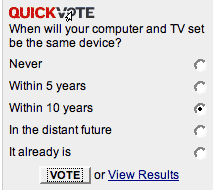
CNN has a poll on computers and TVs (scroll down to see it):

As you can see, I voted for “10 years.” At the moment, I’m one of the tech-pessimists. More people said less than 10 years, and a surprising 9 percent said “it already is.”

I think this may have something to do with definitions. When my son Jimmy was 1 year old, the doctor asked us how many words he knew. We said, “zero,” even though he could say “da-da” and “na-na.” Problem was, he didn’t use them consistently. He did seem to call me “da-da,” but he also said that when his mom gave him a banana. “Da-da” didn’t mean “daddy,” it meant “anything good.” So by my definition, Jimmy didn’t know the word “daddy.”

Similarly, one could argue that my computer already is my TV. After all, my TV is hooked up to a computer — a TiVo. This is a full-fledged computer all right, running Linux and equipped with a 40-gig hard drive. But “my computer” isn’t “my TV” yet, because the computer that runs my TV doesn’t perform any computing functions besides recording and playing TV shows. “My computer” is an iBook, which I use to write, surf the internet, pay my bills, and compute my taxes. Honestly, other than perhaps basic Web surfing, I doubt I’ll be using my TV to do any of that even 10 years from now.

Why not? A better question would be simply “why?” I don’t need a 48-inch monitor and surround sound to pay my taxes, and I don’t need to be able to put my TV into a shoulder bag to take to Starbucks. Convergence can be cool, but sometimes it’s just a waste of time and effort.

11/4/2005

Google Print — what are we really getting?

Filed under: — dave @ 7:34 am

Ben Vershbow of If:book has taken a look at Google Print and doesn’t like what he sees:

This is not an online library, it’s a marketing program. Google Print will undeniably have its uses, but we shouldn’t confuse it with a library.

Well, yes. We knew Google wanted to make money off this enterprise, and it is frustrating that it’s difficult to read Google’s scans online. But did Google ever promise us a library? I thought the point was to index these works, not to loan them out like a library.

More frustrating to me is the workings of Google’s more blatantly commercial Google Print Publisher. Here, the marketing aspect comes out much more clearly. Take a look at this screenshot from a search of Martin Ewans’ Afghanistan:

Entire pages have been omitted from the search. How does this function like an index? If I wanted to know something more specific than whether Ewans covered the Taliban in his history of Afghanistan, I may not find what I’m looking for. Google’s explanation of all this?

I’m already logged in. Why are you telling me the page is unavailable?
As part of our efforts to protect a book’s copyright, a set of pages in every in-copyright book will be unavailable to all users.

I really need to see more of this book. What can I do?
Google Print helps you discover books, not read them online. To read the whole book, we encourage you to use the “Buy this book” link to purchase it online or the “Find this in a library” link to look for a local library that has it.

Well, we knew the idea of Google Print was for Google to make money by marketing the books. But how am I to know if I “really need to see more” if the entire book isn’t indexed? Google’s excuse is that they need to “protect a book’s copyright” — now they’re not seeming like quite the copyright vanguards they once did, are they?

Of course, in public-domain books, the entire text will be available. But it sounds like for out-of-print books still in copyright, arguably the most valuable resource of Google Print, we’re still not going to have a true index of all the pages. That’s a frustrating limitation. On the other hand, Google Print is a free resource that we didn’t have access to before. Can that be such a terrible thing?

11/2/2005

Discussing copies right

Filed under: — dave @ 11:55 pm

One of the most common responses I get when I try to discuss copyright issues with friends (aside from their eyes glazing over) is what I call the c’mon defense. As in “C’mon, isn’t all this hoo-ha about freedom really just a bunch of pirates trying to keep the copyright cops off their backs?” Or a slightly more nuanced response, like “I understand the idea of ‘fair use’ but, it’s not like we’re headed towards some sort of Orwellian nightmare. I mean, jeez, you guys are acting like the sky is falling or something. C’mon! It’s just a bunch legal mumbo-jumbo that applies mainly to big corporations.”

The c’mon defense is hard to defeat. If you play it too subtly, you risk devolving to the eyes-glazing-over phase, which is insurmountable. If, on the other hand, you start to spin dire tales of crippled cell phones and camcorders, of banned Xerox machines and VCRs, of Big Brother closing all the libraries, then you are going to be quickly spotted as a zealot, and your conversation mate will be thinking more about how to get out of the room than how to respond to your arguments. Either that or he/she will reveal him/herself as the other sort of zealot: “Copyright must be protected at all costs! My employer, Microsoft, told me so!” Now you’re the one looking for the exit.

Even if you manage to play the middle ground and have a reasonable debate, you must constantly be aware of the potential for the c’mon defense to return. “Okay, I see your point about fair use, but c’mon, how are we going to deal with these pirates?”

A lot of copyright activists have noticed that part of the problem is that the deck has always been rhetorically stacked against them: it’s “copyright” against “pirates.” Who can argue against a right? Isn’t protecting our rights the American Way?

Yet try to redefine the terms — use the more accurate “copy restriction,” for example — and now you’re some kind of commie pinko radical. My least favorite term of all in this debate is “intellectual property” — what it describes is nearly always not intellectual and is never property. The idea that someone can “steal” “intellectual property” is not just ridiculous, it’s impossible.

What we really are talking about is not “intellectual property,” it’s rewarding creativity. Imagine how the debate would change if instead of talking about “my” property or “your” property, we talked about how to best to compensate those who create ideas. Isn’t the point of all this for artists, scientists, and inventors to be rewarded for their work? Isn’t creativity the thing we want more of, not “property”?

If we’re discussing how to reward creativity, then deciding whether to extend Disney’s copyright on Mickey Mouse another 20 years becomes a no brainer. That creativity has already been well-compensated. If we want to encourage more creativity, it’d be better served by moving Mickey into the public domain so others can use him in as-yet undreamt ways — just as Disney itself has done with other public domain characters like The Little Mermaid or Aladdin.

This doesn’t mean that all copyright laws should be overturned, just that the reasoning behind them should be approached from the standpoint of rewarding creativity rather than protecting property. Does restricting playback on my TiVo reward creativity? It certainly doesn’t reward the people who created the idea of TiVo, and its benefits to the people who created the TV programs I want to watch are marginal. But if we view the TV programs themselves as “property,” then why shouldn’t the shows’ creators be able to decide what happens to them?

Similarly with the case of Google Print. From a pure copyright perspective, Google Print is wrong — after all, Google is copying entire books without the “owners’” permission. But from the perspective of rewarding creativity, the issue becomes more complex. Google’s idea of indexing all books in print is certainly creative. Others can use Google Print for creative purposes, too — to find ideas that inspire them to create even more. Does it hinder new authors from writing books? Only to the extent that those authors believe that if anyone in the world could read a few sentences of their writing, then they would decide not to buy their books. Google Print doesn’t allow people to read entire books for free — just short snippets. Since people can do this (and more) already, in bookstores, or waiting in line at the grocery store, or at the library, and yet still authors write books, it’s doubtful that Google is doing anything at all to hinder creativity. Google Print is a good idea — just one that may be illegal according to current copyright laws.

The c’mon defense doesn’t work very well against redefining “intellectual property” as “encouraging creativity.” I mean, c’mon! who in their right mind is against encouraging creativity?

10/28/2005

Neilsen’s Top Ten Blog Design Mistakes Deconstructed

Filed under: — dave @ 5:30 pm

Jakob Neilsen has a new Top Ten list. Now, what do we think of his recommendations?

1. No Author Biographies
I have to agree with this one. People want to know who you are. If you’re an anonymous blogger, give some background info that explains your reason for blogging and why you’re anonymous.

2. No Author Photo
Guilty. I know it seems arrogant, but again, people want to know what you look like. Someday I’ll get around to posting one in the author bio section. It would probably be better to put it on the front page, but I’m not going to go there. I did on Cognitive Daily, though. Call me a hypocrite.

3. Nondescript Posting Titles
For the most part, I agree with this one as well, but sometimes a vague title, provided it offers a bit of mystery, can help draw a reader in.
Brad DeLong is the master of clear headlines
But Scott Esposito’s cryptic slugs make me want more

4. Links Don’t Say Where They Go
Here Neilsen suggests that readers are too stupid to hover over a link and look in the status bar to see where it leads, but they’re smart enough to hover over a link and wait to see if a mysterious “link title” feature that no one ever uses might pop up. I do agree, to a certain extent, that cryptic links can be annoying, but used with discretion, they can be a great source for humor.

5. Classic Hits are Buried
This is a great tip: put links to your best posts right on your home page. But who has the time?

6. The Calendar is the Only Navigation
Here Neilsen makes a plea for categories. Yes, categories can be useful, but a big problem with them is that you never know when you make a post on a new topic if that’s going to be something you return to over and over again, or if this will be your last post on that topic.

The best approach is probably to constantly revisit categories and re-categorize all your old posts. I’ll get to that one right after I finish organizing my sock drawer.

7. Irregular Publishing Frequency
Yes, right. A regular publishing schedule is a good thing. What I’d suggest, in addition to Neilsen’s points, is to not be afraid to make a short post.

8. Mixing Topics
He’s probably right, here. Single-topic blogs are much more likely to be successful than multi-topic blogs. Cognitive Daily regularly gets five times the readership of Word Munger. But if you don’t care how many readers you get, feel free to wax on about GMail one day and Hurricane Katrina the next. I don’t know anyone who’s done that, though.

9. Forgetting That You Write for Your Future Boss
Yes. Don’t do this, unless you are a member of the leisure class.

10. Having a Domain Name Owned by a Weblog Service
Meh. I haven’t seen any stigma attached to this. If anything, I find people who’ve registered their own name as their domain a little obnoxious. Not that I know anyone who’s done that.

10/14/2005

Blogs and peer review

Filed under: — dave @ 7:52 am

If:book has an interesting post about blog carnivals. Ben Vershbow calls them a “looser, less formal peer review” — a way to preserve some of the institutional authority we might find in journals without the long delays of a publication process.

As I pointed out in the comments, I’m not sure how much real “peer review” actually goes on in the world of blog carnivals. I’ve hosted Tangled Bank before, and it was a radical move for me to separate more actively political posts from more standard science posts. Other than that, I didn’t do a whole lot of rejecting. That said, generally the submissions I got were pretty high quality. Journal quality? Not really. After all, no one’s going to publish their original research on a blog. At their best, science blogs are really not much more than lit reviews. They might be inspiration for real research down the line, but they’re not real research.

I’ve spent less time looking at academic blogs from other disciplines, but as far as I can tell, it’s more of the same. People might toss around some ideas, but they’re never going to publish a fully formed, journal-quality argument. The best English blog posts I’ve seen are better than a lot of conference presentations — but that’s a pretty low bar to leap over.

Ben believes that eventually, scholars may look to blogs before they consult peer-reviewed journals. Why not? After all, your research gets out there much faster; science can proceed much more efficiently. It can take months — years — to publish in a journal, but blogs can be up the same day the result is found. What could be better than that?

The problem is, how to distinguish between really good research and the stuff that’s not much better than data noise. If blogs became the currency of academic research, how would we know when an article is Nature or Science quality? How would we distinguish between something publishable in PMLA versus, say, Bulwer Litton Notes? Just because a blog becomes popular doesn’t mean its author is always doing great work — just that they’re more likely to (and better connected).

One possibility would be to add a peer review “layer” to a group research blog. Posts would be private — only available to preselected board of experts — until a consensus was arrived at. Then, when a post was determined to be of acceptable quality, it would be posted publicly. But again, how would we distinguish between the different research blogs? Where would reputations be built? A journal might consider creating a separate research blog of short reports that builds on its good name, but why would it want to do that? The blog is a disruptive technology, and in this scenario, it threatens to subsume the journal itself. Why would a journal give away something it used to charge hundreds, even thousands of dollars for?

The other problem with such a system is that it threatens to get bogged down the same way journals do. Peer review is work. Finding good reviewers takes time. Why should active researchers review potential blog posts at all? I can imagine a system, similar to what many journals do, where a certain number of reviews are required before posting is allowed, but still, these journals spend a lot of money working to find reviewers and analyze their work.

A peer-reviewed blog might be doable, and it might even be better than the current journal-publication system. But it’s probably not going to be any easier.

10/6/2005

I want this, but for blogs

Filed under: — dave @ 4:19 pm

Okay, this site is super cool: Library Thing. You enter in your book collection, then you can see who out there has the same books as you. I’ve only entered 7 or 8 books, but I’ve already found several kooks who’ve read both The Pelopponesian Wars and The Faerie Queene.

Even better, since I spend a lot more time reading blogs than I do books, would be the equivalent concept but for blogs: a place where you could enter all the blogs you read, then find people who are reading similar blogs. I suppose bloglines comes close to this ideal, but it’s not quite there.

The only other problem with Library Thing is that you very quickly find out just how many people are more well-read than you are.

10/5/2005

I’m not cool enough for my cell phone

Filed under: — dave @ 2:48 pm

My trusty Treo 2700 died the other day, prompting me to take a long, hard look at my cell phone usage. I don’t make many calls at all — generally only two or three a month. These tend to be organizational-type calls: either the kids are somewhere and I’ve given them the phone so they can call when they need to be picked up, or I’m out running errands and need to call home for more information. We’re talking ten minutes a month, tops. At $35 a month, that works out to about $3.50 a minute. Surely I can do better than that!

I’ve long had a hunch that our usage falls into the prepaid mobile range, but I’ve been reluctant to change because the Treo is such a cool gadget. Now that the gadget doesn’t function anymore, I’ve begun to question how many of its features I actually use. Do I use it to surf the Net when I’m away from my computer? No. Do I use its handy calendar and alarm functions? Not really — I tend to just rely on my computer for that. In fact, it’s rather annoying when I’ve synced my computer and the phone, and both alarms ring within 10 minutes of each other. I do use the phone/address book, but is that kind of convenience really worth $420 a year? What I really need is the absolute cheapest phone service.

I think I’ve found it with Virgin Mobile. With their service, there are no contracts — you just pay for your phone up front (mine cost 39 bucks), then pay (in advance) 25 cents a minute for your calls. If you talk for more than 10 minutes a day, the rate goes down to 10 cents (for me, this happens less often than I rotate my tires). The only hitch is that you must spend at least $20 (actually $21.50 with tax) every 90 days. If you forget to pay or if your balance goes down to zero, you lose your phone service. But you don’t actually have to remember — you can set it up to automatically deduct another $20 from your credit card before your service is cut off. If you don’t do this, and you do forget to pay, you have 90 days to reestablish service before you lose your phone number. In my case, I seriously doubt I’ll ever go over $20 in 90 days, so the cost of my service will go down from $420 to $80 a year. This sounds so good, I decided to get two phones, so if both the kids are out, or we’re traveling, we can still all stay in touch.

But here’s the problem. This service is marketed at teenagers. If you haven’t followed the link above, check it out now. Or just take a look the literature that comes with the phones:

Talk about flash-ay! It’s bling-o-matic! And the phones are itty-bitty — they’re smaller and lighter than my keychain. The whole retro-smoove theme carries all the way through not only their marketing material, but also the instructions! Here’s the introduction to “Rescue Rings”:

So you’re on a date and it’s not all that? Program your phone to ring at a specific time and discreetly make your social getaway.

When you turn the phone on, you get a synth-pop R&B riff that would make Snoop Dogg proud. There’s no option for a normal ring tone — your choices are “KrunkTone,” “BeatMix,” “Creepy,” “EvilPizz,” “Galloping Metal,” “Low Rider,” “MoreKrunkness,” and “Techno Loop.”

Even the voice for the automated 800-number service line is a teenager talkin’ slang.

One of the most common uses for prepaid mobile is for parents to limit their teens’ cell phone use. After all, if all your minutes are prepaid, there’ll be no surprise $300 bill for your kid’s 8,000 instant messages. So perhaps that’s Virgin’s angle here — they’re making the service cool for kids so it doesn’t seem like such a bummer when their cell minutes get cut.

I think I can tolerate the pimpin’ ringtones and service with a ‘tude that my 13 year-old would strive for, just to get such a great deal on phone service. Cingular’s equivalent service is $30 per quarter, and seems to have more hidden charges than you can shake a 4-inch phone at. Virgin might sell even more phones, though, if they offered a “grown-up” version of their service.

9/29/2005

Google as the enemy

Filed under: — dave @ 10:30 am

Around here (near Charlotte, NC), Google is nearly always portrayed as the Noble Innovator, constantly coming up with new ideas that make Life Easier for the Rest of Us. In just the last few months, they’ve come out with Picasa, a handy way to organize your photos, Google Desktop for finding critical files on your computer, and even Google Blog Search. Google is Good for you, the popular press seems to say. It’s the search engine with the mostest, the most-important app you couldn’t live with out. Heck, Apple’s built it right into my Web browser!

But (in case you haven’t noticed) I was in Seattle last week, and I was surprised to see a very different depiction of Google. I suppose I shouldn’t have been — after all, this is Microsoft country — but don’t people in Seattle use Google? What do they use instead, MSN? I’m not making fun of MSN here — it’s actually a pretty good search tool, but it’s a little weird to realize that there must be pockets of civilization that don’t have a part of Google engrained in their daily life. In Seattle newspapers, an innovation like Google Print might be reported on as a new threat to copyright holders, whereas everywhere else, it’s a boon to scholars and book-lovers.

I guess if Microsoft has you in its sights, it’s probably a sign that you’ve made it (kinda like when you start worrying about piracy). Think about Apple. A few years ago, Microsoft helped prop Apple up so it could argue that it wasn’t a monopoly (”See! A few geeks and metrosexuals use these other computers, so don’t worry about what we’re shoving down everyone’s throats over at Wal-Mart…”). Now Apple’s got a hit with the iPod, and all the sudden Microsoft is talking about how Apple’s this big monopoly, cornering the music market. Well done, Apple! (Not that Microsoft doesn’t have a point, but still, let’s please not go tossing boulders around our dainty little Chihuly glass house, Mr. Gates.)

It does make you wonder if Google isn’t the 21st-century version of Microsoft in the 1980s. It seemed like every time you turned around back then, Microsoft was coming out with a new product that you couldn’t do without. Remember when Lotus 1-2-3 was the spreadsheet of choice? When every self-respecting secretary typed her memos using WordPerfect? When dBase was king of databases? Here’s this dinky company in Redmond, taking on the Big Boys with cute little apps called Word, Excel, and Access. What an innovator, we all thought — it’s all so much easier to use than those arcane old programs. Now Google’s doing the same sort of thing, coming out with new must-have applications so fast that we forget nobody had ever heard of them just a few years ago. Even my 2001 edition of Researching Online barely gives it a mention (anyone still use AltaVista?).

For Microsoft (and maybe even Apple), this makes Google Enemy Number One. I wonder how long it’ll take for the rest of us to think that way, too.

9/28/2005

Suing Google

Filed under: — dave @ 8:59 am

I know I’m a little late to this party, but I did want to say something about the Author’s Guild’s suit against Google. If you haven’t heard about this yet, the basic premise of the lawsuit is that Google is undergoing a vast project to digitize the texts of major libraries around the world, even copyrighted texts. That’s where they’re running into problems — the authors say this violates copyright, because they never gave permission for Google to do this. Even though Google allows individual authors to opt out, the authors argue that it should be Google’s burden to get permission in the first place. There’s a good summary of the issues surrounding the lawsuit at BoingBoing.

Scalzi may have hit the nail on the head with this little observation: “The day I actually have to worry about online versions of my book cutting into my sales is the day I know I’ve arrived.” For the most part, authors want people to see their work. Maybe Stephen King can afford to ensure that every set of eyes viewing his work is a paying customer, but most authors should be grateful for the opportunity to have more potential readers checking out excerpts from their work.

Like the folks at BoingBoing, I’m really not sure how a two-sentence snippet is going to cut into anyone’s sales, but even if it did, doesn’t this count as “fair use?” After all, fair use permits quotation in critical reviews. I may read a review of a book that convinces me not to buy it. Doesn’t that “cut into a book’s sales?” If I can do a quick search of a book and find a one-sentence gem that convinces me I don’t need the whole thing, doesn’t that suggest that the author hasn’t really written a book for me?

Tony Sanfilippo comments on BoingBoing that the real issue isn’t so much Google providing the snippets, but Google giving a complete digital copy to the libraries, in compensation for letting Google in in the first place. So he’s saying the real problem is libraries having the digital copy. But if memory serves me right, aren’t libraries specifically allowed to make digital copies of their works for archival purposes? If this is the case, isn’t the Google service merely like hiring an external contractor to do that? Surely you can’t sue a contractor for providing a service its client is legally permitted to perform. If authors are really worried about libraries getting a hold of their works, perhaps they should be suing Andrew Carnegie instead of Sergey Brin.

Scalzi argues that authors should ultimately have control over how their works are duplicated, even if said duplication is generally in their own interest. Essentially, his argument is that they’re stupid to be suing Google, but they have every right to do it. After all, copyright governs creating copies, and there’s no doubt that Google is making copies.

But let’s walk down this road a little further. Suppose Google Print doesn’t count as fair use. After all, it’s not really a critical analysis or review, or a satire, or educational use (they may have their best case with the educational use provision, but let’s assume this doesn’t fly). If Google is not allowed to make copies of books for the purpose of making them searchable, what does this say about the whole Google enterprise? Isn’t Google doing the exact same thing with its Web search feature? Google’s search engine trolls the net, placing copies of Web pages on its own servers. They even allow users to see a cache of the entire text of the page, without visiting the site itself. If Google Print is a copyright violation, then surely Google Web is a copyright violation as well. So basically, all current technologies for searching the Internet are illegal.

Imagine a Web without the ability to search — it would be an entirely different place. Some have even argued that the process of linking should be illegal — after all, the author of a site should be in control of its content. If an author only wants you to enter the site through its home page, isn’t that his or her right? But even dismissing that possibility, how would we locate content without the ability to search? Some massive advertising network? Would we go back to the Yahoo! model where site owners submitted URLs and waited for Yahoo! editors to index them? Maybe instead of a robots.txt file which allows site owners to opt out of search engine results, we’d have to use it to expressly give permission to be indexed. But think of the problems with such a system — even supposing everyone could agree to worldwide standard, would everyone understand it? And what about older sites that may not ever be modified to accommodate robots? Do they just … disappear?

These issues are too important to be left to the courts to decide. Unfortunately, they’re also probably too important to be left to Congress. I’m not sure which I’d prefer — the demon of litigation, which already has come down strongly in favor of rightsholders — or the monstrous beast of legislation, which has given us the DMCA and the Sonny Bono act, both basically written by corporate cronies with little input from anyone else. I think rather than opening up the copyright legislation ball of worms, this one is best fought in the courts. Let’s hope Google’s lawyers are better than those from the Author’s Guild, or the Internet is about to get a whole heck of a lot more restrictive.

9/14/2005

Google Blogsearch: Cool, but not quite

Filed under: — dave @ 6:50 am

I just took a look at Google’s new blogsearch tool, and I have to say, it’s quite impressive. Search for perceiving attractiveness and it puts yesterday’s Cognitive Daily post right up top.

And check out the advanced search: it’s all blog specific. You can search by terms in a post title, by post author, by date, or within a single blog.

One thing that’s always bugged me about Google, however, is that it’s not very good at plagiarism-checking in blogs. If you want to see if someone’s been ripping you off, you should be able to enter a short phrase from one of your blog posts — something like this quote from a CogDaily article last February:

One of the most famous perceptual demos is the ambiguous image or “bi-stable figure” of a duck - rabbit

Enter that phrase into blogsearch (or a standard Google search) and this is all you get. Now enter the same search in Yahoo and the offending post pops right up. Interestingly, if I do the same type of search on a more recent blog post, Google does find it. Maybe it’s just not indexed back that far — after all, six months ago is ancient history in the blog world.

One of our concerns when we launched Cognitive Daily was that students in psychology classes would be able to crib essay topics from it. No problem, we thought, teachers can always catch them with a quick Google search. Unfortunately, they can’t — even searching Blogsearch won’t find articles from just last February. I actually conducted a little experiment to see how far back they go, and it seems like it’s about April. Search for a post in March, and you’ll come up with nothing. I wonder if blogsearch’s amnesia is permanent, or if its eventual goal is to search the entire blogosphere, including its history.

UPDATE: I’ve been playing around with the link: command in Google Blogsearch to see if it could be used as a faster, better Technorati. Unfortunately, it really can’t. If you do a search for a specific post (one which I know was linked by several blogs), you come up with nothing. But you can do a link search for a main blog URL, like this, and you will come up with previously unsearchable links, some of which don’t even show up on Technorati. Who knew someone had noticed my article on Taking a dump in the woods?

9/12/2005

My life, my e-mails

Filed under: — dave @ 6:56 am

Scott Esposito links to an interesting collection of snippets about the use of e-mails in writing biographies. While some writers seem to think their e-mails might be of use to future biographers, others are more skeptical. First of all, there is the technological aspect, which I’ve discussed before. How many writers have managed to save all their e-mails, let alone in a format that anyone can read?

As I noted back then, I’ve lost everything from before 1998, but it turns out I’ve also lost more than that. At a critical period in 2000, when I left my business to start writing, the e-mails are also gone. Not surprising: in the hectic transition from working in an office environment to working at home, who worries about saving every last message? But supposing a future biographer of the posthumously famous author Dave Munger wanted to know what motivated him to start writing full-time, she wouldn’t find it in his e-mails — even supposing no additional e-mails were lost in the 75 years between now and his tragic geriatric parasurfing death in 2080.

Now, maybe a service like GMail will ensure that more e-mails do get saved, since it allows easily keep all your messages online in perpetuity. But if I were to switch now to GMail, it would be even more likely for me to lose all my old messages. As the years progressed, and I continued to switch from computer to computer, at some point I just might not want to mess with translating my e-mails to the latest (but still no longer used) format. And what happens 50 years from now when Google is bought out by HoloLaserCorp for 75 trillion dollars? Will HoloLaser have the same dedication to archiving that Google has become famous for? Perhaps HoloLaser will ditch Google’s e-mail system in order to refocus its efforts on the technology to download the entire contents of the human brain into flying cars.

Scott’s commenter Miraida Morales points out that blogging may also be a biographer’s tool. And so it might. But blogging, unlike letter-writing, represents a writer’s public side. You won’t find anything on the old Word Munger site about why I left my business either.

This is not to say that the technology e-mail has replaced — writing paper letters — is especially sturdy. I don’t have any copies of the letters I wrote back in college in the 1980s, even though I still have many of the letters others wrote me. Suppose my best friend from high school is one day remembered as a great biologist. Will anyone think to search through obscure writer Dave Munger’s correspondence files to find out what such a Great Mind had been thinking all those years before?

9/8/2005

More on long prose narrative

Filed under: — dave @ 10:47 am

Scott Esposito is responding to a Michael Blowhard post on the future of long prose narrative. I’ve written about this before, but not in the way these guys are. Michael is speculating that the long prose narrative will be history someday — that the novel will have come and gone as a genre. Scott, perhaps not surprisingly, thinks a bit differently. He suggests that the novel is a welcome respite from the high-speed, plugged-in society we’re living in.

I’m going to argue something slightly different: that the novel is already history. The novel is certainly no longer the mass-media entertainment, the way it was in the 19th century. People still buy and read novels, certainly, and occasionally a book comes out that strikes a nerve and really gets people talking — a Harry Potter, or a Da Vinci Code. But even a mega-blockbuster like Da Vinci only sells around 35 million copies worldwide. There are literally hundreds of movies with this many viewers. Even a midlist film like Vanilla Sky grosses over $200 million worldwide, corresponding to roughly 30 million screenings. But by only counting viewers in theaters, we’re barely getting started. There are DVD sales, rentals, screenings on HBO, and finally regular TV. I haven’t been able to locate the statistics, but I do recall reading that Hollywood now makes more on DVD sales than it does on box office. Even an average film has many, many more viewers than a “blockbuster” novel.

What’s the best hope for a novel writer to really hit it big time? Selling the film rights. Many novelists make more on film rights than on book sales — even when the movie never gets made. Novels may be feeders for true mass-media entertainment, but they are no mass-media entertainment themselves.

This is not to say that novels aren’t worthwhile. Of course they are. And just as I enjoy reading the occasional epic poem even though no one writes them any more, so there will always be novel readers. The question is, how long will it be before we have no more professional novel writers? Michael Blowhard estimates that there may now be fewer than 200 full-time writers of extended prose narrative. Is it possible that in, say, 50 years, that number will have dwindled down to zero?

With the ease of self-publishing, especially with the rise of e-books, what we might see is something like an eBay class of writers, making money off of blogads, audiobooks, podcasts, you name it. They’ll be patching together income in drips and drabs, rather than garnering giant publishing contracts. Nearly all of them will have day jobs. Will what they produce look like a novel? Perhaps some of the time, but it will most certainly depend on what makes the most money. Maybe short stories, or series, or something else entirely, will be more marketable in podcast or e-book form than the traditional 300-page novel.

Is this a bad thing? I don’t know. Did epic poetry fans lament the rise of the novel? Change is inevitable, especially when the technology for delivering literature is undergoing a radical transformation. Will literature itself disappear? Maybe if you’re defining it solely as novels. Literature, however, predates the novel. It’s a more encompassing term that perhaps should be expanded to include all narrative forms, including film (obviously literature comprises more than just narrative, but certainly narrative is a significant, if not the most significant portion of all literature).

So the hallowed novel is perhaps doomed to be replaced entirely by flashier stuff — movies, music, video games, podcasts. An abomination? Remember what preceded it: the “literature” of the ancient Greeks was epic poetry, memorized and performed to music. “Drama” was musical theatre, perhaps more like opera or a Broadway show than a “serious” play. Maybe what we’re really doing, with our iPods, our cell phones, our laptops, our PSPs, is simply returning to our roots.

8/26/2005

How the heck does Google manage to stay in business?

Filed under: — dave @ 6:55 am

Two interesting articles on Google lately. First, from Brad DeLong, an article responding to recent bouts of insider selling at Google. He cites a WSJ article indicating that many insiders at Google are selling their shares. Could they know something we don’t? Should we all be selling too? Brad points out the obvious — that anyone possessing millions of dollars in highly valued Google stock and precious little of everything else would be insane not to diversify, but of course there’s still the question of “why now?”

I have a friend who started working at Microsoft in 1988. He was a paper millionaire by the mid-90s — kinda like a Google employee today. He told me that everyone in the company at that time just expected Microsoft to keep going up. They saw no reason to sell. And it seemed quite rational at the time — forget about Microsoft, except for a brief blip in 1987, practically no stock had gone down since 1980. Of course, by 2000, some of them were wishing that they had at least sold some of that stock, but even now, I’d say most Microsoft employees are doing just fine.

Google employees are in a different situation — Google was built up during the stock bubble. Most of its current employees were probably hired after the bubble burst. With massive financial ruin that close in their sights, why wouldn’t they be a little skittish? Interestingly, Google’s prospects remain so good that perhaps they, like the Microsoft employees of the mid ’90s, are making the wrong decision, too.

Meanwhile, the ever-entertaining David Pogue has an article about Google’s latest tool, Google Talk, which, like many Google products, seems almost too good to be true.

In today’s culture of cynicism, such generosity and software excellence seems highly suspicious; surely it’s all a smokescreen for a darker, larger plot to suck us all in. What, exactly, is Google up to?

Google Talk indeed sounds like a good program (albeit one I can’t use on my Mac), and its ideal of breaking down the barriers between previously incompatible chat programs is a good one, but it isn’t too hard to figure out exactly what Google is doing here. They’re doing the same thing they’ve always done: build popularity first, then figure out a way to make money. Software is so cheap to distribute, there’s really no reason not to give it away, especially when, to be useful, your software requires a lot of people to use it. Google Talk wouldn’t be much use at all if your friends didn’t have it too, so why not just give it away, for starters?

Obviously in the long run, they’re going to need to make money off it, but there are so many ways they could do this, the mind boggles. They could sell ads, of course, or a premium version of the software, or subscriptions with more services, or, I don’t know, a compatible cell phone. It really doesn’t matter.

Google’s business plan is simple, if a bit counterintuitive: Make great products that everyone wants, give them away, and then, when they become an indispensable part of life, figure out nonintrusive ways to make money off them. Heck, maybe I should buy some of their stock or something.

6/28/2005

Video games and learning

Filed under: — dave @ 12:35 pm

Every few weeks, a comment pops up on the Cognitive Daily post I wrote back in April. The post reported on a Chilean study indicating some positive results using Game Boys to teach basic reading and math to students in distressed schools. It’s pretty clear that most people posting on the issue of video games have already made up their mind about them, which is a bit of a shame, because video games are so complex, so it’s difficult to conceive of how anyone could have already arrived at a conclusion about them.

Yesterday “Joshua” posted a response typifying the most paranoid voices from the anti-video game side:

I hesitate to think that people get so easily sucked into agreeing with studies about the benefits of video games, TV or computers. A child’s brain and body was not designed to sit and watch flickering images on a TV or computer screen. It was designed to move, work (like a muscle) and learn from real teachers and real experience. Not inanimate boxes programmed by someone with lots of knowledge of the machine and little real wisdom.

I don’t want to pick Joshua’s quote apart here, because that’s not really the point. The point is that there exists a segment of society that is so afraid of “technology” in general that they simply refuse to distinguish between different technologies and applications for particular technologies. To them, “TV” and “Computer” are “bad” and “book” and “teacher” are “good.” No high-falutin’ study is going to convince them otherwise.

In some ways, these people have a point. Just observing a small child watching television, eyes glazed over, mouth agape, you can’t help by think there’s something better he could be doing with his time. Or take a look at the “computer labs” that have been installed in so many schools, with rows and rows of computers loaded up with edutainment software. Is this really what we’re spending millions of dollars on educating our kids for?

The problem I see with the generic anti-technology point of view is that it refuses to acknowledge that there were plenty of problems with the old system, too. Just because a kid is reading books instead of working at a computer doesn’t mean she’s learning more; it depends on the book — and the computer.

The bigger problem with the anti-technology perspective is that by refusing to acknowledge any effective uses of technology, it forces us to the lowest-common-denominator. One fascinating (to me) aspect of the Chilean study is that it presents an alternative to “edutainment,” those slick CD-ROMs that offer plenty of flash but no proven results. These guys programmed ten-year-old battery-powered toys and achieved real results.

I think a real danger in technology and education is to default to the latest and greatest. If a Game Boy does the job, there’s really no reason to spend millions upgrading all the students to PSPs. If we can’t create a more effective teaching tool than a blackboard, then we should be using blackboards. But we also shouldn’t assume blackboards are the best possible teaching tools. After all, they’re technology too, only developed during the 19th century. The only way to learn which technologies are the most (and least) effective is to do research, and to see what the research shows us.

After all, who’s to say that kids were supposed to learn by sitting in desks staring at this bizarre technology called a “teacher” at the front of the room? Isn’t the standard classroom itself just another example of a learning technology? Shouldn’t we see if we could do better than that — even if it means dismantling the classroom, too?

5/12/2005

This is depressing

Filed under: — dave @ 6:57 am

I don’t sort my e-mail this well.

Of course, that’s not saying much. I currently have 901 messages in my inbox, 78 of which I haven’t even read. It’s not actually quite as bad as all that. Most of the unread messages are spam — I’m just too lazy to mark them as such and move them to the spam folder.

Then there’s the semi-spam: spam from people who you know, such as my kids’ school’s weekly Wednesday letter. Most of the information is truly spam, but then there’s the occasional non-spam message, such as all students in sixth through eighth grade must bring swimsuits to school tomorrow. So at some point, I’d better slog through it.

Meanwhile, in Japan, people dispose of the unused lipstick separately from the lipstick tube.

Semi-spam includes notices of sales from stores I occasionally shop at: I do need new running shoes, so perhaps I ought to look through the 30 or so e-mails from runnersworld.com to see if there are any bargains to be had.

There’s also the real spam with intriguing subject lines. I have an unopened message from “cat” entitled “wetsuit.” I certainly don’t have any friends named Cat, and I’ve never even tried on a wetsuit, but such an enigmatic piece of spam might just warrant three or four seconds’ worth of consideration.

There’s the real messages from real people where the entire substance of the message is conveyed in the subject line: “pick the kids up at 4,” or “meeting tonight cancelled.” I probably shouldn’t just trash these messages, because sometimes people put extra little tidbits of information in them, but somehow I haven’t gotten around to reading them.

In Japan, there are trash inspectors who leave notes when your garbage is sorted into the 34 possible categories incorrectly.

I have 137 unread messages that have been automatically placed in the wordmunger.com mailbox. These are notifying me of new trackback or comment spam. Or there might be a legitimate comment or two there — perhaps a real commenter is named “video poker” or “Cortisone.” Every day the pile of unsorted trash in my inbox gets bigger.

At least I don’t live in Japan.

5/4/2005

Blooks: the next big thing?

Filed under: — dave @ 10:54 am

As I was finishing yester-hour’s post, I got to thinking. If blogs are such a great way to read texts, why not model an e-book after a blog? Why not make a blog book — a “blook”?

A couple reasons, actually. The first is that a book is a fundamentally different thing from a blog. As Scott Esposito has pointed out, you can’t just take a blog and make it into a book. Blogs are meant to be followed along day to day, not read from cover to cover like a book. And, typically, if you go back and read old entries, you’ll read them newest-to-oldest, instead of the other way around.

I had this problem with the vidsanity diary. If people found out about it after it was all over, they had to either read backwards or have a backwards experience of the event. I tried making a chronological post of the event afterwards, but this was unsatisfying because the original comments were lost, and there wasn’t space to interject comments along the way.

But what if the blog concept was applied to a book as a whole? How difficult would it be to take a public-domain work like, say, Huckleberry Finn, and post it like a blog? Instead of organizing the entries by date and posting them in reverse-chronological order, they could be numbered like chapters and posted chronologically. Then readers could comment individually on each chapter (or on smaller divisions if the chapters were longer than 5 or 6 pages), and experience the book in the order it was written.

Searching through the text would be a breeze, and the comments section would invite not only individual notes, but discussion about each chapter. There would be no problem comparing different chapters or parts of the book: just open up a new browser window or tab.

Another problem would be portability. The book could only be experienced where there was Web access. These days, that’s becoming less and less of a problem. Sure, I couldn’t take it with me on a hiking trip, but I could read it in bed on my laptop, probably more comfortably than a standard book, because the laptop stays open on its own. I’ve been through issues of screen legibility before, but given that I’m already comfortable reading online text for hours at a time, perhaps this isn’t as big of a problem as it seems.

I’d like to try such a project, as a sort of experiment to see if the experience of reading a book this way is as satisfying as (or perhaps more satisfying than) reading it on paper. I can get a text from project Gutenberg, then design a WordPress interface for it, and launch it as its own blog — I mean blook. It’d have to be a book I’ve never read before, so I that could consider the blook as its own experience, rather a second reading of a traditional book.

So, whaddya think? Could it work? Any suggestions for books to convert into a blook? Anything published before 1923 that I haven’t read should be fair game.

Yet more on the future of sustained narrative

Filed under: — dave @ 9:51 am

Anne asked a great question in response to my post on Monday. I predict the demise of printed books within 20 years. On Monday, I qualified that prediction, saying that books will still exist, but they will be collector’s items, purchased more for their significance as objects than for the information they contain. Anne asked “What do you think will happen to the sustained grappling with texts that are beautiful or difficult or both?”

The answer is, I think we will continue to grapple with them, onscreen. There is nothing sacred about the physical word on the physical piece of paper. Paper itself has gone through some interesting transitions in its own history. I’m not going to pretend I’m a scholar in the area, but it’s only been quite recently that paper was the preferred medium for text. Papyrus was preferred until well into the first millennium, and machine-made paper from wood pulp didn’t come onto the scene until the 19th century. Important documents were not written on paper but parchment, made from animal skins.

You can argue that our experience with books has been largely the same since Gutenberg, a legacy of over 500 years, and that is true, but for centuries before that people still grappled with important texts. The change of medium did affect the way in which people prefer to approach a significant work: they approached many more of them; they grappled with them less seriously. I see no reason, assuming (as I expect they will be) e-texts are more readily available than printed texts, for that trend not to continue.

I’m not sure that’s a bad thing. It’s a different thing, but is it a bad thing? When scholars finally had the Gutenberg Bible, I suspect that at first they rejected it: their handwritten bibles were more beautiful, more authoritative, written as they were in the church’s latin. But eventually those hand-copied works were set aside: either put in museums or forgotten, because of the increased usability and legibility of a printed book.

There is no reason to believe that printed books are the pinnacle of usability and legibility. With print books, I’ve always found a trade-off. The most usable books allow me to easily write in the margins; they include more informative running heads, and plenty of cross-referencing. These aids actually detract from legibility. Paper that’s easy to write on is not the best for holding printed type. The most legible printed page is probably some sort of glossy, coated stock, likely to repel the pencil and make my ink clot up or run. Running heads detract from the balance of the page and consume precious margin area. Cross-references detract from the reading experience, as do the very written notes that clutter the margins of my books. My copy of Herodotus has so many notes that I can barely see the printed text any more. I think now, if I was going to reread Herodotus, I’d have to start with a fresh copy.

A well-designed e-book reader can be better than a well-designed book. Of course it would come with a stylus, for manual note taking and highlighting. It could display the text with or without my notes. Certainly the resolution and brightness of the screen would have to be improved; e-ink seems to be the most likely candidate so far.

But designing a proper screen is only half the battle. The interface for reading would have to be improved as well. One of the best e-book readers, TK3, still has plenty of room for improvement. While there are many ways to take notes, it only allows viewing of a single page at a time, which makes it difficult to compare passages. The Macintosh version still doesn’t anti-alias the text, making the fonts jagged and difficult to read. And I’d like to see a better way to “thumb through” a text. For simply reading an e-text, I prefer Apple’s Preview, but it falls apart in the note-taking department. Worst of all is Adobe’s ungainly, bloated Acrobat Reader, which bogs down even my six-month-old computer, and doesn’t allow note-taking in its free version.

None of these tools offer a good way for readers to locate themselves within a document. TK3 offers a progress bar that gives a good visual sense of location, but this bar offers precious little information otherwise. Apple and Adobe use the vertical scroll bar in the same way, and offer the additional device of thumbnail images of each page. But why not include some useful information along with the thumbnails, such as chapter titles, or even subheadings? The thumbnails themselves are too small to be legible. Acrobat and Preview do offer a contents view in their sidebars, but again, these provide few clues as to the size of the sections they refer to.

Interestingly, blogs offer many of the features that are lacking in e-book readers. Good blogs offer an intuitive organizing principle: the calendar. Every blog entry has a title, and many blogs also list the most recent posts by title. I can also display all the entries on a certain topic, search the entries, or use the graphical calendar to locate entries. There is a comments section for notes, and an easy and unobstructive way to cross-reference blog entries and comments: links.

This gives me an idea.

Which I’ll cover in my next post.

5/3/2005

The punch line is, “First they need to make a computer that doesn’t crash”

Filed under: — dave @ 2:35 pm

Here’s the joke.

5/2/2005

More on the future of sustained narrative

Filed under: — dave @ 2:23 pm

I was wavering yesterday on whether to predict the book’s demise in 20 or 30 years. I decided to go for it, and chose 20. What the heck, let’s be controversial!

Scott Esposito called me on it right away. I was asking for that, I suppose. I should probably clarify. I’m not predicting the complete demise of the printed book. Of course people will still want books. People still own horses, over 100 years after the introduction of the automobile. Collecting books will be more like a hobby, like buying old ’78s, or, yes, horses. People will buy books more for their significance as objects than for the information they contain. There are still going to be printed books, but they will be an insignificant part of the market compared to the sum of their replacements. What will be difficult is quantifying exactly what those replacements are.

Here’s an interesting question: what proportion of the reading Americans do today is done on printed paper, compared to electronic texts? I would say that I personally have already crossed the fifty percent threshold — I do more than half my reading on the computer. I wonder how many others are like me? This is not to say that I never read printed text. When I’m reading something especially difficult, even if it’s a PDF, I’ll print it out. This allows me to take notes more easily and take advantage of the increased legibility of paper. If I have a choice of an online versus paper text, I invariably choose the paper version for the same reason: I read my Atlantic Monthly in print, even though my subscription also entitles me to read the online version. Certainly in 20 years, we’ll have cheap electronic displays that are better than an inkjet printout, so my proportion of print reading will decrease even more.

In 20 years, my kids will be in their 30s — a generation raised on electronic textbooks, who don’t know a world without the World Wide Web. Do you think they would prefer a printout to an e-text? The median age worldwide today is 26. That means that half the world was born after the personal computer was invented and under age 14 when the Web was invented. In 20 years, no one under 50 will remember a time without the Internet.

My 11-year-old daughter groans when a research assignment requires her to use a book as a source. She barely knows how to find a book in the library, but she’s a whiz with Google. The problem with books, she points out, is that it’s hard to get the pictures from books into your PowerPoint presentations. This is a child whose computer time is limited to 1 hour a day.

There are some caveats. People may cling to paper books to avoid DRM, much the same way many people don’t buy music from iTunes or Napster because of the copy protection involved. It’s much easier to share a book today than it is to share a song from iTunes. However, if eBook readers are literally $20, I could imagine people sharing books by simply trading the readers themselves.

I think the practicality argument will eventually lose out. Even though cell phones are a pain in the neck, with all the recharging and hidden costs, with the gaps in service, with incompatibility with this or that computer, people still say they can’t live without them. People are unbelievably tolerant about the limitations of their technology.

For that matter, people are incredibly tolerant of poorly designed books. People buy books with running heads that offer no information other than the book’s title. They buy books without indexes, with illegible typefaces, with quarter-inch margins, with bindings that fall apart or make it impossible to hold the book open without a vise-like grip. And don’t even get me started on bad kerning, bad hyphenation, let alone bad proofreading. I just finished reading a book called The Design of Everyday Things. It was all about how badly most things are designed. The book’s title had been changed from The Psychology of Everyday Things. Guess what? No one had bothered to change the book’s dozens of internal references to its own title.

The standard that e-books will have to meet to exceed ordinary books is actually quite low. The problem for e-books is much more likely to come from other genres: from television, from movies, from video games. They will have to be more than edutainment, which has been said to “combine the entertainment value of a bad lecture with the educational value of a bad game.”

Here are a couple ideas that just might work. What if every e-book combined the printed transcript with an audiobook? That way, you could start reading the text in “print” form, and then seamlessly move to the audio version when you need to drive to work, or weed the garden. This would give texts a huge advantage over other forms of entertainment, because they would be substantially more portable. As I noted in my review of the audiobook version of The Outlaw Sea, listening to an audiobook when you’re not doing something else is rather boring — it proceeds too slowly to maintain interest. If you could switch back and forth between the two versions as necessary, this problem would go away.

Or how about a different form factor for bedtime reading? There’s nothing more relaxing than reading a book before going to sleep — except trying to figure out a comfortable position to hold the book and still be able to read it. How about a hands-free display integrated into “eyeglasses,” allowing a reader to assume any position while reading?

Something I’ve mentioned before is an e-coffee table book. It would have to be clearly not a computer, because looking on someone else’s computer is sort of like opening up the medicine cabinet in the bathroom of a friend. In addition to the traditional professional photography accompanied by sparse narrative, it could also include the host’s vacation pictures, and perhaps also control the home audio system.

These are just a few ideas for ways that e-books may begin to filter into our lives over the course of the next 20 years. I still have more to say about all this, so stay tuned.

5/1/2005

The future of sustained narrative

Filed under: — dave @ 11:25 am

If:book and the folks at the Institute for the Future of the Book have done a lot of hard thinking about what books will look like in future. Dozens of litblogs offer book reviews, forums for discussing books, and pithy little witticisms about books. One of the most successful Web sites ever is a book store.

Yet the book is in danger, we are told. Kids today have no patience for books; they’re obsessed with video games, with movies, with pornography.

There is no doubt in my mind that physical, bound books will disappear, probably within the next 20 years. As soon as it is cheaper to produce books electronically, paper books will go away. And that moment is fast approaching. Listen, if we can have a $100 laptop within 5 years, we’ll certainly have a $20 e-book reader in 20. When the electronics cost less than the paper, you can say goodbye to paper.

The real question is, with this change in book technology, how will the nature of books change? Because, again, there is no doubt that they will change.

As I have said before, some books have already disappeared. Encyclopedias are gone, and dictionaries aren’t going to be far behind. Textbooks will be next. My kids haul 15 pounds of books to and from school every day. When my son enters the ninth grade in a year and a half, he will be given a 7-pound laptop computer containing all his texts, and he will have no more textbooks. His school has a “special” laptop program, but I suspect by the time he enters college, this type of thing won’t be so special, and many, if not all of his college courses will be taught using e-texts.

Some changes will be positive. You need only take a look at Cognitive Daily to see that many of the topics we cover there would be difficult to present in a typical book. An e-book would have none of those difficulties. I was surprised to learn (via Brad DeLong) of the popularity of an outfit called The Teaching Company. Why would anyone pay $500 for a DVD of a lecture series when they could buy a $20 book covering the same material (it turns out, most people wait for the “sales” when the DVDs cost more like $100, but the question still applies)? The answer is that the DVDs contain demos: audio demos for music classes, interactive demos for physics classes, etcetera. They are multimedia, just like an e-book.

In this sense, what we may start to find is that a technology like TiVo is going to be part of what ends up replacing books. I just finished watching the History Channel’s excellent program on FDR. A 4-hour TV show covers almost as much information as a short book, but I doubt I would ever have purchased a book about FDR. I also doubt I would have watched the live broadcast. TiVo allowed me to treat the program like a book, watching it over a period of several days, pausing whenever I needed to answer the phone or refill my glass of wine. Eventually TiVo (or its descendents) won’t just record shows that happen to be broadcast: it will allow me to search an online catalog and download the shows I want to see, anytime. Someone who then learned about the FDR show could find it online and download it for a buck or two, instead of spending $20 on the equivalent book. It will be difficult for print books to compete.

It’s a mistake to think of an e-book as simply an electronic version of a printed book. “E-books” are going to appear — and have already appeared — in a variety of forms, for a variety of audiences. The real question is what is going to happen to the sustained narrative form. A 300-page book takes me about 10 hours to read (if I’m reading carefully). Will we want our information in 10-hour chunks, or some other size? Maybe 4 hours (like the FDR program) will be more like what we want, or maybe that’s how the economics will work out: maybe people will only be willing to pay $2 or $3 for an e-book, and so from a publishing perspective that only works out to a 4-hour book.

I have a lot more to say about this topic, so for now I’ll have to wrap this post up. Look for several more posts on this topic in the next few days.

4/28/2005

What’s up with Technorati?

Filed under: — dave @ 2:04 pm

I’m not completely obsessed with myself. I mean, I only check Technorati four or five times a day to see who has linked to my blogs. But you know, something’s starting to bother me. Cognitive Daily, which seems to be getting linked more and more lately, is “stuck” at 54 links from 37 sources. It’s been like that for a couple weeks now, even though I’ve seen a dozen or so new links pop up in that time.

The links show up on technorati, it’s just that they don’t seem to be “counted.” Not a big deal, I suppose, except isn’t the count supposed to be some sort of indication of how “respected” a blog is? Will CogDaily perpetually be stuck at 54, or will the count be mysteriously updated some time down the road? Do we need a virtual Fonzie to smack the Technorati juke box to get it back on kilter?

And another thing. The site claims it has three pages’ worth of links for CogDaily, but when I click on page 2, it suddenly forgets about it, displaying this odd message:

Technorati has no problem displaying Boingboing’s second page. Do I have to have 21,000 links before Technorati will deign to display page 2?

Why am I so obsessed with this? I don’t know. Perhaps now would be a good time to start a hobby.

4/27/2005

Now this is good

Filed under: — dave @ 8:52 pm

I have to say, I’m loving Steven Johnson’s new article in NY Times Magazine (thanks, Ben Vershbow). In fact, I can’t wait to get the book.

I was a little disappointed by his previous book, Mind Wide Open, but that might be just a tad unfair, because, psychologically speaking, I’m probably a bit more sophisticated than his baseline reader. But this stuff is good. Popular culture today, Johnson argues, isn’t dumbing us down, it’s smartening us up. Analyze the plot of a typical episode of The Sopranos and compare it to The Dukes of Hazzard, and you’ll see what he’s getting at. Modern audiences expect — demand — more sophisticated plotting than the audiences of 20 years ago. Is it because they’re getting dumber?

My aha! moment came a couple months ago after playing 24 hours of video games with my son. Video games today are immensely more complex than the games I grew up with. The demands on memory alone are astounding.

I spent the past few weeks watching Disney’s new version of Little House on the Prairie with my kids. The complexity of the new show makes the 1970s Michael Landon version look like Saturday morning cartoons (and I don’t doubt that today’s cartoons are also immensely more complex than Hong Kong Phooey or Super Friends). I really think Johnson has a point: contemporary popular culture places significantly more cognitive demands on today’s audience than it did even 25 years ago.

So what’s all this fuss we’re constantly hearing about today’s kids not having the same attention span as kids used to? About their lack of patience, their hyperactivity? If they need to be so smart to deal with contemporary culture, then why do they seem so lacking in other areas?

I suspect these two (admittedly anecdotal) observations aren’t actually incompatible. “Patient” is different from “smart.” The kids of the past had more patience — and they needed it, because their popular culture wasn’t as sophisticated as it is today. Today’s pop culture doesn’t demand patience; it demands mental agility. Teachers and classical musicians are disappointed in today’s kids, because paying attention in school or sitting still for a concert demands patience more than brain power.

Now whether these kids will go on to greatness in the “real world” is probably still an open question. The workplace requires both patience and smarts. Today’s kids have clearly learned the latter; the question is, wil they be able to muster the former?

Update: Turns out Steven Johnson has a blog. Which I would have known if I had actually read Ben’s post. Think I’ll add that one to my links list.

4/21/2005

Are Mac users like Catholics?

Filed under: — dave @ 11:39 am

A new article on BBC News describes the experience of visiting the Apple Store in New York as entering a “temple”:

Beneath its high vault, swish thin young men and women dressed from head to foot in black.

They hold objects in their hands, strange white and silver objects, objects of devotion which they present to lay visitors, to the uninitiated who wander in from Prince Street seeking retail solace.

Are Apple products tools of worship, like a rosary or a censor? Must Mac users bow down before Pope Steve the first and Cardinal Wozniak the other Steve?

Stephen Evans, the article’s author (completing our trinity of Steves), cites a quote I’ve heard before, from Umberto Eco:

Macs, Umberto Eco opined, were “cheerful, friendly, conciliatory,” traits he associated with Catholicism. More to the point, though, their way of operating was different from Microsoft’s, giving more guidance to users.

Macs would, as Umberto Eco put it, “tell the faithful how they must proceed step by step to reach - if not the Kingdom of Heaven - the moment in which their document is printed”.

He saw that as like Catholicism, in contrast to the Protestant faith which he thought, like Microsoft computers, would “allow free interpretation of scripture, demand difficult personal decisions… And take for granted that not all can reach salvation. To make the system work you need to interpret the program yourself”.

I suppose all that is true, if you can accept that printing a document is like eternal salvation. Personally I think I prefer my printing to be easy and religion to be difficult (perhaps even impossible).

Eco could have gone on: like Catholic priests, many Mac users are rumored to be gay. Mac users believe that taking a bite out of an apple is like consuming the flesh of Steve Jobs. Mac users believe it is better to tithe an extra 20 or 30 percent for Apple products than to go the heathen way of Bill Gates.

Joking aside, I think the analogy falls apart rather sooner. Mac users are much more likely to defend their “faith” than Catholics, who typically just apologize for it. Rather than looking to ancient texts of the past for spiritual guidance, Mac users look only to the future, to the possibility of a PowerBook G5, a video iPod, or a dual-core Power Mac. When their “pope,” Steve Jobs, dies, I think the culture of Mac will die along with it — whoever is “elected” to succeed him will never maintain the same allure, and the Mac will fall to the status of Zoroastrianism or some other forgotten religion, never to be heard from again.

4/19/2005

Happy birthday, Word Munger!

Filed under: — dave @ 8:18 am

Hard to believe, isn’t it? Just one year ago, Word Munger was a tiny babe, almost too fragile to hold in your arms. That’s right, Word Munger sprouted into existence one year ago today. It’s a very merry Word Birthday today, and to celebrate, I’m going to use a tactic mastered by sitcoms the world over: a retrospective episode.

So what wise words did I utter that first day? Be amazed. No, not at the lame-o welcome post, at the comment spam. The next day I wondered whether I should post pictures of my kids online. I concluded that it was probably an irrational fear, but that maybe I shouldn’t be sharing my kids with all the stalkers and riff-raff that would naturally be attracted to my musings about the latest e-book reader. Of course, it didn’t take me long to blow that.

Abortion has been a recurring topic here on Word Munger. A recurring theme of my discussion has been the idea that I wouldn’t make much of a pro-choice advocate.

Another topic I just can’t seem to stop yakking about is e-books. You’d think I could just write a post or two about them and then leave them alone, but somehow, I always come back to the topic. Am I destined to become some sort of e-brarian in a future life? Could there really be that much to say about e-books? Why, if I don’t read a lot of books, am I so obsessed with e-books? Would I suddenly read more if I had a better e-book reader? Stay tuned to Word Munger, because if the past is any indication, you’ll hear a lot more about e-books in the future.

I’ve also written a lot about writing over the past year. A common theme in this topic is my own lack of writing ability. There’s been a bit of self-promotion tossed into the mix, along with a touch of literary posturing.

My travel has been another topic of interest to me. If you weren’t interested, too bad, because that’s what I was writing about.

And what’s with all this writing about technology? If I wasn’t writing about my new computer, I was writing software reviews (this incidentally was the most visited post on Word Munger — ever — thanks to a link from MacBytes). And, of course, the fact that I’m not a designer never stopped me from ranting about design.

I’ve also done my fair share of writing about my neighborhood. It’s … shall we say … suburban. That’s right, folks, my kids are growing up in the kind of place we city kids used to always make fun of. They’re reliant on their parents for every little thing, because even the nearest grocery store is sixteen miles away in a strip mall. Forget about going to the movies on your own, or riding a bus … anywhere. And of course, like any suburbanite, I’m obsessed with my lawn (a man’s gotta have one vice, okay? At least I don’t own an SUV).

Satire has been a feature of Word Munger since before the beginning. That’s right, before there was Word Munger, there was Word Munger, the all-satire, all-the-time predecessor to the Word Munger Blog. I like satire, but eventually it wore on me, and I stopped promising it every Friday. Don’t give up, satire fans, every once in a while I’ll whip up some for you. In the meantime, there’s always Michael Berube.

In these past twelve months, I admit to having done just a bit of writing about Social Security. I even got a comment from the blogosphere’s most famous economist, Brad DeLong.

One topic I never enjoy visiting is my own stupidity. Typically this has to do with my reading an article too fast and then exploding into a rant about what I thought I just read. This post is probably the worst example of it. I’m impressed that Tom Maguire took my idiocy as well as he did.

I have written a few posts about my lack of religious faith. Some are intended to be funny, but others are quite serious. My son Jim, who my wife is attempting to raise as a Presbyterian, read that last one and told me he agreed with it. Uh-oh.

All in all, it’s been a good year. I’ve enjoyed it, so I’ll probably stick around for another one. See you in the blogosphere.

4/6/2005

What to do about trackback spam

Filed under: — dave @ 10:16 am

I’ve pretty much obliterated comment spam on Word Munger by simply shutting down comments after a couple of weeks. However, trackback spam continues to be a significant problem.

If you’re not familiar with trackback spam, it is a way to exploit one of the coolest things about blogs: their interconnectedness. If I make a blog post about someone else’s blog, my blogging software “pings” them to alert them that I have written about them. Then readers of that blog know to visit Word Munger for the witty, incisive commentary that typically shows up here when I’m not busy revising manuscripts.

Spammers have figured out that they can set up fake “blogs” that do the same thing, but instead of masterful prose, all you’ll find there are ads for online poker or desperate housewives.

Sometimes I figure I might as well ignore trackback spam — after all, it typically only shows up on ancient posts like this one. On the other hand, perhaps this makes me part of the problem. Maybe I should go back and delete it all, in the interest of making the Internet a better place for all of us.

It’s kind of like those restaurants who hire homeless people to walk through parking lots putting their flyers on every car’s windshield. They’re littering, actually, and my first reaction when I find one of their crappily produced, ungrammatical “flyer’s” on my car is to throw the litter on the ground. But I can never bring myself to do this, so instead I litter the floor of my car with their paper spam, where it generally sits for a few weeks until my son Jim decides he wants earn a little money cleaning out the cars.

So, maybe the solution is the same for trackback spam: I can hire Jim to clean it all out! Perhaps trackback spam is simply the ultimate full-employment solution for lazy teenagers.

UPDATE: Now see, over on Cognitive Daily? That’s how trackback is supposed to work. Why can’t we all just get along?

3/15/2005

My respect for librarians continues to grow

Filed under: — dave @ 9:05 am

Boing Boing pointed me to a great article about the role of libraries in distributing government documents. Traditionally, libraries served as a depository for documents published by the Government Printing Office (GPO). To cover its costs, the GPO sold the documents to the libraries. This reduced the cost for government to provide public access and preservation of the documents. Local governments and learning institutions were happy to pay for this valuable service to the public.

Now many government agencies including the GPO produce many documents digitally and distribute them online. The GPO has a plan to knock libraries out of the loop by charging the public directly for the documents it distributes. Instead of 1,300 libraries, there would be one, central depository for all government documents. Other than the “why do I have to pay for something I used to get for free” argument, it makes some sense. Not so fast, argue the librarians:

If we rely on any single source (e.g., the federal government) for government information, and the single source fails, the information is lost. “Failure” in a single-source information culture includes technological failure, accidents, intentional altering or destruction or removal of information, changing budget priorities that are unable to keep up with a rapidly growing amount of information, changing political priorities, and other unforeseen technical, economic, social, and political problems.

By contrast, in a multi-source information culture, the failure of one node (e.g., the loss of a copy of a document in one FDLP library) does not mean a complete loss of information. With multiple copies of documents at multiple locations under multiple collection policies and budgetary authorities, no single agency, organization, or private company controls access to or preservation of government information. Negligence at one organization affects the materials only at that organization. No act, intentional or unintentional, by any single organization can lose, replace, alter, destroy, or remove information from 1300 separately located, separately controlled, separately budgeted collections.

I hadn’t thought of that. But given the tremendous difficulties many libraries are now facing in preserving digital documents, it makes sense that keeping all our digital eggs in one basket may not be the wisest course of action. The librarians also note that technological failure may not be the most significant flaw in our national digital egg basket. Politicians have, in the past, requested that the GPO “withdraw” publications it has already deposited in the nation’s libraries, and the libraries have refused as a matter of principle.

The biggest danger of a central government knowledge repository is the temptation for the government to rewrite history.

Any time you think libraries may be becoming obsolete, I want you to go back and reread that sentence.

2/28/2005

What can we learn from video games?

Filed under: — dave @ 10:18 am

As you might have noticed, I spent the weekend preparing for, engaging in, and recovering from playing 24 hours of video games with my son.

When I woke up Sunday morning (er… I should say, afternoon) my brain was buzzing with the music from Super Smash Bros, but also with a new sense of understanding about what kids are doing when they play video games. As someone who spent a good part of his childhood in video arcades, you’d think I’d know why kids spend so much time with the silly things.

But games are different now. An old school game like Asteroids had a total of 5 buttons , each of which did exactly one thing (and the hyperspace button was for losers, so it should hardly even count). Nintendo’s GameCube has one of the simpler controllers on the market, with 8 buttons and 3 joysticks. Not only are modern controllers more complex, but buttons can have different meanings in different contexts, and very often commands involve combinations of buttons and joystick directions. It can take hours, if not days, to memorize all the functions for just one game. Learning to play video games is starting to look a lot like, well, learning. Take a look at these two images:

two types of memory?

The picture on the left consists of a fraction of the knowledge necessary to learn Tony Hawk’s Underground: the “flip tricks” available for a skater and how to execute them. On the right is a fraction of the knowledge necessary to master organic chemistry: the major functional groups for organic molecules. To a novice in either discipline, it seems like an overwhelming amount of information. I suspect that any given video game contains just about as much information as an o-chem textbook.

You disagree? You haven’t played many video games, then. Not only must players memorize all sorts of arcane commands, they must also learn what the enemies they encounter will do and then figure out how to counter them. In addition, they must build a complex mental map of the game’s “world,” whether it be a complex power plant in a James Bond game or a cavernous space station in Metroid. The mental processes involved are incredibly demanding, yet tens of millions of kids beg their parents for video games. Meanwhile a measly couple hundred thousand pre-meds a year bother with o-chem.

O-chem promises untold riches as a dermatologist or plastic surgeon. Video games provide only the cheap thrill of watching a robotic-looking Tony Hawk execute a 900 in a New Jersey train station. Yet the vast majority of Americans pick the latter over the former. Why can’t we get kids as excited about the difference between a ketone and an aldehide as they are about distinguishing a double blunt slide from a daffy grind?

I’m not going to say that we should turn school into one giant video game. Even if it was possible, I don’t think it would be advisable. Sure, you could probably get kids to learn more if you made learning more fun. However, the real world doesn’t offer the sort of instant gratification that video games do. The people who are successful in today’s world are precisely those who can delay gratification. Doctors make tons of money, but only after they spend eight years in school and three more in residency.

What we can do is make it clearer to kids what the possibilities are. If millions of kids can master today’s complicated video games, then they’re also smart enough to survive tomorrow’s technological future. That future needs to be as crystal clear to them as the glory of beating a level-9 Jigglypuff in Super Smash Bros.

That is just some of what I learned playing 24 hours of video games with my son.

2/23/2005

Quicken sucks, so sign me up again!

Filed under: — dave @ 8:44 am

About a month ago, I received the following email from the “Quicken Team”:

According to our records, you may be using an older version of Quicken®. If so, some important changes are coming that will affect the way you use your Quicken software.

Online Services are being discontinued for Quicken 2001 and 2002 users.
As of April 19, 2005, in accordance with the Quicken sunset policy, Online Services and live technical support will no longer be available for Quicken 2001 and 2002 users. These services include online bill pay; downloading financial data from your bank, credit union, credit card, brokerage, or mutual fund accounts; downloading stock quotes, news headlines, and other financial information into Quicken; uploading portfolio information from Quicken to Quicken.com; and access to the investing features on Quicken.com, including portfolio tracking, any watch lists you have created, One-Click Scorecard, Stock Evaluator, and Mutual Fund Evaluator.

I had been using Quicken 2002 for the Mac since — well, 2002. The software was working fine for me, allowing me to pay my bills, track my investments, and balance my checkbook. Sure there were a few little issues with the program, but it did what I needed, so I had always tossed their annual software update offers in the trash.

But now — well, now I was being told I didn’t have a choice. Now, in order to use the features I paid for, I’d have to upgrade to the new version of the software. I turns out, I only used one feature on their list of discontinued features: downloading stock quotes. But this was a mighty convenient feature, allowing me to instantly learn how much my kids’ college fund gained on a good day in the market. After griping and swearing a few times, I finally bowed to the inevitable and ordered the new software. Maybe there’d be some new feature I really needed. Maybe they’d fix some of the niggling issues about Quicken that had always bugged me. Maybe when I got the new software I’d write a review and post it online.

About a week ago, my CD arrived (That’s right, it took three weeks. Not very “quick,” Quicken Team!). For “only” $49.95, I now had the latest and greatest version of Quicken. What new features would make managing my home finances even easier? Right away, I could see things were going to be different. Most importantly, of course, Quicken had a new Icon!!!!!

I had always thought the old icon looked fine, but now that I saw the new one, well, how could I not be impressed? It looked like something out of Pixar’s The Incredibles!!!

Then I started the program, only to find yet another Important New Feature: more new icons. These icons were bigger than the old ones, but more importantly, they were completely different. So now I’d have to learn a whole new set of icons for, say, balancing my checkbook or printing checks. Where was that “print checks” icon, anyway? It wasn’t on the toolbar, the way it was in Quicken 2002. No problem, just navigate through a baffling set of menus for 30 minutes or so to add it to my tool bar. Wow! That’s really a completely different icon. I wonder how I’ll remember it. Well, I’m sure I can just hover my mouse over the icon and a convenient text box will pop up and tell me what it means. After all, that was a feature in Quicken 2002, so surely they wouldn’t have removed a convenient feature in Quicken 2005, right? Actually, they would. So not only did my icons take up more space on my screen and look unfamiliar, they were also less functional than in my “old” software. Fortunately, there’s a workaround. I can lose even more screen real estate and display the icon’s meaning permanently below it.

Speaking of screen real estate, I started to wonder if the Quicken 2005 “team” had fixed one of the most annoying “features” of Quicken 2002. Anytime I started up the program, Quicken used to always resize all the windows I’d carefully arranged the last time I used the program. For example, the “portfolio” window would be shrunk so that I could only see half my portfolio. I tried restarting the program to see if things had changed. They hadn’t. Apparently they broke the bank designing all those fancy icons, and couldn’t be bothered to fix Quicken’s functionality.

Another thing that had always irked me was printing checks. Quicken checks come in sheets of three, so if you print an odd number, you’ll be left with a sheet of 1 or 2 checks. Every time you print checks, Quicken has to ask you how many checks are left on the sheet. Wouldn’t it be nice if Quicken could remember how many checks you have left? After all, it remembers that I earned $7.43 in checking interest on February 12, 1997. (Whoah! Was the interest rate really that high back then? I made $0.51 last month, and with more money in the account.) I tried printing some checks and saw that no one at Intuit had intuited my idea: printing checks was the same old, same old (but with NEW icons).

The Quicken people are always trying to sell new services, like paying ten bucks a month for their “bill pay” service so you can save $3.50 on postage, or signing up for their credit card, or a loan, or insurance. It’s almost as if the product wasn’t designed for me to track my money, but for them to siphon it away. It’s almost enough to make me throw the program and my years of financial data into the trash.

Almost, but not quite. Could I really go back to balancing my checkbook by hand? And how would I monitor my investments? $49 every three years isn’t too much to pay to keep track of my money. I’d prefer it if their “improved” software was actually improved, but I’m a creature of habit. I’ve been using Quicken since 1994. Quicken sucked back then, and it still sucks now. And yet I can’t live without it. Isn’t capitalism great?

2/17/2005

Are some people born to code?

Filed under: — dave @ 8:36 am

Fair warning: I’m writing about this question with my “ordinary guy” hat, not my “psychology writer” hat. Over at Macrumors they’re talking about whether just anyone can program a computer, or if it takes a special kind of mind to do it. The first poster has struggled his whole life with programming, and still doesn’t believe himself to be successful at it. He just can’t “get it.”

I’ve dabbled in programming over the years, all the way back to the days when I developed a primitive drawing program for my Commodore 64. I figured out a way to move a tiny dot around the screen with the cursor arrows, and then draw a line to it when the user pressed the “enter” key. It was a simple program, fairly easy to write, and glacially slow. It took hours to draw a recognizable picture of anything, and I typically got bored after making a triangle or two. On the one hand, if I hadn’t had some aptitude, I wouldn’t have ever written the program, but I don’t think this shows I’ve “got what it takes” to be a programmer. A real programmer would have kept coming back to that program, improving it. If I was a real programmer, I would have added a feature to change colors, or to draw different shapes, or to save the drawings I created.

Some of the responses to the initial question on MacRumors were clearly written by programmers. They’re easy to spot, because they go something like this: “sure, anyone can program, all they have to do is break the problem down into five simple steps. Once you master those, the rest is easy.” Or “C++++ is easy once you realize that every argument (except integral functions) must be enclosed with curly brackets, and don’t forget to write inequalities using the tilde and the double-backslash key.” The non-programmers write “No, no way. It’s got to be in the blood.”

I’d like to believe that if I absolutely needed to, I could learn to program a computer well (I’m talking serious programming, not dabbling in HTML or CSS). After all, I love computers. I love the Internet, and I love the power computers give me to do things like write, or edit photos, or make books. What I absolutely hate is when computers stop working (see my Aaaaaaaaaagh post from last week). If I was born to be a computer programmer, these moments when computers stop working correctly would be the good times: after all, they offer a chance to solve a problem, and that’s what any good programmer loves.

So am I saying that programming ability is innate? I don’t think so. But if you’re not particularly good at it, or if you don’t particularly like it, then why try to make a career out of it? Let someone else pull their hair out trying to figure out why their latest app keeps returning a “divided by zero” error.

2/12/2005

Blogging for dollars

Filed under: — dave @ 9:35 am

Slashdot pointed me to this blog designed solely to maximize advertising income. Apparently its proprietor, Michael Buffington, designed the blog as an experiment. He spends about an hour a day culling links from Google News searches on asbestos, a topic he picked because of rumors of high click-through advertising rates on Google advertising.

He had heard that key terms, such as “asbestos” and “mesothelioma” lead to incredibly high click-through advertising rates — $15 and up to $100 per click. He had no interest in asbestos previously; he simply wanted to see if he could create a content site that would make money quickly.

Once the article was posted on Slashdot, sparks began to fly. Isn’t it immoral to make a blog solely designed to make money? Shouldn’t he just be writing about the things that actually interest him? Buffington argues that his site does provide a valuable service. He reads the articles himself and tries to link only to the ones offering new and valid information. And doesn’t Google do the same thing itself? A search on Google for asbestosis reveals ten “sponsored links” which take up more screen area than the actual search results.

Some of the commenters pointed out that Buffington may have already missed the rush: there are already many sites that attempt the same thing. Does that make him more or less “evil” than those who’ve thought of it first? And given this apparent cash grab, what happens to the real victims of asbestos poisoning? I wonder what it would be like wading through this sea of sharks if I was trying to get treatment for an asbestos-related condition, or find a lawyer to represent my family in an asbestos claim. Perhaps that’s the real wrong that’s being perpetrated here, and Michael Buffington isn’t the one we should be blaming.

2/9/2005

Aaaaaaaaagh!

Filed under: — dave @ 8:43 am

I should say that I do not like fiddling with technology. I like technology, but I like it to WORK. I get no enjoyment out of the debugging process.

Nonetheless, I was all psyched to set up my home network with a central music server. You know, so I could play music from any computer in my house, and so there wouldn’t be that awful mess of CDs piled up everywhere — the living room, the kitchen, the bathroom, the pantry, and so on.

I bought an Airport Express base station and a new hard drive for my used PowerMac Cube, so as to have enough room to store all that music. Okay, it was a bit of a pain upgrading the hard drive in the Cube, including removing the CD ROM drive temporarily in order to copy files from the old hard drive to the new one. But I managed to get it working with only a modicum of hair-pulling.

Next it was time to start streaming music. This was supposed to be the easy part. You just plug your stereo into the Airport Express, then select the Airport on the handy-dandy little menu that pops up in iTunes, and you’re streaming, baby!

No such luck. The menu didn’t even show up on my Cube. Even more frustrating, it DID show up on my iBook’s menu. Fat lot of good that did me: the whole point was for the Cube to be the central music server. So I went to Apple’s support site and searched for answers. It turns out, a lot of people were having trouble getting iTunes to play music on Airport Express. They were trying everything: updating firmware, reverting to older versions of the software, you name it. So, dutifully, I tried everything they did, with no luck. This process went on for DAYS. Aaaaaaaagh!

Finally, a few minutes ago, I decided I’d just search through the iTunes preferences. Maybe there was something I’d missed. And there it was: a little checkbox, next to the following text: “Look for remote speakers connected with Airtunes.” The checkbox was not checked.

It couldn’t be that easy.

I checked the box. I watched in shock and horror as the menu popped up in the corner of the screen. I selected my Airport Express and instantly began to hear music. I had wasted three days of my life for THIS?

Aaaaaaaaaaaaagh!

1/29/2005

Can we get over Marshall McLuhan, already?

Filed under: — dave @ 4:19 pm

Okay, I’m starting to get really sick of the repeated dronings from all around the Internet about how computers are such a different medium from X, Y, or Z. My particular area of expertise is books. I’ve worked in the book industry, on and off, for 14 years, so I think I know a bit about books. And of course, I’ve talked a lot about books here. I don’t like to bring in a lot of scholarly hoo-ha to my conversations online, but I have done some of the “medium is the message/massage” reading as well. I know my McCluhan and my Ong — maybe not as well as the true disciples, but well enough that I think I understand the point.

Yes, oral culture is different from written culture, and written culture is different from print culture, and print culture is different from TV culture, which is different from Net culture. This does NOT mean that a work in one medium cannot be transferred to another without transforming its meaning. If I read a newspaper article online, I’ve read it just as much as if I saw it in print. If I see a movie on DVD, I’ve seen the movie. McCluhan goes into a lot of jibjaw about how TV is different from film, because of how the television image is generated one dot at a time and a film gets displayed frame by frame. To a certain extent this is true, but we don’t retain each individual dot in our memories — it’s quickly transformed into a much more compact representation. Each individual is going to have a slightly different memory of a film they saw, but that memory is affected by many things besides the medium they used to view it — the time of day, the other distractions in the room, the other films each person has seen. To suggest that the medium is the most important influence is simple-minded.

With e-books the distinction between the “medium” of a print book and an e-text is even more strained. Yes, the resolution of a computer monitor is different from a printed page. But most books today are written on computers. Does the process of transforming that e-text into a printed book literally change its meaning? Yes, the reader may have different responses to a text depending on the context in which she reads it, but the medium on which the text is displayed is again a comparativley minor influence.

Will the internet transform literature? It already has. Writers like John Scalzi and Cory Doctorow published entire texts online to attract the notice of print publishers. Later these e-texts were transformed into successful print books. Bloggers get commissioned to write books based solely on the day-to-day rantings. Online writing groups allow writers from around the world to get together and rip each other’s work to shreds from thousands of miles away.

Even when books are published conventionally, the way we hear about them by “word of mouth” has been radically transformed. Amazon reviews have become a cottage industry. There are blogs solely devoted to book reviews, and blogs solely devoted to Amazon.

McLuhan was right in that the way we communicate with each other transforms culture. But we don’t discard older vestiges of our culture when a new medium comes along. Homer has been transformed from oral narrative to written text to print text to film to TV to online text and back to oral narrative. Yes, the message is slightly different each time, but the way we understand Homer has changed even more radically because of other changes that are happening around us all the time. This doesn’t mean we still can’t enjoy the works of Homer sung to the music of a lyre sitting next to a campfire — or even simulate that environment on our computer screens — we’ll just never experience it the same way the ancient Greeks did, because our culture is vastly different from theirs.

So asking whether e-books will “replace” print books is in many ways irrelevant. The internet has already had a huge impact on the way we communicate with each other. There will continue to be “books” — extended texts, whether electronic or printed — based on whether our culture still demands them, and I suspect it will, though I also suspect that the types of books we want will continue to change. Right now, the technology for presenting printed books is better than the technology for presenting e-books. That’s why we haven’t seen an explosion of e-books. As electronic display technology improves, more and more extended texts will published electronically. Will the meaning of those texts be changed by moving to a different medium? Not as much as the surrounding culture will have changed, and not for the same reasons.

1/26/2005

Some pet peeves about blog design

Filed under: — dave @ 8:28 am

Now that 8 million of us have blogs (sorry, can’t remember where I got that figure), you’d think some of the mysteries of blog design would be sorted out. For example, why does everyone put the goofy little calendar in their menubar? What purpose does it serve? Does anyone ever scroll down to the calendar and say to themselves, “hmmm… I wonder what Munger said on the 21st of January. Let’s click here and see.”

No, no one ever does. Of course, I do have the calendar on my site, though I’ve thought many times about taking it down. I keep it there because it’s a reminder of my own industriousness (or lack thereof). It’s a point of pride for me to blog every weekday, and the calendar-thing lets me know if I’m keeping at it. Come to think of it, I guess that’s probably what other people use them for, too. People can visit my blog and quickly note that I’m a weekday blogger. Others blog in fits and starts, and still others can’t go half an hour without posting something. The calendar gives you a quick visual impression of what type of blog you’re dealing with.

I guess that’s not much of a peeve. But this one is: don’t you hate it when you want to link to a blog and you can’t immediately tell how to link to a particular post. The best blogs offer a convenient “permalink” link for just that purpose. Mine doesn’t, though. You have to click on the title of the blog post to get the permalink address. That’s not so bad, either — it’s pretty clear from the visual arrangement of my site that that’s what you need to do. Other blogs put the “permalink” in the time stamp of the blog post. This strikes me as amazingly counterintuitive. Why would I ever click on “7:51 a.m.”? Worst of all is when you need to click on the name of the person posting the article. Shouldn’t a click here bring up all the posts by that person? Or maybe an e-mail address? Half the time I end up clicking on the name, just to check to see if it’s the permalink, and all the sudden my e-mail app opens up. Ugh!

Here’s a relatively minor one: the “comments” link. Many blogs (including mine) use this link for a dual purpose: to let readers know the number of comments so far, and to take them to the commenting engine. But if there are no comments yet, the link shouldn’t say “no comments.” This suggests that comments aren’t allowed.

And why do some blogs have text widths that go from here to Albania? I think I keep my browser window at a reasonable width: it covers about 800 pixels of my screen, or roughly the width of a sheet of business paper. If your text can’t fit on 800 pixels, it’s TOO WIDE! That’s like writing a business letter with no margins — and then some. That’s like a newspaper that carries narrow lines of text all the way across the entire page. It’s almost impossible to read. I’ve seen blogs formatted so wide that I can’t see the whole thing, even when I stretch my browser window to the full 1024 pixel width of my screen. Enough, already!

Finally, the blog title. The title of your blog should do something, people! What should it do? Take visitors back to the home page of your blog. What if someone finds your blog via a link from another blog. They won’t be on the home page, and if they actually like your blog, they want to see what else you’ve done. Make it easy for them!

Oh, and one more thing… don’t you just want to puke when people make their sidebar some gaudy color like purple? Or yellow — that’s the worst. Especially when they’ve got some dorky animated logo. And don’t get me started on disingenious wordplay with blog titles and author names…

1/20/2005

Is a networked book still a book?

Filed under: — dave @ 8:07 am

Yesterday I discussed Umberto Eco’s lecture on the future of books from the perspective of whether e-books can replace traditional books. I think Eco rightly distinguishes between “books to read” and “books to consult,” with electronic books to consult likely replacing traditional ones, but traditional books to read maintaining long-term dominance over e-books.

However, I do think the “books to read” / “books to consult” dichotomy oversimplifies things. I might read a computer manual cover to cover, but I might also consult it for just the information I need. Ditto for many (most?) scholarly works. The argument against Google print has often been that it treats all books as if they were books to consult, and this is true, but we might also consult any book, even the quintessential “book to read.”

Eco makes another important point about e-texts. Often e-books have been hailed as a revolutionary new medium because of the infinite possibilities of hyperlinking. Eco argues that the hyperlinking in itself does nothing to expand the original text:

Now suppose that a finite and limited text is organised hypertextually by many links connecting given words with other words. In a dictionary or an encyclopaedia the word wolf is potentially connected to every other word that makes up part of its possible definition or description (wolf is connected to animal, to mammal to ferocious, to legs, to fur, to eyes, to woods, to the names of the countries in which wolves exist, etc.). In Little Red Riding Hood, the wolf can be connected only with the textual sections in which it shows up or in which it is explicitly evoked. The series of possible links is finite and limited. How can hypertextual strategies be used to “open” up a finite and limited text?

Eco is saying that the value of a text comes precisely from the static arrangement of its words. In theory, anyone could have written Hamlet — the words were available to them — but Shakespeare did it first, so we value Shakespeare.

There was a lively discussion at Future of the Book a few days ago about whether a “networked book” was still a book. It is a “text,” but it is infinitely variable and constantly modifiable. Eco would say it is not a book, or even a text. A “text” is a fixed sequence of words. It might be modified — even Hamlet might — but it would no longer be the same text.

There is certainly an inclination among wiki members to preserve a version of their work. Wikipedia is planning a static, printed version, and other, smaller wiki projects have published versions of what they create. Is this because they have some notion that a static text is a different (better?) thing from a networked text?

There are some real benefits to “fixing” texts. I can remember (but I’m too lazy to look up) a significant online debate a year or so ago on whether it’s ethical to change a blog posting once it’s up. The consensus seemed to be that other than to correct typos, it was not. Why? Because others would respond to the original text, and they’d be made to look like idiots if the original was subsequently changed. My personal practice follows this consensus — it certainly seems like a reasonable approach. Larger revisions can be made in the comments section or in clearly marked updates.

We value fixity, but we hail the e-text as a “revolutionary” medium because of its maleability. However, it seems that maleability is not its true virtue: interactivity is. Paradoxically, maleability inhibits interactivity, so we typically form conventions to suppress the ill effects of maleability. And sure, I don’t modify my blog posts, but I respond to others in my posts, and others respond to mine in theirs. Later, I might write a new post synthesizing these thoughts. Still later, I might write a book that brings these thoughts together with newer (and older) ones. All these are good things. Which one is a book? Probably only the last.

1/19/2005

Umberto Eco and the Future of Books

Filed under: — dave @ 9:07 am

Michael Lew points to this transcript of a lecture given by Umberto Eco on the future of books a couple years back. He makes some important observations about e-books:

[B]y inserting a micro- cassette in the book’s spine or by connecting it to the internet one can have a book printed out in front of us. Even in this case, however, we shall still have a book, though as different from our current ones as ours are different from old manuscripts on parchment, and as the first Shakespeare folio of 1623 is different from the last Penguin edition. Yet, up to now e-books have not proved to be commercially successful as their inventors hoped. I have been told that some hackers, grown up on computers and unused to browsing books, have finally read great literary masterpieces on e-books, but I think that the phenomenon remains very limited. In general, people seem to prefer the traditional way of reading a poem or a novel on printed paper. E-books will probably prove to be useful for consulting information, as happens with dictionaries or special documents. They will probably help students obliged to bring with them ten or more books when they go to school, but they will not substitute for other kinds of books that we love to read in bed before sleep, for example.

I think over the short term, Eco is absolutely right about this, and I want to make two important points about what he says. First, he argues that an e-book is still a book, just like a pulp paperback and a parchment scroll are. Some have argued that by computerizing text we have invented a new medium, inherently different from other media, but Eco argues that the two are the same thing. He also divides books into two categories, “books to consult,” like dictionaries and encyclopedias, and “books to read,” like novels and histories. He can see e-books taking over the “books to consult” market rapidly, as indeed they already have, but he suggests that paper books will be the preferred mode for “books to read.”

As an example, Eco points out that most of us can’t imagine editing a text without printing it out first. If we insist on printing things, that suggests that there really is a difference between print media and the electronic word. Here I have to agree: for any kind of extended writing, I do prefer a printout to a computer readout, but not for the reasons Eco gives. The problem with editing on a computer is that the spatial orientation of the text changes as I make edits. If I add a paragraph to page 4, then what was once on page 7 is now on page 8. It’s disorienting! With a printed manuscript, everything stays where it was until I print it again. I can write in all sorts of comments on the margins, and I still have the visual cues of the printed text to help me see what else needs to be done. Now I can imagine a computer interface that would allow me to edit in the same way on a computer, but I probably wouldn’t use it. Why? Because the old way of editing works just fine, and the new way would require me to learn a whole new set of commands just to use it.

For reading a book, however, I’m not sure Eco’s argument applies. The main reasons to use electronic versions of paper books are to save space and to make distribution cheaper. If I had an e-book reader that was as easy on the eyes as paper and as easy to carry as a typical printed hardback, then if it was cheaper than printed books, I’d use it for reading nearly every sort of book. The only type of book I might want read the old fashioned way is one I want to make exensive notes in. However, even in this case, I think the inconveniences of making computerized notes are outweighed by their advantages, so I might be willing to learn a new interface in order to make my notes electronically.

I have a lot more to say about Eco, but no more time today, so I think I’ll finish this post tomorrow.

1/12/2005

What do we value books for?

Filed under: — dave @ 8:58 pm

There are bookstores that sell books by the inch. In the 19th century, many households had faux bookcases, with no books, just the spines. Even today, I have an antique room divider painted with trompe l’oeil books. The New York Review of Books has over a hundred thousand subscribers. Are all those people reading it to decide what to read, or to convey the impression of being well-read?

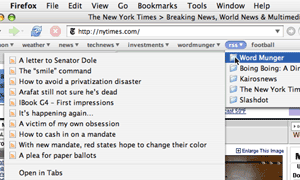
Do we value books because of the knowledge they contain, or because of the status they confer on us as readers?

Over at Future of the Book, Ben Vershbow is speculating about what the ideal e-book will look like. There are some important ergonomic and aesthetic factors defining e-books, but I think the social factors might be the most important of all.

College students use textbooks as tools to help them get the grades they need to graduate. When they’re done with them, they sell the books. No one is impressed with a shelf full of textbooks. What they keep are “status books” like Joyce’s Ulysses or the Complete Works of Shakespeare. Encyclopedia Brittanica used to be a status book, but now people in the know just buy the CD — or use Wikipedia. Printed Brittanicas clog the wastebins of Goodwill stores across the nation.

How will a collection of e-books convey status? It can’t, unless it gives us the knowledge we need to demonstrate that status, or the means for us to give the impression of status. Since most of us read in private, an e-book reader has a tough time fitting the bill.

That suggests to me that the first successful e-books will be ones that convey must-have knowledge. In fact, they already exist: CD encyclopedias are those books. They just seem like a failure compared to the cash-cows that print encyclopedias once were. What will be the next successful e-genre? Probably not pulp fiction; even a cheap $200 e-book reader won’t compete with $6.99 Wal-Mart impulse buy. Maybe it will be the New York Review of Books.

Another possibility might be the e-coffee table book: a $500 tablet that takes a prominent place in the center of the living room. It could definitely be a conversation piece. If it was a dedicated e-book, unlike a laptop, it wouldn’t seem like invading your hosts’ privacy to pick it up while they’re in the kitchen mixing your martinis — just to see what the up-and-coming urbanite browses in her/his spare time.

In that case, the e-books themselves would have to be top-scale as well. They’d need to be professionally designed and produced, with informative text and plenty of pictures. But they’d also need to be accessible: as easy to enter into as flipping open a traditional coffee-table book. No complex navigation; just a touch screen and an easy way to flip from page to page. Scroll bars, the kind that work fine for computer windows, are too ungainly for e-books. What about some sort of external toggle wheel, or even the scroll wheel like on an iPod?

They’d also need to give their owners a reason to forego the standard-issue coffee table book. Some additional functionality, perhaps? Could they also be the control center for the home entertainment system? Could they tie into family photos and basic internet functions such as shopping and checking e-mail? Would they work as video phones? Perhaps they could also serve as visual art: a virtual koi pond, or a fantastic landscape.

Books are status symbols; e-books won’t take their place until they confer the same status.

1/10/2005

Whence horses and buggies?

Filed under: — dave @ 8:20 am

There was a time when the most important thing a man owned was his horse. There was a time when it was a graver offense to steal a horse than to kill a man. Then along came the automobile, belching smoke upon the world, demanding the paving of peaceful country lanes, creating endless traffic snarls and sprawling suburbs.

Have we lost this idyllic past, when men and their beasts were closer companions than brothers or best friends? Did Henry Ford consider what would happen to the horses as he built his first automobile factory? Surely there must have been those who felt the horse would never be replaced. After all, cars were unreliable, and often became stuck in the mud. How could you travel far, when the car was reliant on gasoline? A horse needed only a field of grass for fuel. Cars were much more expensive than horses, and not nearly as good company.

This is functionally the same question Ben Vershbow poses at Future of the Book.

A library encompasses architecture, other people, temptations, distractions, whispers, touch. If the Google library is nothing more than a dynamic book locator, then it will have fallen terribly short of its immense potential to bring these afore-mentioned qualities into virtual space. Inside-the-book browsing is a sad echo of actual tactile browsing in a brick-and-mortar library.

This is like saying that driving a car down a highway is a “sad echo” of riding a horse down a country lane. It might be true, but I’m not going to trade in my Ford Mustang for the four-legged variety. When I want to commune with nature, I drive my car up to the mountains and take a walk.

Horses have not disappeared from our society. There are fanatical horse breeders and riders. Children (ironically, mostly girls) still want ponies for Christmas. Horse racing, though waning in popularity, remains a fascination for many.

At some point in the future, we will be able to say the same thing about paper books. Libraries will become the stables of the future, with their familiar smells and sounds. Many people will be dedicated to the preservation of old books, and new books will continue to be made. People will spend millions, perhaps even billions of dollars on books. But compared to the role books once played in our lives, they will have only a marginal influence.

Will there be a digital version of the library, with free, open access to the information we can now glimpse only a few pages at a time in services like Google Print? The question is as absurd as asking whether a car is a mechanical version of a horse. We will use digital resources for some of the purposes we used to use libraries for, but not all of them. A computer will never be a quiet, inspiring place to study. There will be a price for the convenience of having the world’s store of knowledge at your fingertips.

Personally I believe scholars will eventually recoil from the restrictions of copyright, and most scholarly works will be published with an open-source model, like the Public Library of Science. After all, copyright doesn’t benefit scholars, who want their work distributed as widely as possible as long as their names remain attached to it.

Many others will also prefer wide distribution of their work to the long-shot of a payday from commercial publication. So some, possibly even most knowledge will be freely available to all. The rest will have some sort of price tag. The big question is, how much will we be required to pay?

12/16/2004

Google and the future of the book

Filed under: — dave @ 8:19 am

There’s a great new organization and blog forming, focused on the “Future of the Book.” It’s a fabulously interesting question, of course, to ponder what’s going to happen to books in the digital age, and it’s a great idea to put some minds together and try to not only speculate but also to shape that future.

So far, I think books have proven remarkably resilient. Five years ago, I began preparing my publishing service business (which I’ve since sold) for that future by moving away from book design and towards Web design (the lousy design of this site notwithstanding). Looking back now, I think we would have been better off staying with books. I’m not a big reader of books, spending more and more of my leisure reading time online, but I do love their physicality. I enjoy the feeling of progress as I flip page after page, moving through a complex plot or argument. The Future of the Book begins to examine how (or whether) to duplicate that experience in a digital environment.

I was surprised to see just one article on the blog about Google Print and Google’s new library initiative, this one concerned with the commercialization of libraries. This is a significant question, no doubt, as we begin to wonder what sort of bias a commercial library service will add to the process of library research.

Of course, libraries are already commercialized in that the products they loan are commercial products. Books are published with the intention of making a profit — many of them with libraries in mind as their sole customers. Journals accept advertising. What’s the difference between seeing a Google ad framing the book page you’re viewing and seeing a print ad in a journal?

What I see as a bigger question, however, is what Google Print does to the process of reading a book. As the service works now, I can only read three pages in either direction from the text I’ve searched for. If I want to read more, I can do a new search, but there’s no guarantee I’ll be able to “find” the exact page I’m looking for — after all, I don’t know what words are on it. There’s no way to flip through the entire text, the way I can when I pick up a book in the library to see if it’s worth reading. I can search for terms in the seven pages I’ve been provided, to see if they come up again in other spots in the book, but I never learn of interesting tangents I might never have imagined, several chapters down the road.

Google, of course, offers links to Amazon and other places that will be happy to sell you the book in question (as long as it’s in print or used copies are available), but at that point, why bother with Google in the first place? Many student researchers won’t have the patience to wait several days for a book to arrive in the mail (or the budget to afford it). Or you could head on down to the library to pick up the book there (if it’s available). The promise of Google is to unlock information that it never occured to human indexers to tabulate: some interesting observations about jazz in a psychology text, or a part of a chapter about the Pope in a book on 15th century British history. If it never occurs to the researcher to rifle through the right book, the information will not be found.

I don’t think there’s much doubt, either, what Google’s ultimate intention is. They don’t just plan on linking to Amazon.com — they plan to sell you those public-domain and out-of-print books themselves. If they can coordinate with e-book manufacturers (and they will), they’ll charge you to download the books so that you can browse them more effectively. As e-books become more powerful, we will be able to browse through them as easily as we can with paper books. Will this “commercialization” be a bad thing? Not if it makes books as searchable as the Web, but as tangible and legible as old-fashioned paper books.

The bigger question is, when that day arrives, will anyone still be interested in reading them?

12/14/2004

Digitizing the Harvard library

Filed under: — dave @ 9:17 am

It’s now been over 12 years since I created one of the first books using optical scanning: 80 Readings. You can actually still get the book on Amazon.com. At the time, the procedure I used to produce the book was quite radical: I scanned the readings into a Macintosh computer, used Optical Character Recognition software to translate the digital bits into formattable text, then applied consistent formatting (using good ol’ Microsoft Word) to make it look like a “real” book. Since I only had a 300 DPI printer, I printed out the pages at 150 percent of their final book size, which the book printer then shrunk down to give an effective resolution of 450 DPI. The process was painstaking; the OCR software was nowhere near perfect, so the book had to be carefully proofread to suss out any errors.

A few years later, as I was explaining the process to a friend of mine (Dan Cerutti), he wondered if this same process could be used to put every book on the Internet. This was back before Google was even a glimmer in Sergey Brin’s eye, when AltaVista was the search engine of choice. At that point, comparatively few resources were available online, and all “serious” research was still being done in libraries. What if, say, Harvard University started scanning every book in its collection, the same way I had done with 80 Readings. The problem would not be the time it took to physically scan the pages — with a high-speed scanner and some sort of automatic page-turning device, this might only take a few minutes per book. The problem would be the proofreading, which would take a minimum of ten minutes per page. Multiply by, say 300 pages per book, and then by Harvard’s 15 million books, and you’re talking some serious hours logged.

But Dan pointed out that the main reason you wanted the books proofread at all was because you needed them to be searchable — after all, most of the volumes spend most of their time just sitting on the shelves. The problem is, no one has the time to look through all of them to see what’s inside. Even if there was a considerable number of errors, users would still be able to search the volumes and figure out which ones were relevant to their research. Then they could go find the real books on the shelves to confirm the results of their search. Or even better — Harvard could provide the original, raw scans for readers to compare, and even correct the results of the automated scanning process! Then researchers wouldn’t even need to venture into the stacks to find a copy of the original text.

Fast forward ten years. We now have Distributed Proofreaders, an organization dedicated to doing this same thing, in order to place books in the Project Gutenberg archive. But this project is still not as ambitious as the one Dan and I imagined, because it covers only texts in the public domain. For now, this is mainly texts created before 1923. With ever more restrictive copyright legislation, this means that much of the most valuable research material will be locked up until its value to researchers becomes negligible.

Now, according to a The New York Times article, Google will be working with a group of universities including Harvard to digitize millions of books — and not just the public domain materials. The Times article speculates that for books still under copyright, Google will publish only extracts and not the complete text, thus getting around copyright law. This is the way Google Print works now. For instance, a search for Romeo and Juliet only allows you to view the first three pages of the text. The words in your search are highlighted in the text, but printing is disabled. Google wants to make money with this service, and they do so by encouraging you to buy the book, rather than just use the online service.

But of course, Romeo and Juliet is in the public domain. Why should we have to pay to get the whole book? The reason is that Cambridge University Press still owns the copyright for the extensive notes to its edition of the play, which is why, even for classic works of literature, Project Gutenberg is always careful to use editions that are safely out of copyright.

The Times article implies that the complete text of works in the public domain will be made available, but, of course, there is no assurance that it will. Google seems to be quite close-mouthed about its plans.

Eventually these works will make their way online, and students’ dream of writing a term paper without ever leaving their dorm rooms will be realized. What then? What will change about the way we do research? First of all, I suspect the three-page limit will have a substantial and recognizable effect on the way materials get found and used in research. Long, rambling texts may be cited less frequently than concise ones, because lazy researchers won’t be willing to put forth the effort required to obtain complete texts.

Second, I think publishers of reference works will litigate or negotiate with Google to be omitted from the index. After all, who would subscribe to the Oxford English Dictionary when you can easily get the OED definition of any word just by using Google? The three-page limit would mean the Google version is just as valuable as the complete 30 (or whatever) volume set. Or reference publishers might opt-in to Google, realizing that Google would otherwise make them obsolete. But with declining revenues, reference publishers may be forced to make their works less thorough.

Finally, I wonder where academic journals would fit in to this model. Would Google scan those as well? And again, what would happen to the library subscriptions that form the basis of their revenue streams? A typical journal article might run 30 pages or so, depending on the discipline. Would there be a convenient way to order a reprint of the entire article? Perhaps this will be the new way for journals to cover their expenses.

Ultimately, I hope that most academic journals and other resources move to an open-source model such as that espoused by the Public Library of Science. In the meantime, we’ll have to settle for the drips and drabs Google gives us.

12/7/2004

Are computers bad for learning?

Filed under: — dave @ 8:51 am

The Christian Science Monitor has an article (via slashdot) about a recent cross-cultural German study indicating that students with more than one computer in the home tend to do worse in schools than students with one or less.

A quick survey of my home reveals — gasp — five computers! And that’s not counting the two that have been temporarily decommissioned. Is all this technology numbing my kids’ brains? From the article:

When [parents’ income and education] were removed from the equation, having more than one computer at home was no longer associated with top academic performance. In fact, the study says, “The mere availability of computers at home seems to distract students from learning.” Computers seem to serve mainly as devices for playing games.

What?!? Perhaps I should go upstairs and see what my kids are doing on their computer! I thought they were constantly engaged in wholesome educational activities(r). I thought the InterWeb could only be used for good! Who knew that computers could be used for playing games? But the article goes on:

Still, there were a few exceptions: Academic performance rose among those who routinely engaged in writing e-mail or running educational software.

Oh, so computers can be used for good things. Whew! I guess I won’t bother to check on what the kids are doing with them, then.

Seriously, though — did anyone think the results would be any different? Of course kids are going to use computers to play games. Of course they’ll prefer that to “educational” use. Of course computers do have educational value — if they’re actually being used to educate. I’d have been more surprised if the results had been the opposite: after all, most of the kids I know who have computers tend to use them exclusively as gaming/instant messaging machines.

I suspect a similar survey that controlled for parental education and income would find that the number of cars in a home also correlates to poor academic performance. If you value material things over real interaction with your kids, then your kids will probably value material things over knowledge. If, on the other hand, you view computers — as well as books, musical instruments, and other things — as tools to help your kids develop a better understanding of the world, then they will probably thrive in school.

That’s the philosophy by which my wife and I raising our kids. Yes, we have a lot of things. But it’s the way we use those things, and the way we show our kids how to use them, that makes all the difference.

We hope.

11/30/2004

Secret messages?

Filed under: — dave @ 6:49 am

Site statistics reveal incredibly interesting things. For example, the number one search on Wordmunger.com is “boom box.” Could 24 people really be interested in my post about the online Boom Box Museum? Other popular searches include “Constance Ramos,” “beheading video” and “video beheadings” (yes, you are being watched). These are the searches people type in the little search box to the left of your screen. They are searching just Wordmunger.com, not the entire Web. What are these people thinking — that I’m some kind of home improvement porn site?

It occurred to me, scanning through the sometimes incredibly arcane and specific search strings people use (”brand loyalty among product categories,” “bastard pennington North Carolina,” “free robot plans.” I am not making these up), that the search box could be used for another purpose. It could be used to send secret messages to otherwise unreachable people.

If a blogger is sufficiently vain (and isn’t all blogging simply an act of vanity?), he or she will check his or her site statistics regularly, perhaps daily. By inserting a message into the search box, it’s possible that you could get through to a popular blogger — someone who potentially receives thousands of spam e-mails a day. The intention is not to actually search for something the blogger has written, just to get a message through to them that they’ll actually read.

In the interest of science, I want to see if this actually works. So, I’m going to try it: I will insert a message into the search box of every blog in my blog roll, and see who gets back to me. I’ll also try some of the more popular blogs not in my blogroll, just to see if I can get the attention of some of the really big names in blogging. So, if you’ve just received the following search, let me know by leaving a short comment plugging your blog in the comments thread (or if you want to be really sneaky, you could leave me your own “secret message”). Here’s the “secret message” I’m using: Do you check your search strings? Let Word Munger know. www.wordmunger.com.

This could be fun!

Update: Okay, maybe it’s not so fun. No responses yet. Perhaps I’m the only one who is geeky enough to check his search strings. Perhaps the big names in blogging get so many searches that my “secret message” falls under the radar. Or perhaps the responses will trickle in over the next few days. We shall see….

11/18/2004

Firefox: First impressions

Filed under: — dave @ 12:52 pm

Over the past few days, I’ve been conducting an experiment. I’ve been using Firefox as my primary browser. I figure, since I’ve been active in the open source world for the past several years, I should probably try using the premiere open source browser.

To be fair, it’s not like I was using a completely proprietary browser before: the key components of Safari are also free software, but its graphical interface is not. However, since Windows users seem to be getting genuinely excited about using Firefox, I figured I’d give it a test run.

Firefox has been designed to make the migration from Microsoft Internet Explorer as painless as possible. It automatically imports all your IE bookmarks (or should I say, “favorites”) without you lifting a finger (in my case, this wasn’t very useful. It’s been years since I used Explorer as my primary browser, so the only links I got were the pre-installed ones. Woohoo! Now I can find Apple.com!). The same cannot be said for those of us migrating from Safari (I expect this is about 99.9 percent of Mac users).

Manually adding bookmarks to Firefox is a painful experience. To do it, I had to keep one Safari window open and one Firefox window open, constantly shifting back and forth between the two apps. Firefox’s “Add Bookmark” dialog isn’t nearly as useful as Safari’s. It only provides you with a few choices of folders in which to place your new bookmark. If your choice isn’t in its list, you have to click on a tiny arrow, then navigate through the full list. Though this doesn’t seem like a tremendous problem, when you’re adding dozens of bookmarks, it requires you to remove your hands from the keyboard to mouse to the arrow. In Safari, the entire list is available in the main dialog, and Safari is “smart” enough to assume you want to place each new bookmark in the same folder where you placed the last one. In short, migrating the other direction would have taken me about half the time — and I only imported 30 or so links. I can imagine this process would be a nightmare for someone who relies on bookmarks more heavily than I do.

Once I added the bookmarks to Firefox, the navigation system worked pretty much as expected. All the buttons are basically in the same place as in Safari, and they work essentially the same way. However, rendering of pages was considerably slower. Why was everyone saying that Firefox was faster than Safari? It turns out, “everyone” was using an optimized build. Some innovative Mac users have recompiled Firefox for particular platforms, such as the G4 I have. After I found the correct build here, I was easily running twice as fast — I’d say about the same speed as Safari, more or less. I haven’t run any of the more sophisticated tests, like comparing how fast the two browsers render pages in the background, but speedwise, initially it seems as if the contest is roughly a draw.

On the plus side, Firefox really does have some killer features. Its search bar is fully customizable, so you can not only automatically search Google, but also Yahoo, Amazon, and Dictionary.com. I added Wikipedia and Google News to my list, and the process was amazingly fast and easy. Configuring the menu the way I wanted took perhaps three minutes.

Firefox also offers an incredibly slick way to subscribe to RSS feeds: when you visit a site with a feed available, an icon appears in the lower right corner of the screen. Click on the icon, and a menu of the available subscriptions pops up:

You can specify your feed to appear anywhere: in your bookmarks menu, on the bookmarks bar, or even in a submenu. I’ve created an RSS menu on my bookmarks bar with feeds to several commonly visited sites:

My RSS feeds

I think ideally the subscription feature would offer more than headlines — maybe the first sentence of each article, too, but it still offers a quick way to stay up to date.

Visually, Firefox’s basic setup still leaves a bit to be desired. The icon bar, with its bright icons, looks dated compared to Safari’s crisp, brushed metal look. Also, the little “loading” icon next to the search bar remains onscreen, even after your page has finished. Even though it stops moving when the page is complete, I still always have a sinking feeling, like I’m waiting for something else to happen.

The interface “buttons” that appear on many web sites look very clunky and Windows-like. Firefox allows users to add “themes” — different looks for the interface — but each of these has its own annoyances, and searching for a usable theme takes time. One significant improvement on the Firefox interface is the way it handles long menus: it offers a scroll bar, simplifying the process of negotiating long forms:

menus in Firefox and Safari

For someone from North Carolina, this is a significant improvement, because I’m constantly scrolling past my state. I imagine if you’re from the top or bottom of the list: Alabama, or Wyoming, say, this wouldn’t be as big of a deal.

Firefox has a different autofill philosophy from Safari. Safari makes its best guess as to what you want in a text box, and if you press Return, you can confirm that guess. This can be a problem, if say, you type “nytimes.com” and Safari guesses you want “nytimes.com/ 2004/ 11/ 12/ international/ middleeast/ 12cnd-iraq.html? hp&ex= 1100322000&en= 82063e5b6cd40c73&ei= 5094&partner= homepage”. Firefox, by contrast, offers a menu of choices, assuming that if you type “nytimes.com”, that’s what you want. You can always scroll down to other items in the list, but Firefox will assume that what you type is what you want. When filling out long online forms, if Safari guesses right, it’s going to save you a lot of time compared to Firefox, but Firefox is never going to make the annoying wrong guess. It’s taken me some time to get used to the Firefox way of doing things, but I think I actually prefer it.

One Firefox feature I know I’m going to love is “undo.” This allows me to use Web forms — such as the one I’m using to write this post — like a regular word processor, with multiple levels of undo. The only feature it’s missing is spell check, but that too can be remedied by downloading an extension.

One final peeve: Firefox doesn’t offer a convenient way to page down using keyboard commands. In Safari, you can page down using the space bar, option-down, or fn-down. Page up is shift-space, fn-up, or option-up. In Firefox, the option-up and option-down commands don’t work, and they don’t do anything else, either. Why not enable option-up and option-down, like in Safari? The option key is much more easily reachable on most keyboards than the fn key. For that matter, why not give functionality to command-up and command-down? In Safari, these take you to the top and bottom of the page. I suspect the reason is that most Firefox developers are working on desktop machines with scroll mouses, so they’ve skimped on the keyboard commands we laptop users rely on. There may be a workaround for this flaw, but I haven’t been able to find it yet.

Firefox is definitely written in the do-it-yourself spirit of open-source software. Safari offers a slicker package from the get-go, but Firefox’s customizability makes it ultimately a more powerful tool. I’ll post again about Firefox sometime in the next few weeks and let you know if I decide to keep it as my default browser. So far, it’s looking likely that I will.

11/11/2004

IBook G4 — First impressions

Filed under: — dave @ 9:07 am

Wednesday, November 10, 4:30 p.m. I’m currently in the process of setting up my new computer: a 14-inch Apple iBook. When this machine first came out, I said to myself, who’d ever be stupid enough to buy one of those? Sure, it’s got a bigger screen, but it’s the exact same resolution as the 12-incher! Why pay more for a bigger, heavier computer that doesn’t give you more screen real estate? That was before I saw a 12-incher in person: they’re tiny! So tiny that their miniscule pixels even strain my still relatively healthy, 37-year-young eyes. Suddenly the 14-incher wasn’t looking so bad: the same number of pixels, but bigger.

But what about weight? The 14-inch iBook weighs in at a backpack-dragging 5.9 pounds, an extra pound over its 12-inch cousin. The 15-inch titanium PowerBook I’d be replacing was a relatively demure 5.3. But given the fact that the PowerBooks were now up to 5.7 pounds, again, the 14-incher seemed to measure up relatively well. I’d been testing my wife’s 15-inch Powerbook for about the previous week, the extra weight wasn’t bothering me, and now that the iBooks were nearly as fast as the PowerBooks — 1.33 GHz versus 1.5 GHz (both of those seem astronomically fast next to my 400 MHz TiBook) — there didn’t seem to be much reason to drop almost an extra grand on the PowerBook.

The final nail on the coffin for my trusty PowerBook was the fact that I could now order an iBook with an 80-gig hard drive. I had upgraded my PowerBook from its original 10-gig to a new 40-gig drive, and so a mere 60-gig drive didn’t seem like much of an upgrade. In order for it to truly feel like an upgrade, you’ve got to at least double your capacity, and now I could do just that. (There was also the small matter of my Airport card dying in my old PowerBook. Nothing like not being able to check your e-mail to motivate you to get a new computer!)

The first thing I notice as I’m setting up the iBook is that it is very bad at estimating how long it would take to transfer my files from my dying Titanium PowerBook. I had read about this amazing feature and was excited to see it in action: all new Macs now give you the option to automatically transfer all your files from your old computer. In fact, not only does it transfer your files, it transfers your applications, your settings, your preferences, even your desktop background images. So, when I connected my old computer with a firewire cable, I was a little surprised to see the computer tell me it was going to take nine hours to transfer my files. Did this mean that for the first nine hours my brand-new computer was going to be out of commission? Surely it doesn’t take that long to transfer a mere 20 gigs of data. Fortunately, after fifteen minutes, the estimate has now been revised downward to about four hours. This is the kind of error I might be able to live with. To be sure I can live with it, I think I’ll make a trip down to the local wine store to stock up on provisions.

6:00 p.m. Back from the wine store, and boy, this computer doesn’t have much of a sense of timing: by the time I had uncorked my first bottle, the computer was ready to go.

There is nothing more surreal than firing up your “new” computer for the first time, and having everything work exactly the same as the old one. My bookmarks, my e-mail accounts, my desktop, everything was arranged exactly as before. It’s like moving into a new house and finding all your furniture set up the way you had it in your old place, down to the color of the paint on the walls, even though the rooms are all shaped slightly differently. This is going to require more wine.

Thursday, November 11, 6:10 a.m. My, how time flies when you’re drinking wine. Oh, well.

Even though this is a new computer, there are some things that will take some getting used to. With slightly less screen area to work with, everything feels a little cramped. I’m used to spreading out when using Mail, but now I have to scale down the windows to make everything fit on screen. In Word, the formatting palette encroaches a bit on my documents — again, something I can fix with just a bit of window resizing. I haven’t tried the big boys yet — Dreamweaver, Fireworks, Photoshop — but I imagine working with those apps will feel downright stifling.

But here, composing this post in Safari, I’ve got plenty of room for what I need to do. I’ve never been one of those people who stretches his browser window to fill the entire width of the screen, and even on the iBook, I’m most comfortable with the window covering only about 80 percent of the screen. When I bought my PowerBook, almost four years ago, I was certain I’d never want a smaller screen than my giant 1152 X 768 display. Now I’m relatively content to clip 110 pixels from its width in order to save a thousand bucks. This probably goes with the territory of my new career as a writer, not a book producer.

It’s 7: 30 now. I’d better get going on my morning run, or I’ll never do it.

8:09 a.m., back from my morning run and now I see that Yasser Arafat has died. How sad. But that discussion will have to wait until tomorrow — I’ve got a new computer to play with. (and looking at the calendar, tomorrow is … Satire Friday. So sorry, Yasser, but it has been a slow news week — I think you’re going to be it, buddy.)

Any good Mac user knows the first thing you do with a new laptop (after testing it out on your most demanding video game) is calibrate the battery. This is done by fully charging the battery, then working unplugged until the computer automatically puts itself to sleep, just before it completely runs out of juice. So far, I’m not merely impressed, I’m amazed. I’ve been giving it a good solid workout for an hour and twenty minutes now, and my battery bar is still indicating I have a 77 percent charge, for a pre-calibration estimate of 3 hours and 37 minutes of life remaining. Some thumbnail calculations suggest I might even be able to do a bit better than that — perhaps close to five and a half hours of total battery life. I’m running a timer on the computer, and I’ll post an update with the final battery total when we get there.

Before I wrap up this post, I wanted to say a few words about ergonomics. I loved the keyboard on my old TiBook. In fact, it’s one of the reasons I’ve put up with its quirks for so long. The keys just had a wonderful feel to them: solid enough to make you feel as if you’re accomplishing something, but forgiving enough to make typing feel effortless. I was not so impressed with my wife’s monstrous new AlBook. The keys feel harsh and metallic, not nearly forgiving enough. The mouse button was elevated too far above the trackpad, and there were too many sharp edges to snag your wrist on. The iBook, by comparison, is a dream. The keys are a little mushy compared to the TiBook, but they’re definitely something I could get used to: much more forgiving than the AlBook. The trackpad is the best I’ve ever used, wonderfully responsive, with a button that offers just the right resistance. All the edges are slightly rounded compared to the TiBook. The only serious ergonomic issue is the computer’s thickness: I can definitely feel the extra quarter-inch elevation above the table top, and it doesn’t feel good. On the other hand, this computer is quiet, much quieter than my TiBook, and quieter even than the AlBook. Most of the time, I can barely hear the 80-gig hard drive spinning, and the ambient noise the thing generates is practically nil. In addition, the microphone is place up at eye level, next to the monitor, and away from the noise of the computer. It might be the first usable built-in mike. Later today, I’ll fire up Skype on this baby and let you know how it performs.

All in all, I think I’ll learn to love this machine. But now I think I need some coffee. And some Advil: the wine gods are not as forgiving as the computer gods.

Update 12:25 p.m. The total battery life ended up being 4.5 hours. I think this is because I started doing some more intensive work in Dreamweaver/Fireworks. Yes, definitely a little cramped, but there’s still plenty of room to get things done.

10/21/2004

A world made of cuttlefish

Filed under: — dave @ 9:55 am

Amazing cuttlefish camoflage The cuttlefish is a truly amazing creature. Its entire skin surface is covered with chromatophores, which make it able to blend in to its environment with incredible precision. Some cuttlefish can actually create mesmerizing moving patterns on their skin, making them look like floating animated scoreboards out of some science fiction film.

Now HP has demonstrated a technology that duplicates this incredible trait: e-paper. It’s a thin, flexible sheet of plastic that can be cheaply produced and attached to nearly any surface, displaying up to 125 colors in a bistable passive matrix. This means the technology doesn’t use much energy, and it doesn’t get more expensive as it grows in size — unlike, say, plasma TVs, which become prohibitively expensive and energy-hogging at large sizes.

Imagine living in a world where nearly everything could be covered in HP’s e-paper. You wouldn’t put your monitor on your desk, your desk would BE your monitor. You could put family pictures in one corner, a “window” with a spectacular video display of the Grand Canyon or Victoria Falls in the other, and spread your work out over the rest of the space. Or you could put that “window” up on the wall, or even wallpaper your entire room with it, so your office could become the summit of Mount Everest, or the Board Room from The Apprentice.

The same could go for your kitchen, where you could play a cooking video on the surface of your counter while you make creme brulee, as tall sequoias sway in the breeze “outside.”

When you drive to work, the car in front of you could be programmed to display a dynamic ad customized for you based on the make of car you drove, or even address you personally after determining your identity from your license plate. While you’re shopping, ads could be automatically generated on your shopping cart based on its contents. They could even show up on the floor as you walk over it, or on the food packaging itself.

There would be no need to carry a computer or a phone or even a novel with you anywhere, because everything would be all those things: the back of the seat in front of you on the bus, the bench in the park, even the wall along the sidewalk. All you’d have to do is tap on the nearest surface and log in to your own personal computer account, where all your documents, ebooks, and software would instantly be available.

In just a few years’ time, the technology will be available to turn the entire world into a cuttlefish. The technology is ready for you. The real question is, are you ready for this technology?

10/18/2004

How much e-mail to save?

Filed under: — dave @ 6:52 am

I used to be able to say I had a copy of every e-mail I’d ever sent or received. I just kept whatever it was I’d written and archived my old messages. But in the process of transferring from computer to computer, somehow I lost everything from before 1998. In my case, of course, it’s no big loss, but for someone really important, such a loss could be tragic. So I was intrigued when I saw the slashdot article about the British Library’s efforts to start a public e-mail archive.

Going through my old messages, there’s not much there: mostly questions like “Are we on for poker this friday?” or “Did you get the fax I sent?” However, I did find an intriguing message that must have described one of my earliest pieces of spam:

I don’t usually read “spam”, but this one caught my eye. Why save for years for your kids’ tuition when you can buy them a college degree for less than a days’ pay?

And who ever heard of a college that’s open every day-even Sundays and Holidays!

Dave

>UNIVERSITY DIPLOMAS

>Obtain a prosperous future and secure the
>admiration of all for as little as $125.
>
>Diplomas from prestigious non-accredited
>universities based on your life experience.
>
>No tests, no classes, no interviews.
>All diplomas available including bachelors,
>masters, and doctorates (PhD’s).
>
>No one is turned down.
>
>Open Every Day Including Sundays
>and Holidays

I was literally so excited about this piece of spam that I forwarded it to my friends. For entertainment purposes, only, of course! Back then, spam was almost an amusement; the quantities hadn’t become great enough for it to become a festering boil on the Internet. Now the British Library, in its efforts to preserve the great words of great people, will also be preserving their spam! V1Ag3a for Stephen Hawking! H0t Asian Babes for J.K. Rowling!

Interestingly, trying to find anything of real relevance in those old e-mails may also be somewhat like sifting through spam. Inbetween the “can we meet for lunch” messages and the “will you stop by the grocery store tonight” snippets, I did find the beginnings of a disastrous business partnership: my future short-lived business partner loaned me a fan to use when my office’s AC went down. Maybe if I had never taken that fan, things would have been different. If only…. But in fact, I only started Word Munger (the first time) when I sold my half of the business. So maybe taking the fan was a good thing.

Maybe we’ll find a similar snippet in Rowling’s messages. Perhaps she lost out on a job interview one day, and the next day decided to start work on that little novel she had been thinking about. Maybe Hawking’s theory on black holes was inspired by a cancelled lunch date. Save those e-mails, people. Perhaps one day they’ll be part of history!

10/13/2004

Windows to the rescue?

Filed under: — dave @ 6:58 am

Cnet has assembled a collection of articles on Microsoft’s new version of its Windows Media Center software.

Apparently the new software does two things:

  1. Costs a fortune.

  2. Allows you to record TV on your computer.

Contrast this to TiVo, which

  1. Is practically free.

  2. Allows you to record TV on your TV, where you actually watch TV.

Watch out, people! The Dark Empire will soon possess your TV, too! This does remind me of the days when Windows first came out. Remember that? It was the software that made your computer look like a Mac, except when you actually needed to get some work done, at which point you immediately broke out and returned to the C: prompt.

Now, of course, everyone and her brother uses Windows, which has gotten much better at imitating Macs full-time. Give Microsoft some time, and they’ll probably be able to do almost everything TiVo does, and almost as cheaply. The supposed benefit of Windows Media Center is that it allows you to share the TV shows you’ve recorded on your computer with other devices. I think TiVo already has this feature, but it would require me to spend another hundred bucks. Occasionally I’ve recorded something on one TiVo unit and wish I could move it to the other one, like when I start watching the baseball game in the living room and then decide I’d like to finish watching upstairs. Then I think, “is this worth a hundred bucks,” and usually I tell myself, “nah,” and find something else to watch. Now Windows has the same feature, for only two grand!

Of course we all know the road we’re heading down. Microsoft wants to dominate this market so that they can control the intellectual property it contains. If Microsoft owns the standard for video playback, then Microsoft gets a share of everyone’s entertainment dollar. I think it would be bad for everyone if Microsoft does this, because Microsoft already gets a share of everyone’s computing dollar (except for a few Mac/Linux die-hards).

TiVo is already losing market share to no-name competitors (such as the “free DVR” that comes with your cable TV service), so it’s looking quite vulnerable now. If Microsoft continues this road to dominance, watch out: the next virus attack may not only destroy your computer, but your television as well.

9/29/2004

New phone blues

Filed under: — dave @ 11:33 am

It was a confluence of a few things that led to the new phone purchase.

* My son was now almost a teenager — in fact, he would be in just a couple months. Somehow, inevitably, he has become the dominant phone user in the house. No, we don’t want to get him his own phone, but maybe just one for the hallway, so we don’t have to listen to his pointless discussions about video games and magic cards.

* I was starting to get tired of screaming upstairs, over the CD player, through the closed bedroom door, over the sound of the washer or dryer, just to get the kids to come down to dinner, or clean up the mess they left in the TV room.

* Our primary phone was beginning to tweak out, almost randomly, and usually in the middle of a long-distance call.

“Don’t they make phones that double as intercoms?” My wife asked last Saturday morning, when we just happened to have an extra hour before we each had somewhere else we needed to be.

“Oh, phones these days have everything. It’d be trivial to add an intercom feature.” Thoughts of no more screaming up the stairs to wrest the kids’ attention from their card games and MAD Magazine danced through my head. “Why don’t we just pop up to Staples and see what they’ve got?”

An hour later, we returned home with not just a phone, but a communications system, with two handsets, Caller ID, 40-call memory, and the clincher, the handset-to-handset paging feature. “5.8 gigahertz!” I said. “What did our old phone have, 900 megahertz?” If 900 megahertz is good, 5.8 megahertz can only be better, right?

After the phone had been plugged in about 2 hours, I decided to deliberately flout the manual’s recommendation to allow it to charge a minimum of 12 hours before use.

“Does it work,” the wife asked.

“Yeah, I hear a dial tone, but it’s all static-y. How can there be static in a dial tone?”

“Let me try,” she said, grabbing the phone from me. “I don’t hear anything.”

I grabbed the phone back. “The static’s gone now. Maybe it just needs a little time to establish a connection with the base station. Maybe 5.8 gigahertz phones are different from 900 megahertz phones.”

Soon we had installed both phones, and excitedly showed the kids how we could page them instead of screaming up the stairway.

“It glows!” grinned my son, pointing to the bright blue logo on the base station.

“I know. It’s a little annoying, but at least it works.”

“I think it’s cool!”

We spent the next few minutes testing out the “page” feature. Thanks to modern Digital Spread Spectrum Technology, it was now possible to summon a child without howling like a banshee. It almost made me forget about the glowing blue logo and the dial tone static. That night at dinnertime, I was halfway to the staircase before I remembered: I could page them down for dinner! Soon we were dining pleasantly, without even a hint of parental vocal strain. A victory for technology!

The next day I called my mom, long distance to Arizona. Within minutes I discovered this phone’s achilles heel. While it worked great for paging the kids upstairs, it couldn’t accurately transmit my mom’s words. The static was worse than ever! I had to dig out the old 900 megahertz model just to finish the conversation. 5.8 gigahertz may look impressive on the box, but it sounds like a speech impaired bullfrog with a sore throat.

What’s going on here? What I need is some objective research on phones. Something like Consumer Reports. Hey, wait a minute! I subscribe to Consumer Reports, don’t I? I signed up for their online edition a few months back when I was buying a grill. Sure enough, I found an old password and logged on. Here’s what they have to say about cordless phones:

Cordless phones seem to be bucking the pervasive “digital is better” trend. In our tests, phones using analog transmission had the best voice quality. Many analog phones have another important edge over most digitals, we have found: They aren’t likely to interfere with other wireless hardware in the home.

You don’t say? Damn!

Needless to say, after about 45 minutes smashing the phone back into the box, I’ll be heading back to Staples today to trade my fancy digital phone for a cheap analog one. Then I’ll take my change and head over to Radio Shack to buy an intercom.

8/20/2004

Password hell

Filed under: — dave @ 6:59 am

When modern civilization collapses, it’s not going to be because of nukes, or global warming, or a terrorist attack. It’s going to be because we forgot too many of our passwords.

I can still remember the time when everyone had only one password. It wasn’t even called a password, it was called a “PIN,” and you used it to get money out of the ATM. (Actually nobody called them ATMs, they were all “cash machines,” but then some bank got wise and trademarked “cash machine,” so now we’re all stuck calling cash machines ATMs. But that’s another rant.) Nowadays you’ve got a different PIN for every day of the week. Each credit card comes with its own PIN, your voicemail has a PIN, and that’s just the beginning.

Then along came the Web. At first, the Web was simple: all you had to do was type in an address (they all started with “www”) and up came the information you needed — no passwords necessary. Now you can’t check on the weather before it starts asking you for a password. Soon there were so many passwords that the software programmers had a brilliant idea: password management! What does this mean for you and me? Now, in addition to remembering all the passwords we had before, we have to remember the password for the password management software.

Just the other day I was trying to fix my kids’ computer, and it kept asking me for the “keychain password.” I didn’t know the password, because the kids’ computer used to be my wife’s lab computer, and she has some totally different wacky password system that seems perfectly sensible to a cognitive psychologist (which she is) but not to a _______ (whatever I am). I didn’t even need the password — I was just trying to access the computer’s help file, but the computer was absolutely certain that if I just entered the “keychain password,” my life would be oh so much simpler. Needless to say, rather than rack my brain for whatever obscure psychological fact my wife had set as the password, I just tossed the computer out the window.

This, I think, is how the world is going to end. The mailroom clerk at the Global Infectious Disease Facility is going to call in sick one day, and so the facility director will have to [a] find the mailroom and [b] try to check the weather on the mailroom computer. Then [c] the computer will ask for his password, which the mailroom clerk will have foolishly changed from “password” to “hoobastank.” Finally, [d] in frustration, the facility director will fire the mailroom clerk. Which would be fine, except [e] the mailroom clerk also happens to know the password for his boss’s computer, which his boss has forgotten, which would be fine, but [f] his boss’s computer has the password for his boss’s boss’s computer, which controls the release of funky infectious diseases created during the cold war. Before they can find the mail clerk, seventeen different biotoxins will have been released into the atmosphere, killing thousands of innocent civilians. Which would be fine, but [g] one of them also happens to know the password for the Grand Coolee Dam, which subsequently bursts, killing thousands more innocent civilians, which would have been fine, except [h] it also kills a virologist who would have been able to discover the cure for a new disease beginning to develop in the pygmie roaches of Lithuania, which [i] will be transmitted to humans the following year. The primary symptom of this disease is a mysterious amnesia that causes its victim to forget every password they’ve ever learned except their ATM PIN. The inevitable result will be [j] chaos, anarchy, and finally, the tragic end of civilization as we know it.

8/4/2004

What will e-books look like?

Filed under: — dave @ 2:14 pm

Yesterday I wrote about what e-books will not be. Today I’m going to write about what they might be.

Before we get to that, let’s think more about what they won’t be. They won’t be movies. The book fills a different role than passive entertainment such as film. They won’t be blogs. People like the narrative aspect of books; they want something meaty, a story that they can follow along with. They won’t be simple text dumps like you find on Project Gutenberg. If people didn’t want their books to look pretty, there wouldn’t be such a job title as Book Designer, and publishers wouldn’t spend thousands of dollars on the look and feel of each text they print. They won’t be “interactive fiction.” People want to be told a story, they don’t want to make it up themselves.

Most importantly, however, they won’t simply be electronic versions of printed books. The modern book evolved to be what it is because of limitations in the medium itself. Change the medium, and you’ll change the genre, too. Publishers want their books to have a certain heft to them, in order to match customers’ perception of what a “book” is. If a book runs shorter than expected, they’ll set it in a larger font and use thicker paper to make customers feel like they’re getting their money’s worth. Longer books get smaller type and thinner paper; they all end up about the same size. E-books won’t suffer this limitation: with e-books it’s both easier and more difficult to tell how long they are. You can easily do a word count to get a precise length (something that’s a bit more laborious with a printed book), but you can’t get a general “feel” for how big an e-book is. No longer is “heft” an important consideration.

A more relevant factor will be memory — since readers will have a finite amount of space, e-books that use memory efficiently will at least initially be preferred. Huge image, movie, and sound files will detract from a book’s value because they will be seen as space-hogs. Instead, a few tasteful graphics or an impressive look and feel will be more significant.

I’ve speculated in the past that e-books will spell doom to publishers, because the initial investment to publish an e-book will be so much less than a print book. The way publishers might compete, however, is by producing glitzier, higher production value e-books. Most authors are not prepared to produce flashy, graphics-laden texts. On the other hand, another alternative could be that authors, artists, and designers would work together to produce e-texts that compete with commercial publishers. Since they can save on printing/distribution costs, this might be a viable option; certainly more viable than today’s expensive self-publishing.

I see a future without publishers as a hopeful one, where the barriers to entry are not as high, and hard work and creativity are rewarded. Another possibility is for commercial publishers and media outlets to impose the same old system on the new medium. The least likely future for e-books is that they will fill the same role in our society as printed books do now.

8/3/2004

The future and e-books

Filed under: — dave @ 8:28 am

There’s a really great article over at Gizmodo about e-books. I think it’s completely wrong, but it’s great to see that someone’s been doing some serious thinking about e-books.

Why is it wrong? Here’s a five-second summary of the article:

  • E-books haven’t been successful yet because there hasn’t been a really good e-book reader
  • Sony’s new Librie is a good e-book reader, but its arcane DRM has crippled it
  • Not all DRM is bad, and for e-books to be successful, DRM must be included
  • Once someone gets both DRM and the physical e-books right, e-books and print books will peacefully coexist for years to come

Here’s where I disagree. E-books combine two incredibly disruptive technologies: ease of distribution of information and ease of access to information. They add a third — the back-breaker: convenience. DRM cripples the first two. Sony’s Librie cripples the third as well by making books “disappear” two months after you “buy” them. I think e-book readers are going to be successful when they stop thinking of themselves as e-book readers. What people want is a powerful, portable, Web-surfing machine that’s easier on the eyes than a traditional computer interface.

Once people can carry around their Web browser as easily as they can a book, they will start to use the Web in ways they had never imagined. Instead of relying on those blue highway signs, they’ll find their favorite restaurants with the portable surfing device, on the road. They’ll sketch pictures and upload them to their private Web space. They’ll even start to use them to read longer, more involved texts: books. E-books will evolve the same way the Web itself has evolved. The first successful e-books will be amateur efforts, written by tinkerers just exploring the new medium. Next, classic, copyright-free texts will be transferred to the new format. Finally, gingerly, traditional publishers will get involved as they see the potential for their market to get sapped away by a bunch of amateurs. By this time, e-books will already have evolved into a new medium. Will people want e-books in 300-page chunks, the same way they like their novels? Probably not. Will they want pictures, or sound, or more interactivity than traditional books offer? Probably.

There’s no telling exactly what this new medium will look like, but there’s no doubt that it will not look like today’s traditional, published book. I’ll speculate more about it in a later article.

6/29/2004

Most hated businesses

Filed under: — dave @ 2:56 pm

John Shirley is compiling a list of the businesses we hate most. His top five: banks, insurance companies, credit card companies, government contractors, and hospitals. My number one choice: software companies. They add a few useless “features” to their pre-existing program and market it as an “upgrade.” Then someone sends you a file from the “upgraded” version and you can’t read it. Or, like Microsoft, they write flawed programs, then sell other programs to fix the flaws in the software you already bought from them.

6/24/2004

Backing up your life

Filed under: — dave @ 7:00 am

As more and more of the world becomes digital, a new problem arises: how do we save our memories? Take this blog, for example: it only exists in one place: on the server hosting it. It’s true, I can log onto the server and download a backup to my local computer, which I try to do every few weeks, but I seriously doubt most bloggers bother with such measures. When a service like Weblogs.com shuts down, even temporarily, the outcry is huge. Even places like Macrumors.com have become vibrant communities, with thousands of members posting hundreds of thousands of comments to its active forums. What would happen to the relationships formed here if it were to suddenly shut down?

Closer to home, we now have our photos, our music, our recipes, our finances, our correspondence all saved on computers. I suspect most people back these things up infrequently, if at all. CDs are impractical for backing up, as our digital lives expand to take up more and more space. Even DVDs can’t contain the vast digital archives some of us have begun to accrue. And because so many people don’t even understand where their computer stores their information, they don’t even understand what they should back up. Even people who do regularly back everything up usually put their backups on the shelf above the computer, so if a fire destroyed their homes, it would also destroy their digital lives.

As virtual reality becomes reality for more and more of us, it’s amazing that more of us don’t realize how tenuous that reality is. We become chained to a system that may or may not persist. I have fifteen years of taxes saved in Turbotax format. Just changing tax programs would be a substantial life change for me. I’ve bought 30 or 40 songs using the iTunes Music Service. What happens when I’ve bought three or four thousand and then Apple decides to stop supporting the service? Do I lose all my music?

Virtual relationships can be incredibly strong and robust, but they can also disappear in a flash. I read a fascinating discussion in the MacRumors forums a while back about what would happen if a member of that online community died. How would other members of the forum find out? Would there be a grieving process, or would everyone just move on, as if nothing had ever happened?

5/14/2004

If you can read this, who showed you how?

Filed under: — dave @ 6:37 am

A friend of mine sent me a tactful e-mail the other day offering some basic design critique about this site. She pointed out that someone with impaired vision might have difficulty reading the menu items in the site’s sidebar because of the relatively low contrast between the background color and the menu font.

“That’s ridiculous,” I thought to myself. “I’ve followed the Web accessibility debate for years — I’ve built this entire site with CSS, so that it would be a simple matter for a vision-impaired person to override my settings with his own style sheet.” Then I stepped back for a moment. How would a user know to do this? The average Web user knows nothing of “CSS” or “style sheets,” and they shouldn’t have to. Why should it be different for someone with poor eyesight? I knew there was plenty of advice out there for how to build an accessible Web site, but when I tried to find some basic instructions for how to override a style sheet, I had a hard time finding any advice directed at users, to show them how to access all this content that has been designed for them.

CSS has long been recommended as a way to make Web sites more accessible because all of the design elements on the Web page are controlled by a single file, called a “style sheet.” The idea is that a vision impaired user could create her own style sheet and set her browser to override the site’s styles and make any Web site easier to read. Sounds great, but I spent hours developing the style sheet for this site, and I was only able to do that because I have years of experience building Web sites. Is this what we’re asking vision impaired users to do, just to be able to surf the Web?

Now, I do realize that my site could be even more accessible, and one thing I’m planning to do when I have the time is to create an alternate design that readers can easily switch to — but no single design is going to meet every visitor’s needs.

Visitors — especially those with vision impairments — need to know how to customize their browsers to make a Web site like this more readable. Perhaps my Googling skills are not what they should be, but I’ve only found a single page directed at users (compared to dozens for designers), and while I appreciate the fact that this resource is available, I don’t like the fact that this site automatically resizes my browser window, and that it doesn’t offer step-by-step instructions. Maybe a reader can help me out and point me to additional resources, but it seems like the Web could use a simple site that showed readers, step-by-step, how to create their own CSS and use it to override the settings of a Web site they’d like to read. Better yet, the site would offer free style sheets for download, and show readers how to install them.

Otherwise, all this talk about making Web sites more accessible might as well be falling on deaf ears.

5/11/2004

Is copying bad for you?

Filed under: — dave @ 11:33 am

Cory Doctorow is up in arms about MPAA VP Fritz Attaway’s assertion that it is “against consumers’ interests to permit devices that make backup copies.”

Meanwhile, over at Educated Guesswork, they’re arguing that limiting consumers’ rights can be in their interest:

However, the general principle adduced by Mr. Attaway isn’t necessarily wrong: widespread copying of content potentiallly dramatically reduces the revenues received by the content provider. Any reduction in their potential revenus reduces their incentive to produce new content, which is bad for consumers as well. Now, it may well be that the ability to make backup copies and get cheap copies of the content that’s still available more than offsets the foregone value of content but that’s not something we know to be true by any means.

In other words, we don’t know that Mr. Attaway is right, but we don’t know he’s wrong, either, and what he said certainly isn’t crazy. Yes, it’s counterintuitive that you can improve your situation by restricting your choices but that doesn’t mean it’s not true.

In other words, since we can envision a situation in which consumers might benefit from limiting their ability to backup data, then we know for certain that Attaway might be right. I call foul. On the contrary, if I can come up with one example that shows that backing up data is in a consumer’s interest, then I can say for certain that Attaway is wrong. And I can:

“The worst thing is, one little scratch is enough to make the movie skip forward a chapter,” says Martin, who estimates his collection at more than $3,000. “That’s become really annoying with a few of mine.”

DVDs are easily damaged. Being able to make a backup copy preserves my investment. Therefore, it’s not in my interest to prevent me from making backup copies. I realize Attaway is making an economic argument here, but the argument assumes that the only way to prevent piracy is by restricting backup devices. Imagine if the same logic was applied to automobiles: the only way to prevent car theft is to ban paint — after all, by painting stolen cars, thieves can cover their tracks!

Surely it’s not in the consumers’ interest to restrict their rights simply to prevent miscreants from breaking the law. Wouldn’t the MPAA be better served by devoting its resources to going after the true criminals, rather than restricting its customers’ rights?

5/10/2004

A new way to distribute books?

Filed under: — dave @ 3:17 pm

The news a couple weeks ago about the release of Sony’s new ebook reader has aroused only a touch of speculation. Instead of focusing, like I did, on how the technology will transform publishing (if it has any effect at all), most of the articles I’ve found on the topic tend to center on how publishing companies will be able to use the technology to cut costs:

E-paper could save newspapers a bundle on printing and distribution. In 10 years 12 percent of newspapers could be published on e-paper, says Harald Ritter, technology chief for Ifra, the publisher’s group; eventually they’ll all follow suit, just as the recording industry dropped vinyl. “In 20 to 30 years we will see newspaper publishers abandon print for economic reasons,” says Roger Fidler, director of the Center for Cyber Information at Kent State University.

Wow! Newspapers will save a bundle? Gosh! Let me be the first in line to buy a $400 reader so newspapers can save a bundle! A better question is this: what will a newspaper be when it no longer involves paper? Will the 2034 equivalent of a “newspaper” even exist? Why should it? The reason they exist now is because they are a cheap way to distribute news. Surely with technology like e-books, we can come up with an even cheaper way.

Of course, newspapers aren’t really my thing. I write books. In fact, I’ve just written one, and all this talk of e-books has gotten me to thinking about how I might want to distribute it. Do I really need a publisher? As I pointed out before, the main purpose of publishers is to help authors defray the cost of printing. Once printing is out of the picture, the cost of “publishing” is trivial. Why couldn’t I, for example, distribute my book from an online store? You send me $3, I e-mail you the file, ready for downloading to your e-book reader.

But how would anyone hear about it? How would I get the word out? I could do the same thing “real” publishers do: hire a publicist. Or I could try to do publicity on my own, sending out press releases and offers to do radio interviews. I’d even have a “hook,” since I’m trying out a novel form of book distribution.

I could try other methods: Maybe distribute the first three or four chapters for free, then ask for money once I get readers “hooked.” I could distribute the whole thing free and ask for payment on the honor system. I could try any number of means to get my book out there, and I suspect that’s exactly what most authors will be doing as soon as we see a widespread distribution of e-book readers. Meanwhile, publishers, instead of counting how much money they’ve saved, will be trying to figure out why they exist at all.

5/6/2004

PDAs immortalized

Filed under: — dave @ 6:41 am

Psion 2As soon as you think you’ve seen everything, you find this. It’s the PDA section of the Computer Museum. It’s not as exhaustive as the previously mentioned Boom Box Museum, but it’s a great example of how quickly “cool” becomes “not so cool.” Back in, oh, the late 90s, I would have been proud to walk into a meeting with my original Palm Pilot, but now the thing just looks like a loaf of plastic. One thing I was surprised not to see there was an example of the Handspring Visorphone, which I also once owned.

5/5/2004

The (insert epithet here) of TiVo

Filed under: — dave @ 6:13 am

“TiVo will change your life.”

That’s the pitch delivered by TiVo zealots at water coolers everywhere, and it’s hard to argue with. Never watch commercials, never miss your favorite shows. And it’s true — you won’t miss them.

What they don’t tell you: not only will TiVo change your life, it will rule your life. Start up TiVo, and you’ll see a never-ending list of all the shows you have to watch. Three Novas, two Masterpiece Theatres, three classic films from the thirties, two nights of The Daily Show, an incessant parade of Trading Spaces episodes — it’s all there.

TiVo will record up to thirty hours of shows, which seems like a lot, until you see those shows you should watch marching down to the bottom of the list. If you don’t watch it soon, it will get deleted as TiVo records more and more things you’ll have to watch. You know you should watch that documentary on the forgotten beekeepers of the Holocaust, but wouldn’t it be more fun to check out Def Comedy Jam? As the “quality” shows sink to the bottom of your TiVo list, turning on the television becomes an exercise in guilt management.

Then there’s that “event” programming, like sporting events or must-see reality TV. I have to admit that my family has gotten me hooked on American Idol this year, but we have to TiVo it because it’s on past the kids’ bedtime. Now that Idol is front-page news, I have to avert my eyes when I pick up the newspaper each morning so it won’t ruin the surprise when we finally learn which Idol wannabe is eliminated. Last week, I screwed up though — I overheard a parent reveal the name of the week’s big Idol loser at my daughter’s softball game. The same goes for sports: If I’ve TiVo’d the big game, I must forcibly disconnect myself from reality until I get a chance to watch it a day or two later.

One thing that’s “great” about TiVo: you’ll never miss out on those big television events, like the infamous Janet Jackson boob flash at the Super Bowl. What’s more, TiVo will know you didn’t miss them: the next day TiVo execs revealed Janet’s “wardrobe malfunction” was the most replayed moment ever. They know. They know exactly how many times you replayed it, scratching your head and wondering — is that a nipple, or just part of her “jewelry”?

Isn’t technology great?

4/28/2004

Online music: what’s going on?

Filed under: — dave @ 6:50 am

cnet, of all places, has what looks to be a well-researched story about online music services in general and iTunes in particular. What’s most stunning about the article is its confirmation that record labels are already experimenting with price increases:

Label and Web company executives said the price increases reflect an experimentation with tiered pricing that mimics the way retail album prices fluctuate according to title, and over time. Under this model, pre-release singles or very popular artists might cost $1.50 or more per song, average tracks might stay at 99 cents, and back catalog and other promotional songs or albums could drop even lower, for example.

While this all sounds like the record industry has a coherent plan with pricing of online music, how does it explain the fact that Pink Floyd’s Dark Side of the Moon remains stubbornly priced at $16.99 online, when the physical CD can be had for ten bucks? If online music is going to follow the model of the pricing of physical records, then why should it ever be more expensive? After all, there’s no physical production or distribution costs.

This lack of a coherent strategy in the recording industry bodes poorly for online music. With so many free alternatives available, if paid downloads get a reputation for inconsistent pricing, it will be difficult for the recording industry to win those hearts and minds back.

4/23/2004

The e-book: Death to publishers?

Filed under: — dave @ 7:12 am

This article describes Sony’s latest effort to produce a truly usable e-book. Based on the optimistic marketing-ese in the article, it sounds like they finally might have done it.

The reader uses new e-paper technology, where no energy is required to power the monitor itself; instead, “e-ink” is used: the reader physically changes the state of the pixels. Imagine a giant grid with covered with ping-pong balls painted black on one side and white on the other. You can flip any of the balls at any time to create a black or white “pixel,” but once you’ve created your image, no additional energy is required. At 170 DPI, the resolution of the monitor is more than double that of a typical computer monitor, and the readout is as clear as if it was printed on a sheet of paper.

In short, if we are to believe their adspeak, Sony appears to have produced the Holy Grail of e-books. Now what does this mean for the future of books?

First of all, it has shifted the burden of the initial capital expenditure for making a book. In the old style of publishing, the publisher was responsible for the major capital outlays involved in the publication process. The Big One has always been printing costs: if you want to have a reasonable per-unit publishing cost, you have to print a lot of books-typically at least 5,000. This might bring your per-unit cost down to, say $3 per copy, for a $15,000 initial investment. Once you’re spending that kind of money, you want to make sure your final product looks good, so you spend another $15,000 or so hiring designers and typographers to prepare the book for printing. Now you’re spending some serious money, so you’ll need an editor to make sure the content you’re producing isn’t tripe. Add another $15,000. Once you’ve spent that much, you’ll need to add money in the budget to market the book when it’s printed. Easily another $15,000, give or take. So an absolute bargain basement book costs at least $60,000 before we even begin thinking about paying the author!

In the new e-book model, the publisher never has to make that initial $15,000 investment for printing. Since the publisher never had to invest anything, suddenly editors, designers, and typographers don’t seem so important-there’s no investment to protect. If there’s no investment, then why bother with marketing either? If a book catches on, there’s free money for everyone; if it doesn’t, no one’s lost anything, so it doesn’t matter. In fact, the publisher itself doesn’t matter: the publisher was only there to cover the large initial investment. No investment, no publisher!

So, who now takes the place of the publisher? The reader, of course! It’s the reader who has to make the initial investment in an e-book reading machine, which is what made all this possible. But why would the reader buy the e-book machine if there’s no assurance from publishers that high-quality books will be available? Publishers are caught in a catch-22 here. They’d like nothing better than to shunt printing costs onto their customers, but once e-book readers are widespread, no one will need publishers. I suspect publishers will try to do the same thing the recording industry is doing with music: act as if the new medium doesn’t exist while simultaneously trying to profit from it.

In fact, the publishing industry is actually in a worse position than the recording industry. Once we have a truly viable electronic replacement for books, the publisher’s role will be reduced to near zero. At least with the recording industry, someone has to pay for the expense of producing the music, and studio space doesn’t come cheap these days. By contrast, anyone who can run a word processor can make a book, and if they have talent as a writer, the quality of the design, typography, even the proofreading becomes a distant second in terms of what really matters to readers.

The publishing industry will hold on valiantly for a few years, maybe even a few decades, but it will inevitably become a shadow of its former self. The key to writing a best seller will be publicity, and publishers will be no more than glorified publicists, not the arbiters of taste and culture that they claim to be today.

4/21/2004

Google to offer free personal robot

Filed under: — dave @ 6:29 am

Riding on the success of its new gmail service, Google today unveiled plans to offer each customer a free personal robot. Named gJeeves, the new robot will do “anything you ask it to do…anything,” Google founder Sergey Brin said with a knowing wink.

“People have come to rely on Google for almost everything, so now we’ve found the technology for Google to infiltrate literally every bodily orifice of every human being on earth,” Brin added as he cackled nervously. “Our extensive market research indicates that users don’t mind the fact that gJeeves’ loudspeakers constantly blare advertisements both day and night.”

“The ads are actually really useful,” noted gJeeves beta tester Fawn Hall. “Just the other day as he was toweling me off after my shower, gJeeves told me about the herbal enhancements at Ameri-breast. What could be more relevant than that?”

U.S. Attorney General John Ashcroft pooh-poohed the notion raised by privacy advocates that gJeeves represents a dangerous invasion of privacy. “Anyone stupid enough to get naked in front of gJeeves deserves to have her picture plastered all over the Internet. It’s a simple trade-off clearly explained in the mind-numbingly dull 90-page end user license that people click through when they order their gJeeves.”

The discussion over at slashdot was particularly intense, centering on the fundamental dilemma of whether gJeeves was pronounced jee-jeeves or guh-jeeves.

As Google engineers rush gJeeves into production, one thing remains crystal clear: gJeeves will be raising questions — and eyebrows — by bringing cyberspace into everyone’s living room, bathroom, and bedroom.

4/20/2004

Kids on the Internet

Filed under: — dave @ 6:44 am

A lot of people (maybe most people, if you read Ann Landers) see the Internet as a place where perverts and freaks spend their time looking for little girls to abduct, or identities to steal. For example, a recent article on BBC (via kairosnews) discusses the phenomenon of “baby blogs” — is it okay to put pictures and descriptions of your kids on the Web?

I have pictures of my kids online, but I don’t usually tell the “general public” about them. After reading the article, I’m wondering if I’m just being a paranoid weenie. After all, I send the kids out to the corner to wait for the school bus every day. What difference does it make if the wacko waiting there in the bushes to molest them has seen their pictures on the Internet beforehand?

So why the paranoia on my part? Who even cares about my boring travel photos? Is there any documented example of someone finding pictures on the Web and then going after that person? I can understand the “chatroom” problem, where stalkers seek out little virgins for online trysts, but how do my pictures from Disneyworld become someone else’s rape fantasy?

I know what you’re thinking now… where are those pictures — I want to see them! Sorry, bud — no can do: you’ll have to exercise your sick fantasy on someone else’s baby blog. Leave me and my paranoid delusions out of it!

Copyright on the date of posting by Dave Munger || 1.240 || Powered by WordPress