I’m not cool enough for my cell phone
My trusty Treo 2700 died the other day, prompting me to take a long, hard look at my cell phone usage. I don’t make many calls at all — generally only two or three a month. These tend to be organizational-type calls: either the kids are somewhere and I’ve given them the phone so they can call when they need to be picked up, or I’m out running errands and need to call home for more information. We’re talking ten minutes a month, tops. At $35 a month, that works out to about $3.50 a minute. Surely I can do better than that!
I’ve long had a hunch that our usage falls into the prepaid mobile range, but I’ve been reluctant to change because the Treo is such a cool gadget. Now that the gadget doesn’t function anymore, I’ve begun to question how many of its features I actually use. Do I use it to surf the Net when I’m away from my computer? No. Do I use its handy calendar and alarm functions? Not really — I tend to just rely on my computer for that. In fact, it’s rather annoying when I’ve synced my computer and the phone, and both alarms ring within 10 minutes of each other. I do use the phone/address book, but is that kind of convenience really worth $420 a year? What I really need is the absolute cheapest phone service.
I think I’ve found it with Virgin Mobile. With their service, there are no contracts — you just pay for your phone up front (mine cost 39 bucks), then pay (in advance) 25 cents a minute for your calls. If you talk for more than 10 minutes a day, the rate goes down to 10 cents (for me, this happens less often than I rotate my tires). The only hitch is that you must spend at least $20 (actually $21.50 with tax) every 90 days. If you forget to pay or if your balance goes down to zero, you lose your phone service. But you don’t actually have to remember — you can set it up to automatically deduct another $20 from your credit card before your service is cut off. If you don’t do this, and you do forget to pay, you have 90 days to reestablish service before you lose your phone number. In my case, I seriously doubt I’ll ever go over $20 in 90 days, so the cost of my service will go down from $420 to $80 a year. This sounds so good, I decided to get two phones, so if both the kids are out, or we’re traveling, we can still all stay in touch.
But here’s the problem. This service is marketed at teenagers. If you haven’t followed the link above, check it out now. Or just take a look the literature that comes with the phones:
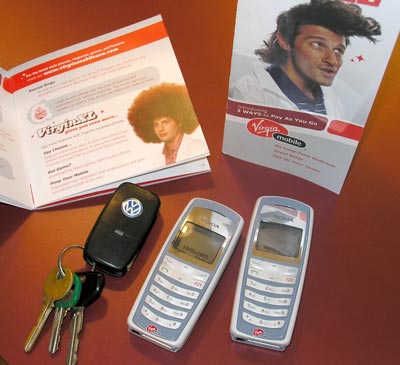
Talk about flash-ay! It’s bling-o-matic! And the phones are itty-bitty — they’re smaller and lighter than my keychain. The whole retro-smoove theme carries all the way through not only their marketing material, but also the instructions! Here’s the introduction to “Rescue Rings”:
So you’re on a date and it’s not all that? Program your phone to ring at a specific time and discreetly make your social getaway.
When you turn the phone on, you get a synth-pop R&B riff that would make Snoop Dogg proud. There’s no option for a normal ring tone — your choices are “KrunkTone,” “BeatMix,” “Creepy,” “EvilPizz,” “Galloping Metal,” “Low Rider,” “MoreKrunkness,” and “Techno Loop.”
Even the voice for the automated 800-number service line is a teenager talkin’ slang.
One of the most common uses for prepaid mobile is for parents to limit their teens’ cell phone use. After all, if all your minutes are prepaid, there’ll be no surprise $300 bill for your kid’s 8,000 instant messages. So perhaps that’s Virgin’s angle here — they’re making the service cool for kids so it doesn’t seem like such a bummer when their cell minutes get cut.
I think I can tolerate the pimpin’ ringtones and service with a ‘tude that my 13 year-old would strive for, just to get such a great deal on phone service. Cingular’s equivalent service is $30 per quarter, and seems to have more hidden charges than you can shake a 4-inch phone at. Virgin might sell even more phones, though, if they offered a “grown-up” version of their service.
