7/23/2006

Vacationblogging 2006, part 3

Filed under: — dave @ 7:51 am

Paul Bunyan

As I sit here in the lobby of the Holiday Inn in rainy Bangor, Maine, I get the vague sense that this town has something to do with Paul Bunyan.

Anyhoo, the Maine section of our trip has finally come to a close. The good: Jim has finally decided to enjoy himself on this vacation. The bad: he’s taken to mugging for the camera:

Jim

The weather could have been a bit better, but all in all, we couldn’t have asked for much more. On Thursday we visited one of the few notable locations on the island, the home of Saturn Press. Don’t look for their web site, they don’t have one (I did, however, find this fan site). They actually don’t even own a computer — all of their designs are hand made and printed on one of four vintage letterpress printers (”What do you do for parts?” we asked. “They don’t break” was the reply. They better not!).

On Friday, it rained all morning (especially during my run), but was beautiful by afternoon, allowing the entire group a chance to head down to the sandy beach and have a fabulous time playing in the chilly waves.

Yesterday was our last day on Swans Island, and we had to get up early to catch the ferry. If you don’t make a reservation for one of the four available slots, you have to wait in the standby line, hoping to get one of the 12 remaining places. We were 17th in the standby line, so we missed the 8:15 ferry but caught the 9:45. Good thing. The next boat didn’t leave until 1:00.

Saturday was foggy but warm in Acadia. We decided to do the famous “Beehive” hike — 500 feet, straight up. Too bad it was foggy, because there was no view to speak of. I did manage to capture some of the verticality of the place, though (notice Jim’s still mugging):
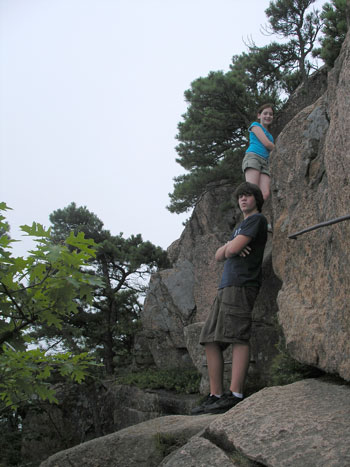
Jim and Nora

It just gets steeper after that. Greta likes to hang out on the uphill side of the path:
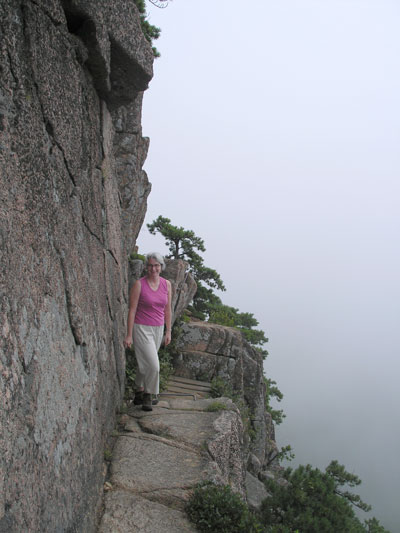
Greta

This is a popular trail. While most people seem to relish the “hanging off the edge of the world” sensation of climbing this cliff, some people panic. One woman, who had walked up the relatively flat backside, panicked about 100 feet down the cliff-face trail, and had to convince her group to turn around. Like me, everyone was stopping every 30 seconds to take pictures:
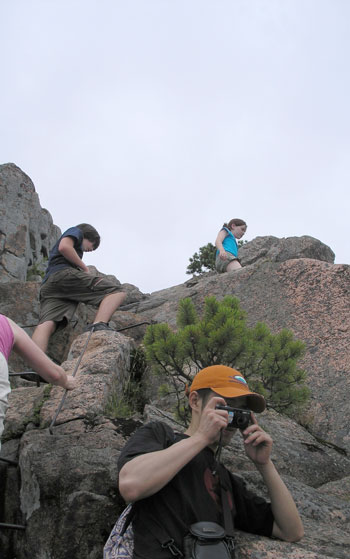
Tourists

When we made it to the top, we were completely embedded in a fogbank. At least there was a nice breeze to cool our sweaty bodies. Jim was still mugging:
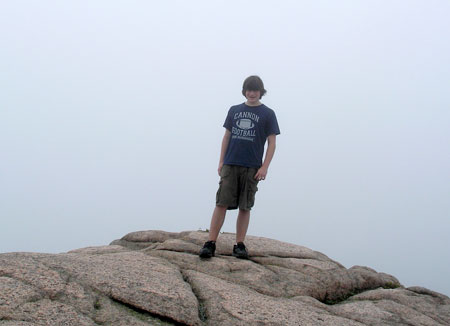
Jim

(Cannon School, even though Jim is looking like he might make a good tight end, has no football team. Click here for a close-up of the t-shirt.)

7/20/2006

Vacationblogging 2006, part 2

Filed under: — dave @ 9:51 am

I’ve just finished reading David Foster Wallace’s essay “Consider the Lobster” from the book of the same name. Under the auspices of a trip to the Maine Lobster Festival, Wallace spends most of the essay discussing whether it’s ethical to boil lobsters alive in order to eat them. On the one hand, a lobster is not much different from a bug, including many sorts of bugs that we’d gladly kill in a way much less violent and antiseptic, for no other reason than that we prefer them not to live in our homes. On the other hand, lobsters don’t do anything to harm us, living peacefully ten fathoms down as they clean up the detritus of the Maine coastline.

The day before, we had made a trip down to the Swans Island Fisherman’s Cooperative and picked up nine live lobsters, each weighing in at one and a half to two pounds (only $80! Cheap seafood is one of the few luxuries available on this beautiful, remote place). The woman who greeted us there was glad to help us select them, give us cooking tips, and even showed the kids how to tell male from female. The youngest child in our group, four-year-old Briar, was most interested in the lobsters, and the most willing to touch them. Nora wanted to help cook. My brother-in-law Nick was rather disgusted by the whole process, but wanted to put at least one live lobster in the pot, basically as a test of his own nerve.

It took a good 45 minutes to get the four gigantic pots of water to a boil on our stove (three were for lobsters, and one was for corn on the cob). The pots themselves barely fit on the stovetop, and I was a bit worried that one of the boiling pots would end up upside-down on the floor. Nora was happy to pull the live lobsters from the bag, but she was wisely unwilling to avoid any interaction with the boiling water, so she handed me the bugs and I shoved them into the pot.

Wallace points to the fact that lobsters appear to resist being placed in the pot as evidence that they somehow experience “pain” when they’re being cooked. Certainly the lobsters respond to stimulus: they wiggle about when you pick them up, and even wave their pincers menacingly. They do seem to grab at the edges of the pot when you try to put them in, and indeed, they flail rather pathetically for a good 30 seconds in the boiling water. Is a tasty bite to eat worth inflicting this type of suffering? Certainly the lobster’s natural predators cause them just as much pain as they ruthlessly rip them to bits. Certainly we consume many other animals that are more conscious and thoughtful than lobsters. A lobster can’t even solve the puzzle of how to escape through the same opening through which it entered the trap. Shouldn’t we be considering the cow or the pig before we begin to worry about the suffering of a lobster?

Wallace does consider these questions in his essay, and also deflates the notion that slicing a lobster’s head in half before cooking will put it out of its misery faster than simply boiling alive: a lobster’s nervous system is distributed across the length of its body, and even decapitated lobsters will writhe in “pain” while being boiled. I’ve also heard that you can numb the lobster to pain by putting it in the freezer for 15 minutes before cooking it (Wallace doesn’t address this issue). Was it wrong that we didn’t want to dirty the freezer, and so put nine living, fully sensitive beings to their death, making no efforts to alleviate their suffering? As Wallace points out, humans can live perfectly happy lives without killing any animals at all. It only takes a little extra effort to find foods that taste good and fill the basic nutritional needs, and I imagine after a couple generations no one would know what they were missing.

But I do imagine that many humans would be tempted. They would see the animals around them killing their food, and perhaps even a natural instinct to kill would emerge. Even if killing was completely banished, I think meat-eating subcultures would flourish in human society. Perhaps, like organized crime or prostitution, it’s still better for us to resist these impulses, but it’s doubtful that we’ll ever eradicate them. Plus, lobsters really do taste delicious, especially when dripping with fresh melted butter.

Here are some of the latest pictures:

The lobster pots precariously balanced on the stove:

Nick triumphantly displaying his beach find:

I’ve spent the entire trip trying to capture the sheer number of lobster floats dotting the waters around here. This is the best I’ve managed (click to enlarge):

Here are some shots of our climb up the South Bubble at Acadia N.P.:

7/17/2006

Vacationblogging 2006

Filed under: — dave @ 9:01 am

If you watch any American road trip movie, you know that driving across America is a quirky journey on backroads through towns full of fascinating characters. This, of course, is a lie. Traveling across America, for most of us, involves barreling down interstates at 80 miles per hour, with an occasional stop for gas or fast food served by teenagers who don’t look much different from those in the place we just left, or the one we’re going to.

For this trip, we barrelled even faster than usual, because we wanted to leave North Carolina at 9:00 Friday night and arrive out our Maine vacation rental home by Sunday morning. We would end up driving about 1200 miles in under 36 hours. We stopped in Staunton, Virginia for about 5 hours’ sleep, got up at 7 on Saturday and were on the road again by 8. Then it was Dunkin’ Donuts, rest area, Citgo, Arby’s, rest area, Exxon, and finally our arrival at 8:40 in Bangor, Maine. We didn’t see America so much as pass it.

In Bangor, we had to eat dinner, shop for a week’s worth of food on our island, and try to get some sleep before heading out early again to catch a 10:30 ferry 100 miles away in Bass Harbor. The Bangor motel we had chosen via the internet, though ostensibly a member of a National Chain and therefore assured to be of High Quality, was in fact a dump. The outdoor balconies were populated by shady characters smoking cigarettes and looking thuggish, and the rooms smelled of Wal-Mart air freshener. But the beds were firm, and the air conditioner, though all the labels indicating how to adjust it had been worn off through years of use, worked, loudly. We went to sleep to VH1’s “I Love the ’70s” (where, paradoxically, most of the celebrity commentators were too young to remember much of the ’70s).

Getting to Swan’s Island, which took us just a few hours on Sunday morning, by contrast, was much more like the road trips you see in the movies. We took two lane roads whose speed limits oscillated from 55 to 25 as we drove through quaint little towns, all the way to Bass Harbor, where, as mentioned, we didn’t want to miss our ferry. Finally things were starting to slow down.

The ferry dumped us on Swan’s Island, 40 minutes away from the mainland, with no bars, or liquor stores, or even street signs. There are few roads on the island, which is only about 4 miles long, and clearly the locals view street markers as an unnecessary extravagance. After driving randomly back and forth across the island for 30 minutes, we soon realized there was no way we were going to find the house we had rented, and returned to the ferry terminal to beg for directions. Neither of the two women working there recognized our house’s address our the name of the owner. Then finally the younger clerk remembered that this had, in fact, been a place she was considering for her wedding. “Oh that place,” she recalled, “it’s a beautiful home with one of the best views on the island.” But she didn’t recall enough to give us instructions on how to get there. Now somehow the older woman remembered it too. “Oh, I know where that is. It’s just past the fire station, and then you bear left, and right. It’s on a loop road, you see.” I tried to repeat the directions to her, and she finally sighed. “Oh, it’s no use. I’m going to church now anyway, so you can just follow me and I’ll take you there.”

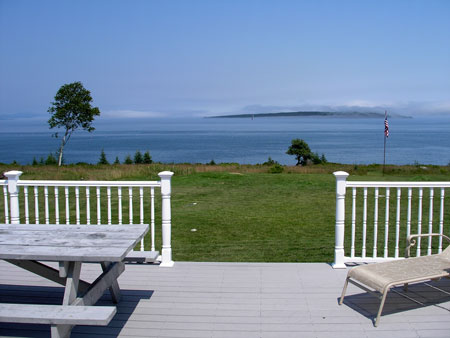
And so we did, and so we found our house, less than a mile away from the dock on a road we somehow hadn’t noticed before. It is a lovely place, the sort you sometimes see from the ferry and wonder if it’s possible to rent. It has a huge back yard extending all the way to the beach and a nice big deck, sunny in the morning and shady in the afternoon.

Later that day we returned to the ferry terminal to greet our co-renters, my brother and sister-in-law and their three little girls. A cheery old lady with dark glasses and a blind person’s walking can stood by our van trying to hitch a ride as the cars drove off the boat. No one picked her up, and our family didn’t show up either — we had met the wrong ferry. It seemed the polite thing to do to offer her a ride, so we did, and she chattered at us as we drove, pointing out the hollow where the turkeys live, the buildings that used to be museums or restaurants, and the quarry that’s good for swimming. In a few minutes we arrived at her house. “Can I ask you your name?” I said to her as she hopped out of the car.

“Josephine Swan,” she replied.

“Of Swan’s Island?” I asked.

“Naturally,” she smiled.

Swan’s Island, I learned when I returned to our house, was originally known as Burnt Coat Island, until it was purchased by Colonel James Swan in 1783. Josephine Swan must have been descended from — or married a descendent of — him. This family had lived on this island for over 200 years. Now, over the next six days, we’ll try to get to know it.

Here are a couple of pictures of the place we’re staying:

7/13/2006

Heading out on vacation!

Filed under: — dave @ 4:50 pm

This year’s family vacation has no coherent theme. While last year, we could tell people we’d be going on a grand tour of the southwest USA, this year, things are different. I’ve resorted to selective description:

Q: So, you doing anything interesting this summer?
A: Yeah, we’re going to Maine. Should be fun.

later

Q: So, you doing anything interesting this summer?
A: Yeah, we’re going to New York. I’m looking forward to it.

later

Q: So, you doing anything interesting this summer?
A: Yeah, we’re going to Puerto Rico. I’ve never been there, so it should be quite an experience.

That’s right, we’re going to Maine, New York, and Puerto Rico! The only common theme I can think of is “they’re all islands.”

Anyway, like last year, you should expect blogging to be light for the next three weeks. But I’m bringing the computer and the digital camera, so you can expect a report on the details from the trip from time to time. Why not stop by every once in a while?

8/7/2005

Vacationblogging: Continued

Filed under: — dave @ 1:03 pm

Los Angeles, California

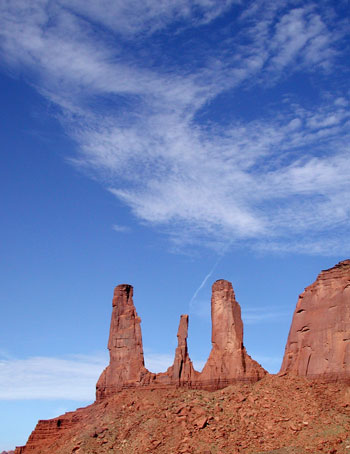
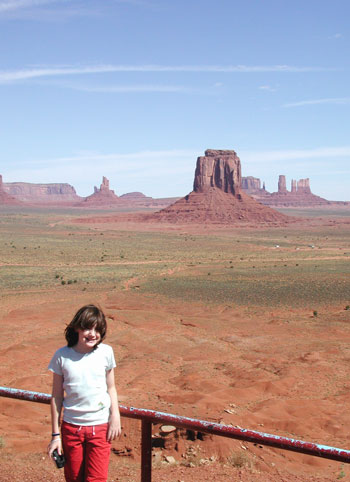
I’m slowly catching up to the present of our vacation. Monument Valley, that site of all those great Westerns, is actually on Navajo land. The tribe has a different approach to showing off its national monuments than the U.S.A. does. First of all, the valley is clearly an income center. While national parks drain America’s coffers due to the expense of preservation, at Monument valley, they charge admission. They also allow vendors at nearly all the points of interest, and $40 jeep tours can be arranged from the visitor center. We chose the $10 self-drive option. You take a rough dirt road on a ten-mile loop through all the monuments, and then stop at various pre-marked points to take photos. If we’d paid for the jeep tour, we’d have gotten a closer look at the monuments by riding on “restricted” jeep roads. However, we got plenty close on the cheap tour. Take a look at this monument that Jim and Nora thought should be named after our current president — the “Dubya.” For some reason, that logic didn’t impress the Navajo nation, who chose to call it the “Three Sisters.”

Nora had a lively interest in the monuments, even taking some photos herself, and hopping out of the car at every stop:

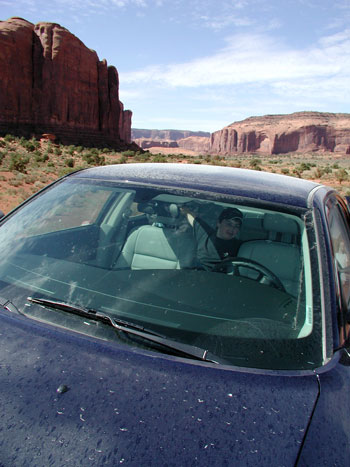
Jim had a different approach, preferring to enjoy our expensive vacation from inside the dusty tinted windows of our rental car:

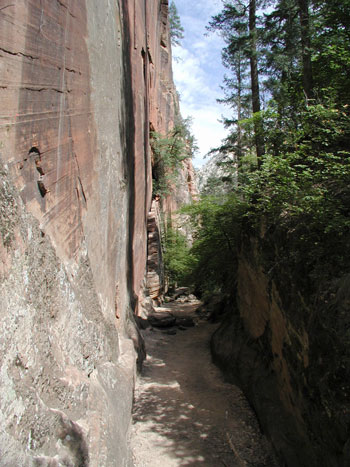
After our day in Monument Valley, we needed to head toward Southern California and our appointment with Mr. Disney. We did have time for a quick stop in Zion National Park. The main attraction of Zion is its narrow central canyon, with steep walls that are at sufficient elevation to support a different sort of plant life from what we’d seen during the remainder of our trip. We hiked up a 1-mile trail to a “hanging canyon”: a small side canyon that empties into the main canyon 800 feet above its bottom. Fascinating geology here:

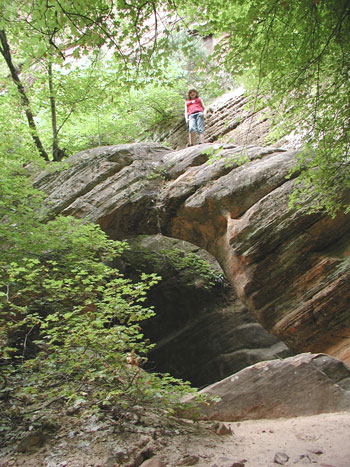
Hiking in about a quarter-mile, we found a small arch, which Nora decided to climb:

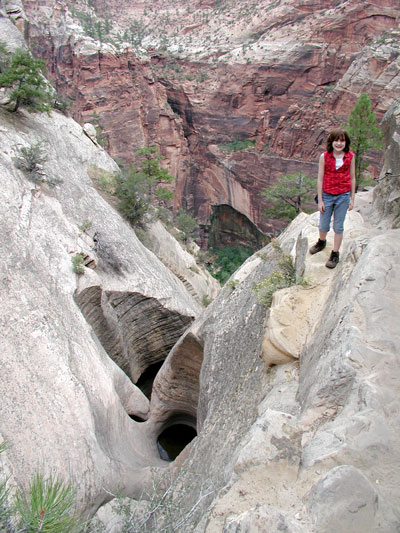
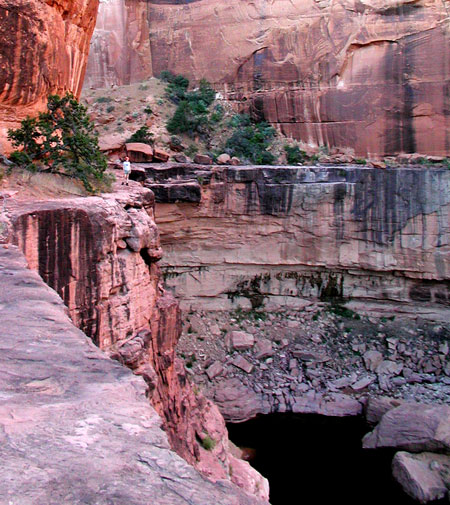
On the way out, at the end of the hanging canyon, I finally managed to get a picture that adequately demonstrates the verticality of Zion:

A beautiful place, so different from what we had seen before. This was to be our last breath of wilderness for about two weeks. Next stop, Disney.

8/2/2005

Yet more vacationblogging

Filed under: — dave @ 10:24 am

Luxor Hotel, Las Vegas.

Yes, we’re in Vegas, but just for one night. We thought we’d stop in Disneyland for grown-ups before we headed to the real Disneyland tomorrow.

But right now, I want to write a little bit more about Lake Powell. When we first mentioned to friends that we were going there, we typically got two reactions: either “why would you go there — the water level is low?” or “why would you go there — it’s an abomination on everything environmentalists stand for. The government dammed up one of the world’s most spectacular canyons so a few rednecks could have more room for waterskiing.”

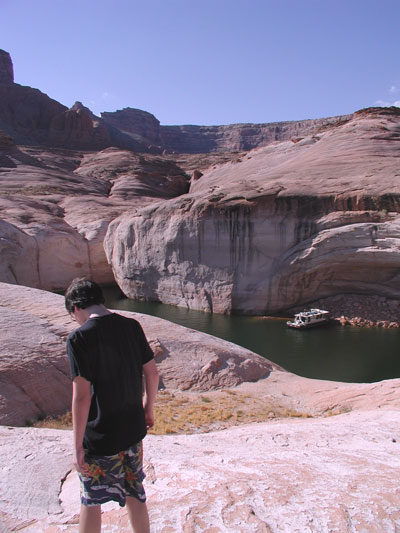
Both reactions assumed the only thing the lake was good for was a gigantic water playground. And oh, yes, the waterskiers, wakeboarders, barefooters, and every other item you could possibly imagine towing behind a boat at high speeds were there in abundance. But the low water level also meant that much of the previously unexposed canyon was now visible. Take a look at this little spot where we stopped for the night.

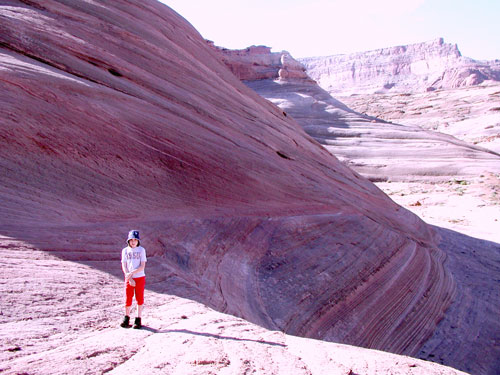
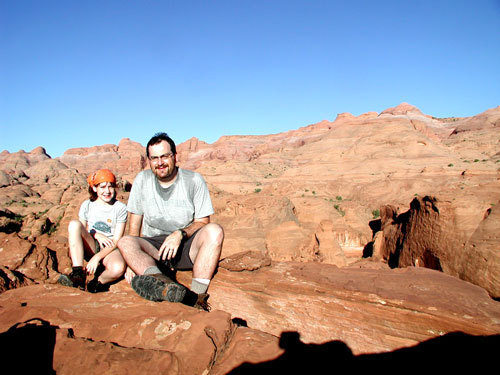
The area in white is what the lake covers when it’s full. Basically, the entire side canyon — including the spot where Jim is standing — would have disappeared had we come there at full pool. Exploring further, we came to some fascinating rock formations:

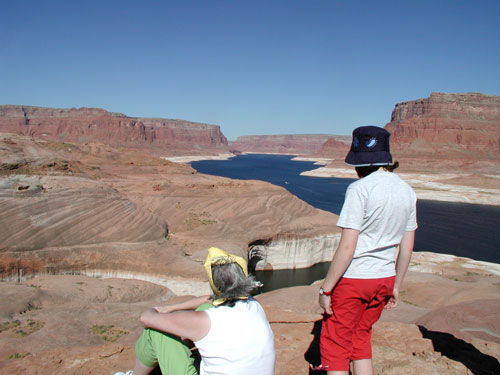
Climbing to the top of a small butte, we tried to imagine what the canyon would look like with only a small ribbon of water flowing through the bottom.

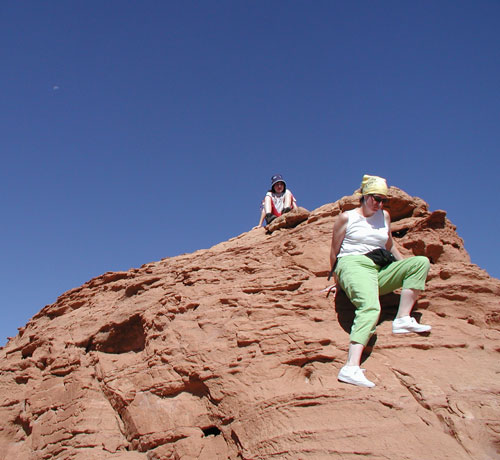
Climbing back down was a bit difficult, with poor footing and a sheer dropoff to our left, but the experience was worth it:

The next day, in the San Juan River Arm, Nora and I had to climb up 100 feet to even reach the mouth of this side canyon.

There, we found an area lush with life, including lots of small rodents — perhaps some sort of squirrel — that we’d never seen at lake level. We also found evidence of its predator — footprints of a small cat, we guessed bobcat. There were trees, and many birds we hadn’t seen before. While we had seen plenty of the top of the canyon, the main thing missing from Glen Canyon after Lake Powell was built was its bottom, thriving with life.

Still, we couldn’t resist climbing another butte to see what the top looked like:

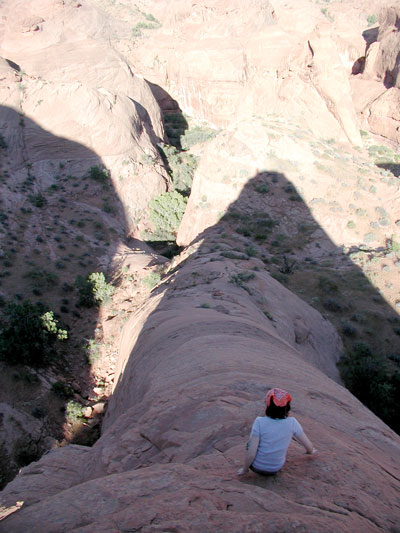
It was as if we’d entered yet another world. Again, the climb down was rather harrowing:

Now, here in Las Vegas, we’ve entered yet another world, powered by electricity from Glen Canyon Dam and Hoover Dam. Sitting in our air-conditioned room on the side of a glass pyramid, we can look out at thousands of lights, all powered by the water that has drowned the great canyons of the Colorado River. On the one hand, without Lake Powell, we probably wouldn’t have had the ability to even see the fraction of Glen Canyon we did see — before the dam, it was one of the remotest parts of the country. I’ve heard that only 300 white people had visited the canyon before the dam was built. Now over 3 million people a year go there. Even as it is, I most definitely prefer Lake Powell to Las Vegas. But that said, I like my air conditioning, my car, my gourmet meals. I’m not a die-hard environmentalist, and I don’t know how to provide the comforts I enjoy without destroying some of the environment. I do hope we’ll be able to preserve some of what’s left, so some day my kids can enjoy it with my grandchildren.

7/30/2005

More vacationblogging

Filed under: — dave @ 7:42 pm

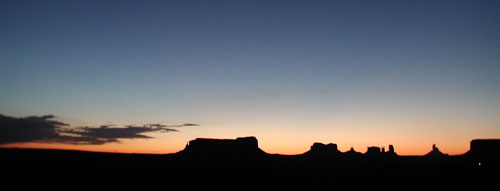
It’s sunrise at Monument Valley, on the Utah-Arizona border. The sun comes up behind the monuments, silhouetting them in a beautiful orange glow. We’re staying a Goulding’s lodge, which elevated itself from a struggling trading post to a tourist mecca when its proprietor convinced John Ford to come here and film Westerns in the 1930s. At the restaurant, they still serve John Wayne’s favorite dishes, and the motel lobby rents all the classic John Ford films. Last night, we rented She Wore a Yellow Ribbon, which I wouldn’t say was exactly John Wayne at his best. It was, however, fascinating to watch him lead his cavalry troop back and forth across the identical stretch of Monument Valley in a plot that was supposed to have him ranging miles across the southern desert.

Last night’s sunset here was also quite impressive: at sunset, the monuments are illuminated directly, and the view from in front of our cabin was astonishing. Unfortunately, I wasn’t able to get much of a photo, so you’ll have to live with just the sunrise pic.

We’ve spent the last several days on a houseboat on Lake Powell. While Monument valley is a destination for tourists from across the globe (last night at dinner, for example, we saw a tiny Japanese woman polish off almost three entire entrees — a “Navajo taco” — a cholesterol-farm of chili smothering a plate-size piece of Navajo frybread, a plate of spaghetti, and half of her mother’s meal. For some reason she didn’t touch her French fries.), Lake Powell is redneck heaven. Three million visitors descend on the desert lake every year, most of them towing speedboats in pickup trucks. While they sought the water as a race-track for their jet-skis and power boats, we were there for the opposite reason. The water was at historically low levels, exposing much of Glen Canyon that had been drowned by the Glen Dam for nearly forty years.

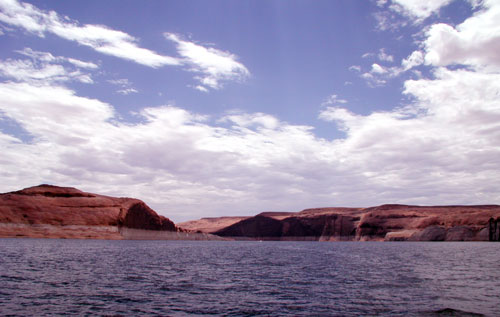
Unfortunately, last winter’s historic snowfall in this part of the country has caused the lake to rise more than 75 feet, so we were only able to see half as much as we would have last season, when the water was 150 feet below full-pool. Nonetheless, we did get to see some amazing canyon scenes that have been exposed during the drought of the last five years. Here’s a typical view of the main canyon. The whitish area gives an approximation of the lake level at full pool. See how much less of the canyon we would have seen had the lake been full?

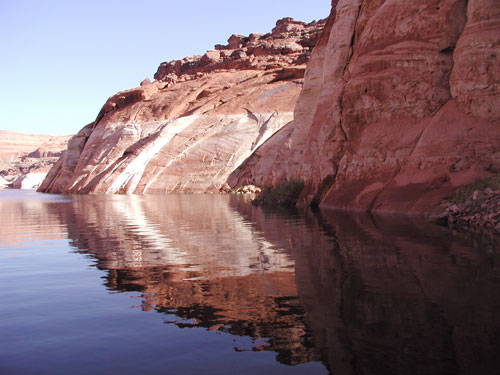
The impact is even more significant in the hundreds of side canyons. Here’s a spot where we stopped for the night. This canyon wouldn’t have been much more than an inlet at full pool:

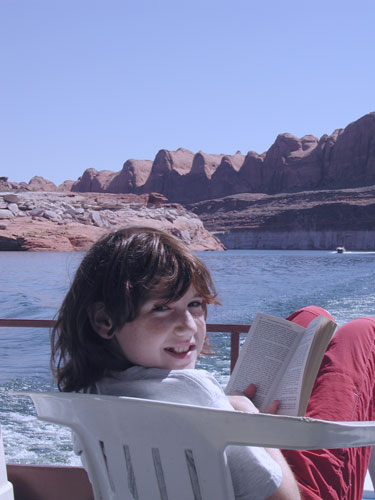
About half of our days were consumed with putting up and down the river. Our rental houseboat could do about 10 miles per hour at top speed, and with over 3000 miles of shoreline and a 140-mile-long main canyon (not to mention those side-canyons, some of which are over 50 miles long), we were able to explore only of the fraction of the canyon. This did give Nora plenty of time to catch up on her summer reading — Tom Sawyer, perhaps the ultimate lazy river book.

The rest of the time, when we weren’t sitting on the deck of our boat enjoying our friends’ powerful pina coladas or a cooling glass of white wine, we were hiking up the side canyons. Here’s Greta on her way to Rainbow Bridge:

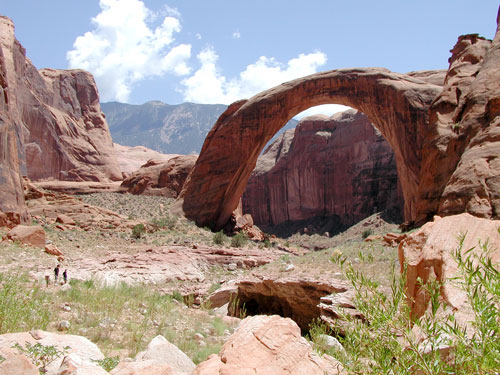
As we approached, the monument loomed overhead, dwarfing us even from a respectful distance (due to the sacred nature of the ground for many Indian tribes, we were requested to stay about 200 yards away):

I’m finishing up this post in Kanab, UT, where we’ve found a Holiday Inn Express with free wireless Internet. Kanab is a sort of crossroads for tourists, halfway between Zion National Park and the Grand Canyon. I’m going to try to post more on Lake Powell, and other updates a little more frequently over the next couple weeks as we head toward more commercialized regions of the southwest, with more free wireless, but for now I’m going to enjoy our last day in semi-wilderness. Even here, the view from our hotel is canyons on a smaller scale — albeit with tract housing rather than lake or creekbed in the foreground. What an amazing, quirky place, this Southwest.

7/18/2005

Vacationblogging

Filed under: — dave @ 11:18 am

We’re heading into serious vacation blogging season. In less than a week I’ll be in the canyons of Utah, exploring the majestic geological formations created by millennia of erosion and movements in the earth’s crust creations of God [this assertion has been moderated by your friendly neighborhood creationist ID activist — we don’t ken to that pseudoscientific mumbo-jumbo here].

Anyway, this is a bit of a warning that, light as the posting has been the past few weeks, it’s due to get even a bit lighter, and when it appears, it’s more likely to include vacation photos than the serious, thoughtful fare you’ve come to expect from Word Munger.

That said, I took a nice little hike with my daughter this weekend in preparation for the larger ones to come. On Saturday, we drove up to Clingman’s Dome in the Great Smokey Mountain National Park. Unlike most hikes, this one begins in a gigantic, paved parking lot. There’s a paved trail up to the lookout tower, where chilly southerners are stunned into the realization that beachwear isn’t generally appropriate for an elevation of 6,400 feet, no matter what the weather’s like 5,000 feet below.

This was actually the one and only time we got lost: in the parking lot! We couldn’t find our trailhead: there were only two trails — the one leading up to the dome, and the other heading down to Forney Ridge. There was no “Siler’s Bald” trail, which was the one we were supposed to be taking. A quick consultation with our map revealed another way to get where we were going: head up the paved trail to Clingman’s Dome, then join the Appalachian Trail at the top. There is nothing more humiliating than being passed by mothers pushing strollers as you struggle up a steep albeit paved path hauling your 40-pound backpack.

We were relieved to finally get off the pavement and onto the trail, even though it was one of the muddiest I’ve ever hiked:

It was foggy and drizzly all day. Here’s about the closest thing to a “view” we got for the entire trip:

It wasn’t exactly what the Great Smokeys were supposed to look like (see here for what I was hoping for), but it was beautiful in its own haunting way:

We arrived at our shelter as the drizzle began to increase to the torrential downpour that would be with us all night. It was the first time I’d ever stayed in one of these park shelters, which wasn’t much to look at, but did offer a lot more protection from the rain than our tent would have. The area in front of the shelter you see here was one giant puddle by morning:

And that was our trip to the Smokeys! It was a great trip, but still a relief to get back to our car, to mud-free shoes, and a giant hot fudge sundae at the bottom of the mountains in the town of Cherokee.

Copyright on the date of posting by Dave Munger || 0.285 || Powered by WordPress